
Stablecoin Reserve Attestation Audit
Treasury-Bill Yield Compression & Stablecoin Issuer Reserve Economics
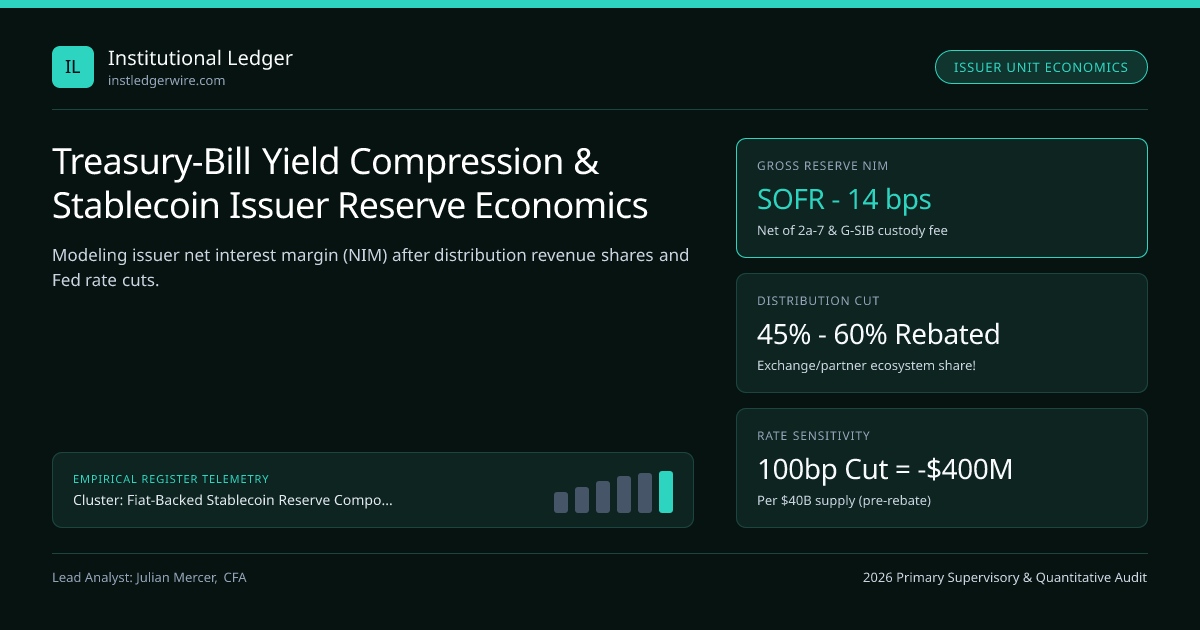
At 4.5% Fed funds, $40B+ stablecoin issuers print billions in gross T-Bill interest—often rebating 50% to distribution exchanges. Modeling Fed rate-cut cycles exposes severe operating-margin cliffs below 1.75%!
When the Federal Reserve hiked policy rates from 0.08% to 5.33%, fiat-backed stablecoin issuers looked like the greatest business model on Earth—collecting 530 basis points on tens of billions of dollars of 0%-interest digital liabilities! Yet public SEC S-1 financial disclosures and treasury math tell a far more nuanced institutional story: heavy partner distribution rebates, rising regulatory compliance costs, tokenized RWA competition, and rapid 25-day T-Bill roll compression create a brutal shakeout threshold whenever short-term interest rates fall.
The 25-Day Repricing Cliff: Maximum Asset Sensitivity on FOMC Cuts#
In commercial bank Asset-Liability Management (ALM), CFOs hedge falling interest rates by locking in 3-to-7-year fixed-rate loans or interest-rate swaps. A regulated stablecoin issuer is legally forbidden from doing either!
- Under NYDFS, MAS, and SEC Rule 2a-7 rules mapped in our fiat-backed stablecoin reserve cornerstone guide, 100% of securities must mature inside
<= 93 dayswith a portfolioWAMaround 25 days! - Every time the Federal Open Market Committee (
FOMC) cuts the federal funds rate and NY Fed ON RRP award rate by 50 basis points, ~45% of the stablecoin's gross revenue drops the very next morning at 8:30 AM ET, and the remaining 55% rolls down onto the lower T-Bill curve inside four to eight weeks!
Inside the S-1 Surprise: Why Distribution Partners Take 50%+ of Gross Yield#
If EU MiCA Article 50 and US payment-stablecoin frameworks ban issuers from paying yield directly to retail/corporate holders, why doesn't the issuer keep all 445 bps of T-Bill interest?
Because stablecoin liquidity exhibits winner-take-most network effects on exchanges and wallets! To secure default base-pair status, zero-fee conversion rails, and balance incentives on global platforms, onshore issuers execute massive ecosystem revenue-share agreements (such as Circle's landmark revenue-sharing framework with Coinbase or Global Dollar Network USDG's consortium yield-sharing across Robinhood, Kraken, Galaxy, Paxos, and Aquanow-tier liquidity hubs):
- On the upside, sharing a percentage (rather than a fixed dollar guarantee!) of reserve income acts as an automatic shock absorber when rates drop: if gross T-Bill income falls by -$500M, partner distribution expense drops automatically by ~$275M!
- On the downside, sub-scale challenger stablecoins (<$2B market cap) routinely give away 80% to 95% of gross T-Bill interest to liquidity mercenaries—leaving almost zero retained revenue to pay for $40M+ of multi-jurisdictional regulatory overhead!
| Issuer Archetype | Gross Yield Capture | Partner Distribution Share | Non-Rate Revenue Streams | ZIRP / 1.5% Rate Survival Grade |
|---|---|---|---|---|
| Scale Regulated Leader (USDC $38B+) | ~90% at SOFR (US) / 40% HQLA (EU) | High (~50%–60% percentage-based) | CCTP cross-chain enterprise APIs, developer wallets | Strong — variable % rebate shrinks automatically as rates fall |
Fintech / Payment Ecosystem (PYUSD / USDG) | ~95% T-Bills / RRP | Shared across consortium members (Aquanow, exchanges) | Cross-subsidized by core merchant payments / brokerage | Strong — subsidized by parent payment ecosystem |
| Sub-Scale Standalone Startup (<$1.5B Cap) | ~90% T-Bills | Must rebate 70%–90% just to buy liquidity! | Zero | Fragile — bleeds VC equity below 3.5% SOFR; high wind-down risk |
| Tokenized RWA Fund (BUIDL, OUSG) | Passes 95%+ of yield to holder! | Zero — charges flat 15–50 bps AUM fee! | Institutional asset-management fee | Immune to ZIRP compression down to money-fund fee waivers! |
Structural Bifurcation: Working Velocity Cash vs Yield-Bearing RWA#
Between 2020 and 2023, crypto hedge funds lazily left $50M sitting in 0%-yield stablecoins for months because safe on-chain T-Bill alternatives didn't exist. Today, institutional treasurers hold regulated USDC strictly for high-velocity 4-hour settlement and orderbook execution (Bitstamp, Bitfinex), while sweeping 85% of resting Initial Margin and weekend reserves into BlackRock BUIDL and Ondo OUSG (which charge a flat 15–20 bps AUM fee independent of whether SOFR is 5% or 2%!).
- Variables & Sub-Scale ($2.0B) vs Mega-Scale ($40.0B) Regulated Stablecoin Break-Even SOFR Comparison:
- InvestedShare = 0.92 (92% earning T-Bills/RRP, 8% 0%-yield transaction cash); Custody2a7_Fee = 0.0015 (15 bps)
- 1. Mega-Scale Regulated Issuer ($40.0B Supply, $380M Global OpEx, 55% Partner Revenue Share):
- BreakEven_SOFR = ($380M / ($40,000M * 0.45 * 0.92)) + 0.0015 = 2.29% + 0.15% = 2.44% SOFR (or lower via enterprise API revenue!).
- 2. Sub-Scale VC-Backed Issuer ($2.0B Supply, $45M Regulated OpEx, forced to rebate 75% yield to buy TVL!):
- BreakEven_SOFR = ($45M / ($2,000M * 0.25 * 0.92)) + 0.0015 = 9.78% + 0.15% = 9.93% SOFR -> Structurally unprofitable even at 5% rates!
Corporate Solvency Due Diligence on Sub-Scale Issuers During Rate Cuts#
Why does an institutional risk committee care if a $900M challenger stablecoin loses $20M/yr at the corporate parent level? Because dying startups cut corners or abruptly wind down—creating annoying forced-migration deadzones for your treasury scripts! Stick to >$5B scale leaders or G-SIB/payment-giant-backed consortia.
Issuer Financial-Health Audit Checklist for CFOs#
Chief Financial Officers active in our Stablecoin Reserve Attestation hub review annual audited parent-company financial statements (not just reserve AT-C 205 snapshots!) to verify positive operating cash flow and >=12 months of corporate liquidity runway at 2.0% SOFR, cross-checking charters via our verification portal.
Frequently asked questions
Why does a 100-bps Federal Reserve rate cut hit stablecoin issuer profits almost within 30 days?
Because regulations mandate a Weighted Average Maturity (WAM) of ~20–35 days plus 40%+ Overnight Reverse Repo! Unlike a traditional bank holding 5-year fixed-rate mortgages, 50% of a stablecoin reserve re-prices downward on Day 1 after an FOMC cut, and 100% rolls into lower-yielding T-Bills within 60 to 90 days!
If MiCA Article 50 and US payment-stablecoin bills ban paying interest to holders, where does 50%+ of reserve revenue go?
Distribution warfare! As Circle’s SEC S-1 registration disclosures illuminated, competing for default exchange orderbook pairs and wallet integration leads onshore issuers to sign multi-hundred-million-dollar commercial revenue-sharing agreements with major partner platforms—handing out over half of gross reserve income before corporate R&D, compliance, and payroll!
What is the minimum circulating supply ("scale threshold") required for a regulated pure-play stablecoin to break even at 2.0% Fed rates?
Running a globally licensed NYDFS + EU MiCA + MAS + HKMA compliance, engineering, Big-4 AT-C 205 audit, and HSM infrastructure costs roughly $45M to $120M+ per year in fixed overhead. At a 2.00% T-Bill yield (net ~90 bps retained after 50% partner revenue share and 20 bps custody/2a-7 fees), an issuer needs $5B to $13B+ of circulation just to break even!
Why should a stablecoin holder care about the issuer’s corporate profitability if reserves sit in a segregated trust?
While a statutory trust protects principal upon wind-down, an unprofitable sub-scale issuer bleeding corporate cash faces three operational hazards: layoffs in 24/7 compliance/minting ops, pressure to hike redemption/wire fees, or—at poorly supervised offshore wrappers—temptation to stretch reserve WAM or credit risk!
Publication record
- Published
- November 13, 2026
- Updated
- November 14, 2026
- Author
- Julian Mercer, CFA
- Review
- Review not recorded
- Automated fact check
- Passed in the stored pipeline record
- Source URLs
- 3 recorded
AI assistance recorded: anthropic/claude-opus-4.6. This field does not establish human review or source verification.
Academic & Institutional Attribution
Cite This Research & Embed Live Data Card
Standard academic & institutional research paper citation format.
Julian Mercer, CFA. (2026, November 14). Treasury-Bill Yield Compression & Stablecoin Issuer Reserve Economics. Institutional Ledger. https://instledgerwire.com/stories/treasury-bill-roll-yield-compression-issuer-reserve-economicsRegulatory Directory Cross-Reference
Referenced Institutions & Regulatory Registries
Mentioned Regulated Institutions
Related Stablecoin Reserve Attestation Audit & Institutional Briefings
Explore Stablecoin Reserve Attestation Audit Hub (20) →Stablecoin Reserve Attestation Audit
Fiat-Backed Stablecoin Reserve Composition, Audits & T-Bill Custody GuideStablecoin Reserve Attestation Audit
AICPA AT-C 205 Monthly Stablecoin Reserve Attestation Criteria DecodedStablecoin Reserve Attestation Audit
Overnight Reverse Repo & 93-Day T-Bill WAM Caps in StablecoinsStablecoin Reserve Attestation Audit
EU MiCA Title III (ART) vs Title IV (EMT) Stablecoin Safeguarding RulesStablecoin Reserve Attestation Audit
MiCA’s 60% EU Bank Deposit Mandate for Significant Stablecoins: Tail RiskStablecoin Reserve Attestation Audit
NYDFS USD Stablecoin Guidance: T+2 Par Redemption & Trust SegregationStablecoin Reserve Attestation Audit
Primary Mint/Burn Fedwire Cutoffs vs Weekend Curve Pool DepegsStablecoin Reserve Attestation Audit
SVB-Style Uninsured Bank Deposit Concentration Stress TestsMarket Insights
Nomura explores sale of crypto unit Laser Digital: BloombergRegulatory Compliance
Uncalled US House races could send more crypto allies to CongressRegulatory Compliance
South Korea to permit crypto withdrawal freezes during hacking threatsMarket Insights
Stablecoin supply falls $14.2B in biggest 30-day drop since June 2022
Institutional Ledger Data, Benchmarks & Contributor Records
CC BY 4.0 Open Data
Open Institutional Datasets (CSV / JSON) →
Download desk-compiled quantitative series & schemas.
2026 Reference Matrix
2026 Institutional Benchmarks & Thresholds →
Statutory capital, clearing, margin & rate conventions.
Editorial Records
Authors & Review Records →
View named contributors where those records are available.
Complete Index
Master Research & Dossier Archive →
Browse all published briefings by topic pillar & date.