
Stablecoin Reserve Attestation Audit
Primary Mint/Burn Fedwire Cutoffs vs Weekend Curve Pool Depegs
Primary stablecoin mint/burn pipes settle at $1.0000 par when US Treasury repo desks run, yet Curve 3pool/USDC-USDT imbalances can push weekend secondary prices off par when banking rails sleep.
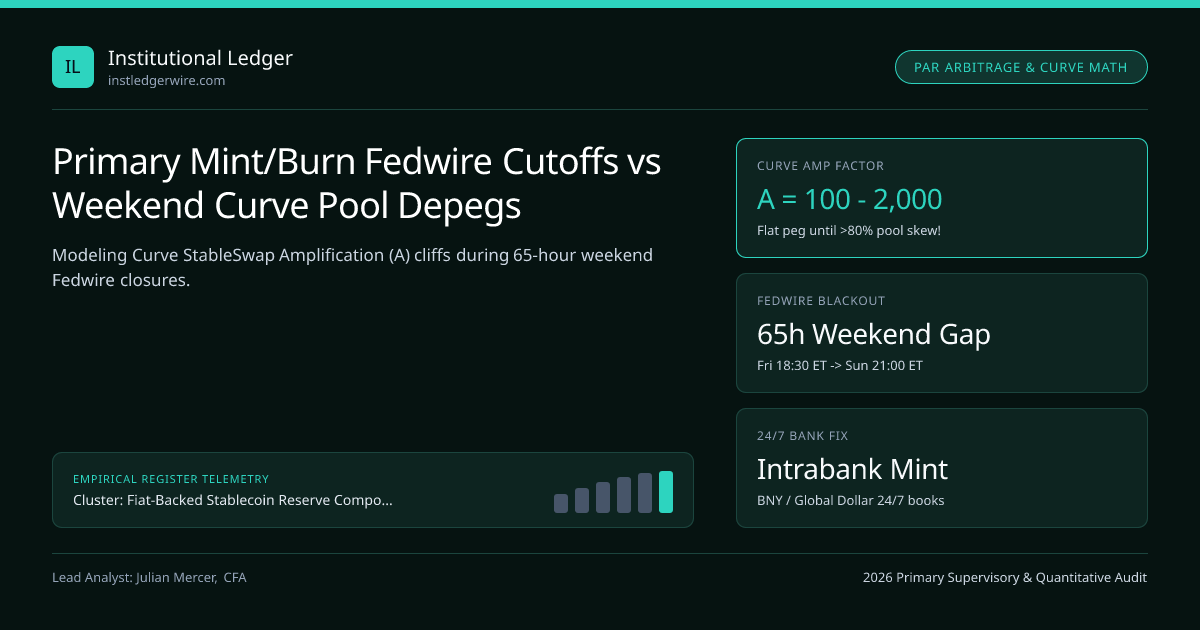
Every few months, crypto Twitter erupts in panic when a $150 million Sunday-night DeFi whale swap momentarily pushes a 100% Treasury-backed stablecoin to $0.994 on an automated market maker—only for the price to snap effortlessly back to $1.0000 at 8:31 AM ET Monday morning. Understanding the interaction between weekday Fedwire primary mint/burn cutoffs and Curve StableSwap's nonlinear Amplification (A) invariant keeps institutional execution engines from donating basis points to weekend arbitrageurs—and lets liquid desks harvest risk-free Monday par spreads instead.
The Two-Tier Arbitrage Loop Holding Fiat Stablecoins at $1.00#
Unlike an algorithmic central bank intervening on open orderbooks, regulated issuers like Circle and Paxos never trade their own stablecoins on secondary exchanges. Instead, as mapped across our fiat-backed stablecoin reserve cornerstone guide, par stability relies entirely on Authorized Participants (APs) and institutional arbitrageurs (authorized participant arbitrage spreads):
- Monday–Friday 08:30–15:00 ET: If regulated USDC dips to
$0.9996(-4 bps) on Bitstamp, Bitfinex, or Curve, an OTC arbitrageur buys $50M of USDC at$0.9996($49,980,000), burns it at Circle Mint for $50,000,000 fiat USD wired via Fedwire/intrabank within 30 minutes, and recycles that exact $50M ten times in one afternoon—locking the peg within+/- 1 to 2 bps! - Friday 18:30 ET – Sunday 21:00 ET: Fedwire Funds and NY Fed Overnight Reverse Repo shut down for 65 hours! Once arbitrageurs deploy their finite pre-funded weekend USD cash buying discounted coins, they cannot liquidate underlying T-Bills to replenish fiat until Monday morning—temporarily turning infinite weekday arbitrage capital into a finite weekend bucket.
Inside Michael Egorov’s Curve StableSwap Invariant: Flat Zone vs The Cliff#
On public blockchains, secondary stablecoin liquidity clusters inside Curve Finance StableSwap pools (3pool, USDC/USDT, USDC/PYUSD). StableSwap interpolates dynamically between zero-slippage Constant Sum ($x + y = D$) and infinite-depth Constant Product ($x cdot y = k$) controlled by Amplification Coefficient $A$:
- Inside 25%–75% Pool Balance: Large $A$ (
200..2000) flattens the curve almost completely horizontal—allowing institutional traders to swap $50M with< 2 bpsprice impact, far tighter than Uniswap v2! - Beyond 88%–92% Pool Imbalance ("The Cliff"): To ensure the pool never hits literal 0 of the scarce coin, StableSwap transitions abruptly onto steep hyperbolic curvature! Monitoring Curve pool reserve ratios (
balance_0 / total_D)—not just spot price!—gives institutional algorithms an early-warning radar 30 minutes before a weekend depeg tick ever prints!
| Market Regime | Primary Mint/Burn Status | Dominant Pricing Mechanism | Expected Secondary Peg Band | Optimal Institutional Execution |
|---|---|---|---|---|
| Weekday 08:30–15:00 ET | 100% Live (Fedwire + NY Fed RRP + T-Bills) | Frictionless T+0 primary par arbitrage | $0.9998 – $1.0002 (+/- 2 bps) | Mint/burn unlimited size directly at issuer ($0 fee) |
| Weekday Overnight (APAC/EU) | Intrabank USD + EU SEPA Instant (EURC/USDC) | Pre-funded AP books + Bitstamp / Aquanow | $0.9995 – $1.0005 (+/- 5 bps) | Intrabank mint or TWAP across CEX + RFQ |
| Normal Weekend | Fedwire closed; intrabank cash buffers active | Curve StableSwap flat zone + OTC dealers | $0.9992 – $1.0008 (+/- 8 bps) | Use OTC RFQ for blocks >$25M; avoid sweeping thin AMMs |
| Stressed Weekend Whale Flow | Pre-funded AP cash temporarily fully deployed | Curve >90% cliff + Monday time-value discount | $0.9940 – $0.9985 (-15 to -60 bps) | WAIT for Mon 08:30 ET primary par burn (or earn arb buying dip!) |
Preventing Smart-Contract Oracle Self-Inflicted Liquidations on Sunday Wicks#
DeFi lending and off-exchange variation-margin vaults learned a hard lesson from temporary weekend Curve imbalances:
- Never Price Regulated Stablecoin Collateral Off a Single AMM Pool! A manipulator can flash-borrow $200M inside one block to tip a thin pool to
$0.96. Institutional oracles aggregate volume-weighted CEX + DEX TWAPs (Bitstamp, Kraken, Coinbase, Curve) paired with fundamental reserve Proof-of-Reserve bounds. - Hardcode Execution Guardrails: Treasury rebalance scripts enforce
min_execution_price >= $0.9985whenever primary reserves remain unimpaired—routing urgent weekend exits to multi-dealer OTC RFQ desks (Aquanow, B2BX) or waiting until Monday 08:30 AM ET primary burn.
- Variables & Weekend Liquidity-Shock Pricing Audit ($200M Total Pool D = 200,000,000, Amplification A = 200):
- 1. Balanced Start (
x = $100M USDC, y = $100M USDT): dx/dy Marginal Price = $1.00000. - 2. Moderate $50M Swap (
x = $150M [75%], y = $50M [25%]): - High
4*A = 800weight keeps price pinned near ~ $0.9989 (-11 bps slippage on $50M!). - 3. Subsequent $38M Panic Swap (
x = $188M [94%], y = $12M [6%]): - Product
4*x*ycollapses by 70%, exploding theD^3 / (4*x*y)term -> Marginal Price drops past $0.9680 (-320 bps) even with 100.0% T-Bill backing intact!
The Long-Term Cure: 24/7 Tokenized Repo & BIS Project Agora#
Weekend recycling bottlenecks shrink every quarter as 24/7 intrabank USD networks expand, atomic T+0 repo on Canton allows dealers to raise Sunday USD liquidity against T-Bills, and BIS Project Agora brings 24/7 central-bank settlement online.
Weekend Stablecoin Execution SOP for Institutional Trading Desks#
Execution quants active in our Stablecoin Reserve Attestation hub ingest live Curve pool ratio telemetry (alert if skew > 82%), maintain direct primary burn accounts at two regulated issuers so Monday 08:30 ET redemptions cost $0, and verify counterparties in our verification portal.
Frequently asked questions
Why does a Curve StableSwap pool stay rock-solid at $0.9998 for $200M of selling, and then suddenly plunge to $0.97 on the next $40M?
Curve’s StableSwap invariant blends a constant-sum line (x + y = D, zero slippage) with a constant-product hyperbola (x * y = (D/2)^2) weighted by Amplification factor A. Inside the balanced middle zone (30%–70%), it behaves almost 1:1 flat; once one stablecoin exceeds ~88%–93% of the pool, constant-product curvature takes over abruptly ("hitting the Curve wall")!
Why can’t arbitrageurs instantly refill a depleted Sunday Curve pool by burning stablecoins for fiat at the issuer?
Suppose arbitrageurs spend $300M of their pre-positioned USDT/USD float buying discounted $0.994 USDC on Saturday night. To recycle that $300M for a second arbitrage round, they burn the $300M USDC with the issuer—but if the issuer’s weekend cash buffer is tapped, wiring back $300M from NY Fed RRP / T-Bill sales waits until Monday 08:30 AM ET Fedwire open!
How do 24/7 intrabank book-transfer networks partially mitigate weekend Fedwire closures?
When both the arbitrageur (e.g., an OTC market maker) and the stablecoin issuer hold institutional accounts at the same global custodian bank (such as BNY Mellon or J.P. Morgan Kinexys), cash already sitting inside that bank transfers 24/7/365 via internal API ledger entries—expanding weekend par capacity up to the issuer’s and dealers’ pre-funded bank cash!
Should an institutional treasury desk panic-sell a regulated NYDFS/MiCA stablecoin on Curve if it ticks down to $0.995 on a Sunday?
Verify on-chain and news catalysts first! If there is zero custodian/reserve credit event (100% T-Bills at BNY Mellon intact) and the dip is purely driven by a DeFi whale dumping $150M into an imbalanced Sunday Curve pool, dumping at $0.995 locks in a gratuitous -50 bps loss right before Monday 08:30 AM ET Fedwire arbitrage snaps it back to $1.0000!
Publication record
- Published
- November 13, 2026
- Updated
- November 15, 2026
- Author
- Julian Mercer, CFA
- Review
- Review not recorded
- Automated fact check
- Passed in the stored pipeline record
- Source URLs
- 3 recorded
AI assistance recorded: anthropic/claude-opus-4.6. This field does not establish human review or source verification.
Academic & Institutional Attribution
Cite This Research & Embed Live Data Card
Standard academic & institutional research paper citation format.
Julian Mercer, CFA. (2026, November 15). Primary Mint/Burn Fedwire Cutoffs vs Weekend Curve Pool Depegs. Institutional Ledger. https://instledgerwire.com/stories/primary-mint-burn-fedwire-cutoffs-vs-weekend-curve-depegsRegulatory Directory Cross-Reference
Referenced Institutions & Regulatory Registries
Mentioned Regulated Institutions
Primary Tier-1 Supervisory Registries
Related Stablecoin Reserve Attestation Audit & Institutional Briefings
Explore Stablecoin Reserve Attestation Audit Hub (20) →Stablecoin Reserve Attestation Audit
Fiat-Backed Stablecoin Reserve Composition, Audits & T-Bill Custody GuideStablecoin Reserve Attestation Audit
SVB-Style Uninsured Bank Deposit Concentration Stress TestsStablecoin Reserve Attestation Audit
SEC Rule 2a-7 Government MMF Wrappers for Stablecoin ReservesStablecoin Reserve Attestation Audit
Authorized Participant Arbitrage Spreads & Stablecoin Par Peg MechanicsStablecoin Reserve Attestation Audit
Singapore MAS Single-Currency Stablecoin (SCS) Framework & 5-Day SLAStablecoin Reserve Attestation Audit
Hong Kong HKMA Fiat-Referenced Stablecoin (FRS) Ordinance & CustodyStablecoin Reserve Attestation Audit
CPMI-IOSCO PFMI Rules for Systemically Important StablecoinsStablecoin Reserve Attestation Audit
Intraday Snapshot Window Dressing vs Continuous Proof-of-Reserve OraclesInstitutional Crypto Prime Margin
Liquid Staking Tokens (LST) Collateral Haircuts & Depeg Cascade ModelsInstitutional Crypto Prime Margin
Principal vs Agency Prime Execution & Institutional Smart Order RoutingInstitutional Crypto Prime Margin
Crypto Securities Lending: Open-Term Recall SLAs, GMSLA & Borrow RatesInstitutional Crypto Prime Margin
Portfolio VaR & SPAN Margin Models for Multi-Leg Digital Asset Books
Institutional Ledger Data, Benchmarks & Contributor Records
CC BY 4.0 Open Data
Open Institutional Datasets (CSV / JSON) →
Download desk-compiled quantitative series & schemas.
2026 Reference Matrix
2026 Institutional Benchmarks & Thresholds →
Statutory capital, clearing, margin & rate conventions.
Editorial Records
Authors & Review Records →
View named contributors where those records are available.
Complete Index
Master Research & Dossier Archive →
Browse all published briefings by topic pillar & date.