
Stablecoin Reserve Attestation Audit
MiCA’s 60% EU Bank Deposit Mandate for Significant Stablecoins: Tail Risk
In a striking regulatory paradox, EU MiCA Articles 36 and 54 force "Significant" E-Money Token issuers to park at least 60% of reserves in fractional-reserve EU bank deposits rather than 100% sovereign bills.
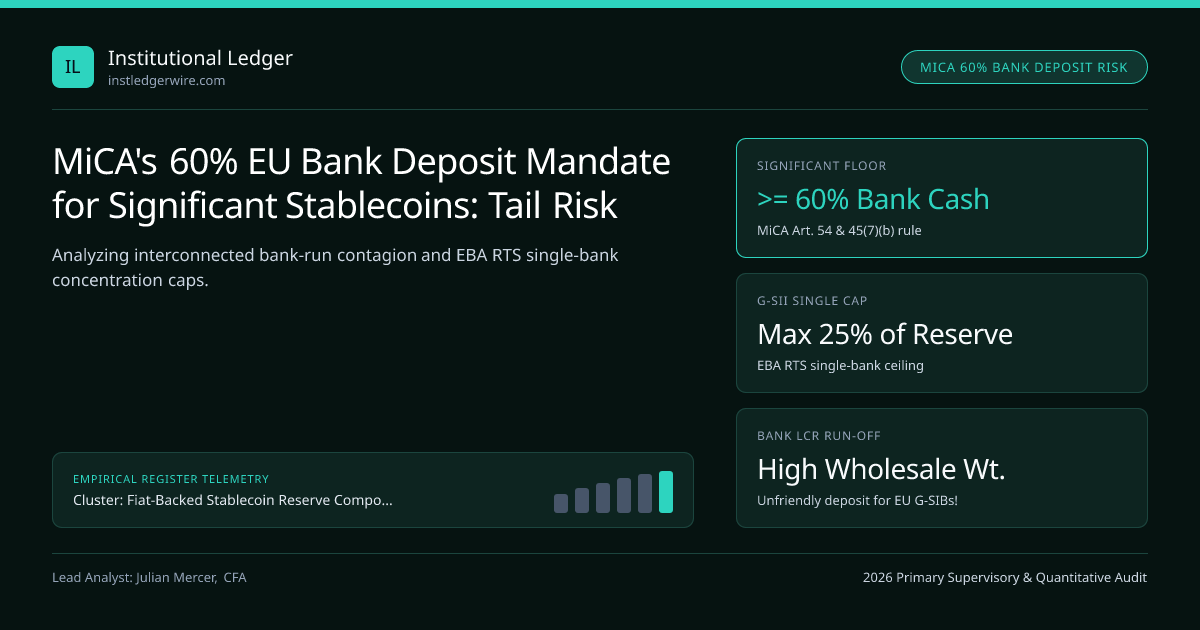
Ask an American risk manager and a European central-bank lawyer how to design the safest possible stablecoin reserve, and you witness the sharpest philosophical clash in global finance: post-SVB US treasurers want 90%+ in sovereign Treasury bills and Fed Reverse Repo with minimal bank deposits, whereas EU MiCA Articles 36 and 54 legally force "Significant" stablecoins to park at least 60% of their reserves inside uninsured EU commercial bank deposits!
The Transatlantic Paradox: Sovereign Narrow Banking vs MiCA’s 60% Bank Mandate#
When Silicon Valley Bank collapsed in March 2023 holding $3.3 billion of Circle's cash, the global crypto market learned in real time that uninsured commercial bank deposits above $250,000 / EUR 100,000 carry fractional-reserve bank credit risk. Circle immediately pivoted US reserves so ~90% sits inside sovereign T-Bills and NY Fed Overnight RRP (as detailed in our fiat-backed stablecoin reserve cornerstone guide).
Meanwhile, across Brussels and Frankfurt, MiCA Articles 36(4), 45(7)(b), and 54(b) took effect with the opposite mandate:
- Standard E-Money Tokens must hold at least 30% of funds received in separate accounts at EU credit institutions.
- EBA-designated Significant E-Money Tokens must hold at least 60% in EU credit-institution deposits!
As European Systemic Risk Board (ESRB) and ECB working papers candidly noted, EUR 100,000 statutory deposit guarantee schemes (DGS) cover 0.002% of a EUR 6 billion wholesale deposit—creating mutual interconnectedness between stablecoin runs and European commercial bank liquidity!
Why European G-SIBs Charge Spreads to Hold Stablecoin Cash (Basel LCR Friction)#
Even more ironically, when a fast-growing MiCA EMT issuer approaches Tier-1 European banks supervised by the ECB Single Supervisory Mechanism, BaFin, and France's ACPR/AMF to deposit EUR 5 billion, the banks' own treasurers push back! Why?
- 100% Basel LCR Outflow Weight: Under EU CRR Article 422, wholesale deposits placed by a non-bank Electronic Money Institution (
EMI) carry a 100% 30-day Liquidity Coverage Ratio outflow assumption! The bank cannot lend a single euro of that deposit into 5-year corporate loans; it must park 100% of it straight at the ECB Deposit Facility! - 3% Leverage Ratio Tax: Even parked risk-free at the ECB, that EUR 5B inflates the bank's Leverage Ratio exposure measure—requiring EUR 150M–200M of expensive Tier-1 bank equity (BCBS SCO60 & Basel III)! Consequently, EU banks pass a 25 to 55 bps sub-ECB deposit haircut onto EMI issuers, squeezing issuer reserve economics.
| Bank Counterparty Tier (EBA RTS) | Max % of Total Stablecoin Reserve | Max % of Receiving Bank's Balance Sheet | Prudential Rationale |
|---|---|---|---|
| G-SII / O-SII Credit Institution | <= 25.0% per bank group | <= 1.5% of bank's total assets | Forces >= 3–4 systemic banks (BaFin / AMF-ACPR / ECB SSM) to satisfy 60% rule |
| Other Large Credit Institution (>EUR 30B) | <= 15.0% per bank group | <= 1.5% of bank's total assets | Limits mid-tier European bank contagion |
| Small / Specialized Credit Inst. | <= 5.0% per bank group | <= 1.5% of bank's total assets | Directly prevents an SVB/Silvergate-style small-bank concentration blowup |
| Remaining HQLA Sleeve (40%–70%) | Level 1 Sovereign Bills / Bonds | Custodied under MiCA Art. 37 / Eurosystem | Must liquidate rapidly to replenish 60% cash within 5 business days |
How EBA’s Final RTS Concentration Caps + 3% Own Funds Contain Tail Risk#
Recognizing the SVB lesson, the European Banking Authority (EBA) engineered strict structural firewalls inside its Final Draft Regulatory Technical Standards (RTS) on the Specification of the Highly Liquid Financial Instruments and Concentration Limits:
- Hard Multi-Bank Diversification: Caps deposits at any single G-SII/O-SII banking group at 25% of reserve assets (15% for other large banks, 5% max for smaller banks), AND caps stablecoin deposits at 1.5% of the receiving bank's total balance sheet!
- BRRD MREL/TLAC Bail-In Shield + 3% Issuer Equity: At an ECB-supervised G-SII (e.g., BNP Paribas, SocGen, Deutsche Bank), 26% to 30% of Risk-Weighted Assets sit in bail-in-able equity, AT1, Tier 2, and Senior Non-Preferred debt that must be wiped to zero before wholesale preferred/senior deposits take 1 cent of loss—and even if a residual haircut occurred, the issuer's mandatory 3.0% Tier-1 Own-Funds equity cushion absorbs the first 300 bps of portfolio loss before EMT par backing breaks!
- Variables & EBA "Significant" EMT Solvency Stress Test Under EU Bank Recovery and Resolution Directive (BRRD):
- Scenario A (Pre-EBA RTS Naive 60% Concentrated in 1 Unrated Small Bank @ 25% LGD, 0% Own-Funds Cushion):
- Reserve Loss = 0.60 * 0.25 = 15.0% hole -> Immediate -1,500 bps stablecoin depeg!
- Scenario B (Compliant EBA RTS Diversification: Max 20% at an ECB-Supervised G-SII w/ 28% MREL/TLAC Subordinated Debt -> Deposit LGD <= 8%, + 3.0% Own Funds):
- Gross Reserve Loss = 0.20 * 0.08 = 1.60% -> Absorbed 100% by Issuer's mandatory 3.00% Tier-1 Own-Funds Equity! Tokenholder Loss = 0.00%!
Direct Bank-Issued EMTs & Eurosystem Wholesale DLT Alternatives#
Note that when an EU Credit Institution itself issues an EMT directly off its banking charter (such as Société Générale Forge's EURCV or bank consortium initiatives), separate third-party EMI deposit placement rules operate differently—bridging directly toward Eurosystem Trigger & Pontes central-bank DvP.
Due-Diligence Protocol for European EUR & USD EMT Reserves#
Institutional risk teams active in our Stablecoin Reserve Attestation hub audit every EU EMT's bank counterparty list under the USDC MiCA & NYDFS 2026 Benchmark Standard, verify >=90% of the bank-deposit sleeve sits inside G-SII/O-SII institutions with A/AA- credit ratings, and confirm EBA/NCA registration in our verification portal.
Frequently asked questions
Why did EU lawmakers require 60% commercial bank deposits instead of allowing 100% sovereign government bonds?
Drafted primarily before Silicon Valley Bank’s March 2023 collapse, EU legislators feared two things: first, that stablecoins backed 100% by central-bank/sovereign debt would drain commercial bank funding ("disintermediation"); second, that forcing 30%–60% cash in EU banks would guarantee instant SEPA wire payouts without selling bonds.
Why are European G-SIB banks reluctant to accept EUR 5 billion of uncollateralized cash deposits from a stablecoin issuer?
Under EU Capital Requirements Regulation (CRR) Liquidity Coverage Ratio (LCR) Article 422, operational/non-operational deposits from another financial institution (like an EMI stablecoin issuer) carry a punitive 100% 30-day LCR outflow weight! Accepting EUR 1B of stablecoin deposits forces the bank to hold EUR 1B of zero-spread HQLA AND increases its Leverage Ratio denominator!
How do EBA Regulatory Technical Standards (RTS) limit exposure to any single European bank?
To prevent an issuer from parking all 60% inside one regional bank like SVB, EBA’s RTS on Reserve of Assets caps single-bank deposit concentration by size tier: maximum 25% of total reserves at a single Global or Other Systemically Important Institution (G-SII / O-SII), 15% at other large credit institutions, and 5% at smaller banks—requiring at least 3 to 5 Tier-1 banking partners!
How does an institutional treasury desk hedge the credit difference between US NYDFS reserves (90% T-Bills) and EU MiCA reserves (30%–60% EU bank cash)?
Inspect the EU issuer’s counterparty bank roster! Confirm 100% of the EU bank deposit sleeve sits exclusively at G-SII banks (BNP Paribas, Société Générale, Deutsche Bank, Santander, ING) protected by deep bail-in MREL/TLAC debt cushions—never in small unrated tier-3 banks—or hold direct bank-issued EMTs (EURCV) / tokenized deposits.
Publication record
- Published
- November 13, 2026
- Updated
- November 15, 2026
- Author
- Julian Mercer, CFA
- Review
- Review not recorded
- Automated fact check
- Passed in the stored pipeline record
- Source URLs
- 3 recorded
AI assistance recorded: anthropic/claude-opus-4.6. This field does not establish human review or source verification.
Academic & Institutional Attribution
Cite This Research & Embed Live Data Card
Standard academic & institutional research paper citation format.
Julian Mercer, CFA. (2026, November 15). MiCA’s 60% EU Bank Deposit Mandate for Significant Stablecoins: Tail Risk. Institutional Ledger. https://instledgerwire.com/stories/significant-emt-60-percent-eu-credit-institution-deposit-capRegulatory Directory Cross-Reference
Referenced Institutions & Regulatory Registries
Top Regulated Institutions in This Coverage Slice
Related Stablecoin Reserve Attestation Audit & Institutional Briefings
Explore Stablecoin Reserve Attestation Audit Hub (20) →Stablecoin Reserve Attestation Audit
Fiat-Backed Stablecoin Reserve Composition, Audits & T-Bill Custody GuideStablecoin Reserve Attestation Audit
NYDFS USD Stablecoin Guidance: T+2 Par Redemption & Trust SegregationStablecoin Reserve Attestation Audit
Primary Mint/Burn Fedwire Cutoffs vs Weekend Curve Pool DepegsStablecoin Reserve Attestation Audit
SVB-Style Uninsured Bank Deposit Concentration Stress TestsStablecoin Reserve Attestation Audit
SEC Rule 2a-7 Government MMF Wrappers for Stablecoin ReservesStablecoin Reserve Attestation Audit
Authorized Participant Arbitrage Spreads & Stablecoin Par Peg MechanicsStablecoin Reserve Attestation Audit
Singapore MAS Single-Currency Stablecoin (SCS) Framework & 5-Day SLAStablecoin Reserve Attestation Audit
Hong Kong HKMA Fiat-Referenced Stablecoin (FRS) Ordinance & CustodyInstitutional Crypto Prime Margin
Validator Exit Churn Limits, Unbonding Queues & Liquidity DiscountsInstitutional Crypto Prime Margin
Prime Broker Cross-Margining: Spot ETFs, CME Futures & Perp OffsetsInstitutional Crypto Prime Margin
Liquid Staking Tokens (LST) Collateral Haircuts & Depeg Cascade ModelsInstitutional Crypto Prime Margin
Principal vs Agency Prime Execution & Institutional Smart Order Routing
Institutional Ledger Data, Benchmarks & Contributor Records
CC BY 4.0 Open Data
Open Institutional Datasets (CSV / JSON) →
Download desk-compiled quantitative series & schemas.
2026 Reference Matrix
2026 Institutional Benchmarks & Thresholds →
Statutory capital, clearing, margin & rate conventions.
Editorial Records
Authors & Review Records →
View named contributors where those records are available.
Complete Index
Master Research & Dossier Archive →
Browse all published briefings by topic pillar & date.