
Stablecoin Reserve Attestation Audit
Fiat-Backed Stablecoin Reserve Composition, Audits & T-Bill Custody Guide
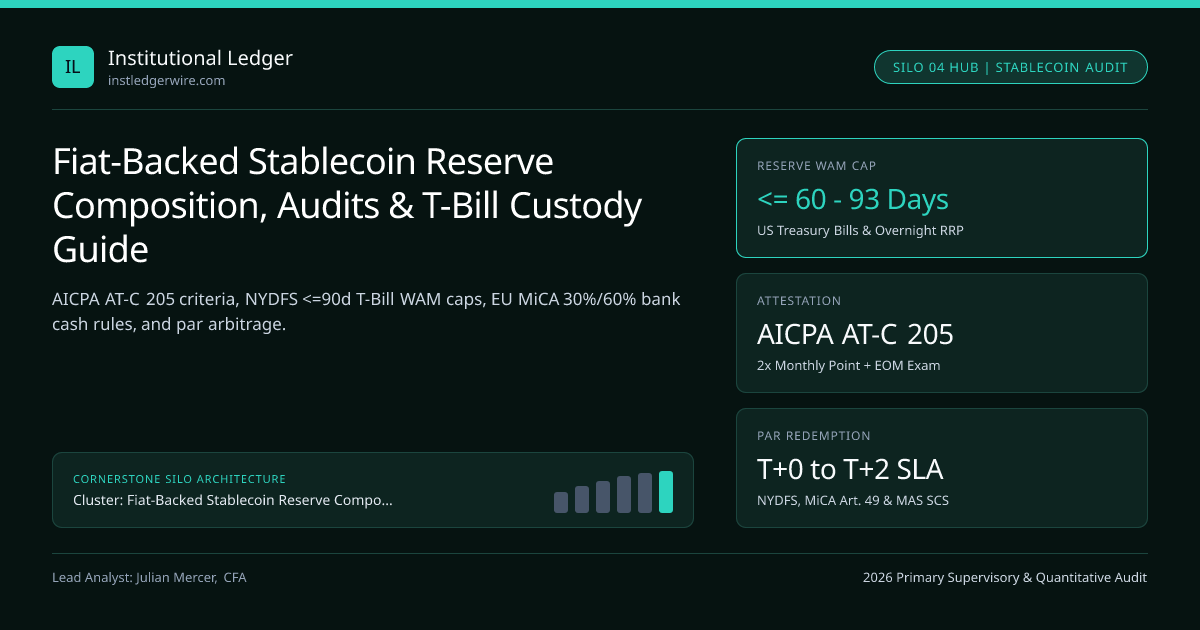
Regulated fiat-backed stablecoins settle trillions in annual institutional digital asset volume, anchored by AICPA AT-C 205 attestations, <=93-day US Treasury WAM caps, NYDFS trust rules, and EU MiCA EMT buffers.
Corporate treasurers, derivatives clearinghouses, and OTC prime desks no longer treat fiat-backed stablecoins as homogenous digital dollars: a stablecoin is legally and economically a pass-through portfolio of ultra-short sovereign bills, overnight reverse-repo agreements, and commercial bank deposits. Across our Stablecoin Reserve Attestation & T-Bill Custody hub, we audit the exact accounting standards, maturity caps, custodial structures, and redemption mechanics governing regulated USDC and EURC and global payment stablecoins in 2026.
Accounting & Maturity Rigor: AICPA AT-C 205, <93-Day T-Bills & Rule 2a-7 Wrappers#
Why did institutional treasury committees reject opaque offshore attestations backed by commercial paper, corporate bonds, and secured loans? Because any credit impairment or duration mismatch inside a 1:1 par-redeemable liability creates an immediate classic bank-run incentive—first redeemers extract $1.00 cash while late holders absorb 100% of the mark-to-market loss!
Modern Tier-1 reserve management rests on four auditable pillars:
- AICPA AT-C 205 Examination Criteria: Dissected in AICPA AT-C 205 monthly stablecoin reserve attestation criteria, Big-4 auditors examine both month-end and unannounced random intra-month timestamps, paired with continuous Proof-of-Reserve oracles to prevent temporary repo window dressing.
- Duration & Liquidity Caps: Modeled in overnight reverse-repo and 93-day T-Bill WAM caps, portfolios maintain Weighted Average Maturity (
WAM) between 12 and 45 days so 50%+ of the reserve matures naturally into cash or rolls overnight via NY Fed/dealer RRP every single week! - SEC Rule 2a-7 & G-SIB Custodial Safekeeping: Rather than holding raw CUSIPs in corporate brokerage accounts, leading US issuers isolate reserves inside dedicated SEC-registered government money-market funds—analyzed in SEC Rule 2a-7 government MMF wrappers for stablecoin reserves and custodial omnibus T-Bill safekeeping at BNY Mellon and State Street.
Global Regulatory Divergence: NYDFS vs EU MiCA vs MAS & HKMA#
Operating a global multi-currency treasury requires reconciling four distinct statutory playbooks:
- New York (NYDFS): Examined in NYDFS USD stablecoin guidance and T+2 redemption segregation, NYDFS mandates 100% backing in <=3-month US T-Bills, RRP, and segregated depository accounts with timely <=2-business-day par redemption.
- European Union (
MiCATitles III & IV): Compared in MiCA Title III ART versus Title IV EMT reserve safeguarding, single-currency fiat stablecoins classify as E-Money Tokens (EMTs). Controversially, as stress-tested in significant EMT 60% EU credit-institution deposit caps and SVB-style uninsured bank deposit concentration stress tests, MiCA forces issuers to hold 30% to 60% of reserves in commercial bank deposits! - Asia-Pacific Hubs: We benchmark Singapore's MAS Single-Currency Stablecoin (SCS) 5-day redemption framework, Hong Kong's HKMA Fiat-Referenced Stablecoin (FRS) licensing, and wholesale oversight under CPMI-IOSCO PFMI systemically important stablecoin rules.
| Prudential Regime | Max T-Bill Maturity / WAM | Commercial Bank Deposit Rule | Statutory Par Redemption SLA | Audit / Attestation Cadence |
|---|---|---|---|---|
| NYDFS USD Guidance | <= 3 months US T-Bills & RRP | Segregated at FDIC/NYDFS depository | <= T+2 business days after order | Monthly CPA AT-C 205 (EOM + random day) |
| EU MiCA EMT (ESMA / BaFin / AMF) | Level 1 HQLA low-risk liquid debt | Mandatory >= 30% (60% if Significant!) | At any moment, at par, free of retail fee | Independent audit every 6 mo + NCA reporting |
| Singapore MAS SCS | <= 3 months AA- central bank/gov | Segregated trust in SG banks | <= 5 business days from valid request | Monthly external audit + annual report |
| Hong Kong HKMA / SFC FRS | High-quality ultra-short sovereigns | Segregated trust at HKMA Authorized Inst. | <= 1 business day normal SLA | Monthly independent attestation + HKMA exam |
Primary Redemption Gates, Weekend Curve Depegs & AP Arbitrage#
Why does a 100%-backed stablecoin ever trade at $0.996 or $1.003 on a Sunday? Because primary mint/burn banking pipes and secondary DeFi/CLOB orderbooks operate on different clocks and onboarding perimeters:
- We model Friday-evening liquidity friction in primary mint/burn Fedwire cutoffs versus weekend Curve depegs, Authorized Participant arbitrage spreads keeping par pegs, and redemption gate fees and minimum burn thresholds during liquidity runs.
- Variables & Institutional Stablecoin Reserve Stress Test (Post-SVB Architecture vs 2023 Concentration):
- 1. March 2023 Architecture (8.25% concentrated in single uninsured regional bank SVB @ 50% feared weekend LGD + 48h wire lockout @ 60% AP carry):
- Feared Theoretical Floor = 1.0000 - (0.0825 * 0.50) - (0.60 * 48 / 8,760) = $0.9555 (overshot to $0.88 due to retail panic before FDIC rescue!).
- 2. 2026 G-SIB + SEC Rule 2a-7 Architecture (90% in BlackRock-managed SEC 2a-7 Circle Reserve Fund [T-Bills/Fed RRP] + 10% split across 4 G-SIBs):
- Max Single-Bank Uninsured Exposure = 2.5% at a G-SIB (TLAC-protected, LGD -> 0.00%) -> Fundamental Credit Depeg Floor = $0.9985+!
Prudential Bank Capital, Blacklist Governance & Issuer Rate Economics#
Rounding out institutional due diligence, bank risk officers examine why secondary-market micro-deviations cause stablecoins to fail Basel III tests in Basel SCO60 Group 1b stabilisation mechanism test failures; compliance teams map OFAC/FinCEN blacklist risk in stablecoin freeze and blacklist governance; FX desks evaluate negative-spread risks in non-USD Euro and Yen stablecoins; and equity analysts stress-test issuer profitability under Fed rate cuts in Treasury-bill roll yield compression and issuer economics.
Institutional Treasury Selection Scorecard for Payment Stablecoins#
Chief Risk Officers use our USDC MiCA & NYDFS 2026 Benchmark Standard, benchmarks directory, and verification portal to maintain active primary burn accounts across at least two regulated issuers while sweeping idle weekend treasury surpluses into BlackRock BUIDL.
Frequently asked questions
What is the difference between an AICPA AT-C 205 stablecoin attestation and a full GAAP financial statement audit?
An AICPA AT-C 205 Examination Attestation expresses a Big-4 CPA opinion that management’s assertion of redeemable token supply and segregated backing assets met AICPA Stablecoin Criteria as of two specific monthly timestamps (month-end plus one random unannounced intra-month cutoff), whereas an annual PCAOB/AICPA audit covers full-year corporate entity financials and internal controls.
Why did Silicon Valley Bank’s collapse cause USDC to trade at $0.88 on a Saturday despite 100% reserve backing?
In March 2023, $3.3 billion (~8%) of Circle’s $40B reserve sat in uninsured commercial bank cash at SVB when California regulators closed SVB on a Friday—while Fedwire was shut all weekend so primary Authorized Participants could not mint/burn T-Bills until Monday morning and FDIC invoked the systemic-risk guarantee.
Why does EU MiCA require 30% to 60% of e-money token (EMT) reserves to sit in EU commercial bank deposits?
European lawmakers under MiCA Articles 36, 38, and 54 prioritized instant same-day fiat SEPA redemption liquidity inside European banks, requiring at least 30% of standard EMT reserves (and 60% for "significant" EMTs supervised by the EBA) in diversified credit-institution deposits—creating bank credit concentration debates post-SVB.
Can retail or un-onboarded hedge funds redeem stablecoins directly with the issuer at $1.00 par?
Only entities holding direct KYB-verified primary mint/burn accounts (such as Circle Mint or Paxos institutional accounts) enjoy statutory 1:1 par wire redemption! Non-onboarded secondary holders rely on Curve/Uniswap pools and Authorized Participant arbitrageurs to bridge weekend/intraday supply shocks.
Publication record
- Published
- November 14, 2026
- Updated
- November 15, 2026
- Author
- Julian Mercer, CFA
- Review
- Review not recorded
- Automated fact check
- Passed in the stored pipeline record
- Source URLs
- 4 recorded
AI assistance recorded: anthropic/claude-opus-4.6. This field does not establish human review or source verification.
Academic & Institutional Attribution
Cite This Research & Embed Live Data Card
Standard academic & institutional research paper citation format.
Julian Mercer, CFA. (2026, November 15). Fiat-Backed Stablecoin Reserve Composition, Audits & T-Bill Custody Guide. Institutional Ledger. https://instledgerwire.com/stories/fiat-backed-stablecoin-reserve-attestation-tbill-guide-2026Regulatory Directory Cross-Reference
Referenced Institutions & Regulatory Registries
Top Regulated Institutions in This Coverage Slice
Referenced Supervisory Authorities
Related Stablecoin Reserve Attestation Audit & Institutional Briefings
Explore Stablecoin Reserve Attestation Audit Hub (20) →Stablecoin Reserve Attestation Audit
AICPA AT-C 205 Monthly Stablecoin Reserve Attestation Criteria DecodedStablecoin Reserve Attestation Audit
Overnight Reverse Repo & 93-Day T-Bill WAM Caps in StablecoinsStablecoin Reserve Attestation Audit
EU MiCA Title III (ART) vs Title IV (EMT) Stablecoin Safeguarding RulesStablecoin Reserve Attestation Audit
MiCA’s 60% EU Bank Deposit Mandate for Significant Stablecoins: Tail RiskStablecoin Reserve Attestation Audit
NYDFS USD Stablecoin Guidance: T+2 Par Redemption & Trust SegregationStablecoin Reserve Attestation Audit
Primary Mint/Burn Fedwire Cutoffs vs Weekend Curve Pool DepegsStablecoin Reserve Attestation Audit
SVB-Style Uninsured Bank Deposit Concentration Stress TestsStablecoin Reserve Attestation Audit
SEC Rule 2a-7 Government MMF Wrappers for Stablecoin ReservesInstitutional Crypto Prime Margin
Institutional Crypto Prime Brokerage, Cross-Venue Netting & zk-PoR Guide (2026)Qualified Custody Mpc Hsm Controls
NYDFS Limited Purpose Trust vs OCC National Trust Charters in Crypto CustodyQualified Custody Mpc Hsm Controls
Threshold ECDSA & EdDSA MPC Key-Share Refresh Ceremonies in CustodyQualified Custody Mpc Hsm Controls
Air-Gapped FIPS 140-3 Level 3 & Level 4 HSM Cold Signing Vaults Explained
Institutional Ledger Data, Benchmarks & Contributor Records
CC BY 4.0 Open Data
Open Institutional Datasets (CSV / JSON) →
Download desk-compiled quantitative series & schemas.
2026 Reference Matrix
2026 Institutional Benchmarks & Thresholds →
Statutory capital, clearing, margin & rate conventions.
Editorial Records
Authors & Review Records →
View named contributors where those records are available.
Complete Index
Master Research & Dossier Archive →
Browse all published briefings by topic pillar & date.