
Stablecoin Reserve Attestation Audit
SVB-Style Uninsured Bank Deposit Concentration Stress Tests
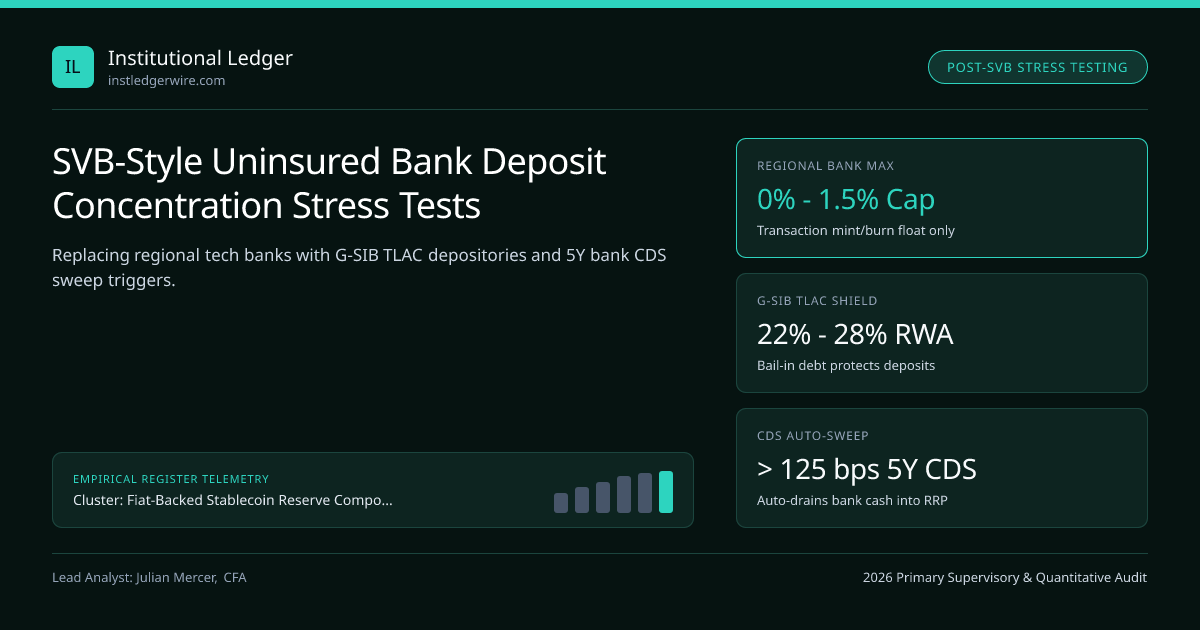
March 2023 proved that holding $3.3B in an uninsured regional bank turns a 100%-backed stablecoin into a weekend credit derivative. Modern risk desks stress-test bank CDS spreads and G-SIB TLAC buffers.
On Thursday, March 9, 2023, depositors attempted to wire $42 billion out of Silicon Valley Bank in ten hours—and by Saturday afternoon, $3.3 billion of trapped cash sent USDC down to $0.88 on secondary orderbooks until federal regulators invoked the systemic-risk exception. That weekend permanently rewired institutional treasury risk management: every stablecoin allocation now undergoes a rigorous bank-deposit concentration stress test.
Why "Pass-Through FDIC Insurance" Is an Illusion for Public-Chain Stablecoins#
Before 2023, marketing decks from smaller stablecoin issuers routinely claimed that cash held at US partner banks enjoyed "$250,000 per-holder pass-through FDIC deposit insurance." Institutional banking lawyers knew better—and post-2023 FDIC enforcement and 12 CFR Part 330 guidance removed all doubt.
For pass-through deposit insurance to attach under 12 CFR §§ 330.5 & 330.7:
- The deposit account records at the failed bank must expressly disclose the fiduciary/custodial relationship; AND
- Either the bank or the custodian/good-faith party must maintain ascertainable records of the identity and exact dollar interest of every beneficial owner as of the exact moment the FDIC closes the bank!
On Ethereum, Solana, or Arbitrum, an ERC-20 payment stablecoin sits inside Curve liquidity pools, multi-sig smart contracts, offshore exchange omnibus wallets (Bitfinex, BitMEX), and millions of un-KYC'd self-custody addresses! An issuer cannot hand the FDIC a verified taxpayer-ID ledger of 4 million pseudonymous DeFi addresses on Friday night—meaning a $2 billion cash account collapses to $250,000 total insured ($0.000125 on the dollar)! As established across our fiat-backed stablecoin reserve cornerstone guide, institutional models conservatively assume 0% deposit insurance on wholesale stablecoin reserves.
G-SIB Single-Point-of-Entry (SPOE) & TLAC Bail-In vs Regional Banks#
Why does moving cash from regional banks into Global Systemically Important Banks (G-SIBs) like BNY Mellon and State Street (as codified in the USDC MiCA & NYDFS 2026 Benchmark Standard) fundamentally eliminate weekend seizure panic?
- Regional banks between $50B and $250B were exempted in 2018 from FSB Total Loss-Absorbing Capacity (
TLAC) long-term bail-in debt rules; when SVB failed, there was no holding-company debt layer to absorb losses ahead of uninsured operating-bank depositors! - Under US Title II Orderly Liquidation Authority Single-Point-of-Entry (
SPOE) resolution and BCBS Basel III G-SIB rules, ONLY the top-tier parent Bank Holding Company enters receivership—wiping out common equity and converting $100B+ of parent TLAC bonds into new equity to recapitalize the Operating Bank Subsidiary, which opens at 8:00 AM Monday with 100% of operating deposits intact and wireable!
| Bank Risk Metric | Silicon Valley Bank (Q4 2022 Warning) | 2026 Institutional Stablecoin Redline | Custody G-SIB Profile (BNY Mellon / State St) |
|---|---|---|---|
| Uninsured Deposits / Total | 93.8% uninsured tech/VC cluster! | Reject non-G-SIBs with >60% sector-clustered uninsured deposits | Diversified global institutional custody sticky operational balances |
| Unrealized HTM Losses / TCE | > 115% (technically underwater on mark!) | Reject any bank where (AFS + HTM Loss) / TCE > 40% | Short asset duration; fee-driven custody model |
| FSB TLAC Bail-In Debt Cushion | 0% (Exempt under 2018 tailoring!) | Require G-SIB / G-SII status for any deposit > 1.5% of reserve | ~24% – 28% TLAC holding-company debt protects operating bank |
| Max Reserve Allocation | 8.25% ($3.3B) in single regional bank | <= 0.5% – 1.0% non-G-SIB; <= 5%–15% per G-SIB (NYDFS / EBA) | Paired with 85%–90% sovereign T-Bills / RRP in USDC Standard |
Automated Footnote HTM/TCE & 5-Year CDS Sweep Triggers#
Both stablecoin issuers and large corporate holders (especially in Europe where MiCA mandates 30%–60% bank cash) run automated quarterly and daily bank-health screens:
- Quarterly Call-Report / IFRS Screen: Compute mark-to-market Tangible Common Equity deducting 100% of unrecognized Held-to-Maturity (
HTM) bond losses! Any bank dropping below5.0% adjusted TCE/TAis cut immediately. - Daily Market-Implied Alarm: If any depository bank's 5-year Senior Credit Default Swap (
CDS) widens past 125 bps (or single-day equity drops> 12%), automated treasury sweeps drain cash into Overnight Reverse Repo and <93-day T-Bills before Fedwire's 6:30 PM ET close!
- Variables & Post-SVB Depository Screening Filter Applied by Institutional Stablecoin Risk Committees:
- 1. Regional Bank X (Q4 2022 SVB-Style Profile):
- Reported TCE = $11.8B; Unrecognized Footnote HTM MBS/UST Loss = -$15.1B; Tangible Assets = $209B
- Mark-to-Market Adjusted TCE = ($11.8B - $15.1B) / $193.9B = -1.70% INSOLVENT ON LIQUIDATION! -> Auto-Blacklisted as Reserve Depository!
- 2. Tier-1 Custody G-SIB +Issuer Equity Stress Rule:
- Enforce hard invariant:
Max_Single_Non_GSIB_Cash_USD <= 0.50 * Issuer_Unencumbered_Corporate_Tier1_Equity - Guarantees that even a sudden Friday 5:00 PM regional partner seizure leaves the stablecoin reserve >= 100.00% backed by Monday morning!
Reverse Stress-Testing Dual-Stablecoin Treasury Allocations#
Prudent prime desks diversify working stablecoin balances (e.g., 70% primary NYDFS/MiCA issuer + 30% secondary NYDFS trust issuer custodial-banked at a different depository roster) so no single operational incident freezes 24/7 variation-margin sweeps.
CRO Bank-Concentration Audit Checklist#
Chief Risk Officers active in our Stablecoin Reserve Attestation hub verify from monthly AT-C 205 reports that non-G-SIB ramp cash stays strictly below 1.5% of total reserves (and below issuer corporate equity), confirm G-SIB custody, and audit issuer regulatory status via our verification portal.
Frequently asked questions
Why doesn’t FDIC $250,000 pass-through deposit insurance protect every individual holder of a public-chain stablecoin?
Under FDIC 12 CFR § 330.5 & § 330.7 (and sharpened 2024 FDIC custodial-account recordkeeping proposals), pass-through insurance requires the fiduciary/custodian to maintain accurate, up-to-date records of each beneficial owner’s identity and balance! Because ERC-20 stablecoins transfer pseudonymously across millions of DeFi smart contracts and wallets every second, bank deposits collapse to a single $250,000 cap unless KYC-locked!
Why is an uninsured $2B deposit at BNY Mellon fundamentally safer than an uninsured $2B deposit at a regional commercial lender?
Two structural protections: first, custody G-SIBs (BNY Mellon, State Street) operate low-credit-risk fee/custody balance sheets rather than concentrated venture-capital or commercial-real-estate loan books; second, FSB/Fed G-SIB rules mandate massive Total Loss-Absorbing Capacity (TLAC) long-term holding-company debt that converts to equity in SPOE resolution while the operating bank stays open Monday morning!
What early-warning market signals flashed weeks before Silicon Valley Bank failed on March 10, 2023?
Three public telemetry alarms screamed months/days early: (1) Footnote disclosures showing Held-to-Maturity (HTM) unrealized bond losses exceeding 100% of Tangible Common Equity (TCE); (2) surging Federal Home Loan Bank (FHLB) emergency advances; and (3) widening bank equity-implied credit spreads / 5-year senior CDS jumping past 150 bps!
Why do stablecoin issuers still keep 1%–2% in agile partner settlement banks alongside G-SIBs?
To power 24/7 API mint/burn onboarding ramps across global time zones (Singapore, Zurich, Latin America, Europe). Institutional issuers cap each non-G-SIB transaction ramp account strictly below the issuer’s own retained corporate equity buffer (e.g., <0.5%–1.5% of reserves), sweeping excess cash hourly into G-SIB / Rule 2a-7 sovereign vaults!
Publication record
- Published
- November 13, 2026
- Updated
- November 14, 2026
- Author
- Julian Mercer, CFA
- Review
- Review not recorded
- Automated fact check
- Passed in the stored pipeline record
- Source URLs
- 3 recorded
AI assistance recorded: anthropic/claude-opus-4.6. This field does not establish human review or source verification.
Academic & Institutional Attribution
Cite This Research & Embed Live Data Card
Standard academic & institutional research paper citation format.
Julian Mercer, CFA. (2026, November 14). SVB-Style Uninsured Bank Deposit Concentration Stress Tests. Institutional Ledger. https://instledgerwire.com/stories/svb-style-uninsured-bank-deposit-concentration-stress-testsRegulatory Directory Cross-Reference
Referenced Institutions & Regulatory Registries
Mentioned Regulated Institutions
Related Stablecoin Reserve Attestation Audit & Institutional Briefings
Explore Stablecoin Reserve Attestation Audit Hub (20) →Stablecoin Reserve Attestation Audit
Fiat-Backed Stablecoin Reserve Composition, Audits & T-Bill Custody GuideStablecoin Reserve Attestation Audit
SEC Rule 2a-7 Government MMF Wrappers for Stablecoin ReservesStablecoin Reserve Attestation Audit
Authorized Participant Arbitrage Spreads & Stablecoin Par Peg MechanicsStablecoin Reserve Attestation Audit
Singapore MAS Single-Currency Stablecoin (SCS) Framework & 5-Day SLAStablecoin Reserve Attestation Audit
Hong Kong HKMA Fiat-Referenced Stablecoin (FRS) Ordinance & CustodyStablecoin Reserve Attestation Audit
CPMI-IOSCO PFMI Rules for Systemically Important StablecoinsStablecoin Reserve Attestation Audit
Intraday Snapshot Window Dressing vs Continuous Proof-of-Reserve OraclesStablecoin Reserve Attestation Audit
Custodial T-Bill Safekeeping: BNY Mellon & State Street Reserve ModelsInstitutional Crypto Prime Margin
Principal vs Agency Prime Execution & Institutional Smart Order RoutingInstitutional Crypto Prime Margin
Crypto Securities Lending: Open-Term Recall SLAs, GMSLA & Borrow RatesInstitutional Crypto Prime Margin
Portfolio VaR & SPAN Margin Models for Multi-Leg Digital Asset BooksInstitutional Crypto Prime Margin
Weekend Gap Risk: CME Friday 4:00 PM CT Close vs 24/7 Perpetuals
Institutional Ledger Data, Benchmarks & Contributor Records
CC BY 4.0 Open Data
Open Institutional Datasets (CSV / JSON) →
Download desk-compiled quantitative series & schemas.
2026 Reference Matrix
2026 Institutional Benchmarks & Thresholds →
Statutory capital, clearing, margin & rate conventions.
Editorial Records
Authors & Review Records →
View named contributors where those records are available.
Complete Index
Master Research & Dossier Archive →
Browse all published briefings by topic pillar & date.