
Stablecoin Reserve Attestation Audit
Overnight Reverse Repo & 93-Day T-Bill WAM Caps in Stablecoins
Silicon Valley Bank failed holding 10-year Treasuries and MBS against instant deposits. Regulated stablecoins cap individual T-Bills at <=93 days and anchor instant liquidity in Tri-Party Overnight Reverse Repo.
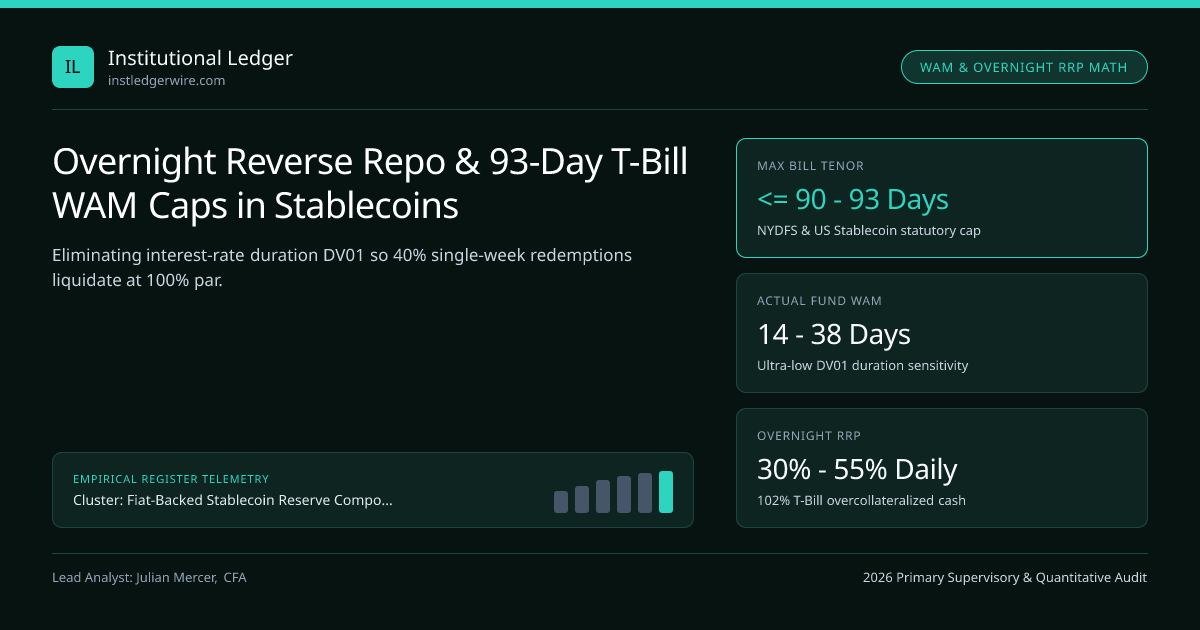
Silicon Valley Bank did not collapse because it bought subprime junk loans—it collapsed because it funded instant-withdrawal uninsured deposits with 10-year Treasuries and Agency MBS carrying 7+ years of interest-rate duration. Regulated stablecoin issuers survive 30% to 50% redemption shocks without breaking the buck by enforcing an ironclad fixed-income discipline: zero securities longer than 93 days, portfolio Weighted Average Maturity (WAM) under 30–45 days, and 35% to 50% parked in Overnight Reverse Repo (ON RRP).
The Duration Math That Separates 30-Day T-Bills From SVB’s 10-Year Bonds#
Fixed-income physics leaves nowhere to hide when depositors demand 1:1 par cash during a central-bank tightening cycle. Every 100 basis points of yield increase lowers a bond's market price by approximately -Duration * 1.00%:
- On a 10-year Treasury note (
Duration ~ 8.1), a +300 bps rate cycle creates a -24.3% mark-to-market principal hole—wiping out bank equity the moment depositors run! - Under NYDFS USD Stablecoin Guidance and our fiat-backed stablecoin reserve cornerstone guide, every individual US Treasury bill in the reserve must have <= 3 months (~90–93 days) remaining to maturity at purchase, and SEC Rule 2a-7 reserve funds cap portfolio
WAM <= 60 days(typically running 18 to 32 days in practice!). - At a 25-day WAM (
Duration = 0.068 years), even an unprecedented overnight +100 bps shock moves portfolio market value by just -6.8 basis points—less than six days of accrued interest!
Why Overnight Reverse Repo (ON RRP) Is the Ultimate Bank-Run Shock Absorber#
Holding 90-day T-Bills protects credit and duration, yet how does a $40 billion stablecoin like regulated USDC raise $15 billion of wireable fiat cash by 9:00 AM tomorrow without keeping $15 billion in uninsured commercial bank deposits?
The answer is Overnight Reverse Repurchase Agreements (ON RRP):
- Direct Federal Reserve ON RRP (accessed via SEC Rule 2a-7 government MMF reserve wrappers): Cash sits overnight directly on the balance sheet of the Federal Reserve Bank of New York collateralized by System Open Market Account (
SOMA) US Treasuries—carrying zero commercial bank failure risk and returning 100% liquid Fedwire reserves tomorrow morning! - Tri-Party Dealer Overnight Reverse Repo: Executed via BNY Mellon's tri-party repo platform against diversified G-SIB primary dealers. The stablecoin reserve receives 102% physical US Treasury collateral (2% overcollateralization haircut!) segregated inside BNY Mellon's tri-party vault overnight. If a primary dealer failed at midnight, BNY Mellon hands 102 cents of liquid US Treasuries per $1.00 lent at 8:30 AM ET!
| Reserve Bucket | Typical Allocation % | Maturity / Liquidity Profile | Counterparty / Credit Exposure | Role During Redemption Run |
|---|---|---|---|---|
| G-SIB Operating Cash | 8% – 12% | Instant intraday Fedwire / intrabank | Diversified across BNY Mellon, State Street, JPM, Citi | Absorbs initial intraday primary burns |
Overnight Reverse Repo (ON RRP) | 35% – 50% | 1 business day (matures 08:30 AM ET) | NY Fed or 102% UST Tri-Party (BCBS SCO60 0% sovereign) | Converts up to half the reserve into cash tomorrow morning with zero bond sales! |
| 1–30 Day US Treasury Bills | 25% – 35% | Laddered Tue/Thu Treasury bill maturities | Direct US Sovereign (0% credit weight) | Natural par cash roll-off across Week 1–4 |
| 31–93 Day US Treasury Bills | 10% – 25% | Same-day T+0 Fedwire Securities sale | Direct US Sovereign (0% credit weight) | Liquidated at < 0.5 bps spread only if >60% of supply burns |
SEC 2023–2024 Money-Market Reforms: 25% Daily & 50% Weekly Liquid Assets#
Following the SEC's post-2023 amendments to 17 CFR § 270.2a-7, government money-market funds must maintain at least 25% in Daily Liquid Assets (DLA) (cash, direct US Treasuries, or securities maturing in 1 business day like ON RRP) and 50% in Weekly Liquid Assets (WLA) (cash, direct US Treasuries, or Government agency discount notes maturing within 5 business days). Leading stablecoin reserve funds routinely exceed 55% DLA and 85% WLA!
- Variables & $40.0B Regulated USD Stablecoin Simultaneous +150 bps Rate Shock + 45% ($18.0B) 48-Hour Run Stress Test:
- ReserveAUM = $40,000,000,000; WAMDays = 24 days (via 42% Overnight RRP [1d] + 10% Cash [0d] + 48% T-Bills [avg 49d])
- 1. Day-1 + Day-2 Natural Cash Without Selling ANY T-Bills:
- $4.0B G-SIB Cash + $16.8B Overnight RRP maturing 08:30 AM ET = $20,800,000,000 cash (> $18.0B run! Zero forced T-Bill sales!).
- 2. Even if forced to liquidate $5B of 49-day T-Bills after an instantaneous +150 bps emergency Fed hike:
- Mark-to-Market Discount on $5B slice = $5,000M * (49 / 365) * 0.0150 = -$10,068,493 (0.025% of reserve — absorbed 8x over by issuer statutory capital!).
Contrast With Offshore Issuers Holding Gold, Bitcoin & Corporate Paper#
When reviewing non-NYDFS/non-MiCA offshore stablecoins under AICPA AT-C 205 vs ISAE 3000 standards, treasury risk committees immediately flag any issuer mixing volatile assets (BTC, gold, corporate bonds, or secured loans) alongside T-Bills: a simultaneous 25% Bitcoin crash and 30% redemption wave eats through an issuer's 3%–4% equity cushion far faster than a pure <=93-day sovereign bill book.

Quantitative Reserve-Duration Audit Checklist#
Treasury analysts active in our Stablecoin Reserve Attestation hub calculate live portfolio WAM and Daily Liquid Asset % from monthly CUSIP schedules, verify zero corporate paper or >93-day maturities, and monitor regulatory compliance across NYDFS and MAS in our verification portal.
Frequently asked questions
Why did 10-year US Treasuries bankrupt Silicon Valley Bank while 30-day US Treasury bills kept stablecoin reserves 100% intact?
Bond price sensitivity (Modified Duration) scales directly with maturity! SVB bought 10-year MBS and Treasuries (Duration ~ 7.5 years), suffering a -22% unrealized principal hole when rates rose 300 bps. A stablecoin reserve with a 28-day Weighted Average Maturity (Duration = 0.076 years) experiences only ~7.6 bps of price change per +100 bps rate shock—fully offset by 6 days of yield!
How does Tri-Party Overnight Reverse Repo (RRP) beat uninsured bank deposits for daily stablecoin liquidity?
An uninsured cash deposit at a commercial bank is an unsecured claim if the bank fails overnight. In a Tri-Party Overnight Reverse Repo custodied at BNY Mellon, the stablecoin reserve lends cash overnight (maturing at 8:30 AM ET tomorrow!) against 102% physical US Treasury collateral locked in a segregated tri-party box—zero bank credit exposure plus 100% T+1 cash maturity!
Can a private stablecoin corporate LLC access the Federal Reserve’s Overnight Reverse Repo (ON RRP) window directly?
Not directly as a fintech LLC—the NY Fed restricts ON RRP counterparties to banks, GSEs, primary dealers, and qualifying SEC-registered Rule 2a-7 Money Market Funds with >=$2B+ net assets. By structuring reserves inside a dedicated SEC-registered 2a-7 fund (such as the BlackRock-managed Circle Reserve Fund), the reserve gains direct NY Fed ON RRP counterparty access!
What happens if an issuer experiences a 50% run and has to sell 60-day T-Bills in the secondary market?
On-the-run 4-week and 8-week US Treasury bills are the single most liquid securities on Earth (~$200B+ daily trading volume with 0.25–0.50 bps bid-ask spreads)—and before touching secondary sales, the issuer first drains its 35%–50% Overnight RRP sleeve maturing at 8:30 AM ET!
Publication record
- Published
- November 13, 2026
- Updated
- November 15, 2026
- Author
- Julian Mercer, CFA
- Review
- Review not recorded
- Automated fact check
- Passed in the stored pipeline record
- Source URLs
- 3 recorded
AI assistance recorded: anthropic/claude-opus-4.6. This field does not establish human review or source verification.
Academic & Institutional Attribution
Cite This Research & Embed Live Data Card
Standard academic & institutional research paper citation format.
Julian Mercer, CFA. (2026, November 15). Overnight Reverse Repo & 93-Day T-Bill WAM Caps in Stablecoins. Institutional Ledger. https://instledgerwire.com/stories/overnight-reverse-repo-93-day-tbill-wam-caps-stablecoinsRegulatory Directory Cross-Reference
Referenced Institutions & Regulatory Registries
Top Regulated Institutions in This Coverage Slice
Related Stablecoin Reserve Attestation Audit & Institutional Briefings
Explore Stablecoin Reserve Attestation Audit Hub (20) →Stablecoin Reserve Attestation Audit
Fiat-Backed Stablecoin Reserve Composition, Audits & T-Bill Custody GuideStablecoin Reserve Attestation Audit
EU MiCA Title III (ART) vs Title IV (EMT) Stablecoin Safeguarding RulesStablecoin Reserve Attestation Audit
MiCA’s 60% EU Bank Deposit Mandate for Significant Stablecoins: Tail RiskStablecoin Reserve Attestation Audit
NYDFS USD Stablecoin Guidance: T+2 Par Redemption & Trust SegregationStablecoin Reserve Attestation Audit
Primary Mint/Burn Fedwire Cutoffs vs Weekend Curve Pool DepegsStablecoin Reserve Attestation Audit
SVB-Style Uninsured Bank Deposit Concentration Stress TestsStablecoin Reserve Attestation Audit
SEC Rule 2a-7 Government MMF Wrappers for Stablecoin ReservesStablecoin Reserve Attestation Audit
Authorized Participant Arbitrage Spreads & Stablecoin Par Peg MechanicsInstitutional Crypto Prime Margin
Cross-Exchange Delta-Neutral Cash-and-Carry Basis Margining MechanicsInstitutional Crypto Prime Margin
Institutional ETH Staking Slashing Insurance & Correlated Penalty MathInstitutional Crypto Prime Margin
Validator Exit Churn Limits, Unbonding Queues & Liquidity DiscountsInstitutional Crypto Prime Margin
Prime Broker Cross-Margining: Spot ETFs, CME Futures & Perp Offsets
Institutional Ledger Data, Benchmarks & Contributor Records
CC BY 4.0 Open Data
Open Institutional Datasets (CSV / JSON) →
Download desk-compiled quantitative series & schemas.
2026 Reference Matrix
2026 Institutional Benchmarks & Thresholds →
Statutory capital, clearing, margin & rate conventions.
Editorial Records
Authors & Review Records →
View named contributors where those records are available.
Complete Index
Master Research & Dossier Archive →
Browse all published briefings by topic pillar & date.