
Tokenized Treasuries Rwa Settlement
G-SIB SLR, LCR & Level 1 HQLA Eligibility of Tokenized Sovereign Debt
Under Basel SCO60 and LCR rules, tokenized US Treasuries qualify for 0% credit risk weight and Level 1 HQLA status only if banks prove bankruptcy-remote legal parity and instant monetization.
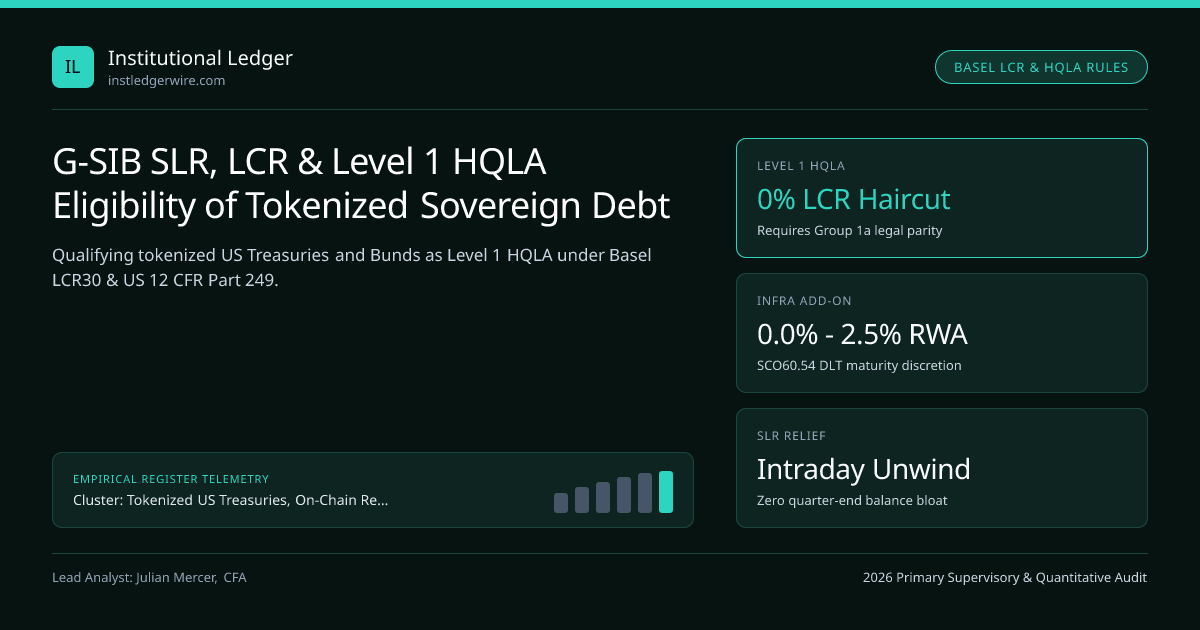
Why do hedge funds and crypto prime brokers eagerly hold public-chain tokenized money-market funds, whereas Global Systemically Important Banks (G-SIBs) build permissioned sovereign bond registries on Canton Network and German eWpG? The answer lies inside three interlocking Basel III balance-sheet equations: BCBS SCO60 credit risk weights, Basel LCR30 (US 12 CFR Part 249) Level 1 HQLA eligibility, and the 5% Enhanced Supplementary Leverage Ratio (eSLR).
Gate 1: Passing Basel SCO60 Group 1a & BCBS d579 Public-Chain Scrutiny#
As established in our analysis of Basel SCO60 Group 1 vs Group 2 bank capital weights and our tokenized US Treasuries cornerstone guide, a bank holding a tokenized US Treasury or German Bund achieves a 0% sovereign credit risk weight (Group 1a) only when every classification condition (SCO60.8–SCO60.19) passes unconditionally.
Crucially, the Basel Committee's BCBS d579 amendments warn supervisors regarding permissionless blockchains where banks cannot vet or sanction consensus validators. Consequently, while non-bank buy-side desks deploy billions into public-EVM funds, G-SIB balance-sheet treasuries under the BCBS SCO60 2026 Benchmark Standard overwhelmingly hold direct tokenized CUSIPs/ISINs on permissioned validator networks (Canton, SWIAT, GL1) to guarantee Group 1a parity and avoid discretionary SCO60.54 infrastructure add-ons.
Gate 2: LCR30 Level 1 HQLA Operational Monetization Tests#
Even with a 0% credit risk weight, a G-SIB's Chief Investment Office (CIO) will not allocate corporate liquidity buffers into tokenized sovereign debt unless those tokens count at 100% face value (0% haircut) toward the 30-day Liquidity Coverage Ratio (LCR). Under Basel LCR30.13–30.18 and US Federal Reserve 12 CFR § 249.22, Level 1 High-Quality Liquid Assets (HQLA) must satisfy strict operational requirements:
- Treasury Control: Private signing keys or custodial control over the tokenized bond vault must reside directly under the bank's Liquidity Management Function (
CFO/Treasurer), never trapped as rehypothecated trading-desk margin. - Demonstrated Monetization: The bank must periodically execute live test repos or outright sales on the DLT venue—proving that $500M+ of tokenized Treasuries converts into central-bank reserves or cash intraday without smart-contract gas spikes or liquidity discounts.
| Tokenized Instrument Structure | BCBS SCO60 Class | US 12 CFR Part 249 LCR Status | EU CRR / BaFin LCR Status | G-SIB eSLR Optimization |
|---|---|---|---|---|
| Direct Sovereign Token (Canton / German eWpG) | Group 1a (0% RWA) | Level 1 HQLA (0% haircut) | Level 1 HQLA (0% haircut) | Intraday unwind + FICC netting |
| 1940 Act / UCITS Gov MMF (BENJI / EU CIU) | Look-through Group 1a | Excluded from US Bank HQLA (fund rule) | Eligible CIU look-through (up to EUR 500M) | Off-balance-sheet client sweep |
| 3(c)(7) Private RWA Fund (BUIDL) | Look-through / Equity test | Non-HQLA for bank LCR; top client margin | AIF look-through limits | Held off-balance-sheet as client pledge |
| Permissionless Synthetic T-Bill | Group 2b (1,250% RWA) | 0% HQLA (Ineligible) | 0% HQLA (Ineligible) | Prohibitive Tier 1 deduction |
Direct Tokenized CUSIPs vs MMF Shares Under US & EU LCR Rules#
Here a sharp regulatory divergence separates bank balance sheets from hedge funds:
- US Banks (12 CFR § 249.20): Shares in investment companies—including registered 1940 Act Rule 2a-7 government money-market funds like Franklin BENJI and 3(c)(7) private funds like BlackRock BUIDL—are excluded from a US G-SIB's own HQLA numerator! US banks therefore accept BUIDL/BENJI off-balance-sheet as client derivatives collateral, while tokenizing direct CUSIP entitlements for their own HQLA books.
- EU Banks (CRR Liquidity Delegated Act): Supervised by the ECB, BaFin, and AMF, EU banks can apply Collective Investment Undertaking (
CIU) look-through to count qualifying government MMF shares as HQLA up to regulatory caps (EUR 500M per CIU), alongside direct eWpG sovereign bonds settled via Eurosystem Trigger DvP.
- Variables & US G-SIB Fixed-Income Repo Desk Balance-Sheet Model ($15.0B Daily Intraday Liquidity Peak):
- DailyIntradayRepo_Peak = $15,000,000,000 client & interdealer Treasury funding peak (09:00 ET - 14:30 ET)
- USeSLRRequirement = 0.050 (5.0% Enhanced Supplementary Leverage Ratio Tier 1 capital charge on overnight repo assets)
- CostofGSIBTier1Equity= 0.115 (11.5% pre-tax return on Tier 1 bank equity hurdle)
- 1. Legacy Overnight Tri-Party Repo (Cannot unwind mid-afternoon; $15B remains on balance sheet at 23:59 ET snapshot):
- Required Tier 1 Equity = $15,000M * 0.050 = $750,000,000 -> Annual Equity Hurdle Cost = $86,250,000/yr!
- 2. Canton Atomic Intraday Tokenized Repo (80% unwinds cleanly by 15:00 ET after settlement peak; 20% netted via FICC):
- End-of-Day Unnetted Leverage Exposure = $0 -> Frees up to $750M of G-SIB Tier 1 balance-sheet capacity!
Gate 3: Defeating eSLR Balance-Sheet Bloat via Intraday Repo#
Because US G-SIBs face a flat 5% Enhanced Supplementary Leverage Ratio (eSLR) on gross repo assets regardless of 0% Treasury risk weights, atomic intraday repo on Canton paired with DTCC FICC Sponsored Service netting transforms dealer economics—allowing desks to provide massive intraday liquidity and unwind cleanly before end-of-day balance-sheet reporting.
Prudential Sign-Off Checklist for Bank ALCO Committees#
Asset-Liability Committees (ALCO) reviewing tokenized sovereign deployments across our Tokenized Treasuries & RWA Settlement hub compile external SCO60.8 legal opinions, schedule quarterly LCR monetization drills, and verify regulated counterparties through our verification portal.
Frequently asked questions
Does Basel SCO60 Group 1a status automatically make a tokenized Treasury token Level 1 HQLA for LCR?
No. SCO60 governs Risk-Weighted Asset (RWA) credit capital, whereas Basel LCR30 (and US Federal Reserve 12 CFR Part 249) governs liquidity buffers. To qualify as Level 1 HQLA with a 0% haircut, the bank’s Liquidity Management Function must periodically test monetizing the tokenized asset via outright sale or repo without legal or DLT congestion barriers.
Why do G-SIB treasurers distinguish between direct tokenized T-Bills and tokenized money-market fund shares for LCR?
Under US 12 CFR 249.20, direct US Treasury CUSIPs immobilized in a bank-controlled token register are unambiguously Level 1 liquid assets. By contrast, shares in an investment fund often face stricter look-through or exclusion rules under US LCR regulations compared to EU CRR rules unless structured as direct custodial immobilizations.
What is the Basel SCO60.54 infrastructure risk add-on?
Even when a tokenized bond qualifies as Group 1a, national supervisors under SCO60.54 retain discretion to apply an infrastructure risk add-on (initially calibrated around 0% to 2.5% of exposure value) if the underlying DLT settlement rail exhibits untested operational weaknesses—strongly favoring regulated platforms like Canton or Eurosystem Trigger.
How does intraday tokenized repo optimize a G-SIB’s Supplementary Leverage Ratio (SLR)?
SLR imposes a flat 5% Tier 1 capital floor (for US G-SIBs under eSLR) against total leverage exposure regardless of 0% sovereign risk weights. Traditional overnight repo sits on the balance sheet across daily/quarter-end measurement windows, whereas 4-hour intraday DLT repo opens at 09:00 ET and extinguishes cleanly by 14:00 ET.
Publication record
- Published
- November 13, 2026
- Updated
- November 14, 2026
- Author
- Julian Mercer, CFA
- Review
- Review not recorded
- Automated fact check
- Passed in the stored pipeline record
- Source URLs
- 4 recorded
AI assistance recorded: anthropic/claude-opus-4.6. This field does not establish human review or source verification.
Academic & Institutional Attribution
Cite This Research & Embed Live Data Card
Standard academic & institutional research paper citation format.
Julian Mercer, CFA. (2026, November 14). G-SIB SLR, LCR & Level 1 HQLA Eligibility of Tokenized Sovereign Debt. Institutional Ledger. https://instledgerwire.com/stories/gsib-slr-lcr-hqla-eligibility-tokenized-sovereign-debtRegulatory Directory Cross-Reference
Referenced Institutions & Regulatory Registries
Top Regulated Institutions in This Coverage Slice
Related Tokenized Treasuries Rwa Settlement & Institutional Briefings
Explore Tokenized Treasuries Rwa Settlement Hub (20) →Tokenized Treasuries Rwa Settlement
Tokenized US Treasuries, On-Chain Repo DvP & RWA Settlement: 2026 GuideTokenized Treasuries Rwa Settlement
Rebasing ($1.00 Par) vs Accumulating NAV Tokenized Money-Market FundsTokenized Treasuries Rwa Settlement
Forced Transfer, Freeze & Wallet Recovery in Permissioned RWA TokensTokenized Treasuries Rwa Settlement
Primary RWA Subscription: Fedwire Cutoffs vs T+0 Stablecoin SweepsTokenized Treasuries Rwa Settlement
Secondary OTC RFQ Liquidity & Weekend Discounts in Tokenized TreasuriesTokenized Treasuries Rwa Settlement
ERC-3643 (T-REX) Identity Registries & On-Chain RWA WhitelistingTokenized Treasuries Rwa Settlement
SEC Rule 17Ad Transfer-Agent Recordkeeping for Tokenized FundsTokenized Treasuries Rwa Settlement
Atomic T+0 DvP Intraday Repo vs DTCC & Fedwire Cutoff WindowsOff Exchange Triparty Collateral
EU MiCA Article 70 & 75 CASP Safeguarding in Off-Exchange SettlementOff Exchange Triparty Collateral
English-Law Fixed vs Floating Charges & Trusts on Digital CollateralOff Exchange Triparty Collateral
Intraday Variation Margin Sweeps Over 24/7 Regulated Stablecoin RailsOff Exchange Triparty Collateral
Venue API Outages, Halted Matching & Collateral Release Triggers
Institutional Ledger Data, Benchmarks & Contributor Records
CC BY 4.0 Open Data
Open Institutional Datasets (CSV / JSON) →
Download desk-compiled quantitative series & schemas.
2026 Reference Matrix
2026 Institutional Benchmarks & Thresholds →
Statutory capital, clearing, margin & rate conventions.
Editorial Records
Authors & Review Records →
View named contributors where those records are available.
Complete Index
Master Research & Dossier Archive →
Browse all published briefings by topic pillar & date.