
Off Exchange Triparty Collateral
English-Law Fixed vs Floating Charges & Trusts on Digital Collateral
Many institutional off-exchange networks (including Copper ClearLoop) rely on English law. Misstructuring withdrawal permissions risks recharacterizing a senior Fixed Charge into a subordinated Floating Charge!
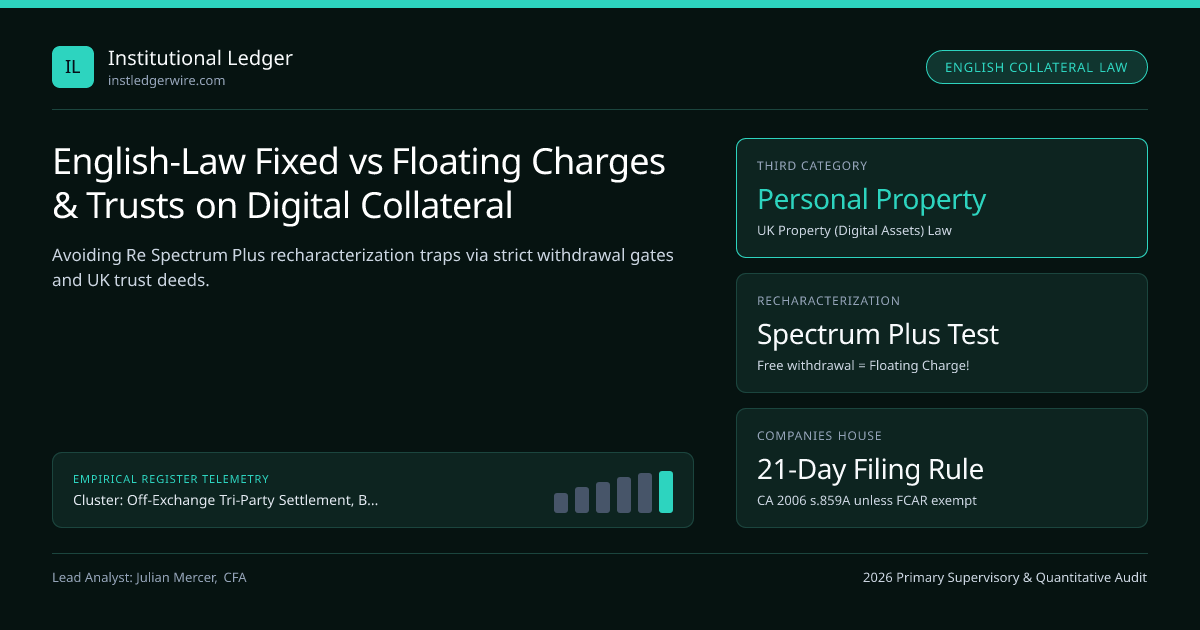
Walk through Mayfair or Canary Wharf and you will find that English law governs more cross-border institutional off-exchange custody deeds—spanning London, Dubai (DIFC DFSA, ADGM FSRA), Singapore (MAS), Hong Kong (SFC), Cayman (CIMA), and Bermuda (BMA)—than any other legal system outside New York. Yet English collateral law harbors a notorious doctrinal trap: *one sloppy API withdrawal permission can recharacterize a senior Fixed Charge into a subordinated Floating Charge under Re Spectrum Plus!*
The UK Third Category of Personal Property & Express Bare Trusts#
For over a century following Colonial Bank v Whinney (1885), English textbooks taught that all personal property had to be either a chose in possession (something physical you can hold, like gold bullion) or a chose in action (a legal right enforceable only by lawsuit, like a bank debt). Native Bitcoin fit neither box cleanly—until the UK Jurisdiction Taskforce, English High Court decisions (AA v Persons Unknown), and the Law Commission of England and Wales's Property (Digital Assets etc) legislation formally established a third category of personal property encompassing cryptographic data objects.
Building on that foundation—and integrated across our off-exchange tri-party collateral cornerstone guide—networks like Copper ClearLoop wrap custodied digital assets inside an English-law Express Bare Trust overseen by an independent Security Trustee:
- Provided the three classic certainties of Knight v Knight (1840) hold—certainty of intention (explicit trust deed), subject matter (identifiable segregated vault balances, affirmed for digital assets in Ruscoe v Cryptopia), and objects (named institutional clients)—beneficial ownership never enters an insolvent custodian's UK administration estate!
Surviving Re Spectrum Plus: Why Cryptographic Locks Create True Fixed Charges#
Suppose a UK trading firm grants Bitstamp, Bitfinex, or BitMEX an English-law "First Fixed Charge" over a £50M collateral vault. Under House of Lords law in **Re Spectrum Plus [2005] UKHL 41** (and recently reaffirmed in digital/equipment security contexts in Re Avanti Communications [2023] EWHC 940 (Ch)), English judges ignore what you call the document on page 1 and ask one brutal factual question: Can the charger withdraw and deal with the charged assets in the ordinary course of business without the active consent of the chargee?
- If the trader's API key can unilaterally pull coins out of the vault whenever its internal margin engine thinks it has excess equity, it is a Floating Charge as a matter of law—subordinating the chargee behind multimillion-pound UK administrator fees and HMRC preferential tax claims!
- Conversely, inside a properly engineered blocked tri-party custody vault, 100% of outbound withdrawals from the charged sub-account are cryptographically disabled unless the Security Trustee or Secured Party actively executes a formal release-and-substitution gate! Even after Re Avanti clarified some nuance around restricted permissions, Magic Circle law firms insist on hard cryptographic gating on principal vaults, while channeling agile intraday cash flows through a separate Variation Margin account.
| English-Law Doctrine | Leading UK Authority | Requirement for Digital Collateral | Drafting / Operational Fix |
|---|---|---|---|
| 3rd Category Property | Law Commission & Property (Digital Assets) Act | Crypto-tokens capable of personal property & trust rights | Express English governing law & situs clause |
| Fixed vs Floating Charge | Re Spectrum Plus [2005] UKHL 41 | Chargee/Trustee MUST exercise real operational blocking control over vault | Hard cryptographic lock on Pledgor withdrawals; substitutions require Trustee value-check |
| Perfection Filing | Companies Act 2006 s.859A | Register charge created by UK company within 21 days (void if missed!) | Always file precautionary Form MR01 even when claiming FCARs exemption! |
Financial Collateral (FCARs) | SI 2003/3226 | Covers "cash" & "financial instruments" (BUIDL); native BTC debated | Pair tokenized RWA / USDC with explicit contractual appropriation valuation |
The 21-Day Companies House Trap (s.859A) & FCARs Precautions#
When taking an English-law charge from a UK-incorporated company (or certain UK LLP structures), Section 859A of the Companies Act 2006 imposes an unforgiving cliff: unless the charge is registered electronically at Companies House (Form MR01) within 21 calendar days of creation, the security interest is completely void against an administrator or liquidator!
While cash and tokenized securities like BlackRock BUIDL can qualify for exemption under the UK Financial Collateral Arrangements (No. 2) Regulations 2003 (FCARs)—which also unlock rapid self-help appropriation without court order—whether native spot Bitcoin/Ether qualifies as "cash" or "financial instruments" under FCARs remains conservatively treated as non-FCARs by Magic Circle opinions. Mandatory institutional rule: ALWAYS file a precautionary £15 electronic Form MR01 within 21 days!
- Variables & £50M UK Hedge Fund / Trading Company Administration Waterfall Audit:
- PledgedVaultValue = £50,000,000; Exchange/Dealer Owed Claim = £35,000,000
- UK Insolvency Administrator Legal/Accounting Fees + HMRC Crown Preferential Tax + Prescribed Part = £24,000,000
- 1. Sloppy "Fixed Charge" Allowing Unfettered Pledgor API Withdrawals (Recharacterized as Floating Charge under Spectrum Plus!):
- Net Available Pool After £24M Admin/HMRC Priority = £50M - £24M = £26,000,000 -> Secured Party suffers -£9,000,000 haircut!
- 2. Blocked Custodial Security-Trustee Vault (True Fixed Charge + Precautionary 21-Day MR01 Filing):
- Paid ahead of Administrator expenses and HMRC -> Secured Party recovers £35,000,000 (100.0%), and £15M surplus returns cleanly!
Commonwealth Reach: ADGM, DIFC, Cayman, BVI & Singapore#
Because courts in ADGM (FSRA, which directly incorporates English common law!), DIFC (DFSA), Singapore (MAS), Cayman Islands (CIMA), and Bermuda (BMA) apply Spectrum Plus fixed/floating-charge tests as persuasive or binding authority, mastering English vault-blocking mechanics protects global offshore fund structures simultaneously.
Magic Circle Legal Opinion Checklist for English-Law Pledges#
General counsels active in our Off-Exchange Tri-Party Collateral hub audit custody APIs alongside segregated pledge-vault rehypothecation audits to verify unilateral client withdrawals from charged vaults are technically blocked, diary 21-day Companies House MR01 filings on Day 1, and verify regulated counterparties via our verification portal.
Frequently asked questions
What is the "Re Spectrum Plus" recharacterization trap in English digital-asset security deeds?
Under House of Lords precedent in National Westminster Bank plc v Spectrum Plus Ltd [2005] UKHL 41 (and Agnew v Commissioner of Inland Revenue), labels do not govern—substance does! If a borrower can freely draw assets out of a charged crypto wallet in the ordinary course of trading without obtaining specific consent or value-checked release from the chargee/security trustee, the court downgrades the Fixed Charge to a Floating Charge.
Why is downgrading from a Fixed Charge to a Floating Charge so dangerous in a UK insolvency?
A valid Fixed Charge gives the secured exchange or dealer #1 priority directly out of the specific vault proceeds. A Floating Charge is subordinated behind UK Insolvency Act 1986 administration expenses (which can run tens of millions of pounds in complex crypto insolvencies!), HMRC secondary preferential tax debts, and the statutory Prescribed Part!
Do UK or overseas companies have to register English-law crypto charges at UK Companies House within 21 days?
Under Section 859A of the UK Companies Act 2006, a UK company granting a charge MUST register it at Companies House within 21 days of creation—otherwise the charge is completely VOID against a liquidator or administrator (unless the arrangement qualifies as an exempt "Security Financial Collateral Arrangement" under the UK Financial Collateral Arrangements (No. 2) Regulations 2003 FCARs)!
How does an English-law Express Bare Trust protect institutional clients inside off-exchange networks like ClearLoop?
Under English trust jurisprudence (affirmed in crypto cases including Ruscoe v Cryptopia and Wang v Darby), holding specific segregated digital assets under an express bare trust with certainty of intention, subject matter, and objects keeps beneficial ownership 100% outside an insolvent custodian’s or trustee’s liquidation estate!
Publication record
- Published
- November 13, 2026
- Updated
- November 14, 2026
- Author
- Julian Mercer, CFA
- Review
- Review not recorded
- Automated fact check
- Passed in the stored pipeline record
- Source URLs
- 3 recorded
AI assistance recorded: anthropic/claude-opus-4.6. This field does not establish human review or source verification.
Academic & Institutional Attribution
Cite This Research & Embed Live Data Card
Standard academic & institutional research paper citation format.
Julian Mercer, CFA. (2026, November 14). English-Law Fixed vs Floating Charges & Trusts on Digital Collateral. Institutional Ledger. https://instledgerwire.com/stories/english-law-fixed-vs-floating-charges-digital-collateralRegulatory Directory Cross-Reference
Referenced Institutions & Regulatory Registries
Mentioned Regulated Institutions
Related Off Exchange Triparty Collateral & Institutional Briefings
Explore Off Exchange Triparty Collateral Hub (20) →Off Exchange Triparty Collateral
Off-Exchange Tri-Party Settlement & Bankruptcy-Remote Crypto Custody GuideOff Exchange Triparty Collateral
Intraday Variation Margin Sweeps Over 24/7 Regulated Stablecoin RailsOff Exchange Triparty Collateral
Venue API Outages, Halted Matching & Collateral Release TriggersOff Exchange Triparty Collateral
Custodial Mirror-Settlement Loops vs Bank Tri-Party Control AgreementsOff Exchange Triparty Collateral
UCC Article 12 Controllable Electronic Records (CER): Crypto Lien PerfectionOff Exchange Triparty Collateral
UCC Article 8 Financial-Asset Election & Securities Intermediary CustodyOff Exchange Triparty Collateral
Post-Trade Net Settlement Windows & Intraday Venue Credit ExposureOff Exchange Triparty Collateral
Counterparty Default Waterfall Isolation for Off-Exchange PledgesStablecoin Reserve Attestation Audit
Basel SCO60 Group 1b Stabilisation Test Failures on StablecoinsStablecoin Reserve Attestation Audit
Treasury-Bill Yield Compression & Stablecoin Issuer Reserve EconomicsInstitutional Crypto Prime Margin
zk-SNARK Merkle-Sum Tree Proof-of-Reserves: Auditing Exchange LiabilitiesInstitutional Crypto Prime Margin
Negative-Balance Non-Existence Proofs & Hidden Collateral Encumbrance Risk
Institutional Ledger Data, Benchmarks & Contributor Records
CC BY 4.0 Open Data
Open Institutional Datasets (CSV / JSON) →
Download desk-compiled quantitative series & schemas.
2026 Reference Matrix
2026 Institutional Benchmarks & Thresholds →
Statutory capital, clearing, margin & rate conventions.
Editorial Records
Authors & Review Records →
View named contributors where those records are available.
Complete Index
Master Research & Dossier Archive →
Browse all published briefings by topic pillar & date.