
Off Exchange Triparty Collateral
Intraday Variation Margin Sweeps Over 24/7 Regulated Stablecoin Rails
Fedwire closes every evening and all weekend while crypto derivatives move +/-15%. Automating intraday Variation Margin sweeps over regulated USDC and custodial book rails eliminates weekend credit buildup.
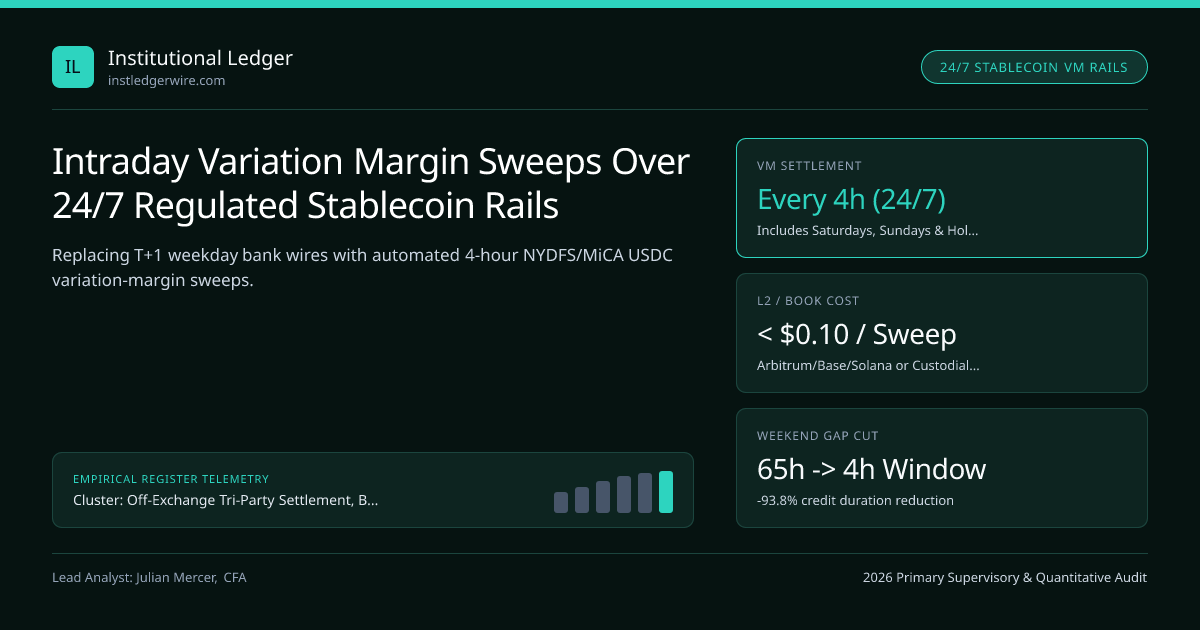
Picture Memorial Day or Labor Day weekend in New York: Fedwire shuts down at 6:30 PM ET on Friday and stays dark for nearly 88 consecutive hours until Tuesday morning—while global Bitcoin and Ethereum markets trade $150 billion of volume across Tokyo, Dubai, London, and perpetual orderbooks! Replacing weekday bank-wire margin calls with automated 24/7 intraday Variation Margin (VM) sweeps over regulated stablecoin and custodial ledger rails closes the single biggest temporal blind spot in institutional risk management.
Settle-to-Market (STM) vs Collateralize-to-Market (CTM) on 24/7 Rails#
In institutional derivatives accounting and Basel III SA-CCR counterparty capital math, how you structure intraday variation-margin sweeps determines whether credit exposure accumulates over weeks or resets to zero every four hours:
- Settle-to-Market (
STM): Used across cleared futures and institutional perpetual mirror loops (off-exchange tri-party collateral cornerstone guide). Every 4-hour or 8-hour USDC sweep legally settles realized gain/loss and resets the derivative's reference entry price to the current mark—compressing residual maturity $M$ in counterparty risk models to hours! - Collateralize-to-Market (
CTM): Used under bilateral ISDA Digital Asset CSAs for multi-month OTC crypto options on desks like Aquanow and B2BX, where automated 24/7 USDC transfers collateralize live delta/vega moves continuously across weekends.
Unattended MPC Policy Signing Guards for 03:00 UTC Sunday Sweeps#
No Chief Operating Officer wants human treasury analysts waking up at 3:00 AM every Sunday to manually approve $4M stablecoin transfers—nor would any CISO grant an exchange API unconstrained hot-key withdrawal access! Institutional MPC custody platforms enforce Four-Factor Automated VM Policy Guards:
- Strict Destination Address Allowlist: The VM sweep wallet can only sign transfers to the counterparty's pre-verified, cryptographically attested settlement vault address.
- Independent Mark-Price Sanity Check: Before signing an outbound -$3.2M VM call, the internal policy engine independently queries composite spot/perp prices (Chainlink / CME CF / Kaiko) to verify the desk's open positions actually lost ~$3.2M—blocking spoofed exchange margin calls!
- Hard Per-Epoch & Rolling 24h Velocity Caps: Caps automated unattended signing (e.g., max $5M per 4h cut, $15M per 24h), paging human risk officers on Slack/PagerDuty above that ceiling.
- Automated
IVMS101Travel Rule Injection: Attaches cryptographic LEI originator/beneficiary compliance payloads under FinCEN, ESMA EU TFR, and MAS rules prior to broadcast.
| Settlement Rail | Operating Hours | Counterparty Reach | Settlement Asset Risk | Ideal Institutional VM Use Case |
|---|---|---|---|---|
| Domestic Fedwire / TARGET2 | Business days until 18:30 ET / 18:00 CET | Universal bank accounts | 0% Sovereign | Weekday CME FCM & traditional bank swaps |
| Intra-Custodian USD/Token Book | 24/7/365 Continuous | Counterparties on same custody hub | Custodial trust/segregation | Bitstamp, Bitfinex, BitMEX mirror loops |
| Regulated USDC (L1 / L2 + CCTP) | 24/7/365 Continuous | Universal — all OTC (Aquanow) & global CLOBs | NYDFS & ESMA MiCA EMT 1:1 reserve | Cross-custodian & weekend bilateral OTC VM |
| Tokenized Bank Deposits (Project Agora) | 24/7/365 Continuous | G-SIB institutional network | Commercial bank / wCBDC | Inter-dealer wholesale OTC & FX swaps |
Stablecoin Depeg Circuit Breakers Under the USDC Benchmark Standard#
Under the USDC MiCA & NYDFS Reserve 2026 Benchmark Standard, USDC reserves sit 100% in short-dated US Treasuries, overnight reverse repo, and cash at systemically important banks. Even so, prudent CSA schedules bake in a automated depeg oracle switch: if USDC deviates outside $0.997–$1.003, VM accounting switches from nominal 1:1 par to live VWAP mark-to-market, and below $0.985 fails over automatically to pledged tokenized T-Bill transfers.
- Variables & 3-Day US Holiday Weekend (90-Hour Fedwire Blackout: Friday 18:30 ET -> Tuesday 08:30 ET) OTC / Perp Volatility Test:
- BookNotional = $150,000,000 BTC/ETH options & forwards; HourlyVol = 1.65%; Z_999 = 3.09
- 1. Legacy Weekday-Only Fedwire Variation Margin (
Gap = 90 Hours): - 99.9% Unsettled Holiday Weekend VM Exposure = $150M * 0.0165 * sqrt(90) * 3.09 = $72,562,000 uncollateralized credit risk!
- 2. Automated 4-Hour Regulated USDC Smart-CSA Sweep (
Gap = 4 Hours): - 99.9% Peak Unsettled VM Exposure = $150M * 0.0165 * sqrt(4) * 3.09 = $15,296,000 (-78.9% volatility gap cut; further capped at $2.5M with dynamic triggers!).
Zero-Reconciliation Deterministic ERP Sub-Ledger Posting#
Unlike traditional bank wires where missing OBI memo text leaves $5M sitting in suspense accounts on Monday morning, every on-chain USDC VM sweep carries an immutable smart-contract event MarginSettled(marginCallId, tradeBookId, netAmount)—reconciling 100% deterministically into treasury ERP sub-ledgers within 15 seconds.
24/7 Variation-Margin Automation Checklist for Treasury Ops#
Treasury operations leads active in our Off-Exchange Tri-Party Collateral hub deploy independent price-sanity policy engines on automated VM wallets, configure Travel Rule VASP API handshakes ahead of holiday weekends, and verify counterparties via our verification portal.
Frequently asked questions
Why do institutional desks settle Variation Margin in USDC instead of burning tokenized T-Bills every 4 hours?
Variation Margin oscillates back and forth every 4 hours (+$1.8M at 04:00 UTC, -$1.2M at 08:00 UTC, +$900k at 12:00 UTC). Settling those high-frequency cash swings in zero-fee USDC over custodial book transfers or L2 rails avoids generating 2,190 taxable security disposals per year while leaving 85% of Initial Margin untouched in T-Bills!
How do automated Sunday-night Variation Margin sweeps comply with FinCEN and EU Travel Rule (TFR) laws?
Every institutional off-exchange and OTC counterparty address is pre-paired via automated Travel Rule protocols (TRISA, Notabene, Sygna) exchanging encrypted originator/beneficiary LEIs (IVMS101 schema) milliseconds before the MPC policy engine signs the outbound USDC variation-margin transaction.
What happens if USDC itself experiences a secondary-market depeg below $0.990 during a Variation Margin sweep?
Institutional ISDA Stablecoin VM Riders include an automatic "Depeg Valuation & Fallback Clause": if USDC trades between $0.985 and $0.997, VM credits at live composite market price rather than $1.00 par; if USDC drops below $0.985, automated stablecoin sweeps pause and fall back to 24/7 intrabank USD networks (BNY/Customers/JPM Kinexys) or pledged T-Bill transfers!
Does paying Variation Margin extinguish debt or merely post collateral?
Depends on contract election ("Settle-to-Market" STM vs "Collateralize-to-Market" CTM): on perpetual exchanges and STM futures, 4-hour/8-hour VM sweeps legally extinguish and reset the contract mark price to current market (STM), lowering Basel SA-CCR Potential Future Exposure; on bilateral OTC options, VM typically operates as CTM collateral until option expiry.
Publication record
- Published
- November 13, 2026
- Updated
- November 15, 2026
- Author
- Julian Mercer, CFA
- Review
- Review not recorded
- Automated fact check
- Passed in the stored pipeline record
- Source URLs
- 3 recorded
AI assistance recorded: anthropic/claude-opus-4.6. This field does not establish human review or source verification.
Academic & Institutional Attribution
Cite This Research & Embed Live Data Card
Standard academic & institutional research paper citation format.
Julian Mercer, CFA. (2026, November 15). Intraday Variation Margin Sweeps Over 24/7 Regulated Stablecoin Rails. Institutional Ledger. https://instledgerwire.com/stories/intraday-variation-margin-sweeps-stablecoin-rail-settlementRegulatory Directory Cross-Reference
Referenced Institutions & Regulatory Registries
Mentioned Regulated Institutions
Referenced Supervisory Authorities
Related Off Exchange Triparty Collateral & Institutional Briefings
Explore Off Exchange Triparty Collateral Hub (20) →Off Exchange Triparty Collateral
Off-Exchange Tri-Party Settlement & Bankruptcy-Remote Crypto Custody GuideOff Exchange Triparty Collateral
Venue API Outages, Halted Matching & Collateral Release TriggersOff Exchange Triparty Collateral
Custodial Mirror-Settlement Loops vs Bank Tri-Party Control AgreementsOff Exchange Triparty Collateral
UCC Article 12 Controllable Electronic Records (CER): Crypto Lien PerfectionOff Exchange Triparty Collateral
UCC Article 8 Financial-Asset Election & Securities Intermediary CustodyOff Exchange Triparty Collateral
Post-Trade Net Settlement Windows & Intraday Venue Credit ExposureOff Exchange Triparty Collateral
Counterparty Default Waterfall Isolation for Off-Exchange PledgesOff Exchange Triparty Collateral
Bankruptcy-Remote SPVs & Statutory Trusts in Exchange InsolvencyStablecoin Reserve Attestation Audit
Treasury-Bill Yield Compression & Stablecoin Issuer Reserve EconomicsInstitutional Crypto Prime Margin
zk-SNARK Merkle-Sum Tree Proof-of-Reserves: Auditing Exchange LiabilitiesInstitutional Crypto Prime Margin
Negative-Balance Non-Existence Proofs & Hidden Collateral Encumbrance RiskInstitutional Crypto Prime Margin
Cross-Exchange Delta-Neutral Cash-and-Carry Basis Margining Mechanics
Institutional Ledger Data, Benchmarks & Contributor Records
CC BY 4.0 Open Data
Open Institutional Datasets (CSV / JSON) →
Download desk-compiled quantitative series & schemas.
2026 Reference Matrix
2026 Institutional Benchmarks & Thresholds →
Statutory capital, clearing, margin & rate conventions.
Editorial Records
Authors & Review Records →
View named contributors where those records are available.
Complete Index
Master Research & Dossier Archive →
Browse all published briefings by topic pillar & date.