
Tokenized Treasuries Rwa Settlement
SEC Rule 17Ad Transfer-Agent Recordkeeping for Tokenized Funds
SEC-registered Transfer Agents under Exchange Act Section 17A and Rule 17Ad reconcile off-chain Master Securityholder Files against public blockchain ledgers to preserve legal share title.
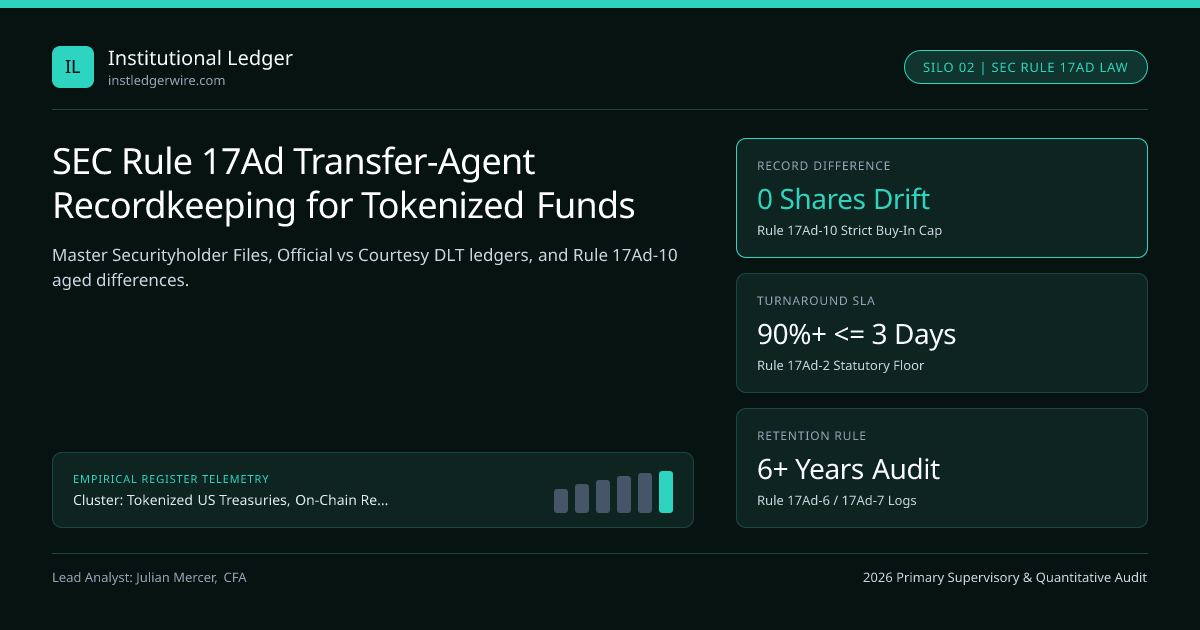
Every share of BlackRock BUIDL and Franklin OnChain US Government Money Fund (BENJI) is legally a US security governed by Section 17A of the Securities Exchange Act of 1934. Behind the scenes of sub-second blockchain transfers stands an SEC-registered Transfer Agent operating under 17 CFR Rules 17Ad-1 through 17Ad-20—reconciling on-chain ERC-20 / ERC-3643 state against statutory Master Securityholder Files with zero tolerance for aged record differences.
Courtesy Mirror Ledgers vs Synchronized On-Chain Primary Books#
When an institution holds a tokenized money-market share inside its custody wallet, a foundational legal question arises: if a blockchain suffers a contentious hard fork or an RPC bug, which ledger determines legal shareholder title? As outlined in our tokenized US Treasuries and RWA settlement cornerstone guide, US tokenized funds navigated SEC Division of Investment Management review via two evolutionary architectures:
- The Courtesy / Shadow Ledger Model (1940 Act Pioneer): Pioneered by Franklin Templeton's BENJI (
FOBXX), the SEC Form N-1A prospectus specifies that the Transfer Agent maintains the official record of share ownership in book-entry form off-chain while recording secondary mirror balances on Stellar and EVM chains. If an anomalous blockchain fork occurs, the Transfer Agent's Master Securityholder File governs unambiguously. - The Synchronized Whitelist-Constrained Model (Reg D 3c7): Deployed by Securitize Markets (an SEC-registered Transfer Agent and FINRA Broker-Dealer) for BlackRock BUIDL, ERC-3643 smart-contract compliance hooks prohibit any transfer on-chain unless the recipient's wallet is already mapped to a KYC-verified
ONCHAINIDinside the Transfer Agent's Master File—keeping on-chain state and 17Ad books continuously isomorphic.
Rule 17Ad-10 Aged Record Differences & 30-Day Mandatory Buy-In Liability#
Among all Exchange Act transfer-agent rules, Rule 17Ad-10 carries the sharpest financial teeth. The Transfer Agent must maintain an accurate Control Book (total shares authorized and issued by the fund) balanced continuously against the Master Securityholder File (sum of individual investor balances). Any discrepancy between the two constitutes a record difference; if unresolved beyond 30 calendar days, it becomes an aged record difference triggering mandatory reporting to the issuer and the SEC.
Even worse, under Rule 17Ad-10(g), if a Transfer Agent causes an actual overissuance—for example, if a poorly secured minting script double-processes a $25 million subscription webhook—the Transfer Agent must buy in shares equal to the overissuance in the open market using its own corporate capital within 30 days. To eliminate MINTER_ROLE key compromise under Rule 17Ad-12 (safeguarding of funds and securities, equivalent to physical vaulting of blank stock certificates), digital Transfer Agents house mint/burn keys inside air-gapped HSM or enclave MPC quorums and wait for 2 finalized Ethereum epochs before crediting Master File records.
| SEC Rule 17Ad Clause | Traditional Paper / DTCC Requirement | Tokenized RWA Fund Implementation | Failure Consequence |
|---|---|---|---|
| Rule 17Ad-2 (Turnaround) | >=90% of routine items processed within 3 business days | Atomic sub-15-second on-chain P2P transfer via ERC-3643 | Mandatory written notice to SEC & Chairman |
| Rule 17Ad-10 (Prompt Posting & Buy-In) | Post to Master Securityholder File within 5 days; 0 overissuance | Finalized block event indexer reconciles totalSupply every block | Mandatory TA corporate buy-in within 30 days |
| Rule 17Ad-12 (Safeguarding) | Physical vaulting of unissued stock certificates | FIPS 140-3 HSM / MPC quorum over MINTER_ROLE | SEC enforcement + SAB 122 loss accrual |
| Rule 17Ad-13 (Annual Study) | Independent CPA report on internal accounting control | Combined Rule 17Ad-13 + SOC 1 Type II smart-contract/indexer audit | 90-day statutory window to cure material inadequacy |
| Rule 17Ad-17 (Lost Holders) | Two database searches for undeliverable dividend checks | Inactive wallet monitoring + administrative recoveryAddress | State escheatment penalties (Franklin BENJI / BUIDL) |
Hard-Fork Governance, Rule 17Ad-13 CPA Audits & State Escheatment#
Every tokenization prospectus must also codify Chain Fork Governance: the Transfer Agent and Fund Board reserve sole contractual authority to designate which branch of a forked Layer-1 or Layer-2 network represents the canonical security token—rendering duplicate tokens on unsupported forks legally worthless zero-claim artifacts.
Annually, Rule 17Ad-13 requires an independent accountant to file an examination report with the SEC evaluating the Transfer Agent's internal accounting controls, verifying zero material inadequacies across smart-contract event indexers, daily dividend-reinvestment sweeps, and Rule 17Ad-17 lost-securityholder remediation via administrative forced-transfer and wallet recovery.
- Variables & Registered Digital Transfer Agent Risk & Efficiency Model ($3.0B Tokenized Treasury Fund):
- MaxMintPer_Epoch = $50,000,000 per single subscription batch
- 1. Unfinalized 1-Block Indexing (Vulnerable to L1 Reorg / RPC Spoof, P_fault = 0.0008):
- Expected Rule 17Ad-10(g) 30-Day Buy-In Exposure = $50,000,000 * 0.0008 = $40,000/batch risk!
- 2. Two-Epoch Finalized Indexing (64 Ethereum Slots = ~12.8 min finality, P_fault -> 0.000000):
- Expected Rule 17Ad-10(g) Overissuance Exposure = $0.00 (economic finality requires >$30B ETH slash to revert)
- 3. Back-Office Cost Compression (2,500 Institutional Accounts, 45,000 Intraday Collateral Transfers/yr):
- Legacy Manual Non-DTCC Private Fund TA Processing @ $38/transfer = $1,710,000/yr
- Automated ERC-3643 + Rule 17Ad Event-Indexed Sub-Ledger @ $2.10/transfer = $94,500/yr (-94.5% TA ops cost)
Comparing US SEC Rule 17Ad with European eWpG Crypto Registrars#
Whereas US issuers adapt 1970s paper-crisis Section 17A rules to smart contracts, civil-law jurisdictions in Europe enacted bespoke statutes: under Germany's Electronic Securities Act (eWpG) supervised by BaFin and the EU DLT Pilot Regime overseen by ESMA, a licensed Crypto-Securities Registrar operates the distributed ledger directly as the sole statutory securities register, eliminating off-chain shadow mirroring entirely while connecting into institutional venues like Bitstamp and Aquanow.
Transfer-Agent Due Diligence Checklist for RWA Allocators#
Institutional investors subscribing to tokenized Treasury funds inside our Tokenized Treasuries & RWA Settlement hub inspect the Transfer Agent's SEC EDGAR Form TA-1/TA-2 filings, request the annual Rule 17Ad-13 CPA control report, confirm canonical fork-designation clauses in the Private Placement Memorandum, and verify counterparty status on our verification portal.
Frequently asked questions
In a tokenized US mutual fund like Franklin BENJI, does the blockchain or the Transfer Agent database govern legal title?
Under early SEC Form N-1A registration statements for blockchain-enabled 1940 Act funds, the Transfer Agent maintains an off-chain proprietary database alongside the public blockchain (e.g., Stellar or Ethereum) and designates the off-chain Master Securityholder File as controlling in the event of a fork, 51% attack, or smart-contract bug, while evolving toward integrated on-chain books.
What is a "record difference" under SEC Rule 17Ad-10 and how could a blockchain reorg trigger one?
Under 17 CFR 240.17Ad-10, a record difference occurs whenever the total shares recorded in the Master Securityholder File do not equal the authorized shares in the Control Book. If a transfer agent credits shares on 1 block confirmation and a chain reorganization drops that mint, or if an unindexed transfer occurs, an immediate record difference arises.
What financial penalty hits a Transfer Agent if a smart-contract bug causes an unauthorized token overissuance?
Under SEC Rule 17Ad-10(g), any registered transfer agent that erroneously causes an actual physical or digital overissuance and fails to resolve it must buy in shares equal to the overissuance at its own corporate expense within 30 calendar days of discovery.
Why must tokenized funds support state escheatment and lost-wallet replacement under Rule 17Ad-17?
Unlike bearer cryptocurrencies where lost keys mean permanently burned coins, registered securities are governed by SEC Rule 17Ad-17 (lost securityholders) and US state unclaimed property laws. Transfer Agents must identify inactive accounts and maintain administrative burn-and-reissue capability to replace lost client keys or remit abandoned shares.
Publication record
- Published
- November 14, 2026
- Updated
- November 15, 2026
- Author
- Julian Mercer, CFA
- Review
- Review not recorded
- Automated fact check
- Passed in the stored pipeline record
- Source URLs
- 3 recorded
AI assistance recorded: anthropic/claude-opus-4.6. This field does not establish human review or source verification.
Academic & Institutional Attribution
Cite This Research & Embed Live Data Card
Standard academic & institutional research paper citation format.
Julian Mercer, CFA. (2026, November 15). SEC Rule 17Ad Transfer-Agent Recordkeeping for Tokenized Funds. Institutional Ledger. https://instledgerwire.com/stories/sec-rule-17ad-transfer-agent-recordkeeping-tokenized-fundsRegulatory Directory Cross-Reference
Referenced Institutions & Regulatory Registries
Mentioned Regulated Institutions
Related Tokenized Treasuries Rwa Settlement & Institutional Briefings
Explore Tokenized Treasuries Rwa Settlement Hub (20) →Tokenized Treasuries Rwa Settlement
Tokenized US Treasuries, On-Chain Repo DvP & RWA Settlement: 2026 GuideTokenized Treasuries Rwa Settlement
Atomic T+0 DvP Intraday Repo vs DTCC & Fedwire Cutoff WindowsTokenized Treasuries Rwa Settlement
BlackRock BUIDL (Reg D 3c7) vs Franklin BENJI (1940 Act MMF) ComparedTokenized Treasuries Rwa Settlement
Tokenized MMF Collateral Haircuts & CFTC GMAC Derivatives Margin RulesTokenized Treasuries Rwa Settlement
Chainlink & DTCC Smart NAV Oracle Attestation Latency ControlsTokenized Treasuries Rwa Settlement
Canton Network & Broadridge DLR Intraday Tokenized Repo ClearingTokenized Treasuries Rwa Settlement
Ondo OUSG & USDY Bankruptcy-Remote SPV Note Structuring AuditTokenized Treasuries Rwa Settlement
BIS Project Agora: Tokenized Commercial Bank Deposits & Wholesale CBDCOff Exchange Triparty Collateral
UCC Article 8 Financial-Asset Election & Securities Intermediary CustodyOff Exchange Triparty Collateral
Post-Trade Net Settlement Windows & Intraday Venue Credit ExposureOff Exchange Triparty Collateral
Counterparty Default Waterfall Isolation for Off-Exchange PledgesOff Exchange Triparty Collateral
Bankruptcy-Remote SPVs & Statutory Trusts in Exchange Insolvency
Institutional Ledger Data, Benchmarks & Contributor Records
CC BY 4.0 Open Data
Open Institutional Datasets (CSV / JSON) →
Download desk-compiled quantitative series & schemas.
2026 Reference Matrix
2026 Institutional Benchmarks & Thresholds →
Statutory capital, clearing, margin & rate conventions.
Editorial Records
Authors & Review Records →
View named contributors where those records are available.
Complete Index
Master Research & Dossier Archive →
Browse all published briefings by topic pillar & date.