
Tokenized Treasuries Rwa Settlement
Atomic T+0 DvP Intraday Repo vs DTCC & Fedwire Cutoff Windows
Atomic T+0 on-chain repo executes simultaneous collateral-versus-cash swaps 24/7/365, eliminating Fedwire Securities 15:15 ET cutoffs, daylight overdraft charges, and weekend HQLA traps.
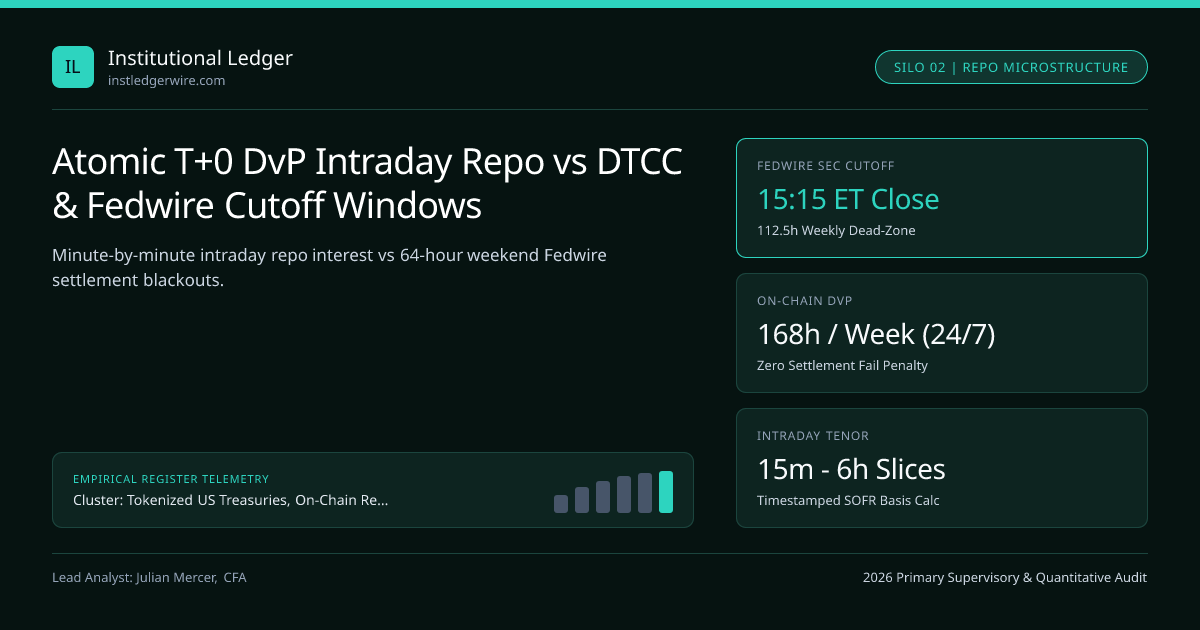
Every Friday at 3:15 PM Eastern Time, Fedwire Securities Service closes third-party collateral transfers against payment—freezing trillions of dollars of US Treasury High-Quality Liquid Assets (HQLA) in static custodial silos for the next 65 hours while global crypto, FX, and Asian liquidity venues continue moving. By executing CPMI Model 1 atomic Delivery-versus-Payment (DvP) on synchronized distributed ledgers such as Canton Network, institutional treasury desks unlock minute-by-minute intraday repo and compress precautionary liquidity funding costs by up to 80%.
The 112-Hour Weekly Dead-Zone in Legacy Fedwire & Tri-Party Repo#
Even in the world's deepest sovereign debt market, post-trade settlement remains tethered to batch mainframes designed decades ago. On business days, Fedwire Securities opens at 8:30 AM ET and cuts off third-party transfers against payment at 3:15 PM ET (15:15 ET)—giving treasury desks just 6.75 hours per weekday (33.75 hours out of a 168-hour week, or 20% uptime) to settle bilateral CUSIP deliveries directly over Fedwire. While BNY Mellon tri-party repo and DTCC FICC GSD extend internal netting windows slightly later, neither rail operates overnight across Asian/European morning spikes or across Saturdays, Sundays, and US federal holidays.
Consequently, global banks hold massive precautionary cash buffers (nostro and Federal Reserve master-account reserves) solely to survive intraday timing mismatches between incoming and outgoing wires. Within our tokenized US Treasuries and RWA settlement cornerstone guide, atomic smart-contract DvP directly attacks this temporal mismatch.
Atomic Model 1 DvP & Second-Level Intraday Repo Interest Math#
In an on-chain repo smart contract, collateral delivery and cash payment execute inside a single indivisible state transition:
- At
t_0 = 09:00:12 UTC, the smart contract transfers USD 510,000,000 of tokenized Treasury bills (reflecting a 2% haircut) into an immutable repo-escrow vault if and only if USD 500,000,000 of tokenized bank deposits or regulated USDC transfers simultaneously to the borrower. If either wallet lacks balance or fails ERC-3643 KYC registry checks, the entire transaction reverts—reducing Herstatt principal risk and Treasury Market Practices Group (TMPG) 300-bps settlement-fail penalties to exactly zero. - At
t_1 = 13:30:12 UTC(4.5 hours later), once the bank's European/US settlement peak subsides, the unwind leg repays principal plus exact timestamped interest(t_1 - t_0) / 86,400, avoiding 19.5 hours of unnecessary overnight interest expense.
| Repo Settlement Rail | Operating Hours | DvP Model & Finality | Minimum Tenor | Primary Cash Leg |
|---|---|---|---|---|
| Fedwire Securities + Tri-Party | Mon-Fri 08:30 - 15:15 ET (3:15 PM cutoff) | Gross / Bank Tri-Party End-of-Day unwind | 24h Overnight (1 day min) | Federal Reserve Master Account / Bank Book |
| DTCC FICC Sponsored Repo | US Business Hours (GSD Netting Windows) | CPMI Model 3 Multilateral Netting | Overnight / Term | Fedwire / Clearing Bank Net Wire |
| Canton Network / Broadridge DLR | 24/7 Institutional Windows | Atomic Synchronized Smart-Contract DvP | By-the-Minute Intraday | Tokenized Bank Deposit / Sponsored Cash |
| Public EVM Permissioned Repo | 24/7/365 Continuous (168h/wk) | Atomic EVM swap Model 1 DvP | 1 Block (12 Seconds) | Regulated USDC (Aquanow / Prime) |
| BIS Project Agora | 24/7 Multi-Currency Corridors | Unified Ledger Atomic PvP / DvP | Sub-5-Second Intraday | 7-Central-Bank Wholesale CBDC |
Weekend Crypto Margin Rescues & SEC Treasury Clearing Mandate Alignment#
For multi-strategy hedge funds trading 24/7 perpetuals and spot books across Bitstamp, Bitfinex, and Aquanow, weekend Fedwire blackouts previously created existential liquidation danger: a 15% Sunday-night Bitcoin rally could trigger short-leg variation margin calls while the fund's T-Bill reserves sat untouchable at a traditional prime broker until Monday morning. Holding BlackRock BUIDL or Franklin BENJI paired with on-chain repo or instant USDC redemption vaults allows instant Sunday collateral conversion.
Simultaneously, for regulated US dealers preparing for the SEC Mandatory Treasury Central Clearing Rule through DTCC's Fixed Income Clearing Corporation (FICC), platforms under the DTCC Smart NAV Framework and Canton Broadridge DLR map sponsored repo novation directly onto synchronized DLT sub-ledgers.
- Variables & G-SIB Liquidity Buffer Optimization ($2.0B Daily Peak Intraday Clearing Liquidity Needed for 4.5 Hours):
- N_days = 252 trading days/yr; Notional = $2,000,000,000
- rSOFRON = 0.0455 (4.55% overnight repo rate; legacy rails force 24-hour borrowing = 1/360 yr per day)
- rSOFRIntra = 0.0465 (4.65% intraday tokenized repo rate — +10 bps premium for intraday flexibility, paid ONLY for 4.5 hours)
- FailPenaltySaved = $420,000/yr avoided TMPG 300-bps Treasury fail charges from operational cutoff misses
- Worked Annual Treasury Desk P&L Impact:
- 1. Legacy 24-Hour Overnight Repo Cost = 252 * $2,000M * (0.0455 / 360) = $63,700,000/yr
- 2. Atomic 4.5-Hour Intraday Tokenized Repo Cost = 252 * $2,000M * (0.0465 * (4.5 / 8,640)) = $12,206,250/yr
- 3. Total Annual Funding + Fail Savings = ($63,700,000 - $12,206,250) + $420,000 = $51,913,750/yr freed net interest margin!
Harmonizing Sovereign Cash Legs via BIS Project Agora#
True G-SIB scale requires central-bank money finality on the cash leg so banks avoid stablecoin credit risk weights under BaFin, MAS, and US rules. That exact capability is advancing through BIS Project Agora wholesale CBDC and tokenized commercial deposits, unifying sovereign reserves and tokenized Treasury DvP on one programmable rail.
Operational Repo Execution Checklist for Institutional Desks#
Fixed-income and digital-asset funding teams active in our Tokenized Treasuries & RWA Settlement hub execute SIFMA/ICMA Global Master Repurchase Agreement (GMRA) Digital Asset Annexes specifying smart-contract finality timestamps, verify oracle price feeds, and audit venue registrations through our verification portal.
Frequently asked questions
What exact operating hours restrict traditional US Treasury repo settlement on Fedwire and FICC?
While Fedwire Funds runs until 18:30 ET (and 19:00 ET settlement), Fedwire Securities Service cuts off third-party repo collateral transfers against payment at 15:15 ET Monday through Friday. Between Friday 15:15 ET and Monday 08:30 ET—a 65.25-hour window—primary dealers cannot mobilize unencumbered CUSIPs into cash via legacy rails.
How does BIS CPMI DvP Model 1 on a blockchain differ from DTCC FICC DvP Model 2 or Model 3?
DTCC FICC Government Securities Division uses multilateral net settlement (DvP Model 3), batching gross trades to shrink liquidity needs during US business hours. On-chain atomic DvP implements gross simultaneous settlement (DvP Model 1) 24/7—and when combined with flash-netting or Canton multi-party synchronization, achieves atomic multilateral netting without CCP batch delays.
How is repo interest calculated on a four-hour intraday tokenized Treasury transaction?
Traditional overnight repo charges Notional * SOFR * (1 / 360) regardless of whether cash is returned in 3 hours or 23 hours. On-chain repo smart contracts read exact block timestamps (t_close - t_open) / 86,400, accruing Notional * r_intraday * (Delta_seconds / 31,104,000) to the exact second.
What cash leg instruments settle institutional on-chain Treasury repo today?
Depending on venue and counterparty charter, cash legs settle via tokenized commercial bank deposits (JPM Coin / Kinexys, Citi Token Services), wholesale CBDC pilots (BIS Project Agora, SNB Helvetia, Eurosystem Trigger), or regulated NYDFS/MiCA fiat-backed USDC for non-bank hedge funds.
Publication record
- Published
- November 14, 2026
- Updated
- November 14, 2026
- Author
- Julian Mercer, CFA
- Review
- Review not recorded
- Automated fact check
- Passed in the stored pipeline record
- Source URLs
- 3 recorded
AI assistance recorded: anthropic/claude-opus-4.6. This field does not establish human review or source verification.
Academic & Institutional Attribution
Cite This Research & Embed Live Data Card
Standard academic & institutional research paper citation format.
Julian Mercer, CFA. (2026, November 14). Atomic T+0 DvP Intraday Repo vs DTCC & Fedwire Cutoff Windows. Institutional Ledger. https://instledgerwire.com/stories/atomic-t0-dvp-intraday-repo-vs-dtcc-fedwire-cutoff-windowsRegulatory Directory Cross-Reference
Referenced Institutions & Regulatory Registries
Mentioned Regulated Institutions
Related Tokenized Treasuries Rwa Settlement & Institutional Briefings
Explore Tokenized Treasuries Rwa Settlement Hub (20) →Tokenized Treasuries Rwa Settlement
Tokenized US Treasuries, On-Chain Repo DvP & RWA Settlement: 2026 GuideTokenized Treasuries Rwa Settlement
BlackRock BUIDL (Reg D 3c7) vs Franklin BENJI (1940 Act MMF) ComparedTokenized Treasuries Rwa Settlement
Tokenized MMF Collateral Haircuts & CFTC GMAC Derivatives Margin RulesTokenized Treasuries Rwa Settlement
Chainlink & DTCC Smart NAV Oracle Attestation Latency ControlsTokenized Treasuries Rwa Settlement
Canton Network & Broadridge DLR Intraday Tokenized Repo ClearingTokenized Treasuries Rwa Settlement
Ondo OUSG & USDY Bankruptcy-Remote SPV Note Structuring AuditTokenized Treasuries Rwa Settlement
BIS Project Agora: Tokenized Commercial Bank Deposits & Wholesale CBDCTokenized Treasuries Rwa Settlement
Eurosystem DLT Trials: Bundesbank Trigger, Pontes & Appia Central Bank DvPOff Exchange Triparty Collateral
Post-Trade Net Settlement Windows & Intraday Venue Credit ExposureOff Exchange Triparty Collateral
Counterparty Default Waterfall Isolation for Off-Exchange PledgesOff Exchange Triparty Collateral
Bankruptcy-Remote SPVs & Statutory Trusts in Exchange InsolvencyOff Exchange Triparty Collateral
Account Control Agreements (ACA) for Bilateral Crypto Derivatives
Institutional Ledger Data, Benchmarks & Contributor Records
CC BY 4.0 Open Data
Open Institutional Datasets (CSV / JSON) →
Download desk-compiled quantitative series & schemas.
2026 Reference Matrix
2026 Institutional Benchmarks & Thresholds →
Statutory capital, clearing, margin & rate conventions.
Editorial Records
Authors & Review Records →
View named contributors where those records are available.
Complete Index
Master Research & Dossier Archive →
Browse all published briefings by topic pillar & date.