
Tokenized Treasuries Rwa Settlement
Tokenized US Treasuries, On-Chain Repo DvP & RWA Settlement: 2026 Guide
Tokenized US Treasury funds and on-chain repo ledgers now settle $1.5T+ in monthly intraday Delivery-versus-Payment volume under ERC-3643 identity registries, SEC Rule 17Ad, and CFTC GMAC haircuts.
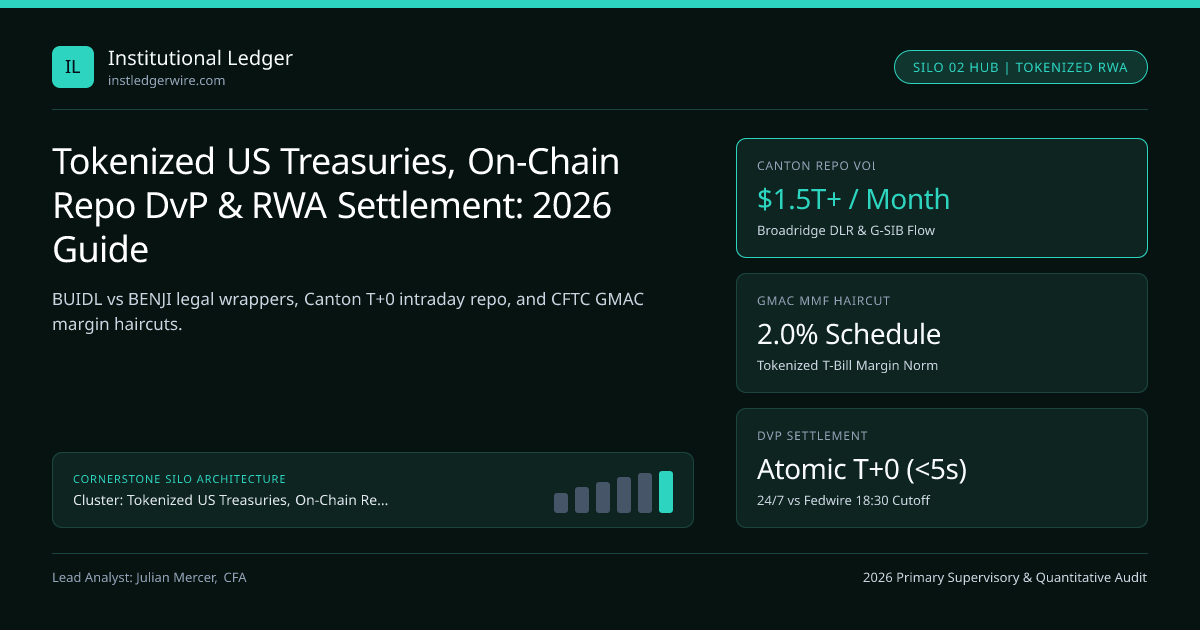
Tokenized US Treasury money-market funds and synchronized distributed-ledger repo platforms have crossed from experimental pilots into core fixed-income plumbing, anchoring over $8 billion in public-chain RWA liquidity alongside $1.5 trillion+ in monthly intraday repo volume on Canton Network. Navigating our Tokenized US Treasuries & RWA Settlement hub requires mastering five institutional pillars: smart-contract compliance under ERC-3643, SEC Rule 17Ad transfer-agent books, legal fund wrappers separating BlackRock BUIDL from Franklin BENJI, CFTC GMAC collateral haircuts, and wholesale central-bank DvP rails.
Permissioned Compliance on Public Chains: ERC-3643 & SEC Rule 17Ad#
Regulated asset managers cannot issue bearer security tokens that flow freely into unscreened pseudonymous wallets. Instead, public-blockchain RWA deployments embed regulatory perimeter checks directly inside token bytecode. As dissected in our technical audit of ERC-3643 (T-REX) on-chain identity registries and KYC whitelisting, every token transfer executes an atomic lookup against verifiable claims signed by trusted issuers, verifying Accredited Investor or Qualified Purchaser status, OFAC clean-list checks, and country-cap compliance before modifying balances.
Simultaneously, US securities law governs who holds the authoritative shareholder register. In SEC Rule 17Ad transfer-agent recordkeeping for tokenized funds, registered transfer agents (such as Securitize Markets or Franklin Templeton Investor Services) reconcile on-chain balances with statutory master securityholder files, ensuring court-ordered recovery and estate transfers work seamlessly via forced-transfer, freeze, and recovery functions.
Legal Wrapper Architecture: 3(c)(7) Private Funds vs 1940 Act MMFs vs SPV Notes#
Institutional treasurers select among three legal wrappers depending on investor eligibility, peer-to-peer transferability, and accounting classification:
- Section 3(c)(7) / Regulation D 506(c): Exemplified by BlackRock BUIDL versus Franklin BENJI, BUIDL restricts shares to Qualified Purchasers ($5M+ investable assets) to remain exempt from 1940 Act registration while enabling whitelisted institutional peer-to-peer collateral transfers and instant 24/7 USDC redemption liquidity buffers.
- 1940 Act Registered Rule 2a-7 Funds: Franklin OnChain US Government Money Fund (
BENJI / FOBXX) files monthly Form N-MFP3 portfolio disclosures with the SEC, enforcing strict <=60-day weighted average maturity (WAM) and daily/weekly liquid-asset floors. - Bankruptcy-Remote SPV Notes: Analyzed in Ondo OUSG and USDY bankruptcy-remote SPV structuring, independent Delaware trusts supervised by third-party collateral trustees wrap underlying T-Bills and BUIDL shares into accumulating or rebasing tokens—a structural choice we model in rebasing versus accumulating RWA share classes.
| Tokenized RWA Benchmark | Statutory Wrapper | Custody & Transfer Agent | Settlement Rail | Primary Institutional Utility |
|---|---|---|---|---|
| BlackRock BUIDL | SEC Reg D 506(c) & ICA Sec. 3(c)(7) | BNY Mellon + Securitize Markets (SEC TA) | Ethereum, Arbitrum, Aptos, Polygon, Solana | Prime derivatives collateral & corporate cash sweep |
| Franklin OnChain BENJI | 1940 Act Registered Rule 2a-7 MMF | State Street / Bank Custody + Franklin TA | Stellar, Ethereum, Base, Arbitrum, Avalanche | Regulated 40-Act treasury yield & peer-to-peer transfer |
| Ondo OUSG & USDY | Reg D 506(c) LP / Reg S Bankruptcy-Remote SPV | Ankura Trust oversight + BUIDL/T-Bill backing | Ethereum, Solana, Mantle, Sui | Instant 24/7 mint/redeem against USDC |
| Canton Network Repo | Bilateral / Sponsored Master Repo (GMRA/MRA) | G-SIB Custodians & Broadridge DLR | Canton Privacy-Enabled Synchronized DLT | Intraday T+0 Treasury repo & weekend HQLA mobility |
| Eurosystem DLT Trials | German eWpG / EU DLT Pilot (ESMA / BaFin) | Bundesbank Trigger / Banque de France wCBDC | Permissioned & Trigger-linked DLT | Central-bank money atomic DvP sovereign issuance |
Atomic T+0 Intraday Repo vs Fedwire & DTCC Settlement Cutoffs#
Traditional US Treasury repo markets go dark when Fedwire Securities Service closes around 3:15 PM ET and Fedwire Funds closes at 6:30 PM ET (and for 64 consecutive hours every weekend). In atomic T+0 DvP intraday repo versus DTCC and Fedwire cutoff windows and Canton Network and Broadridge DLR intraday repo clearing, G-SIB treasury desks borrow cash against tokenized HQLA for exact four-hour intraday liquidity windows—paying repo interest calibrated to the minute and releasing balance-sheet leverage before regional regulatory reporting snapshots.
Global central banks are building direct sovereign cash legs for these exact DvP loops: we benchmark BIS Project Agora tokenized commercial deposits and wCBDC, the ECB's Eurosystem Trigger, Pontes, and Appia wholesale DLT trials, Singapore's MAS Project Guardian and GL1 cross-border bond repo, and Project mBridge multi-CBDC PvP corridors.
- Variables & $250M Delta-Neutral Derivatives & Prime Treasury Desk Allocation:
- Collateral_Posted = $250,000,000 posted as initial margin across institutional derivatives & OTC venues
- Yield_TBill = 0.0445 (4.45% gross portfolio yield on <93-day US Treasury Bills & Fed Overnight RRP)
- Expense_RWA = 0.0020 (20.0 bps management + SEC Transfer Agent + custody fee on BUIDL/BENJI class)
- Haircut_Drag = 0.020 * 0.0085 = 0.00017 (1.7 bps financing cost of 2.0% CFTC GMAC collateral haircut buffer)
- YieldIdleStablecoin = 0.0000 (0.00% pass-through yield under EU MiCA Art. 50 & US payment stablecoin interest bans)
- Annual_Slippage = $0.00 on par $1.00 USDC smart-contract liquidity buffer redemptions
- Worked Institutional Treasury Carry Improvement:
- 1. Net Annualized RWA Margin Yield = 4.45% - 0.20% - 0.017% = 4.233% (423.3 bps)
- 2. Incremental Annual Pre-Tax Income vs Idle Stablecoin Margin = $250,000,000 * 0.04233 = +$10,582,500/yr
- 3. Capital Velocity Bonus: Atomic T+0 weekend repo eliminates 64-hour Friday-to-Monday Fedwire settlement dead-zones.
Derivatives Margin Haircuts, Smart NAV Oracles & G-SIB Capital Treatment#
Posting tokenized Treasuries as margin across CME FCMs or institutional crypto venues (Bitstamp, Aquanow, Bitfinex) unlocks over 400 bps of collateral carry previously stranded in zero-yield stablecoins. Our empirical review of tokenized MMF collateral haircuts under CFTC GMAC guidelines pairs directly with Chainlink and DTCC Smart NAV oracle attestation latency controls and cross-chain CCIP burn-and-mint RWA interoperability. For bank balance sheets supervised by BaFin, MAS, and US agencies, we evaluate G-SIB SLR, LCR, and Level 1 HQLA eligibility for tokenized sovereign debt.
Primary Wire Sweeps vs Secondary OTC Liquidity Execution#
Before deploying corporate cash into on-chain Treasuries, execution teams audit both primary subscription wire cutoffs and T+0 stablecoin sweeps and secondary OTC RFQ liquidity discounts during stressed redemptions, verifying fund entity disclosures across our institutional benchmarks and compliance verification registry.
Frequently asked questions
Why do institutional desks hold tokenized US Treasuries instead of zero-yield fiat stablecoins?
Holding $500 million in non-interest-bearing stablecoins forfeits roughly $20M to $24M in annual risk-free Treasury carry when front-end bills yield 4.0% to 4.8%. Tokenized US Treasury MMFs preserve 24/7 on-chain collateral mobility and instant USDC liquidity pools while accruing daily sovereign yield.
What is the legal difference between BlackRock BUIDL and Franklin Templeton BENJI?
BlackRock BUIDL operates under Investment Company Act Section 3(c)(7) and Regulation D Rule 506(c), restricting ownership to Qualified Purchasers ($5M+ investments) with a $5M minimum subscription. Franklin BENJI (FOBXX) is a SEC-registered 1940 Act Rule 2a-7 government money market fund accessible to broader institutional and retail tiers.
How does ERC-3643 prevent sanctioned or non-KYC wallets from receiving tokenized securities on public chains?
Every transfer and transferFrom call inside an ERC-3643 token contract queries an on-chain Identity Registry (ONCHAINID) before updating balances. Unless both sender and receiver hold valid cryptographic claims signed by the fund's registered Transfer Agent, the EVM reverts the transaction atomically.
Can tokenized Treasury shares satisfy variation or initial margin on regulated derivatives venues?
Yes. Under CFTC GMAC Digital Asset Markets Subcommittee recommendations, registered Futures Commission Merchants (FCMs) and Derivatives Clearing Organizations (DCOs) can accept qualifying tokenized government MMFs as non-cash margin using existing CFTC Regulation 1.25 / 39.13 sovereign haircut schedules (~2%).
Publication record
- Published
- November 14, 2026
- Updated
- November 14, 2026
- Author
- Julian Mercer, CFA
- Review
- Review not recorded
- Automated fact check
- Passed in the stored pipeline record
- Source URLs
- 4 recorded
AI assistance recorded: anthropic/claude-opus-4.6. This field does not establish human review or source verification.
Academic & Institutional Attribution
Cite This Research & Embed Live Data Card
Standard academic & institutional research paper citation format.
Julian Mercer, CFA. (2026, November 14). Tokenized US Treasuries, On-Chain Repo DvP & RWA Settlement: 2026 Guide. Institutional Ledger. https://instledgerwire.com/stories/tokenized-us-treasuries-on-chain-repo-dvp-rwa-guide-2026Regulatory Directory Cross-Reference
Referenced Institutions & Regulatory Registries
Mentioned Regulated Institutions
Related Tokenized Treasuries Rwa Settlement & Institutional Briefings
Explore Tokenized Treasuries Rwa Settlement Hub (20) →Tokenized Treasuries Rwa Settlement
ERC-3643 (T-REX) Identity Registries & On-Chain RWA WhitelistingTokenized Treasuries Rwa Settlement
SEC Rule 17Ad Transfer-Agent Recordkeeping for Tokenized FundsTokenized Treasuries Rwa Settlement
Atomic T+0 DvP Intraday Repo vs DTCC & Fedwire Cutoff WindowsTokenized Treasuries Rwa Settlement
BlackRock BUIDL (Reg D 3c7) vs Franklin BENJI (1940 Act MMF) ComparedTokenized Treasuries Rwa Settlement
Tokenized MMF Collateral Haircuts & CFTC GMAC Derivatives Margin RulesTokenized Treasuries Rwa Settlement
Chainlink & DTCC Smart NAV Oracle Attestation Latency ControlsTokenized Treasuries Rwa Settlement
Canton Network & Broadridge DLR Intraday Tokenized Repo ClearingTokenized Treasuries Rwa Settlement
Ondo OUSG & USDY Bankruptcy-Remote SPV Note Structuring AuditOff Exchange Triparty Collateral
Off-Exchange Tri-Party Settlement & Bankruptcy-Remote Crypto Custody GuideStablecoin Reserve Attestation Audit
Fiat-Backed Stablecoin Reserve Composition, Audits & T-Bill Custody GuideInstitutional Crypto Prime Margin
Institutional Crypto Prime Brokerage, Cross-Venue Netting & zk-PoR Guide (2026)Qualified Custody Mpc Hsm Controls
NYDFS Limited Purpose Trust vs OCC National Trust Charters in Crypto Custody
Institutional Ledger Data, Benchmarks & Contributor Records
CC BY 4.0 Open Data
Open Institutional Datasets (CSV / JSON) →
Download desk-compiled quantitative series & schemas.
2026 Reference Matrix
2026 Institutional Benchmarks & Thresholds →
Statutory capital, clearing, margin & rate conventions.
Editorial Records
Authors & Review Records →
View named contributors where those records are available.
Complete Index
Master Research & Dossier Archive →
Browse all published briefings by topic pillar & date.