
Qualified Custody Mpc Hsm Controls
Basel III SCO60 Group 1 vs Group 2 Crypto Bank Capital Weights Explained
Basel III BCBS SCO60 assigns a 1,250% risk weight and 1%-2% Tier 1 exposure cap to Group 2 cryptoassets while exempting fiduciary digital asset custody from credit-risk RWA.
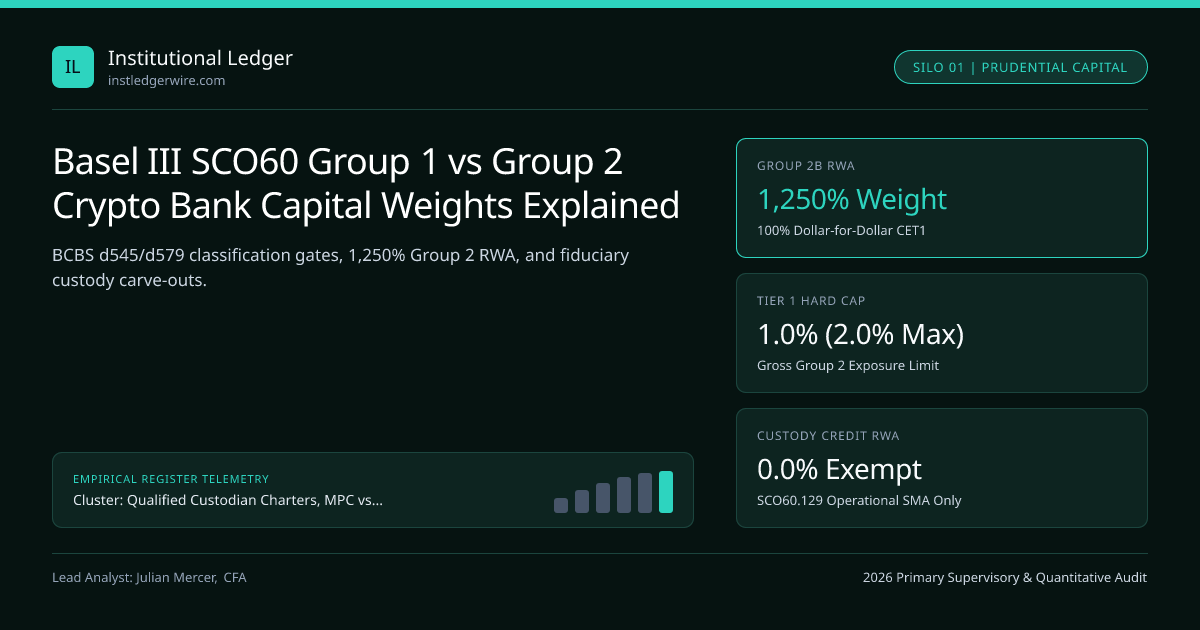
Under the Basel Committee on Banking Supervision prudential framework BCBS SCO60 (d545 and d579), an internationally active bank holding $500 million of unhedged spot Bitcoin on its own balance sheet must lock up $500 million in regulatory capital under a 1,250% risk weight—whereas safeguarding $25 billion of client Bitcoin in bankruptcy-remote custody consumes under $10 million in operational risk capital. This 2,600-to-1 capital asymmetry explains why global custodian banks aggressively pursue fee-based digital asset safekeeping while avoiding principal inventory.
The Four SCO60 Classification Gates Separating Group 1 from Group 2#
Published in December 2022 (d545) and tightened in July 2024 (d579) ahead of the 2026 SCO60 Benchmark Standard, Basel SCO60 establishes four cumulative gates before any tokenized asset or stablecoin receives traditional capital look-through under Group 1. First, the asset must either be a tokenized traditional instrument (Group 1a) or possess an effective stabilization mechanism (Group 1b). Second, all rights, obligations, and legal settlement finality must be clearly defined and enforceable in every relevant jurisdiction. Third, network functions—consensus, validation, and bridge mechanisms—must mitigate material operational and cyber risks. Fourth, entities performing redemptions, transfers, or node validation must be regulated and supervised, or subject to comprehensive risk governance.
Failing even a single sub-clause automatically demotes an asset into Group 2. Consequently, native Bitcoin, Ether, and permissionless governance tokens sit permanently in Group 2, alongside any stablecoin that lacks direct par redemption rights or holds illiquid reserve assets—a topic we examine in our cross-silo analysis of Group 1b stabilization test failures.
Group 2a Hedging Recognition vs Group 2b 1,250% Gross Add-Ons#
Within Group 2, SCO60 offers a narrow relief valve (Group 2a) for dealer banks making markets in CME futures or hedging spot Bitcoin and Ethereum ETF creation baskets. To qualify for Group 2a, the cryptoasset must have exchange-traded derivatives or ETFs clearing on a regulated venue, maintain an average market capitalization of at least $10 billion over the prior year, record at least $50 million in daily trading volume, and log 100+ verified price observations per day. Group 2a permits partial long-versus-short netting within the same underlying ticker under modified standardized market-risk formulas.
Any asset failing those liquidity thresholds—or any aggregate Group 2 exposure breaching the 1% Tier 1 capital soft limit (capped strictly at 2% Tier 1)—falls into Group 2b. Group 2b forbids netting completely, applying a 1,250% risk weight to the larger of gross long or gross short positions. As a result, liquidity provisioning in long-tail tokens migrates away from prudentially consolidated banks toward non-bank liquidity venues such as Aquanow, B2bx, and 8 Blocks Capital.
| BCBS SCO60 Exposure Class | Qualifying Asset Examples | Risk-Weighted Asset (RWA) Formula | Tier 1 Exposure Limit | Netting & Collateral Recognition | ||||
|---|---|---|---|---|---|---|---|---|
| Group 1a (Tokenized Traditional) | Permissioned tokenized T-Bills, Canton bonds | Same credit/market RWA as underlying traditional asset (+ infra add-on) | Exempt from Group 2 cap | Eligible financial collateral if legally perfected | ||||
| Group 1b (Compliant Stablecoin) | Regulated EMTs passing redemption & reserve test | Underlying reserve issuer RWA + pool credit risk | Exempt if d579 tests pass | Ineligible as CRM collateral unless Group 1a | ||||
| Group 2a (Hedged Liquid Crypto) | Regulated BTC/ETH futures & Spot ETFs | Modified standardized / internal market risk (netting capped) | 1% Tier 1 soft cap; 2% hard cap | Partial long/short recognition within same asset | ||||
| Group 2b (Unbacked / Failed Test) | Unhedged spot crypto, algorithmic or unredeemable coins | `1,250% * max( | Long | , | Short | )` | Strict 1%-2% Tier 1 aggregate | Zero collateral value; zero hedge offset |
| Fiduciary Custody (SCO60.129) | Off-balance-sheet client safekeeping (NYSDFS / BaFin) | 0% credit & market RWA; SMA operational risk on fee income | Exempt | Off-estate under SEC SAB 122 |
SCO60 Paragraph 129: Why Pure Fiduciary Custody Escapes Credit RWA#
For custody executives reviewed in our qualified digital asset custody cornerstone guide, the decisive clause in Basel's rulebook is SCO60.129. When a bank provides digital asset safekeeping on a purely fiduciary, bankruptcy-remote basis—segregating client tokens off its balance sheet without guaranteeing asset market value or extending intraday principal credit—SCO60 exempts custodied AUM from credit risk, market risk, credit valuation adjustment (CVA), and the 1%-to-2% Group 2 exposure cap.
Historically, US banks could not enjoy SCO60.129 relief because SEC SAB 121 forced safeguarded crypto back onto GAAP balance sheets, triggering Leverage Exposure and CET1 deductions under US Collins Floor rules. The issuance of SEC SAB 122 and FASB ASC 450-20 custody accounting harmonized US accounting with SCO60.129, restoring pure fee-driven operational risk treatment under the Standardized Measurement Approach (SMA).
- Variables & G-SIB Capital Simulation ($120B Tier 1 Capital Bank):
- 1. Scenario A — $500M Unhedged Group 2b Principal Inventory:
- RWA_G2b = $500M * 12.50 = $6,250M; Capital Required = $500M (100% CET1 deduction equivalent)
- Tier 1 Share = $500M / $120,000M = 0.417% (within 1.0% $1.20B soft cap, but requires 15% ROE -> $75M/yr pre-tax spread!)
- 2. Scenario B — $25.0B Fiduciary Qualified Custody Mandate at 18 bps Fee ($45.0M Annual Custody Fee Revenue):
- Credit & Market RWA = $0 (per SCO60.129 + SEC SAB 122 off-balance-sheet bailment)
- Marginal Basel III SMA Business Indicator Component (alpha_BI = 18% Bucket 3) = $45.0M * 0.18 = $8.10M
- Assuming Internal Loss Multiplier (ILM) = 1.15 -> Operational Risk Capital = $8.10M * 1.15 = $9.315M
- Capital Efficiency Ratio: $25.0B custodied AUM consumes only $9.315M CET1 (0.037% of AUM vs 100.0% for Group 2b principal)
Supervisory Infrastructure Add-Ons & European CRR III Alignment#
Even when a tokenized sovereign bond qualifies for Group 1a, SCO60 empowers national supervisors—including the Federal Reserve under SR 23-8, BaFin, FINMA, and MAS—to impose an infrastructure risk add-on if distributed-ledger settlement introduces novel smart-contract or consensus fragilities. In the European Union, CRR III transitional crypto rules operationalize these thresholds alongside MiCA CASP safeguarding requirements, reinforcing why banks strongly prefer permissioned institutional networks or air-gapped HSM custody stacks.
Capital Structuring Takeaways for Institutional Counterparties#
Treasury and prime desks selecting bank-affiliated custodians inside our Qualified Custody & HSM Controls hub must structure intraday settlement lines carefully: if a bank custodian advances uncollateralized Group 2 overdrafts during settlement windows, the bank immediately incurs 1,250% RWA and passes that cost through in wider spreads. Counterparty charter filings can be audited directly via our regulatory directory and compliance benchmarks.
Frequently asked questions
Why does Basel III SCO60 assign a 1,250% risk weight to unhedged Bitcoin and Ether on bank balance sheets?
Under the Basel 8% minimum total capital ratio, multiplying an exposure by 1,250% produces Risk-Weighted Assets equal to 12.5x the asset value; 8% of 12.5x equals 100%. This requires dollar-for-dollar capital deduction so a total write-off cannot impair depositor-backed capital.
Can tokenized US Treasuries on public permissionless blockchains qualify for Group 1a capital look-through?
Under BCBS d545 and d579 technical amendments, Condition 3 scrutinizes permissionless validator finality and sanction-screening governance. Until supervisors grant permissionless exemptions, G-SIBs favor permissioned networks or apply an infrastructure risk add-on (initially calibrated at 0 bps with discretionary buffers).
What differentiates Group 2a from Group 2b crypto exposures for bank market-making desks?
Group 2a covers cryptoassets with regulated futures or ETFs meeting strict market-cap ($10B+), daily volume ($50M+), and price-observation thresholds, allowing limited modified-standardized or internal-model netting between spot and derivatives. Group 2b bans netting and applies 1,250% to max(|long|, |short|).
How does SCO60 treat custodial banks providing safekeeping for spot Bitcoin ETFs?
Under SCO60 paragraph 129, when a bank acts strictly as a bankruptcy-remote custodian without principal ownership or settlement credit guarantees, credit, market, and CVA risk rules do not apply; custody fee revenue simply enters the Business Indicator for operational risk.
Publication record
- Published
- November 14, 2026
- Updated
- November 15, 2026
- Author
- Julian Mercer, CFA
- Review
- Review not recorded
- Automated fact check
- Passed in the stored pipeline record
- Source URLs
- 3 recorded
AI assistance recorded: anthropic/claude-opus-4.6. This field does not establish human review or source verification.
Academic & Institutional Attribution
Cite This Research & Embed Live Data Card
Standard academic & institutional research paper citation format.
Julian Mercer, CFA. (2026, November 15). Basel III SCO60 Group 1 vs Group 2 Crypto Bank Capital Weights Explained. Institutional Ledger. https://instledgerwire.com/stories/basel-sco60-group-1-vs-group-2-crypto-bank-capital-weightsRegulatory Directory Cross-Reference
Referenced Institutions & Regulatory Registries
Mentioned Regulated Institutions
Referenced Supervisory Authorities
Related Qualified Custody Mpc Hsm Controls & Institutional Briefings
Explore Qualified Custody Mpc Hsm Controls Hub (20) →Qualified Custody Mpc Hsm Controls
Qualified Digital Asset Custody, MPC Signing & FIPS 140-3 HSM Controls: 2026 GuideQualified Custody Mpc Hsm Controls
SEC SAB 122 & FASB ASC 450-20 Custody Liability Accounting for BanksQualified Custody Mpc Hsm Controls
Specie & Crime Insurance Exclusions in Digital Asset Cold VaultsQualified Custody Mpc Hsm Controls
Omnibus vs Segregated On-Chain Wallets: Insolvency & Bailment LawQualified Custody Mpc Hsm Controls
BaFin Krypto-Verwahrgeschaeft vs EU MiCA Article 70 CASP Custody RulesQualified Custody Mpc Hsm Controls
Spot Bitcoin & Ether ETF In-Kind Creation Custody SLA WorkflowsQualified Custody Mpc Hsm Controls
Quorum Policy Engines & Biometric Hardware Co-Signing ControlsQualified Custody Mpc Hsm Controls
Disaster Recovery, Shamir Key Sharding & Geographic Custody QuorumsTokenized Treasuries Rwa Settlement
Chainlink & DTCC Smart NAV Oracle Attestation Latency ControlsTokenized Treasuries Rwa Settlement
Canton Network & Broadridge DLR Intraday Tokenized Repo ClearingTokenized Treasuries Rwa Settlement
Ondo OUSG & USDY Bankruptcy-Remote SPV Note Structuring AuditTokenized Treasuries Rwa Settlement
BIS Project Agora: Tokenized Commercial Bank Deposits & Wholesale CBDC
Institutional Ledger Data, Benchmarks & Contributor Records
CC BY 4.0 Open Data
Open Institutional Datasets (CSV / JSON) →
Download desk-compiled quantitative series & schemas.
2026 Reference Matrix
2026 Institutional Benchmarks & Thresholds →
Statutory capital, clearing, margin & rate conventions.
Editorial Records
Authors & Review Records →
View named contributors where those records are available.
Complete Index
Master Research & Dossier Archive →
Browse all published briefings by topic pillar & date.