
Tokenized Treasuries Rwa Settlement
Secondary OTC RFQ Liquidity & Weekend Discounts in Tokenized Treasuries
When Sunday institutional redemptions exceed $100M smart-contract USDC buffers, secondary OTC RFQ liquidity providers price tokenized US Treasuries using precise weekend carry and inventory haircuts.
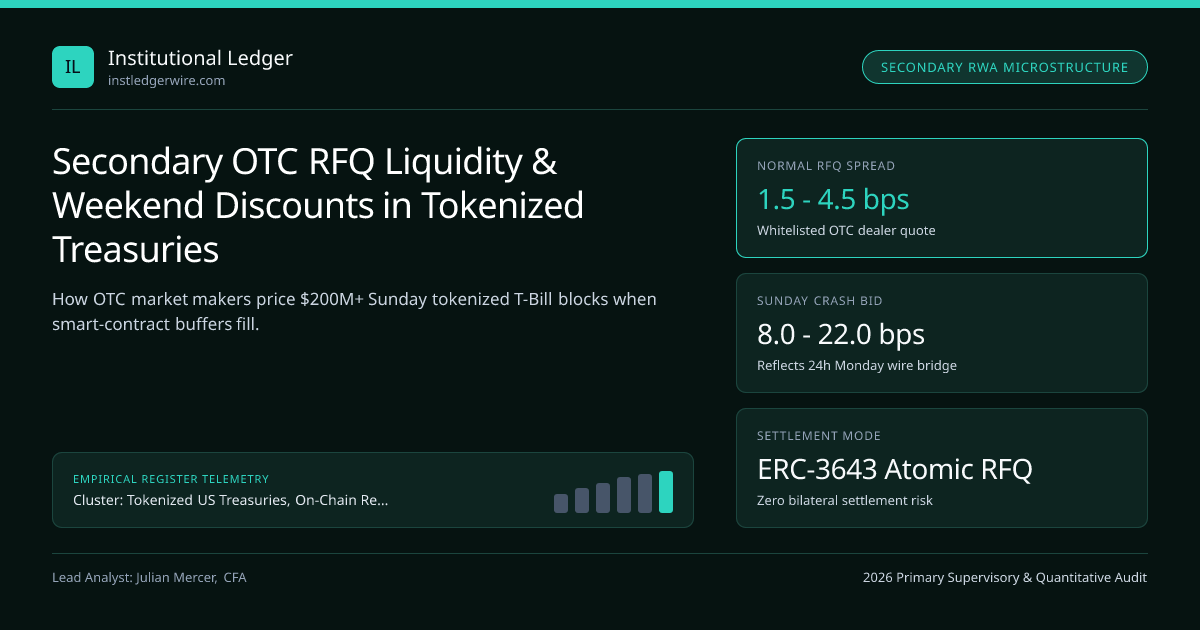
Risk committees stress-testing $500 million allocations into tokenized US Treasuries always ask the ultimate tail-risk question: "Suppose Bitcoin drops 25% on a Sunday night, Circle's $100 million smart-contract USDC buffer hits $0, and our desk urgently needs $150 million of stablecoin variation margin before Monday morning—what price do we get?" Thanks to deterministic Monday 08:30 AM ET par Fedwire redemptions and permissioned EIP-712 atomic OTC Request-for-Quote (RFQ) markets, secondary weekend liquidity discounts obey tight no-arbitrage boundaries.
Why Permissioned RWA Secondary Liquidity Runs on EIP-712 RFQ, Not Retail AMMs#
In unpermissioned DeFi, tokens trade inside constant-product or concentrated-liquidity Automated Market Makers (AMMs). However, regulated securities governed by ERC-3643 Identity Registries under SEC Section 3(c)(7) (BlackRock BUIDL) or EU ESMA / MAS rules restrict ownership strictly to KYC-whitelisted Qualified Purchasers and institutional accounts.
Consequently, secondary institutional liquidity operates via permissioned Request-for-Quote (RFQ) settlement contracts connected to multi-dealer OTC liquidity providers such as Aquanow, B2BX, and institutional desks on Bitstamp:
- Both the hedge fund seller and the OTC market maker hold verified
ONCHAINIDcredentials in the Transfer Agent's registry. - Off-chain via FIX or encrypted WebSocket API, five whitelisted dealers stream private, firm EIP-712 cryptographically signed quotes valid for 30 to 120 seconds—preventing public mempool front-running or sandwich MEV.
- On-chain, the seller submits the winning signed quote to an audited RFQ settlement contract, which executes
transferFrom(seller, dealer, rwaShares)andtransferFrom(dealer, seller, usdcAmount)atomically inside a single EVM transaction.
No-Arbitrage Pricing Math During Sunday Buffer Exhaustion#
As detailed in our tokenized US Treasuries and RWA settlement cornerstone guide, Tier 1 weekend liquidity comes from 24/7 USDC redemption buffers at 0.0 bps slippage. If systemic weekend outflows temporarily empty that buffer, OTC market makers step in with dry USDC powder.
Why won't tokenized Treasury shares plunge 5% or 10% on a Sunday panic like an illiquid altcoin? Because every whitelisted OTC dealer holds direct Monday 08:30 AM ET primary redemption access to the Transfer Agent at 100.00% par (primary wire settlement sweeps), backed by <60-day US Treasury bills with near-zero interest-rate duration (DV01 < 0.15 bps per 1 bps Fed move). Even if emergency Sunday overnight USDC borrow rates spike to 85% annualized for 18 hours until Fedwire opens, 85% * (18 / 8760) = 17.5 bps—capping competitive institutional RFQ bids tightly around USD 0.9978 to USD 0.9992 (8–22 bps discount).
| Liquidity Tier | Execution Mechanism | Typical Ticket Capacity | Bid Discount to Official NAV | Governing Legal / Tech Rail |
|---|---|---|---|---|
| Tier 1: Smart-Contract Buffer | Direct Circle / OUSG vault | Up to $100M+ rolling pool | 0.0 bps (100.00% Par) | Automated Solidity liquidity pool |
| Tier 2: Primary Wire Redemption | Transfer Agent burn -> Fedwire | $500M – $2B+ daily | 0.0 bps (100.00% Par) | Weekday 08:30–14:30 ET Fedwire / RRP |
| Tier 3: Permissioned OTC RFQ | Aquanow, Bitstamp OTC, prime dealers | $25M – $300M 24/7 blocks | 1.5–4.5 bps (wkdy) / 8–22 bps (stressed Sun) | EIP-712 atomic swap + ERC-3643 KYC |
| Tier 4: Direct Collateral Pledge | Post BUIDL directly as margin | $500M+ tri-party pledge | 0.0 bps sale (2.0% margin haircut) | Avoids selling RWA entirely during volatility! |
Tier 4 Escape Hatch: Posting RWA Directly Instead of Liquidating#
Better yet, as more derivatives clearinghouses and off-exchange tri-party custodians implement CFTC GMAC 2% tokenized MMF collateral haircuts, institutional desks eliminate Sunday USDC liquidation altogether—transferring BUIDL or Ondo OUSG directly into pledged collateral vaults in 12 seconds without paying a single basis point of OTC spread.
- Variables & Sunday 20:00 UTC Crypto Liquidation Stress Test ($150M Block After On-Chain Buffer Depletion):
- HoursToMonday_Fedwire = 17.5 hours (Sunday 20:00 UTC -> Monday 13:30 UTC / 08:30 AM ET Fedwire open)
- rStressedUSDC_Funding = 0.8500 (85.0% annualized emergency overnight USDC borrow spike during flash liquidation)
- rTBillCarry = 0.0445 (4.45% annualized T-Bill yield earned by the OTC dealer while holding RWA overnight)
- DealerRiskCharge_bps = 3.5 bps (dealer capital & operational execution spread)
- Worked Equilibrium OTC Bid Price:
- 1. Net 17.5-Hour Funding Cost = (0.8500 - 0.0445) * (17.5 / 8,760) * 10,000 = 16.09 bps
- 2. Total Equilibrium Sunday Discount = 16.09 bps + 3.50 bps = 19.59 bps ($0.99804 bid per $1.00 share -> $293,850 cost on $150M urgent rescue).
Pre-Onboarding Multiple Whitelisted OTC Dealers Before Stress Hits#
You cannot complete KYB onboarding with an OTC market maker at 11:00 PM on a Sunday during a market crash. Best-practice treasury committees pre-paper ISDA/master spot agreements and pre-verify ERC-3643 whitelist interoperability with at least three independent OTC liquidity providers across North America, Europe (FINMA / BaFin), and Asia (SFC / MAS).
Secondary Liquidity Stress-Testing Protocol for Risk Committees#
Chief Risk Officers active in our Tokenized Treasuries & RWA Settlement hub conduct quarterly live $5M test RFQ swaps across onboarded OTC counterparties, benchmark historical spreads in our datasets hub, and verify counterparty regulatory status via our verification portal.
Frequently asked questions
Why don’t BlackRock BUIDL or Franklin BENJI trade on open permissionless Uniswap pools?
Every holder of a permissioned security token must sit inside the Transfer Agent’s ERC-3643 KYC whitelist. Deploying an unpermissioned AMM pool contract would either fail isVerified checks or illegally allow anonymous wallets to swap into LP shares representing unregistered beneficial ownership.
How do institutional OTC market makers price a $150M Sunday-night BUIDL-for-USDC RFQ block if the Circle instant buffer is empty?
The market maker knows with certainty it can redeem the acquired BUIDL shares at 100.00% par via primary Fedwire at 8:30 AM ET Monday (~12 to 36 hours away), PLUS earn the accrued T-Bill yield overnight. Its bid discount simply charges for 12–36 hours of opportunistic crypto funding cost (r_crypto_stress - r_TBill), typically 8 to 22 bps.
How does atomic on-chain RFQ eliminate bilateral OTC counterparty risk?
Instead of sending tokens first and waiting hours for an OTC desk to wire USDC back, institutional RFQ contracts (such as AirSwap/0x permissioned settlement contracts) verify the dealer’s EIP-712 signed quote and swap ERC-3643 shares against USDC atomically inside one block.
Why did Silicon Valley Bank’s 2023 weekend collapse cause an 1,200 bps USDC depeg whereas tokenized T-Bill secondary discounts stay under ~25 bps?
In March 2023, 8% of USDC’s reserves sat in uninsured commercial bank deposits at failed SVB—creating genuine principal-impairment uncertainty. Tokenized government MMFs hold 100% segregated US Treasury bills and Fed RRP at G-SIB custodians; zero principal credit impairment exists, leaving only a 24-hour time-value bridge.
Publication record
- Published
- November 13, 2026
- Updated
- November 15, 2026
- Author
- Julian Mercer, CFA
- Review
- Review not recorded
- Automated fact check
- Passed in the stored pipeline record
- Source URLs
- 3 recorded
AI assistance recorded: anthropic/claude-opus-4.6. This field does not establish human review or source verification.
Academic & Institutional Attribution
Cite This Research & Embed Live Data Card
Standard academic & institutional research paper citation format.
Julian Mercer, CFA. (2026, November 15). Secondary OTC RFQ Liquidity & Weekend Discounts in Tokenized Treasuries. Institutional Ledger. https://instledgerwire.com/stories/secondary-otc-rfq-liquidity-discounts-tokenized-treasuriesRegulatory Directory Cross-Reference
Referenced Institutions & Regulatory Registries
Mentioned Regulated Institutions
Referenced Supervisory Authorities
Related Tokenized Treasuries Rwa Settlement & Institutional Briefings
Explore Tokenized Treasuries Rwa Settlement Hub (20) →Tokenized Treasuries Rwa Settlement
Tokenized US Treasuries, On-Chain Repo DvP & RWA Settlement: 2026 GuideTokenized Treasuries Rwa Settlement
ERC-3643 (T-REX) Identity Registries & On-Chain RWA WhitelistingTokenized Treasuries Rwa Settlement
SEC Rule 17Ad Transfer-Agent Recordkeeping for Tokenized FundsTokenized Treasuries Rwa Settlement
Atomic T+0 DvP Intraday Repo vs DTCC & Fedwire Cutoff WindowsTokenized Treasuries Rwa Settlement
BlackRock BUIDL (Reg D 3c7) vs Franklin BENJI (1940 Act MMF) ComparedTokenized Treasuries Rwa Settlement
Tokenized MMF Collateral Haircuts & CFTC GMAC Derivatives Margin RulesTokenized Treasuries Rwa Settlement
Chainlink & DTCC Smart NAV Oracle Attestation Latency ControlsTokenized Treasuries Rwa Settlement
Canton Network & Broadridge DLR Intraday Tokenized Repo ClearingStablecoin Reserve Attestation Audit
AICPA AT-C 205 Monthly Stablecoin Reserve Attestation Criteria DecodedStablecoin Reserve Attestation Audit
Overnight Reverse Repo & 93-Day T-Bill WAM Caps in StablecoinsStablecoin Reserve Attestation Audit
EU MiCA Title III (ART) vs Title IV (EMT) Stablecoin Safeguarding RulesStablecoin Reserve Attestation Audit
MiCA’s 60% EU Bank Deposit Mandate for Significant Stablecoins: Tail Risk
Institutional Ledger Data, Benchmarks & Contributor Records
CC BY 4.0 Open Data
Open Institutional Datasets (CSV / JSON) →
Download desk-compiled quantitative series & schemas.
2026 Reference Matrix
2026 Institutional Benchmarks & Thresholds →
Statutory capital, clearing, margin & rate conventions.
Editorial Records
Authors & Review Records →
View named contributors where those records are available.
Complete Index
Master Research & Dossier Archive →
Browse all published briefings by topic pillar & date.