
Institutional Crypto Prime Margin
Validator Exit Churn Limits, Unbonding Queues & Liquidity Discounts
Native staked tokens cannot teleport back into liquid orderbooks during a crash: protocol exit-churn caps throttle Ethereum, Solana, and Cosmos unstake redemptions into multi-day or multi-week liquidity queues!
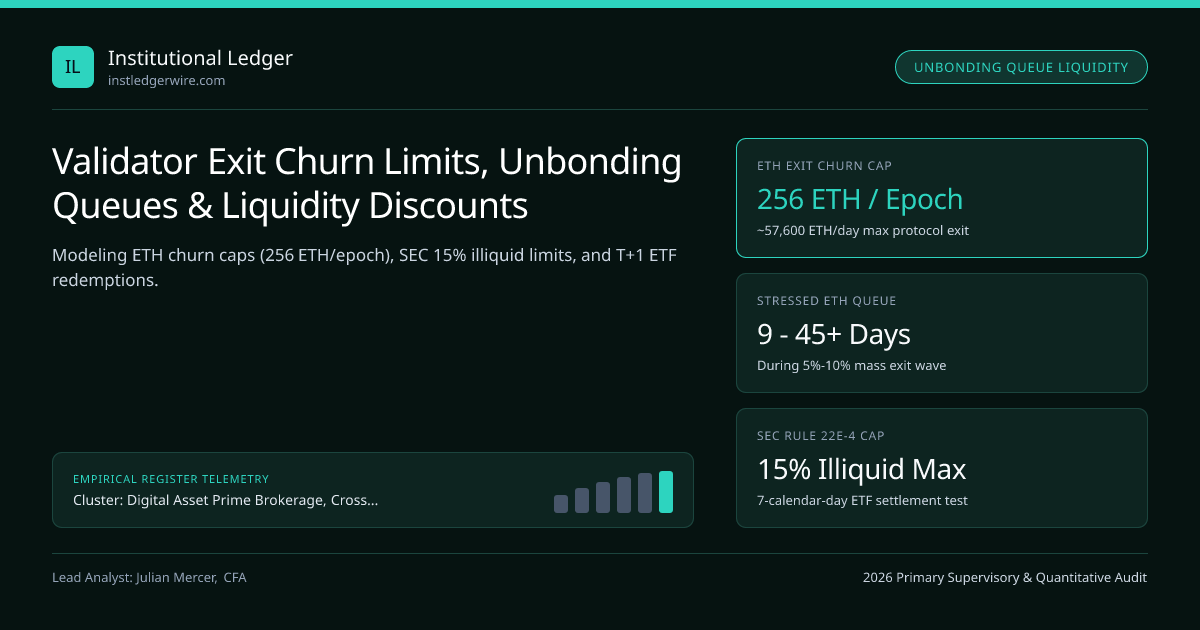
During calm markets, staking 50,000 ETH feels indistinguishable from a liquid savings account: rewards accrue every 6.4 minutes and withdrawals clear in two days. During a systemic liquidity crunch, however, every institutional treasurer collides with hard consensus physics: Proof-of-Stake blockchains throttle exits behind deterministic protocol churn queues. When 1.8 million ETH rushes for the door at once, Ethereum's 57,600 ETH/day cap turns "liquid staking" into a 34-day time lock—driving secondary discounts and T+1 ETF liquidity traps.
Consensus Security Physics: Why Blockchains Throttle Validator Exits#
Why can't Ethereum or Cosmos simply let 50% of validators unstake instantaneously in a single 12-second block? Because Proof-of-Stake relies on Weak Subjectivity and Slashable Accountable Safety:
- If a Byzantine cartel controlling 34% of staked ETH finalized two conflicting forks (stealing billions via double-spends on exchanges like Bitstamp and Bitfinex) and withdrew 100% of its ETH in the very next block, the protocol would have zero collateral left to slash once honest nodes detected the equivocation!
- Therefore, as modeled in our institutional crypto prime brokerage cornerstone guide, Ethereum enforces a 256 ETH per epoch (
57,600 ETH/day) balance-based exit churn ceiling (upgraded viaEIP-7514and PectraEIP-7251), followed by a mandatory 256-epoch (27.3-hour) slashability hold.
Game-Changer Upgrade: EIP-7002 Execution-Layer Triggerable Exits#
Historically, institutional custodians faced a terrifying operational hostage risk when delegating validation to external node operators: only the hot BLS validator signing key held by the node operator could broadcast a VoluntaryExit message! If a node operator went bankrupt, suffered ransomware, or turned hostile, your ETH sat trapped until inactivity leaks slowly bled it below 16 ETH!
Ethereum's Pectra EIP-7002 Execution-Layer Triggerable Withdrawals & Exits solved that permanently:
- Now, your NYDFS, FINMA, or BaFin cold custody vault holding the
0x01/0x02withdrawal key can submit a signed EVM transaction directly to the Ethereum system contract (0x00000961Ef480Eb55e80D19ad83579A64c007002)—forcing partial withdrawals or full validator exit with zero cooperation from the node operator!
| Network | Protocol Unbonding Rule | Daily Network Exit Cap | Yield Earned While Exiting? | Prime / ETF Liquidity Grade |
|---|---|---|---|---|
Ethereum (ETH) | Dynamic FIFO (256 ETH/epoch) + 27.3h hold | 57,600 ETH / day | Yes until Exit_Epoch (0% during final 27h) | High (Calm) / Constrained (Panic) — use EIP-7002 |
Solana (SOL) | 1 Epoch cooldown (~48–60 hours) | 25% of active network stake / epoch | No once deactivated at epoch boundary | Highest — matches T+2 equity/ETF settlement |
Avalanche (AVAX) | Fixed stake end-timestamp (14d–365d) | Preset maturity calendar | Yes until maturity; zero early exit! | Term-Locked — ladder maturities across 14d buckets |
Cosmos / Celestia (ATOM/TIA) | Rigid 21-calendar-day unbonding | Unlimited (time-locked) | 0.00% for all 21 days + slashable! | Illiquid — exceeds SEC Rule 22e-4 7-day threshold |
Structuring Staked Spot ETFs Around T+1 Settlement & SEC Rule 22e-4#
How do issuers of staked US & European Spot Ethereum ETPs honor T+1 cash and in-kind AP redemptions when Ethereum's exit queue can exceed SEC Rule 22e-4's 7-calendar-day liquidity window?
- Tiered Liquidity Sleeve ("Barbell Staking"): Staking 70%–80% of trust ETH across staggered validators while holding 20%–30% unstaked spot ETH in cold vaults—instantly covering even a historic 20% multi-day ETF outflow wave!
- Committed Revolving Repo / Prime Liquidity Lines: Contracting pre-committed ETH overdraft facilities with regulated liquidity providers (Aquanow, B2BX, bank prime desks) secured by the exiting
0x02withdrawal receivable. - Dynamic Queue-Triggered Unstaking: Automated treasury daemons monitor the global Beacon Chain exit queue 24/7; if global queued exits cross
200,000 ETH(3.5 days), the trust proactively pre-queues an additional 10% buffer into liquid spot!
- ImpliedIlliquidityFundingDiscountBps = ( (PrimeBridgeBorrowRate + HedgeMarginCarryCost) * (Unbonding_Days / 365) ) * 10,000
- Variables & Worked $250,000,000 Staked Ethereum ETF Mass-Redemption Stress Test (1,800,000 ETH Global Exit Queue):
- 1. Queue Duration: (1,800,000 / 57,600) + 1.14 + 1.86 = 31.25 + 3.00 = 34.25 Calendar Days Locked!
- 2. Fair Secondary OTC / LST Arbitrage Discount (AP demands 14.5% annualized capital + hedge VM charge to warehouse 34.25-day locked ETH):
- Implied_Discount = 14.50% * (34.25 / 365) = 1.36% (136 bps minimum carry floor) + tail-volatility risk premium (~180 bps) = ~3.16% Secondary Discount!
Why Delta-Hedging Locked Unbonding Stake Requires Cash Margin Reserves#
Suppose an institutional hedge fund triggers a 21-day Cosmos or 30-day stressed ETH unstake and immediately sells perp/futures on BitMEX or Backpack Exchange to lock in $3,200/ETH. Remember: unbonding native stake has 0% collateral value at external venues! Always reserve 35%–45% liquid USDC/T-Bill variation margin alongside that short hedge so a temporary +35% short-squeeze bounce doesn't liquidate your hedge before Day 30 (LST collateral haircuts & depeg cascades).
Liquidity Risk Governance Checklist for Staked Portfolios#
Treasury and risk committees active in our Digital Asset Prime Brokerage & PoR hub require EIP-7002 cold-key exit readiness under the Spot Crypto ETFs 2026 Benchmark Standard, enforce <= 7-day liquidity stress ladders, and verify custodians via our verification portal.
Frequently asked questions
How long does it take to unstake Ethereum during calm markets vs a 2022-style panic?
When the Ethereum exit queue is empty, exiting takes a minimum of ~27.3 hours (256 epochs withdrawability delay) plus up to ~4–8 days for the automated validator sweep cursor to credit your 0x01/0x02 withdrawal address (instant via 0x02 partial EIP-7002 execution-layer trigger). During a 5%–8% panic rush (like Celsius/Shapella waves), the FIFO queue stretches 20 to 50+ calendar days!
How do Solana and Cosmos (ATOM / TIA) unbonding periods differ from Ethereum’s dynamic FIFO queue?
Solana enforces a 1-epoch cooldown (~2.0 to 2.5 days) subject to a 25%-of-total-stake per-epoch warmup/cooldown cap—making Solana the fastest major institutional PoS exit! Conversely, Cosmos SDK chains (ATOM, TIA, DYDX) enforce a rigid fixed 21-day unbonding period (Polkadot: 28 days) during which tokens earn 0% yield and remain 100% exposed to validator slashing!
Why does SEC Rule 22e-4 create a strict staking cap for US Spot Ethereum & Solana ETFs?
Under SEC Rule 22e-4 (and T+1 ETF Authorized Participant redemption SLAs), an open-end fund may hold no more than 15% of net assets in "illiquid investments"—defined as assets that cannot be sold or redeemed in cash/in-kind within 7 calendar days without materially altering market value! Staked ETH ETFs therefore combine unstaked liquidity sleeves (~20%–30%), LST sleeves, or revolving bank/AP liquidity lines.
Can you hedge price risk while your ETH sits trapped inside a 30-day unbonding queue?
Yes—WITH one huge prime-margin caveat! You can short 1:1 ETH CME futures or perpetuals to lock in your USD exit price on Day 1, but as covered in our cash-and-carry basis guide, if ETH spikes +40% on Day 10 while your staked ETH is still locked in the unbonding queue until Day 30, you must post liquid cash/T-Bill variation margin to keep that short hedge alive!
Publication record
- Published
- November 13, 2026
- Updated
- November 14, 2026
- Author
- Julian Mercer, CFA
- Review
- Review not recorded
- Automated fact check
- Passed in the stored pipeline record
- Source URLs
- 3 recorded
AI assistance recorded: anthropic/claude-opus-4.6. This field does not establish human review or source verification.
Academic & Institutional Attribution
Cite This Research & Embed Live Data Card
Standard academic & institutional research paper citation format.
Julian Mercer, CFA. (2026, November 14). Validator Exit Churn Limits, Unbonding Queues & Liquidity Discounts. Institutional Ledger. https://instledgerwire.com/stories/validator-exit-churn-limits-unbonding-queue-liquidity-discountsRegulatory Directory Cross-Reference
Referenced Institutions & Regulatory Registries
Mentioned Regulated Institutions
Referenced Supervisory Authorities
Related Institutional Crypto Prime Margin & Institutional Briefings
Explore Institutional Crypto Prime Margin Hub (20) →Institutional Crypto Prime Margin
Institutional Crypto Prime Brokerage, Cross-Venue Netting & zk-PoR Guide (2026)Institutional Crypto Prime Margin
Prime Broker Cross-Margining: Spot ETFs, CME Futures & Perp OffsetsInstitutional Crypto Prime Margin
Liquid Staking Tokens (LST) Collateral Haircuts & Depeg Cascade ModelsInstitutional Crypto Prime Margin
Principal vs Agency Prime Execution & Institutional Smart Order RoutingInstitutional Crypto Prime Margin
Crypto Securities Lending: Open-Term Recall SLAs, GMSLA & Borrow RatesInstitutional Crypto Prime Margin
Portfolio VaR & SPAN Margin Models for Multi-Leg Digital Asset BooksInstitutional Crypto Prime Margin
Weekend Gap Risk: CME Friday 4:00 PM CT Close vs 24/7 PerpetualsInstitutional Crypto Prime Margin
Restaking & EigenLayer AVS Slashing Contagion: Institutional PolicyRegulatory Compliance
European Union Presses the Button for Tokenized Assets: Common Standards Are Coming - Cryptonews.netMonetary Policy
Hot US inflation raises odds of half-point Fed hike in DecemberRegulatory Compliance
Crypto ally Tom Emmer elected House GOP minority whipcybersecurity
Bitget Wallet reports sevenfold jump in crypto phishing risk alerts
Institutional Ledger Data, Benchmarks & Contributor Records
CC BY 4.0 Open Data
Open Institutional Datasets (CSV / JSON) →
Download desk-compiled quantitative series & schemas.
2026 Reference Matrix
2026 Institutional Benchmarks & Thresholds →
Statutory capital, clearing, margin & rate conventions.
Editorial Records
Authors & Review Records →
View named contributors where those records are available.
Complete Index
Master Research & Dossier Archive →
Browse all published briefings by topic pillar & date.