
Institutional Crypto Prime Margin
Crypto Securities Lending: Open-Term Recall SLAs, GMSLA & Borrow Rates
Shorting digital assets cleanly requires enforceable securities-lending agreements—governing 102%–125% cash/T-Bill collateralization, hard-to-borrow fee spikes, T+1 lender recall SLAs, and protocol hard-fork/airdrop corporate actions!
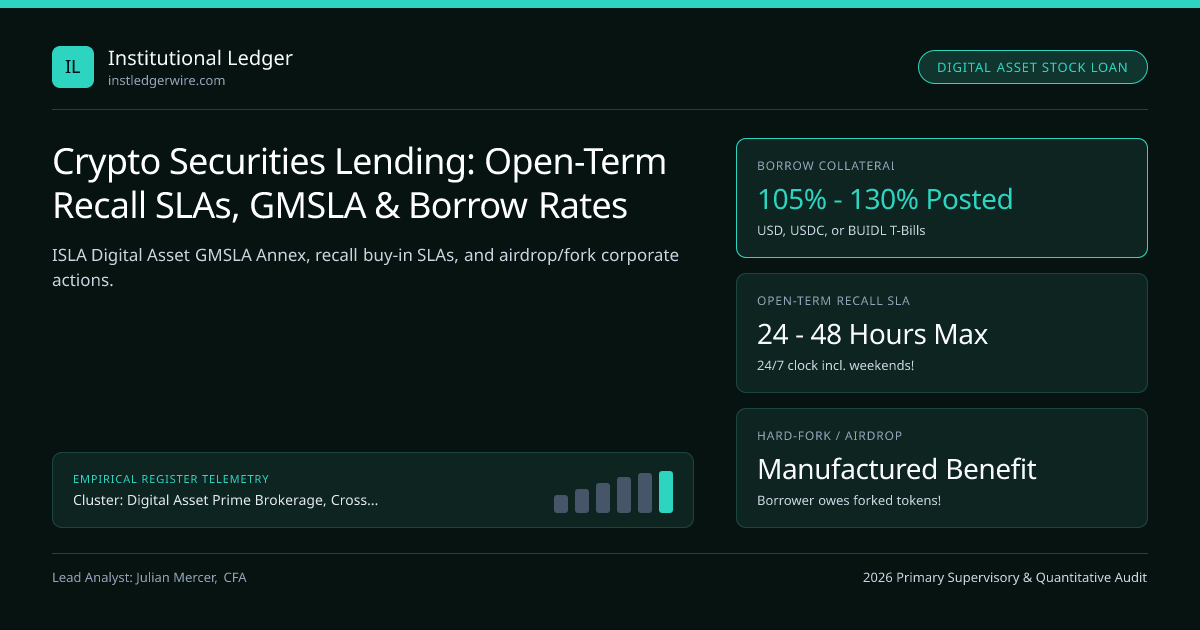
Ask any veteran equity long/short portfolio manager what turns a profitable fundamental short thesis into a career-ending loss, and they won't say price volatility—they'll say an unexpected 24-hour stock-loan recall right at the peak of a short squeeze! In 24/7 digital asset markets—where Proof-of-Stake yields raise baseline borrow floors and random protocol airdrops create sudden "manufactured dividend" traps—mastering the ISLA Digital Asset GMSLA Annex, recall SLAs, and cash collateral rebates separates institutional prime desks from retail perp traders.
Why PoS Staking Yields Set the Floor on Institutional Token Borrow Rates#
In traditional G10 equities, S&P 500 stocks held in pension vaults sit idle at 0% native protocol yield—so General Collateral (GC) stock-loan fees average a tiny 25 to 40 basis points. Why does borrowing spot ETH or SOL cost 3.2% to 6.5% even when short demand is calm?
- Because lending out native ETH or SOL forces the lender to unstake from consensus validation! No rational endowment or ETF custodian will lend you ETH at
0.50%if staking natively earns3.10%! - Consequently, the risk-free borrow floor for any Proof-of-Stake token equals
Native_Staking_APY + Unbonding_Opportunity_Spread (40–90 bps), while non-PoS Bitcoin (BTC) continues to trade as true low-rate General Collateral (1.00%–2.25%), as modeled in our institutional crypto prime brokerage cornerstone guide!
Open-Term Callable vs Fixed-Term Locked Borrows: Surviving Short Squeezes#
When sourcing borrows from regulated prime brokers or wholesale lenders (Bitfinex institutional borrow book, Aquanow, B2BX, Hidden Road, Marex, Galaxy), portfolio managers choose between two recall structures:
- Open-Term (Callable on
24h–48hNotice): Notice in crypto that 24 hours means 24 real clock hours—including Saturday at 3:00 AM UTC! If an altcoin foundation triggers a governance vote or staking lockup, lenders recall en masse, borrow rates jump from5%to90%, and open-term borrowers face forced market buy-ins via agency SOR or RFQ. - Fixed-Term (
30d / 60d / 90dNon-Callable): Paying an extra75–150 bpslocks in both your exact fee rate and contractual immunity from discretionary lender recalls—essential for token-unlock hedges, convertible-note arbitrage, and M&A/protocol-merge trades!
| Loan Contract Term | Open-Term ("At-Will") Borrow | Fixed-Term (30d–180d) Institutional Borrow | Unregulated Pre-2022 Crypto Loan |
|---|---|---|---|
| Governing Agreement | ISLA GMSLA Digital Asset Annex | ISLA GMSLA DA Annex + Term Confirmation | Bespoke 4-page unregulated note |
| Borrower Collateral Posted | 110% – 125% Cash / USDC / BUIDL | 115% – 130% segregated tri-party pledge | 0% – 50% Undercollateralized! (Banned!) |
| Lender Recall Right | Anytime on 24h–48h notice | Non-Callable prior to maturity (barring Default/Fork!) | Chaotic unilateral freeze |
| Borrow Fee Rate | Floating daily GC / HTB reset | Locked fixed bps for full term | Fixed unhedged yield trap |
| Execution & Return Venues | Bitstamp, Backpack, Aquanow | Multi-venue SOR + OTC block buy-in protection | Opaque internal ledger |
Redlining the ISLA GMSLA Digital Asset Annex: Forks, Airdrops & Voting#
The International Securities Lending Association (ISLA) Digital Asset Annex modernized traditional securities lending law for bearer cryptographic assets under English and New York law (harmonized with FASB ASC 350-60 and Basel SCO60 repo/SFT netting). General counsels redline three critical clauses:
- Hard Forks & Contentious Chain Splits: Pre-defining objective materiality criteria (e.g., forked asset must maintain
>10%of parent market cap and list on>= 2specified regulated venues like Bitstamp and Backpack Exchange after 30 days) before any delivery obligation attaches! - Unsolicited Third-Party Airdrops: Explicitly capping or cash-settling third-party ecosystem airdrops so an illiquid governance airdrop cannot trap a short seller in an impossible physical buy-in!
- Zero Undercollateralization: Confirming 100%+ daily mark-to-market collateralization (undercollateralized lending bans).
- Variables & $25,000,000 90-Day Fixed-Term ETH Institutional Short Economics (SOFR = 4.45%):
- ShortSaleProceedsHeldAtPrime = $25,000,000 (100%) + AdditionalEquityMargin = $3,750,000 (15%) -> TotalCash_Collateral = $28,750,000 (115% Ratio)
- PrimeRebateSpread = 0.40% (40 bps); 90-DayTermETHBorrowFee = 3.60% (covers lender's foregone ~3.1% ETH staking yield + 50 bps fee!)
- 1. Gross Rebate Interest Earned on $28.75M Cash = $28,750,000 * (4.45% - 0.40%) = +$1,164,375/yr (+4.66% on $25M notional!)
- 2. Less 90-Day Locked ETH Borrow Fee = -$25,000,000 * 3.60% = -$900,000/yr (-3.60%)
- 3. Net Short Rebate Carry = +$264,375/yr (+1.06% POSITIVE carry earned while holding a recall-immune 90-day physical ETH short!)
Maximizing Short Rebate Alpha: Auditing Your Prime’s Cash Rebate Spread#
Never leave 445 bps of short-sale cash proceeds earning 0%! On a $25M short sale, careless funds accept "0% rebate" terms—gifting the prime broker +$1.1M/yr of free SOFR float! Negotiate explicit SOFR - 35 bps cash-collateral rebates or post non-cash tokenized T-Bills directly.
Stock-Loan & Short Desk Legal Checklist#
Legal and trading leads active in our Digital Asset Prime Brokerage & PoR hub execute all borrows under signed ISLA GMSLA Digital Asset Annexes with clean ESMA / FCA / NYDFS netting opinions, lock fixed-term borrows on multi-week shorts, and verify prime counterparties via our verification portal.
Frequently asked questions
What happens if a prime lender recalls your borrowed tokens during a +80% short squeeze and you fail to return them within 24 hours?
Under the ISLA GMSLA Digital Asset Annex, failing to return recalled tokens before the Recall Cutoff (24h or 48h) triggers the lender’s Contractual Buy-In Right: the prime broker sweeps public orderbooks at market price using your posted 120% cash/T-Bill collateral, deducting execution slippage plus default interest!
If I borrow 10,000 ETH or SOL to short it, and a major protocol drops a $5M token airdrop to ETH/SOL holders, do I owe the lender $5M?
DANGEROUSLY YES unless explicitly excluded in your Digital Asset Annex Schedule! Because there is no central issuer like Apple declaring official dividends, unsolicited third-party airdrops and contentious hard forks can bankrupt a short seller! Institutional GMSLA schedules include an Explicit Supported Fork & Airdrop Whitelist / Materiality Threshold so random spam/illiquid airdrops never create unhedgeable delivery obligations!
Why do institutional equity-style long/short funds borrow spot tokens instead of just shorting perpetual swaps?
Three reasons: (1) Perpetual swaps charge uncapped 8-hour funding spikes (sometimes exceeding -100% annualized during altcoin squeezes!); (2) spot shorting avoids perpetual Automatic Deleveraging (ADL) clawbacks on offshore exchanges; and (3) borrowing actual tokens is required for physical cross-chain bridge inventory, market-making inventory, and physical ETF/OTC settlement.
How does collateral rebate pricing work when posting Cash (USD/USDC) vs Non-Cash (BUIDL T-Bills) against a crypto borrow?
Just like equity stock loan! If you borrow $20M BTC (2.00% borrow fee) and post $22M USD cash when SOFR is 4.45%, the prime broker pays you a Cash Collateral Rebate (4.45% - 2.00% - 0.35% spread = +2.10% net rebate earned by the short seller!)—or you post non-cash BUIDL T-Bills directly and pay a flat 2.00% borrow fee while keeping 100% of your T-Bill yield!
Publication record
- Published
- November 13, 2026
- Updated
- November 14, 2026
- Author
- Julian Mercer, CFA
- Review
- Review not recorded
- Automated fact check
- Passed in the stored pipeline record
- Source URLs
- 3 recorded
AI assistance recorded: anthropic/claude-opus-4.6. This field does not establish human review or source verification.
Academic & Institutional Attribution
Cite This Research & Embed Live Data Card
Standard academic & institutional research paper citation format.
Julian Mercer, CFA. (2026, November 14). Crypto Securities Lending: Open-Term Recall SLAs, GMSLA & Borrow Rates. Institutional Ledger. https://instledgerwire.com/stories/crypto-securities-lending-open-term-recall-slas-borrow-ratesRegulatory Directory Cross-Reference
Referenced Institutions & Regulatory Registries
Mentioned Regulated Institutions
Related Institutional Crypto Prime Margin & Institutional Briefings
Explore Institutional Crypto Prime Margin Hub (20) →Institutional Crypto Prime Margin
Institutional Crypto Prime Brokerage, Cross-Venue Netting & zk-PoR Guide (2026)Institutional Crypto Prime Margin
Portfolio VaR & SPAN Margin Models for Multi-Leg Digital Asset BooksInstitutional Crypto Prime Margin
Weekend Gap Risk: CME Friday 4:00 PM CT Close vs 24/7 PerpetualsInstitutional Crypto Prime Margin
Restaking & EigenLayer AVS Slashing Contagion: Institutional PolicyInstitutional Crypto Prime Margin
On-Chain Wallet Ownership Proofs: BIP-322, EIP-191 & Micro-TransfersInstitutional Crypto Prime Margin
Prime Credit Intermediation & Post-2022 Undercollateralized Lending BansInstitutional Crypto Prime Margin
Perpetual Funding-Rate Volatility, Impact Notional & Auto-Liquidation EnginesInstitutional Crypto Prime Margin
Institutional MEV Protection: Private RPCs, Block Relays & Sandwich DefenseDigital Assets
Deutsche Bank launches crypto custody for companies and institutionsCryptocurrency Markets
Mercado Bitcoin to resume cash withdrawals after $49M hackCryptocurrency Markets
BitGo Q3 profit nearly doubles on crypto gains as revenue falls 51%Banking Crisis
‘Very strange, very sad’: Paraguay bank collapse fells a presidency and leaves millions broke
Institutional Ledger Data, Benchmarks & Contributor Records
CC BY 4.0 Open Data
Open Institutional Datasets (CSV / JSON) →
Download desk-compiled quantitative series & schemas.
2026 Reference Matrix
2026 Institutional Benchmarks & Thresholds →
Statutory capital, clearing, margin & rate conventions.
Editorial Records
Authors & Review Records →
View named contributors where those records are available.
Complete Index
Master Research & Dossier Archive →
Browse all published briefings by topic pillar & date.