
Institutional Crypto Prime Margin
Institutional Crypto Prime Brokerage, Cross-Venue Netting & zk-PoR Guide (2026)
Institutional crypto prime brokerage has rebuilt from the ground up since 2022—replacing opaque unsecured lending with bankruptcy-remote collateral netting, zk-SNARK Merkle-sum Proof-of-Reserves, and quantified staking risk models.
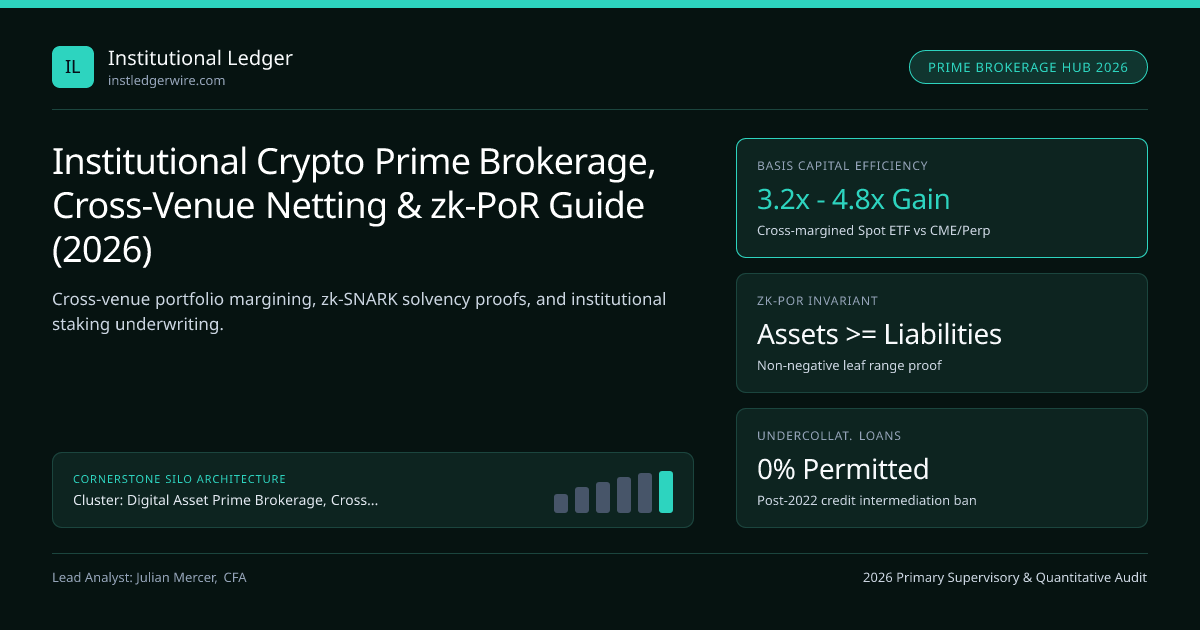
Ask the chief risk officer of a $5 billion multi-strategy hedge fund why they avoided digital assets in 2021 and allocated aggressively in 2025–2026, and the answer comes down to one missing piece of market plumbing: institutional prime brokerage. In traditional equities and FX, a fund signs one prime agreement with Goldman Sachs or Morgan Stanley, posts collateral once, trades across twenty liquidity venues, nets long against short exposures, and receives consolidated tax and fair-value reporting. Rebuilding that exact architecture for 24/7 digital assets—without repeating the uncollateralized shadow-banking disasters of 2022—defines the 2026 prime standard.
Pillar 1: Zero-Unsecured Credit Intermediation & Multi-Venue SOR#
After the 2022 collapses of Three Arrows Capital, Genesis, and Alameda proved that uncollateralized crypto lending is existential suicide, institutional prime brokers enforce a non-negotiable rule documented in prime credit intermediation and undercollateralized lending bans: every dollar of trading line is backed 100%+ by real-time pledged collateral!
How does a fund execute seamlessly across fragmented global orderbooks without parking coins on ten exchanges?
- Custody-Backed Credit Lines: The fund locks BTC, ETH, USDC, and tokenized T-Bills inside segregated vaults at NYDFS or BaFin custodians (multi-custodian prime routing).
- Agency vs Principal Execution: Through principal vs agency prime execution and smart order routing, the prime broker sweeps resting liquidity simultaneously across regulated CLOBs (Bitstamp, Backpack Exchange, Bitfinex, BitMEX) and wholesale OTC liquidity providers (Aquanow, B2BX, 8 Blocks Capital) while shielding institutional order flow from mempool front-running via private RPCs and MEV block relays.
- Securities Lending & Short Coverage: When equity-long/short or statistical-arbitrage pods short tokens, crypto securities lending open-term vs fixed-term recall SLAs govern borrow fee caps and mandatory buy-in windows.
Pillar 2: Cross-Venue Portfolio Margin, Basis Books & Tail-Risk Models#
Fragmented gross margin destroys Sharpe ratios. If a quant desk holds long US Spot Bitcoin & Ethereum ETFs at an onshore broker-dealer while shorting perpetual swaps offshore, siloed margin engines treat both legs as naked directional bets!
Modern prime risk engines solve this across six specialized risk modules:
- Delta-Neutral Basis Optimization: Cross-exchange delta-neutral cash-and-carry basis margining models exact variation-margin cash drains so rising spot prices never trigger premature short-leg liquidations.
- Regulated BD/FCM Offsets: Prime broker cross-margining across spot ETFs, CME futures, and perpetuals unlocks 70%–85% margin reductions under unified portfolio risk grids.
- Multi-Asset SPAN & VaR Grids: Portfolio VaR and SPAN margin models for multi-leg books evaluate 16+ price-and-implied-volatility shock scenarios alongside stressed VaR liquidity add-ons for illiquid altcoin collateral.
- 24/7 vs TradFi Clock Mismatches: Risk officers model weekend gap risk between CME Friday 4:00 PM CT close and 24/7 perpetuals plus perpetual funding-rate volatility and auto-liquidation engines on synchronized networks like Canton Network.
| Prime Brokerage Pillar | Legacy Pre-2022 Crypto Desk | 2026 Institutional Prime Standard | Key Counterparties & Regulatory Anchors |
|---|---|---|---|
| Collateral Custody | Commingled omnibus wallet; unlimited rehypothecation | Segregated vault + off-exchange tri-party pledge | NYDFS Trusts, BaFin Custodians, CFTC FCMs |
| Credit & Lending | Uncollateralized / 50%-LTV opaque balance-sheet loans | 100%+ overcollateralized real-time SPAN/VaR margin only | BCBS SCO60 & SEC Rule 15c3-1 |
| Execution Routing | Conflicted internal principal desk front-running flow | Conflict-free agency SOR across Bitstamp, Backpack, Aquanow & B2BX | ESMA MiCA Art. 78 Best Execution & MAS |
| Solvency Verification | Unaudited PDF screenshots or asset-only wallet lists | zk-SNARK Merkle-Sum Tree + signed cold-wallet challenges | Backpack Exchange, Bitfinex, BitMEX |
| Accounting & Tax Sync | Broken CSV exports with missing gas & funding legs | Real-time API sync for FASB ASC 350-60 fair value & HIFO lots | Big-4 Fund Admins & Institutional Sub-Ledgers |
Pillar 3: Cryptographic Proof-of-Reserves (zk-PoR) & Encumbrance Audits#
When routing client orders or margin through any exchange or prime venue, institutional Operational Due Diligence (ODD) teams refuse to trust marketing claims—demanding mathematical solvency verification:
- Zero-Knowledge Merkle-Sum Liabilities: In zk-SNARK Merkle-sum tree Proof-of-Reserves audits, venues commit every user's account equity into a cryptographic tree where zero-knowledge circuit constraints guarantee no leaf hides a negative number.
- Blocking Hidden Liens & Negative Accounts: As detailed in negative-balance non-existence proofs and hidden encumbrance risk, ODD teams pair zk-SNARK liabilities with legal representation audits to ensure on-chain assets haven't been secretly pledged off-chain.
- Cryptographic Wallet Control: On the asset side, on-chain wallet ownership cryptographic signature challenges verify live private-key signing power via BIP-322 / EIP-191 messages or deterministic micro-transfers.
- Variables & Worked $100,000,000 Delta-Neutral BTC Cash-and-Carry Book Comparison:
- Leg A: Long $100,000,000 Spot BTC (or Spot ETF IBIT/ETHA)
- Leg B: Short $100,000,000 3-Month BTC Futures / Perpetual Swap @ 11.20% Annualized Basis
- 1. Siloed Gross Margin (No Prime Netting): $100.0M (Spot) + $25.0M (Short Futures IM + Buffer) = $125.0M Equity -> Net Yield = $11.2M / $125M = 8.96% ROE.
- 2. Unified Prime Portfolio Margin (85% Cross-Product Correlation Offset + Weekend Basis Add-On):
- NetPrimePortfolio_Margin = $14.5M (Basis Tracking VaR) + $7.5M (CME/Perp Funding Cushion) + $3.0M (Concentration Add-On) = $25.0M Equity!
- Capital Freed ($100M financed at 5.85% SOFR + 140bp Prime Borrow) -> Net Levered Basis ROE = 21.40% annualized with zero unsecured CEX balance!
Pillar 4: Institutional Staking, LST Haircuts & Sub-Ledger Tax Sync#
Yield generation on staked Proof-of-Stake collateral introduces protocol-level operational and liquidity risks into prime portfolios:
- Slashing & Validator Exit Queues: Allocators model institutional ETH staking slashing insurance and correlated penalties, price validator exit churn limits and unbonding-queue liquidity discounts, apply Liquid Staking Token (`LST`) collateral haircuts, and enforce strict EigenLayer restaking AVS slashing contagion policies.
- Sub-Ledger Accounting: Finally, every prime fill, borrow fee, staking reward, and funding payment flows cleanly into HIFO/FIFO tax-lot relief and FASB ASC 350-60 prime sub-ledger synchronization.
Explore the Complete Prime Brokerage & Proof-of-Reserves Silo#
Navigate every technical specification across our Digital Asset Prime Brokerage & Proof-of-Reserves hub, benchmark capital weights under the Basel SCO60 Standard, inspect venue risk grades in our institutional venues directory, and validate licenses via our verification portal.
Frequently asked questions
How does modern 2026 digital asset prime brokerage differ from pre-2022 crypto lending desks?
Pre-2022 desks like Genesis and BlockFi acted as unregulated shadow banks—taking rehypothecated client collateral and lending it unsecured or undercollateralized to opaque funds. Modern 2026 prime brokers enforce real-time SPAN/VaR initial margin, zero-rehypothecation custodial tri-party pledges, and automated 24/7 margin liquidation waterfalls.
Why is an on-chain wallet list useless as Proof-of-Reserves without a cryptographic liabilities tree?
Publishing $10 billion of cold-wallet Bitcoin addresses proves asset holdings on only one side of the balance sheet—ignoring whether the exchange owes customers $12 billion or borrowed those coins overnight! Only pairing signed on-chain assets with a zk-SNARK Merkle-Sum Liabilities Tree proves Total_Unencumbered_Assets >= Total_Customer_Liabilities.
Can a US institutional fund cross-margin IBIT/ETHA spot ETF shares against short CME Bitcoin or Ether futures?
Yes, through dual-registered SEC broker-dealer / CFTC Futures Commission Merchant (BD/FCM) prime brokers! Holding long spot crypto ETF shares (15% haircut) against short CME futures inside a portfolio-margin account offsets directional delta and cuts capital usage by more than two-thirds.
Why do prime brokers apply 15% to 35% collateral haircuts to Liquid Staking Tokens (stETH, cbETH)?
While an LST represents staked ETH 1:1 upon validator exit, during an acute market crash the Ethereum protocol’s per-epoch exit churn limit can stretch redemption queues to weeks—causing secondary DEX/CEX LST prices to trade at steep temporary liquidity discounts.
Publication record
- Published
- November 14, 2026
- Updated
- November 15, 2026
- Author
- Julian Mercer, CFA
- Review
- Review not recorded
- Automated fact check
- Passed in the stored pipeline record
- Source URLs
- 4 recorded
AI assistance recorded: anthropic/claude-opus-4.6. This field does not establish human review or source verification.
Academic & Institutional Attribution
Cite This Research & Embed Live Data Card
Standard academic & institutional research paper citation format.
Julian Mercer, CFA. (2026, November 15). Institutional Crypto Prime Brokerage, Cross-Venue Netting & zk-PoR Guide (2026). Institutional Ledger. https://instledgerwire.com/stories/institutional-crypto-prime-brokerage-netting-por-guide-2026Regulatory Directory Cross-Reference
Referenced Institutions & Regulatory Registries
Mentioned Regulated Institutions
Related Institutional Crypto Prime Margin & Institutional Briefings
Explore Institutional Crypto Prime Margin Hub (20) →Institutional Crypto Prime Margin
zk-SNARK Merkle-Sum Tree Proof-of-Reserves: Auditing Exchange LiabilitiesInstitutional Crypto Prime Margin
Negative-Balance Non-Existence Proofs & Hidden Collateral Encumbrance RiskInstitutional Crypto Prime Margin
Cross-Exchange Delta-Neutral Cash-and-Carry Basis Margining MechanicsInstitutional Crypto Prime Margin
Institutional ETH Staking Slashing Insurance & Correlated Penalty MathInstitutional Crypto Prime Margin
Validator Exit Churn Limits, Unbonding Queues & Liquidity DiscountsInstitutional Crypto Prime Margin
Prime Broker Cross-Margining: Spot ETFs, CME Futures & Perp OffsetsInstitutional Crypto Prime Margin
Liquid Staking Tokens (LST) Collateral Haircuts & Depeg Cascade ModelsInstitutional Crypto Prime Margin
Principal vs Agency Prime Execution & Institutional Smart Order RoutingQualified Custody Mpc Hsm Controls
NYDFS Limited Purpose Trust vs OCC National Trust Charters in Crypto CustodyQualified Custody Mpc Hsm Controls
Threshold ECDSA & EdDSA MPC Key-Share Refresh Ceremonies in CustodyQualified Custody Mpc Hsm Controls
Air-Gapped FIPS 140-3 Level 3 & Level 4 HSM Cold Signing Vaults ExplainedQualified Custody Mpc Hsm Controls
SOC 1 Type II vs SOC 2 Type II Audits in Institutional Crypto Custody
Institutional Ledger Data, Benchmarks & Contributor Records
CC BY 4.0 Open Data
Open Institutional Datasets (CSV / JSON) →
Download desk-compiled quantitative series & schemas.
2026 Reference Matrix
2026 Institutional Benchmarks & Thresholds →
Statutory capital, clearing, margin & rate conventions.
Editorial Records
Authors & Review Records →
View named contributors where those records are available.
Complete Index
Master Research & Dossier Archive →
Browse all published briefings by topic pillar & date.