
Institutional Crypto Prime Margin
Liquid Staking Tokens (LST) Collateral Haircuts & Depeg Cascade Models
Posting wstETH or cbETH as margin collateral stacks staking yield atop derivatives execution—until a market panic exhausts DEX liquidity pools and triggers a secondary LST-to-ETH discount cascade!
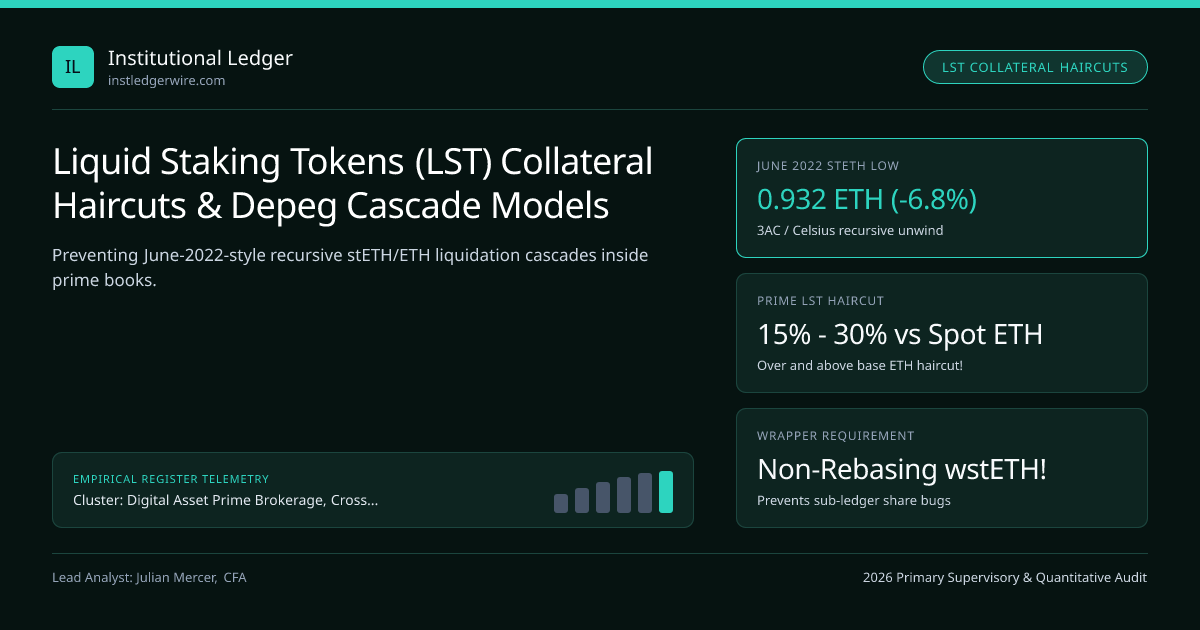
Posting $50 million of wrapped staked Ether (wstETH or cbETH) as Initial Margin on a derivatives book sounds like pure treasury alchemy: earn 3.1% native Ethereum consensus + MEV rewards on collateral that simultaneously backs your futures and perpetual trades! Done at 1x–2x prudent prime haircuts, it adds 220+ basis points of risk-controlled ROE; done naively with high leverage or spot-wick oracles, it recreates the June 2022 Three Arrows / Celsius stETH liquidation cascade.
Post-Mortem of June 2022: How Recursive LST Loops Amplify Exit Queues#
Why did BIS Working Paper No. 1149 study the June 2022 stETH depeg as the textbook case of endogenous DeFi liquidity spirals?
- Dozens of leveraged funds deposited
10,000 ETHinto Lido forstETH, postedstETHinto lending pools at80% LTVto borrow8,000 ETH, staked again, and looped 5 to 7 times—controlling45,000 stETHon10,000 ETHof equity! - When Terra's collapse forced Three Arrows Capital and Celsius to raise emergency ETH cash, Curve's
stETH/ETHpool became 82% lopsided;stETHfell to0.932 ETH(-6.8%); every6x+looped borrower hit liquidation simultaneously—dumping morestETHinto an exhausted pool! - Even post-Shapella, as proven in validator exit churn limits and unbonding-queue discounts, Ethereum's 57,600 ETH/day exit cap means arbitrageurs cannot burn
500,000 stETHinstantaneously—requiring a 9+ day warehouse window that still prices a 1.5%–5.0% panic discount!
How Institutional Prime Risk Engines Haircut & Price LST Collateral#
In our institutional crypto prime brokerage cornerstone guide, we specify the four-part risk architecture tier-1 prime brokers and exchanges (Backpack Exchange, Bitfinex, BitMEX) apply before accepting any LST as pledged margin:
- Mandatory Non-Rebasing Share Standard: Only constant-balance share tokens (
wstETH,cbETH,LsETH,BNSOL) pass custody intake—aligning cleanly with rebasing vs accumulating share-class accounting and FASB ASC 350-60. - Multiplicative Two-Tier Haircut (
25%–30%Total): Applying the base spot ETH volatility haircut (18%) multiplied by an explicit LST liquidity + smart-contract governance haircut (10%–15%). - Position Concentration vs 2%-Depth Pool Cap: Never allowing a single client's pledged LST to exceed 25% of combined 2%-slippage depth across Curve, Uniswap, Bitstamp, and wholesale OTC desks (Aquanow, B2BX).
- Strict Quarantine of Liquid Restaking Tokens (
LRTs): Refusing or heavily cappingLRTsdue to multi-AVS slashing opacity (EigenLayer restaking AVS slashing contagion).
| Staked Wrapper | Share Accounting | Governance & KYB Model | Secondary Liquidity Venues | Typical Prime Haircut |
|---|---|---|---|---|
Lido wstETH | Non-rebasing (c-token exchange rate) | Permissionless LDO DAO + Dual Governance | Deepest DEX (Curve, Uniswap) + Bitfinex / OTC (Aquanow) | 25% – 30% |
Coinbase cbETH | Non-rebasing exchange rate | Regulated public company + NYDFS/custody controls | Institutional CLOBs (Bitstamp/CEXs) + Base DEXs | 24% – 28% |
Liquid Collective LsETH | Non-rebasing exchange rate | Institutional KYB minting + multi-operator SLA + Nexus/Lloyd's | Institutional OTC (B2BX) + primary exit queue | 24% – 28% |
Solana BNSOL / jitoSOL | Non-rebasing exchange rate | Exchange / validator MEV-shared stake pool | Backpack Exchange + Jupiter/Orca DEXs (~2.2d epoch exit!) | 30% – 38% (higher SOL vol) |
DAO Upgrade Risk: Dual-Governance Timelocks & Smart-Contract Audits#
Unlike native spot ETH inside cold custody, every LST introduces smart-contract proxy upgrade risk. If a malicious DAO governance proposal could swap out the wstETH withdrawal contract in 24 hours, every prime lender would face 100% collateral theft! Institutional risk committees require either regulated corporate fiduciary issuance (cbETH, LsETH) or veto-enabled dual governance with >= 7-day timelock escape hatches.
- Variables & Worked $50,000,000 wstETH Prime Margin Collateral Valuation Under Normal vs Depeg Stress:
- Holdings = 13,500 wstETH; InternalProtocolRatio = 1.1852 ETH/wstETH (= 16,000 underlying ETH)
- hETH (Spot ETH Haircut) = 18.0%; hLST_Depeg (Liquidity/Smart-Contract Haircut) = 12.0% -> Combined Multiplier = 0.82 * 0.88 = 0.7216 (27.84% Total Haircut)
- 1. Calm Market (ETH = $3,125 -> $50.00M NAV; Market wstETH trades at par 1.1852 ETH):
- Borrowing / Margin Credit = $50,000,000 * 0.7216 = $36,080,000 Initial Margin Credit (earning ~3.1% staking yield!).
- 2. Acute Panic (-20% ETH drop to $2,500 AND -4.5% secondary wstETH depeg to 1.1319 ETH/wstETH):
- Stressed Market Value = 16,000 * $2,500 * 0.955 = $38,200,000 -> Margin Credit = $27,565,120 (27.8% buffer prevents forced liquidation!).
Optimal Capital-Stacking: LSTs for Long-Bias vs BUIDL for Short-Perp Margin#
Notice a critical correlation rule for basis desks: if you are short ETH perpetuals and post wstETH as margin, a sudden -30% ETH crash earns you +$30M on the short perp while shrinking your wstETH collateral USD value; conversely, in a +40% rally your wstETH rises with ETH! Match wstETH collateral strictly to short-ETH / inverse carry or moderate-LTV volatility books, never unhedged recursive loops.
LST Collateral Risk Approval Checklist#
Risk officers active in our Digital Asset Prime Brokerage & PoR hub enforce <= 72% maximum collateral credit on vetted non-rebasing LSTs under ESMA and NYDFS risk standards, verify DEX+OTC exit depth weekly, and validate venues via our verification portal.
Frequently asked questions
Now that Ethereum withdrawals (Shapella) are live, why can stETH or cbETH still trade below 1.000 NAV during a crash?
Shapella enabled primary 1:1 ETH burns—which dramatically tightened normal stETH spreads compared to 2022! HOWEVER, primary burns still pass through Ethereum’s 57,600 ETH/day exit churn limit. If 2.0 million ETH tries to exit during a market crash (35-day queue), secondary sellers demanding instant ETH today must pay arbitrageurs a 2% to 6% liquidity discount!
Why do institutional prime brokers ban raw rebasing stETH and accept only wrapped wstETH or cbETH?
Raw Lido stETH updates balanceOf(vault) once daily via an oracle rebase—which breaks fixed-share tri-party pledge locks, perpetual margin engines, and FASB ASC 350-60 tax-lot tracking! Non-rebasing wstETH, Coinbase cbETH, and Liquid Collective LsETH keep token units 100% constant while increasing their internal ETH-per-share exchange rate!
Which oracle trap wipes out recursive LST-collateralized borrowers: "Market Price Oracle" vs "Exchange-Rate NAV Oracle"?
Using a Spot DEX/CEX Market Oracle liquidates healthy long-term borrowers on temporary 5% Curve pool dumps—triggering a death spiral of forced LST sales! Conversely, using a hardcoded 1:1 Protocol Exchange-Rate Oracle without conservative LTV caps risks leaving the lender with bad debt if a smart-contract exploit or massive slashing permanently impairs the LST! Prime desks blend TWAP market bounds + conservative LTV caps (<=75%).
What is Liquid Collective (LsETH) and why do KYB-regulated institutions favor permissioned institutional LSTs?
Retail DAO-governed LSTs accept permissionless deposits and govern upgrades via anonymous token votes. Institutional-grade LSTs like Liquid Collective (LsETH) or cbETH enforce KYB/AML screening on primary minters, multi-operator SOC 2 enterprise node validation (Figment, Kiln, Coinbase), and dedicated commercial slashing coverage.
Publication record
- Published
- November 13, 2026
- Updated
- November 15, 2026
- Author
- Julian Mercer, CFA
- Review
- Review not recorded
- Automated fact check
- Passed in the stored pipeline record
- Source URLs
- 3 recorded
AI assistance recorded: anthropic/claude-opus-4.6. This field does not establish human review or source verification.
Academic & Institutional Attribution
Cite This Research & Embed Live Data Card
Standard academic & institutional research paper citation format.
Julian Mercer, CFA. (2026, November 15). Liquid Staking Tokens (LST) Collateral Haircuts & Depeg Cascade Models. Institutional Ledger. https://instledgerwire.com/stories/liquid-staking-tokens-lst-collateral-haircuts-depeg-cascadesRegulatory Directory Cross-Reference
Referenced Institutions & Regulatory Registries
Mentioned Regulated Institutions
Related Institutional Crypto Prime Margin & Institutional Briefings
Explore Institutional Crypto Prime Margin Hub (20) →Institutional Crypto Prime Margin
Institutional Crypto Prime Brokerage, Cross-Venue Netting & zk-PoR Guide (2026)Institutional Crypto Prime Margin
Principal vs Agency Prime Execution & Institutional Smart Order RoutingInstitutional Crypto Prime Margin
Crypto Securities Lending: Open-Term Recall SLAs, GMSLA & Borrow RatesInstitutional Crypto Prime Margin
Portfolio VaR & SPAN Margin Models for Multi-Leg Digital Asset BooksInstitutional Crypto Prime Margin
Weekend Gap Risk: CME Friday 4:00 PM CT Close vs 24/7 PerpetualsInstitutional Crypto Prime Margin
Restaking & EigenLayer AVS Slashing Contagion: Institutional PolicyInstitutional Crypto Prime Margin
On-Chain Wallet Ownership Proofs: BIP-322, EIP-191 & Micro-TransfersInstitutional Crypto Prime Margin
Prime Credit Intermediation & Post-2022 Undercollateralized Lending BansRegulatory Compliance
Crypto ally Tom Emmer elected House GOP minority whipcybersecurity
Bitget Wallet reports sevenfold jump in crypto phishing risk alertsDigital Assets
Deutsche Bank launches crypto custody for companies and institutionsCryptocurrency Markets
Mercado Bitcoin to resume cash withdrawals after $49M hack
Institutional Ledger Data, Benchmarks & Contributor Records
CC BY 4.0 Open Data
Open Institutional Datasets (CSV / JSON) →
Download desk-compiled quantitative series & schemas.
2026 Reference Matrix
2026 Institutional Benchmarks & Thresholds →
Statutory capital, clearing, margin & rate conventions.
Editorial Records
Authors & Review Records →
View named contributors where those records are available.
Complete Index
Master Research & Dossier Archive →
Browse all published briefings by topic pillar & date.