
Institutional Crypto Prime Margin
Principal vs Agency Prime Execution & Institutional Smart Order Routing
Routing a $50M institutional order through a conflicted principal desk leaks trading intent within milliseconds; understanding when to deploy agency TWAP/SOR algorithms versus multi-dealer blind RFQ saves 8 to 35 bps per trade!
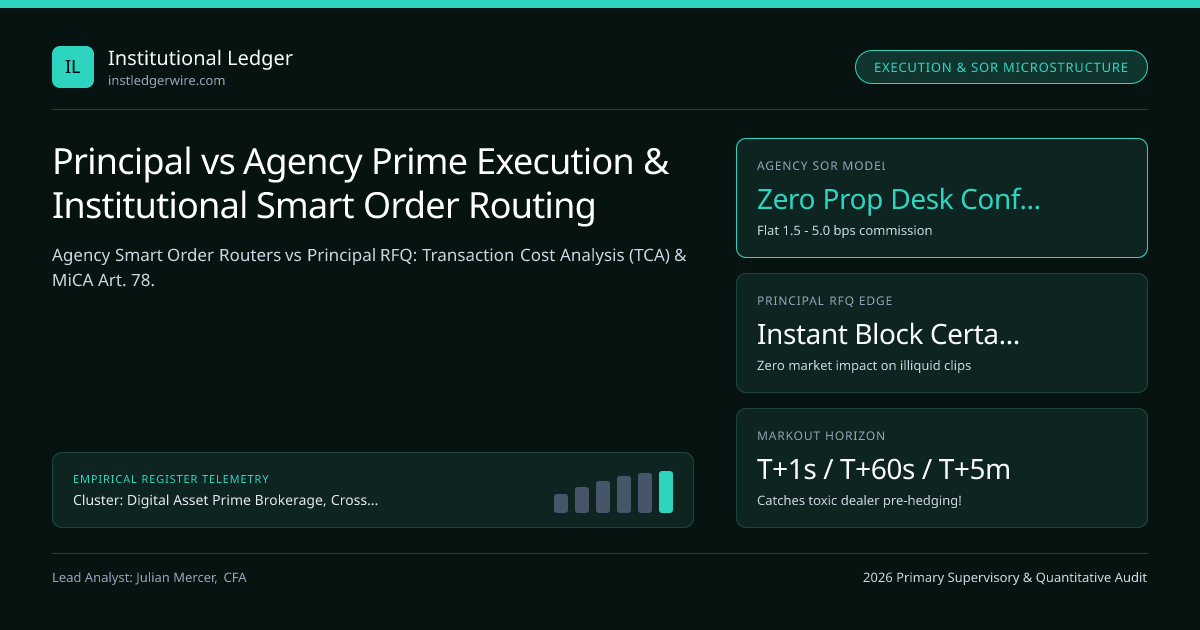
Nothing in institutional crypto is more expensive than a "zero-commission" trading desk. When a conflicted broker quotes you a "zero-fee" block price while simultaneously running an internal proprietary market-making book, your fund routinely pays 15 to 40 basis points of invisible spread and pre-hedging slippage! Institutional execution desks separate conflict-free Agency Smart Order Routing (SOR) from vetted 2-Way Principal RFQ, policing every counterparty down to the millisecond with Transaction Cost Analysis (TCA) markouts.
Structural Conflict of Interest: Pure Agency Prime vs Internalizing Principal#
In traditional equities and FX, every institutional head trader knows whether they are speaking to the Agency Algo Desk (fiduciary wall, compensated strictly by flat bps commission) or the Principal Risk Desk (adverse counterparty pricing balance-sheet risk). Early crypto platforms blurred both roles inside one entity!
In our institutional crypto prime brokerage cornerstone guide and under EU MiCA Articles 72 & 78 supervised by ESMA, AMF, and BaFin, institutional execution mandates enforce strict separation:
- Conflict-Free Agency SOR: Your prime router holds zero proprietary positions. It connects via co-located FIX / binary WebSockets to regulated spot CLOBs (Bitstamp, Backpack Exchange, Bitfinex) across both USD and regulated USDC books—normalizing maker/taker fee tiers so a
-1.0 bpsmaker rebate on Venue A beats a+5.0 bpstaker fee on Venue B even when Venue B's raw top-of-book looks3 bpstighter! - Post-Trade Netting Magic: Even if your
$40Mparent order fills in 1,400 child slices across 9 venues, your prime broker settles one single net custody transfer at the end of the window!
Policing Principal OTC Liquidity Providers With Millisecond Markout Curves#
Wholesale electronic liquidity providers (Aquanow, B2BX, 8 Blocks Capital, Wintermute, B2C2, Galaxy, Flow Traders) play an indispensable role when an ETF Authorized Participant needs a firm $50M block at 4:00:00 PM ET or wants dark midpoint fills inside an SOR without moving public orderbooks.
How do quantitative execution teams separate high-integrity risk-warehousing LPs from toxic "back-to-back pre-hedgers"?
- Timestamp Capture (
T_inquiry,T_quote,T_fill,T+1s,T+10s,T+60s,T+300s): Record the composite global mid-price before your RFQ packet ever leaves your server! - Pre-Fill Drift Check (
T_fill - T_inquiry): If composite mid-price consistently jumps+6 bpsagainst you during the 800 milliseconds an LP takes to return or confirm a quote, that LP is hedging on Binance/CME BEFORE filling you! - Post-Fill Decay Curve: A genuine balance-sheet warehouse LP absorbs your
$25Mclip smoothly (T+5smarkout< 2 bps) and unwinds patiently over 20 minutes; a toxic pass-through LP dumps your entire clip onto public perps within 2 seconds, spiking the market against your remaining parent order!
| Execution Model | Counterparty Capacity | Fee & Spread Structure | Information Leakage Profile | Ideal Institutional Use Case |
|---|---|---|---|---|
| Pure Agency SOR / Algo | Fiduciary Agent (Zero Prop Book) | Explicit 1.5–4.0 bps fee; passes venue rebates | Lowest — randomized child slice sizes & venues | $10M–$200M BTC/ETH rebalancing over 30m–4h |
Firm Streaming OTC (No Last Look) | Principal Liquidity Provider (Aquanow, B2BX, 8 Blocks) | 0 commission; tight 2–6 bps bid-ask spread | Low if audited via T+5s markout curves | Sub-$5M instant fills integrated inside SOR |
| 2-Way Blind Block RFQ | Principal Block Desk | All-in guaranteed risk-transfer price | Low (when capped at <= 2 vetted dealers) | Exact 4:00 PM ET Spot ETF creation/redemption blocks |
| Conflicted Internalizer ("Free" Brokerage) | Undisclosed Principal / Payment-for-Flow | "Zero fee" marketing hiding 15–45 bps wide spread! | SEVERE — internal prop desk trades against you | AVOID — fails institutional TCA & ESMA MiCA Art. 78 |
Almgren-Chriss Scheduling & Cross-Pair Synthetic Routing (USD vs USDC vs EUR)#
Crypto liquidity fragments not just across venues, but across quote currencies (BTC/USD, BTC/USDC, BTC/EUR). Advanced institutional SORs paired with prime credit intermediation run multi-leg triangular graph search—simultaneously sweeping BTC/USD on Bitstamp, BTC/USDC via zero-fee Circle Mint parity, and on-chain DEX liquidity protected by private MEV RPC relays.
- PostTradeDealerToxicityMarkout(Deltat) = DirectionSign * ( (MidPrice(Tfill + Deltat) - MidPrice(Trfqrequest)) / MidPrice(Trfq_request) ) * 10,000
- Variables & $30,000,000 BTC Buy Order TCA Audit (Arrival Mid at 14:00:00.000 UTC = $96,000.00):
- 1. Agency Adaptive SOR (62% Maker @ -0.5 bps rebate across Bitstamp/Backpack/Bitfinex + 38% Firm LP; Avg Fill = $96,014.40; Prime Fee = 2.0 bps):
- Shortfall = ((96,014.40 - 96,000.00) / 96,000) * 10,000 + 2.0 = 1.50 + 2.00 = 3.50 bps ($10,500 total friction on $30M!)
- 2. Conflicted "Zero-Commission" Principal Desk (Quotes $96,172.80 after pre-hedging 150ms post-inquiry):
- Shortfall = 18.00 bps ($54,000 cost — $43,500 hidden execution tax exposed instantly by T+1s Markout Audit!)
Establishing a Quarterly Best-Execution (TCA) Governance Committee#
Under SEC fiduciary investment-adviser duties, MAS fund-management rules, and EU MiCA Article 78, institutional asset managers convene a Quarterly Best-Execution Committee reviewing broker implementation-shortfall league tables, LP markout scorecards, and outage failover metrics.
Institutional Execution & SOR Onboarding Checklist#
Head traders active in our Digital Asset Prime Brokerage & PoR hub require written Agency-Only disclosures or Zero-Last-Look LP SLAs, integrate independent millisecond TCA telemetry, and verify execution counterparties via our verification portal.
Frequently asked questions
When does an Agency Smart Order Router (SOR) beat a Principal OTC Request-for-Quote (RFQ), and vice versa?
For deep Tier-1 pairs (BTC/USD, ETH/USD, SOL/USD) where you have a 15-to-120-minute execution window, an Agency Adaptive VWAP/Implementation-Shortfall SOR capturing passive maker rebates across multiple CLOBs typically beats RFQ by 4 to 12 bps! Conversely, when you need instantaneous T+0 certainty (e.g., matching a 4:00 PM ET ETF NAV cut or moving $15M of a thinner mid-cap token), a 2-way Blind Principal RFQ eliminates orderbook signaling!
What is "two-way blind RFQ" and why should you NEVER tell an OTC desk whether you are buying or selling?
If you ask three OTC market makers *"Give me an offer on 500 BTC,"* two losing dealers instantly know a 500-BTC buyer is in the market—and their automated hedging engines lift offers on Binance/Bitstamp ahead of the winning dealer ("winner’s curse")! Requesting a two-way quote (Bid / Ask for 500 BTC) conceals your direction until fill confirmation!
What is "Last Look" in electronic principal liquidity streams, and should institutional desks allow it?
Borrowed from FX markets, Last Look lets an electronic liquidity provider (LP) hold your order for 5–50 ms and asynchronously reject the trade ONLY if prices moved against the LP (while filling 100% of trades that moved in the LP’s favor!). Institutional crypto desks demand Zero-Last-Look (Firm Liquidity) streams or strictly symmetric hold-time audits!
How does EU MiCA Article 78 enforce institutional Best Execution on European CASPs?
Modeled directly on MiFID II Article 27, MiCA Article 78 obligates every EU-licensed CASP executing orders for clients to take "all necessary steps to obtain the best possible result" across price, costs, speed, likelihood of execution/settlement, and custody safety—and prohibits routing client flow to an internal principal market maker without explicit conflict controls and disclosure!
Publication record
- Published
- November 13, 2026
- Updated
- November 14, 2026
- Author
- Julian Mercer, CFA
- Review
- Review not recorded
- Automated fact check
- Passed in the stored pipeline record
- Source URLs
- 3 recorded
AI assistance recorded: anthropic/claude-opus-4.6. This field does not establish human review or source verification.
Academic & Institutional Attribution
Cite This Research & Embed Live Data Card
Standard academic & institutional research paper citation format.
Julian Mercer, CFA. (2026, November 14). Principal vs Agency Prime Execution & Institutional Smart Order Routing. Institutional Ledger. https://instledgerwire.com/stories/principal-vs-agency-prime-execution-smart-order-routingRegulatory Directory Cross-Reference
Referenced Institutions & Regulatory Registries
Mentioned Regulated Institutions
Related Institutional Crypto Prime Margin & Institutional Briefings
Explore Institutional Crypto Prime Margin Hub (20) →Institutional Crypto Prime Margin
Institutional Crypto Prime Brokerage, Cross-Venue Netting & zk-PoR Guide (2026)Institutional Crypto Prime Margin
Crypto Securities Lending: Open-Term Recall SLAs, GMSLA & Borrow RatesInstitutional Crypto Prime Margin
Portfolio VaR & SPAN Margin Models for Multi-Leg Digital Asset BooksInstitutional Crypto Prime Margin
Weekend Gap Risk: CME Friday 4:00 PM CT Close vs 24/7 PerpetualsInstitutional Crypto Prime Margin
Restaking & EigenLayer AVS Slashing Contagion: Institutional PolicyInstitutional Crypto Prime Margin
On-Chain Wallet Ownership Proofs: BIP-322, EIP-191 & Micro-TransfersInstitutional Crypto Prime Margin
Prime Credit Intermediation & Post-2022 Undercollateralized Lending BansInstitutional Crypto Prime Margin
Perpetual Funding-Rate Volatility, Impact Notional & Auto-Liquidation Enginescybersecurity
Bitget Wallet reports sevenfold jump in crypto phishing risk alertsDigital Assets
Deutsche Bank launches crypto custody for companies and institutionsCryptocurrency Markets
Mercado Bitcoin to resume cash withdrawals after $49M hackCryptocurrency Markets
BitGo Q3 profit nearly doubles on crypto gains as revenue falls 51%
Institutional Ledger Data, Benchmarks & Contributor Records
CC BY 4.0 Open Data
Open Institutional Datasets (CSV / JSON) →
Download desk-compiled quantitative series & schemas.
2026 Reference Matrix
2026 Institutional Benchmarks & Thresholds →
Statutory capital, clearing, margin & rate conventions.
Editorial Records
Authors & Review Records →
View named contributors where those records are available.
Complete Index
Master Research & Dossier Archive →
Browse all published briefings by topic pillar & date.