
Institutional Crypto Prime Margin
Institutional ETH Staking Slashing Insurance & Correlated Penalty Math
An isolated validator double-sign loses ~0.03 to 1 ETH, whereas a correlated client bug hitting 33% of Ethereum staked supply triggers a 100% principal wipeout—shaping every institutional slashing insurance policy!
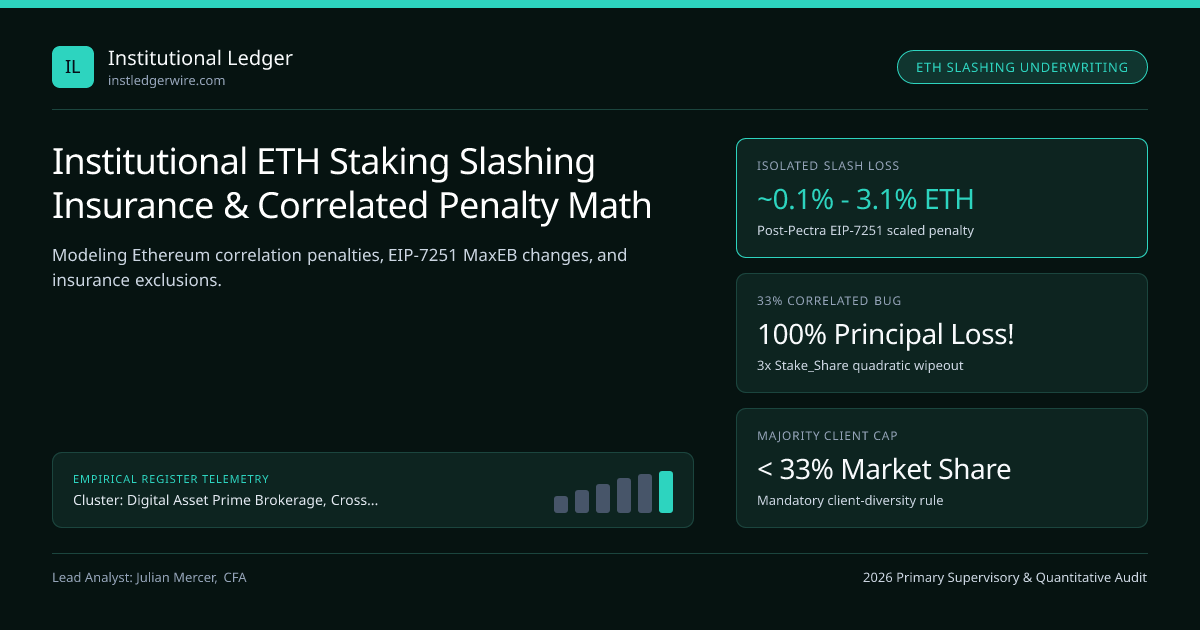
When traditional institutional allocators first underwrite native Ethereum staking—whether inside ETPs, sovereign wealth accounts, or prime brokerage collateral vaults—their first question is always "Do you carry slashing insurance?" Veteran protocol engineers immediately ask a sharper second question: "Have you read Exclusion Clause 4(b) of that slashing policy, and what consensus client runs your validators?" Because Ethereum's correlation penalty scales quadratically from 0.40% loss on an isolated operator mistake up to 100.0% wipeout on a >33.3% client bug, true institutional underwriting marries actuarial insurance with strict multi-client engineering.
Cryptographic Separation of Keys: Why Validator Operators Cannot Steal Principal#
Before pricing slashing penalties, let's reinforce a foundational custody guarantee connected to custodian sub-custody delegation and ancillary staking liability: Ethereum natively separates the hot BLS signing key from the cold 0x01/0x02 withdrawal credential!
- Even if a third-party validator node operator's cloud server were completely compromised by an attacker, the attacker CANNOT redirect your staked ETH to their own wallet—withdrawn principal and consensus rewards can ONLY ever return to the immutable withdrawal vault address locked inside your NYDFS, FINMA, or BaFin cold HSM!
- What a compromised or misconfigured validator can do is broadcast two conflicting signatures for the same slot/epoch—triggering protocol slashing.
The Quadratic Correlation Formula & EIP-7251 (MaxEB 2,048 ETH)#
Why did Ethereum researchers design the *Day-18 Correlation Multiplier (`3 SlashedStake / TotalStake`)** analyzed in our institutional crypto prime brokerage cornerstone guide?
- Forgiving Toward Honest Mistakes: Under Pectra
EIP-7251, which raised Maximum Effective Balance from32 ETHto2,048 ETHwith auto-compounding0x02credentials, the immediate Epoch-0 penalty dropped 128-fold (fromEB/32toEB/4096). If a boutique custodian accidentally double-signs 500 ETH in isolation, the combined initial + correlation + 36-day bleed costs less than 0.25% of principal! - Merciless Toward Coordinated Attacks & Monocultures: If a rogue staking cartel—or a consensus bug in a client exceeding 33.33% network share—causes one-third of all validators to equivocate within an 18-day before / 18-day after window,
3 * 0.3334 = 1.00—burning 100% of staked principal!
| Risk Factor | Isolated Operator Double-Sign | Large Staking Pool Outage/Bug (5% Stake) | Supermajority Client Bug (>33.3% Stake) |
|---|---|---|---|
| 36-Day Correlation Multiplier | ~0.00% – 0.03% | 15.00% of principal (3 * 5%) | 100.00% Principal Wipeout! (3 * 33.3%) |
| Commercial Insurance Coverage? | Yes — up to policy cap ($25M–$100M) | Capped — policy sub-limit exhausted fast! | EXCLUDED — systemic protocol bug carve-out! |
| Root Engineering Cause | Manual active-active key copy on failover | Automated Ansible/Terraform fleet misconfig | Consensus bug in dominant Execution/Consensus client |
| Mandatory Institutional Control | EIP-3076 HSM/Remote Signer high-water lock | Canary staggered rollouts + multi-custodian split | Ban any EL/CL client >33% network share + DVT |
Reading the Fine Print of Lloyd’s & Captive Staking Insurance Policies#
Institutional staking providers (Kiln, Figment, Blockdaemon, Twinstake, Coinbase Prime, Bitstamp/Bitfinex staking desks) market commercial slashing policies backed by Munich Re or Lloyd's syndicates. General counsels auditing those policies verify four exact terms:
- Aggregate Policy Limit vs Total Stake: If a node operator stakes $8 billion of ETH across all clients and carries a $50 million aggregate policy limit, a fleet-wide Ansible script error costing 8% ($640M) reimburses clients 7.8 cents on the dollar!
- Client-Bug Carve-Out: Policies universally exclude bugs inside open-source Ethereum Execution (
Geth,Nethermind) or Consensus (Prysm,Lighthouse) clients! - First-Loss Deductible: Best-in-class institutional SLAs contractually obligate the node operator's corporate balance sheet to reimburse the first
0.5%–1.0%deductible before insurance attaches.
- where:
- InitialPenalty = EffectiveBalance / 4096
- CorrelationPenalty = EffectiveBalance * Min( 1.0, (3 * TotalSlashedBalanceIn36dWindow) / TotalActiveNetworkStake )
- Variables & $100,000,000 Institutional ETH Stake (32,000 ETH @ $3,125/ETH; Network Stake = 34,000,000 ETH):
- Case A — Isolated Single-Operator Misconfiguration (Only your 32,000 ETH = 0.094% of network slashed):
- Initial ($24.4k) + Correlation (0.282% = $282.4k) + 36d Bleed (~$95k) = ~$401,800 Total Loss (0.40% of stake — fully insurable!)
- Case B — Majority Execution/Consensus Client Bug (12,000,000 ETH = 35.3% of network slashed simultaneously!):
- Correlation_Penalty = Min(1.0, 3 * 0.353) = 100.0% -> -$100,000,000 TOTAL PRINCIPAL LOSS (Excluded from insurance!)
Engineering Zero-Double-Sign Infrastructure: EIP-3076, Minority Clients & DVT#
Institutional staking mandates enforce three technical covenants in every validator SLA:
- Contractual
< 33%Minority Client Cap: Validators must run minority execution + consensus pairs (Lighthouse/Teku/Nimbus+Nethermind/Besu/Reth), with automated circuit-breakers halting signing rather than attesting to an invalid chain! - Dedicated Remote Signers (
Dirk/ HSM): Signing keys reside on isolated HSMs enforcing atomicEIP-3076high-water-mark locks—never copied across cloud VMs! - Multi-Operator Split & DVT: Splitting large allocations across
>= 3uncorrelated operators (and avoiding unvetted EigenLayer AVS slashing contagion) keeps operator correlation near zero while managing validator exit churn queues.
Staking Underwriting Checklist for ETFs & Prime Vaults#
Investment committees active in our Digital Asset Prime Brokerage & PoR hub cap any single validator operator at <= 25% of fund stake, verify US Spot Ethereum ETF custody-staking segregation under SEC SAB 122, and confirm charters via our verification portal.
Frequently asked questions
What is the difference between an Ethereum "inactivity leak / offline penalty" and a "slashing event"?
Going offline during normal network finality merely misses attestations—losing roughly the same modest ~0.008% per day you would have earned (no slashing, no forced exit!). Slashing occurs ONLY when a validator commits a provable cryptographic equivocation: signing two conflicting blocks at the same slot (Double Proposal) or signing conflicting Casper FFG checkpoints (Surround / Double Vote).
How did EIP-7251 (Max Effective Balance 2,048 ETH in Pectra) change institutional staking risk math?
Before EIP-7251, institutional custodians staking 320,000 ETH had to run 10,000 separate 32-ETH validators, and an accidental failover double-sign immediately burned 1/32 (1.0 ETH per validator). EIP-7251 lets institutions consolidate into 157 validators of 2,048 ETH while slashing initial penalties dropped 128x from EB / 32 to EB / 4096 (0.50 ETH on 2,048 ETH)!
Why do Lloyd’s of London staking slashing policies exclude supermajority consensus-client bugs?
Because a bug inside a consensus client holding >66% of Ethereum’s ~$100B+ staked supply would destroy tens of billions of dollars simultaneously—exceeding global specialty insurance capacity! Slashing insurance covers operator human error / failover misconfiguration (e.g., running active-active duplicate keys), whereas client diversity is the ONLY defense against a consensus client bug!
How do Distributed Validator Technology (DVT — Obol / SSV) and Dirk/Vouch remote signers prevent failover double-signing?
Almost 100% of historical institutional slashings happened when a DevOps engineer failed over a downed primary node to a backup node that signed the same slot twice! Hardware-backed remote signers (Web3Signer / Dirk) with acid-compliant EIP-3076 slashing-protection DBs—or 3-of-4 threshold DVT clusters across independent clouds—mathematically refuse to sign any slot <= Highest_Signed_Slot.
Publication record
- Published
- November 13, 2026
- Updated
- November 15, 2026
- Author
- Julian Mercer, CFA
- Review
- Review not recorded
- Automated fact check
- Passed in the stored pipeline record
- Source URLs
- 3 recorded
AI assistance recorded: anthropic/claude-opus-4.6. This field does not establish human review or source verification.
Academic & Institutional Attribution
Cite This Research & Embed Live Data Card
Standard academic & institutional research paper citation format.
Julian Mercer, CFA. (2026, November 15). Institutional ETH Staking Slashing Insurance & Correlated Penalty Math. Institutional Ledger. https://instledgerwire.com/stories/institutional-eth-staking-slashing-insurance-correlated-penaltiesRegulatory Directory Cross-Reference
Referenced Institutions & Regulatory Registries
Mentioned Regulated Institutions
Referenced Supervisory Authorities
Related Institutional Crypto Prime Margin & Institutional Briefings
Explore Institutional Crypto Prime Margin Hub (20) →Institutional Crypto Prime Margin
Institutional Crypto Prime Brokerage, Cross-Venue Netting & zk-PoR Guide (2026)Institutional Crypto Prime Margin
Validator Exit Churn Limits, Unbonding Queues & Liquidity DiscountsInstitutional Crypto Prime Margin
Prime Broker Cross-Margining: Spot ETFs, CME Futures & Perp OffsetsInstitutional Crypto Prime Margin
Liquid Staking Tokens (LST) Collateral Haircuts & Depeg Cascade ModelsInstitutional Crypto Prime Margin
Principal vs Agency Prime Execution & Institutional Smart Order RoutingInstitutional Crypto Prime Margin
Crypto Securities Lending: Open-Term Recall SLAs, GMSLA & Borrow RatesInstitutional Crypto Prime Margin
Portfolio VaR & SPAN Margin Models for Multi-Leg Digital Asset BooksInstitutional Crypto Prime Margin
Weekend Gap Risk: CME Friday 4:00 PM CT Close vs 24/7 PerpetualsCryptocurrency Markets
Crypto hack losses equal 57 cents per $1 earned onchain: Ark’s ValenteRegulatory Compliance
European Union Presses the Button for Tokenized Assets: Common Standards Are Coming - Cryptonews.netMonetary Policy
Hot US inflation raises odds of half-point Fed hike in DecemberRegulatory Compliance
Crypto ally Tom Emmer elected House GOP minority whip
Institutional Ledger Data, Benchmarks & Contributor Records
CC BY 4.0 Open Data
Open Institutional Datasets (CSV / JSON) →
Download desk-compiled quantitative series & schemas.
2026 Reference Matrix
2026 Institutional Benchmarks & Thresholds →
Statutory capital, clearing, margin & rate conventions.
Editorial Records
Authors & Review Records →
View named contributors where those records are available.
Complete Index
Master Research & Dossier Archive →
Browse all published briefings by topic pillar & date.