
Institutional Crypto Prime Margin
Portfolio VaR & SPAN Margin Models for Multi-Leg Digital Asset Books
Linear delta-sum margining penalizes hedged option butterflies, calendar spreads, and dispersion books; institutional prime engines deploy 16-point SPAN scenario grids and Filtered Historical Simulation VaR.
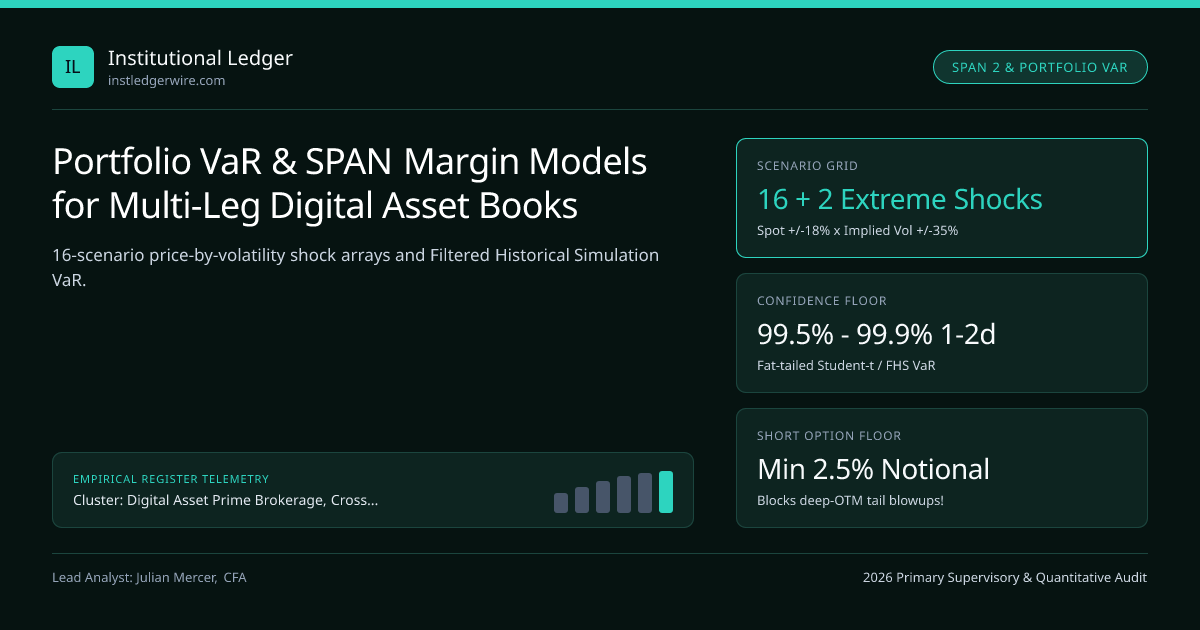
Try trading a $50 million iron condor or volatility dispersion book on a legacy crypto platform and you hit an immediate wall of broken math: leg-by-leg margin engines charge $18 million of Initial Margin on a structure whose maximum mathematical loss at expiration is capped at $5 million! Conversely, naive linear delta models ignore negative gamma and blow up on the first 20% crash. Institutional prime desks solve both extremes simultaneously with 18-scenario SPAN 2 option arrays paired with GARCH-Filtered Historical Simulation Expected Shortfall (FHS-ES).
Inside the 18-Point Scenario Grid: Capturing Gamma & Vega Convexity#
Why has SPAN (Standard Portfolio Analysis of Risk)—invented at CME after the October 1987 Black Monday crash and upgraded to SPAN 2—endured as the global clearinghouse backbone mapped in our institutional crypto prime brokerage cornerstone guide?
Because derivatives portfolios fail nonlinearly! A trader who is delta-zero at $100,000 BTC via short front-week options becomes catastrophically short -450 BTC if Bitcoin drops -15% to $85,000 while front-week implied volatility rockets from 52% to 110%!
- Rather than trusting local first-order Greeks (
Delta,Vega), the prime SPAN engine evaluates full Black-76 / Sabr volatility-surface option pricing across 16 standard grid points (+/- 33%, 67%, 100%of the 99% scan range crossed with+/- Implied Vol) plus 2 extreme +/-200% scan-range tail cells weighted at35%to catch unhedged deep-OTM short wings!
Why Term-Scaled Implied Volatility Shocks Matter in 24/7 Crypto#
A rookie error in crypto option margining is applying a flat +/-25% implied volatility shock across all expiries!
- During an acute crypto crash (March 12, 2020 or November 9, 2022), 7-day ATM implied volatility jumps +80% to +120%, whereas 180-day implied volatility rises only +20% to +30% ("backwardation of the vol surface")!
- Institutional prime engines scale volatility shocks by
Sqrt(30 / Days_To_Expiry)—properly margining short weekly gamma sellers while rewarding calendar-spread and hedged Spot ETF option structures (US Spot Crypto ETFs).
| Risk Dimension | Isolated Retail Margin | Naive Linear Parametric VaR | Institutional Prime SPAN 2 / FHS-ES |
|---|---|---|---|
| Multi-Leg Option Spreads | Penalized (full margin per leg) | Misses pin risk & gamma convexity | Full Black-76 nonlinear surface repricing |
| Implied Volatility Shocks | Ignored until mark-to-market hit | Flat vega linear approximation | Term-scaled IV shock (front-week +60% IV) |
| Fat-Tail Crash Calibration | Ad-hoc leverage tier cuts | Gaussian understates 6-sigma tails | 2020/2021/2022 stressed returns + SOM floor |
| Collateral Wrong-Way Risk | Static haircut until liquidation | Separate collateral & trade models | Jointly shocks collateral + derivatives in same cell |
| Institutional Venues & Primes | Retail perp platforms | Legacy prime v1 scripts | CME Clearing, OCC STANS, Backpack, BitMEX PM |
Joint Wrong-Way Collateral Shock & Inter-Asset Correlation Caps#
Aligned with Basel FRTB Expected Shortfall (BCBS d457) and Basel SCO60 hedged Group 2a recognition, tier-1 prime engines (Backpack Exchange, BitMEX, Bitfinex, and bank/FCM primes) enforce three non-negotiable overlays:
- Joint Collateral Revaluation: Your pledged collateral (
BTC,ETH,wstETH,USDC,BUIDL) is shocked inside the exact same scenario cell as your trades—automatically penalizing Wrong-Way Risk (e.g., long BTC perps margined in BTC) while rewarding Right-Way / Neutral Collateral (T-Bills / USDC)! - Capped Cross-Coin Offset (
<= 70%): Even ifBTCandETHshowed0.88correlation last month, cross-asset spread offsets cap at65%–70%so an idiosyncratic protocol event never breaches maintenance equity. - Illiquid Altcoin Add-Ons: Integrating stressed VaR liquidity add-ons for illiquid altcoin collateral.
- BindingPortfolioInitialMargin = Max{s in 1..18}( ws * SPANScenarioPortfolioLoss(s) ) + ShortOptionMinimum + BasisTimeSpread_Charge
- Variables & Worked $50,000,000 Short Strangle Hedged With Long Wing Protection ("Iron Condor") Margin Check:
- Book: Short 500 BTC $90k Put / $110k Call + Long 500 BTC $80k Put / $120k Call (Spot = $100,000; Max Possible Expiry Loss = $5,000,000!)
- 1. Siloed Leg-by-Leg Margin (Ignores long wings): Charges 18% on naked shorts = $18,000,000 IM (3.6x the mathematical max loss!).
- 2. Prime SPAN 2 Scenario #14 (-18% Spot to $82k + 45% Front-Month IV Spike):
- Worst Scenario Mark-to-Market Loss = $4,120,000 + SOM ($625,000) = $4,745,000 Binding IM (Saves $13.25M of trapped capital safely!).
Daily Kupiec Backtesting & Pre-Trade Sub-50ms Margin APIs#
Institutional quant pods query the prime broker's What-If Pre-Trade Margin REST/FIX endpoint before routing multi-leg blocks through Aquanow or Bitstamp—verifying exact incremental IM impact in < 50 ms, while risk teams run daily Kupiec POF 99.5% VaR backtests to verify zero model under-coverage.
Portfolio Margin Risk Model Audit Checklist#
Chief Risk Officers active in our Digital Asset Prime Brokerage & PoR hub require full whitepaper disclosure of all 18 SPAN scan ranges, Short-Option Minimum floors, and cross-asset offset tables under ESMA and CFTC / BaFin clearing standards, verifying venues via our verification portal.
Frequently asked questions
Why does Gaussian (Normal-distribution) parametric VaR fail catastrophically on digital asset portfolios?
A Gaussian distribution assumes a 5-sigma daily move happens once every 13,900 years; in Bitcoin and Ether, 15%–25% single-day flash crashes and short squeezes occur every 12–18 months (kurtosis > 12)! Prime risk engines use Expected Shortfall (CVaR) calibrated via GARCH-Filtered Historical Simulation including March 2020 (-48%) and May 2021 (-32%) stress windows!
How does the 16-scenario SPAN matrix protect against "short-gamma / short-vega" option blowups?
Delta-only models look only at a tiny 1% move—missing the fact that a short strangle has negative gamma (losses accelerate quadratically as spot moves!) and short vega (implied volatility explodes from 50% to 115% during crashes!). Evaluating full Black-76 option repricing at -18% Spot AND +40% Implied Vol captures nonlinear convexity exactly!
When can cross-asset correlation offsets (BTC vs ETH vs SOL) break down inside a Portfolio VaR model?
If a fund runs Long $50M ETH / Short $50M BTC, historical 90-day correlation Rho = 0.84 suggests low daily variance. However, during idiosyncratic catalyst shocks (e.g., surprise SEC Ethereum ETF news or a Solana network halt), ETH/BTC can jump 22% in 4 hours! SPAN 2 caps inter-commodity spread credits at 60%–75%—never 95%+!
What is "Wrong-Way Collateral Risk" inside a multi-currency portfolio margin engine?
Posting 1,000 BTC as collateral to margin a Long $100M BTC Perpetual + Short Put position creates lethal Wrong-Way Risk: in a -25% crash, your derivative loses -$28M at the exact same moment your BTC collateral shrinks -25%! Prime SPAN engines shock collateral assets and derivative positions jointly inside every scenario cell!
Publication record
- Published
- November 13, 2026
- Updated
- November 14, 2026
- Author
- Julian Mercer, CFA
- Review
- Review not recorded
- Automated fact check
- Passed in the stored pipeline record
- Source URLs
- 3 recorded
AI assistance recorded: anthropic/claude-opus-4.6. This field does not establish human review or source verification.
Academic & Institutional Attribution
Cite This Research & Embed Live Data Card
Standard academic & institutional research paper citation format.
Julian Mercer, CFA. (2026, November 14). Portfolio VaR & SPAN Margin Models for Multi-Leg Digital Asset Books. Institutional Ledger. https://instledgerwire.com/stories/portfolio-var-span-margin-models-digital-asset-multi-leg-booksRegulatory Directory Cross-Reference
Referenced Institutions & Regulatory Registries
Mentioned Regulated Institutions
Related Institutional Crypto Prime Margin & Institutional Briefings
Explore Institutional Crypto Prime Margin Hub (20) →Institutional Crypto Prime Margin
Institutional Crypto Prime Brokerage, Cross-Venue Netting & zk-PoR Guide (2026)Institutional Crypto Prime Margin
Weekend Gap Risk: CME Friday 4:00 PM CT Close vs 24/7 PerpetualsInstitutional Crypto Prime Margin
Restaking & EigenLayer AVS Slashing Contagion: Institutional PolicyInstitutional Crypto Prime Margin
On-Chain Wallet Ownership Proofs: BIP-322, EIP-191 & Micro-TransfersInstitutional Crypto Prime Margin
Prime Credit Intermediation & Post-2022 Undercollateralized Lending BansInstitutional Crypto Prime Margin
Perpetual Funding-Rate Volatility, Impact Notional & Auto-Liquidation EnginesInstitutional Crypto Prime Margin
Institutional MEV Protection: Private RPCs, Block Relays & Sandwich DefenseInstitutional Crypto Prime Margin
Tax-Lot Relief (HIFO, Specific ID) & FASB ASC 350-60 Prime Sub-Ledger SyncCryptocurrency Markets
Mercado Bitcoin to resume cash withdrawals after $49M hackCryptocurrency Markets
BitGo Q3 profit nearly doubles on crypto gains as revenue falls 51%Banking Crisis
‘Very strange, very sad’: Paraguay bank collapse fells a presidency and leaves millions brokeCryptocurrency Crime
The Shadowy Crypto Services Helping the Binance Hackers Launder Stolen Billions
Institutional Ledger Data, Benchmarks & Contributor Records
CC BY 4.0 Open Data
Open Institutional Datasets (CSV / JSON) →
Download desk-compiled quantitative series & schemas.
2026 Reference Matrix
2026 Institutional Benchmarks & Thresholds →
Statutory capital, clearing, margin & rate conventions.
Editorial Records
Authors & Review Records →
View named contributors where those records are available.
Complete Index
Master Research & Dossier Archive →
Browse all published briefings by topic pillar & date.