
Institutional Crypto Prime Margin
Restaking & EigenLayer AVS Slashing Contagion: Institutional Policy
Native Ethereum staking slashes solely on deterministic consensus equivocation; restaking exposes that same 32–2,048 ETH principal to custom Actively Validated Services (AVS) smart contracts, subjective faults, and escrow delays!
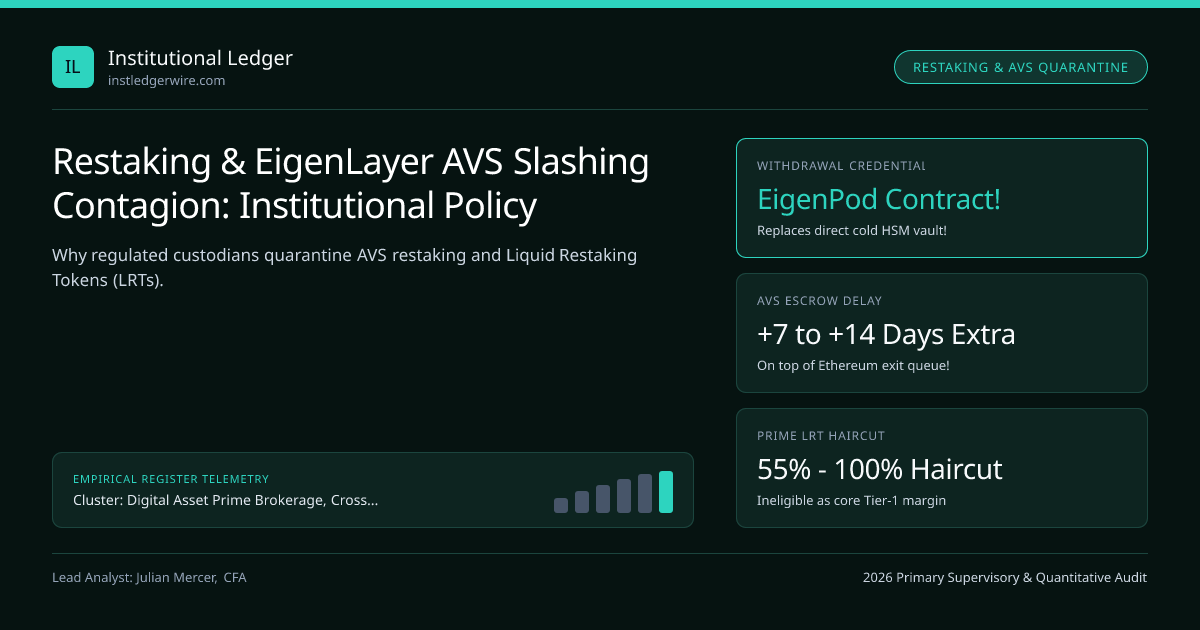
Whenever an institutional treasury committee earns 3.10% on native Ethereum staking, someone inevitably pitches the next step up the yield curve: "Why not restake our ETH into Actively Validated Services (AVSs) or wrap it into a Liquid Restaking Token (LRT) for an extra 90 basis points?" Once general counsels and quantitative risk officers map the EigenPod withdrawal-credential interposition, uninsured custom AVS slashing hooks, and stacked 7-to-14-day escrow locks, 95% of fiduciary institutions reach the same policy verdict: strictly quarantine restaking outside core custody and prime collateral books.
The Custody Dealbreaker: Surrendering Direct Cold-HSM Withdrawal Control#
Recall from institutional ETH staking slashing insurance and correlated penalties why conservative NYDFS trusts, BaFin custodians, and FINMA banks approved native Ethereum staking: the validator's 0x01/0x02 withdrawal credential points immutably to the custodian's air-gapped cold HSM, and EIP-7002 lets the custodian force exit directly from Layer 1!
Native restaking breaks that direct hardware line of sight:
- To prove to restaking contracts that your validator's stake can be penalized if you misbehave on an external bridge, oracle, or data-availability layer, you must set your validator's withdrawal address to a smart contract (
EigenPod)! - Under SEC SAB 122 risk disclosures and Basel SCO60 Classification Condition 2/3, interposing an external DeFi smart-contract system ahead of fiduciary vault recovery disqualifies the asset from institutional cold-storage treatment!
April 2024 ezETH Flash-Crash Case Study: Compounded LRT Illiquidity#
What happens when leveraged traders ignore stacked escrow queues and loop Liquid Restaking Tokens (LRTs) on money markets?
- In April 2024, amid airdrop-farming unwind pressure and thin DEX liquidity pools, Renzo's
ezETHflash-crashed on secondary markets to~0.82–0.85 ETH(-15% to -18% discount in minutes!), wiping out tens of millions of dollars of leveraged Morpho/Gearbox/Aave loopers! - Why didn't arbitrageurs step in at
0.99 ETH? Because primary LRT redemptions had to wait through BOTH the Ethereum validator exit queue (validator exit churn limits) AND EigenLayer's mandatory 7-to-14-day slashing-verification escrow!
| Risk & Legal Dimension | Native Institutional ETH Staking | Vetted Enterprise LST (cbETH / LsETH) | Restaking / LRT (EigenLayer / AVSs) |
|---|---|---|---|
0x01 / 0x02 Withdrawal Key | Direct Cold HSM Vault (NYDFS / FINMA) | Protocol pool smart contract | EigenPod + LRT Delegation Contracts |
| Slashing Rulebook | Deterministic Ethereum L1 Consensus ONLY | Deterministic Ethereum L1 Consensus ONLY | L1 + Multiple Custom Third-Party AVS Contracts! |
| Commercial Insurance? | Yes — up to $50M–$100M operator policy | Partial (via underlying node operators) | No — excluded from standard specie/slashing policies |
| Total Redemption Lag | Beacon Queue (~2d calm / 30d stressed) | Beacon Queue (or instant CEX/OTC swap) | Beacon Queue + 7 to 14 Days AVS Escrow! |
| Prime Margin Haircut | N/A (Unbonding locked) | 25% – 30% on Backpack / Bitfinex | 55% – 100% (Generally Ineligible) |
Where Restaking IS Permitted: Ring-Fenced DeFi Venture Sub-Funds#
Does institutional quarantine mean no crypto fund ever touches EigenLayer or Symbiotic? Not at all—as outlined in our institutional crypto prime brokerage cornerstone guide, dedicated crypto-native DeFi yield hedge funds actively underwrite restaking when three strict governance firewalls are in place:
- Separate Legal Sub-Fund / SPV: Never commingled inside core BTC/ETH prime margin accounts or pension custody mandates.
- Unique-Stake Per-AVS Caps: Utilizing EigenLayer's Unique Stake architecture so each vetted, formally audited AVS can only ever slash its explicitly allocated
2%–5%sub-slice—never 100% of theEigenPod! - Immediate AVS Token Auto-Hedge: Automatically sweeping volatile AVS reward emissions through OTC desks (Aquanow, B2BX) or Backpack Exchange / Bitfinex into hard ETH or USDC rather than booking paper altcoin APYs!
- Variables & Institutional Risk-Committee Hurdle Test on Adding Restaking Atop 3.10% Native ETH Staking:
- GrossAVSRewardAPY (paid in high-inflation AVS governance tokens) = +0.90% (90 bps); CashRealization_Haircut = 0.70 -> +63 bps Realized
- Less: EigenPod/AVS Smart-Contract Hazard (35 bps/yr) + Uninsured AVS Slashing Hazard (25 bps/yr) + Extra 10-Day Escrow Liquidity Option Cost (30 bps/yr) = -90 bps!
- Net Risk-Adjusted Spread = +63 bps - 90 bps = -27 bps NEGATIVE Risk-Adjusted Alpha for Fiduciary Core Vaults!
Prime Brokerage Collateral Blacklist Policy on Unvetted LRTs#
Tier-1 prime risk committees assign 0% Cross-Margin Initial Margin Value (100% haircut) to unvetted LRTs—preventing a single buggy AVS slashing event from infecting the prime broker's multi-client default waterfall.
Institutional Restaking Governance Checklist#
Chief Risk Officers active in our Digital Asset Prime Brokerage & PoR hub prohibit pointing core fiduciary vault withdrawal credentials to external smart contracts, require formal verification + Unique-Stake isolation on any DeFi sleeve, and verify regulated custodians via our verification portal.
Frequently asked questions
Why does pointing a validator’s 0x01 withdrawal credential to an EigenPod alter qualified-custody bankruptcy analysis?
In standard native staking, no smart contract sits between the Ethereum Beacon Chain and your custodian’s FIPS 140-3 HSM key! Once you point 0x01 to an EigenPod smart contract, withdrawn principal flows into a programmable smart contract governed by external protocol upgrade multisigs and AVS slashing hooks—breaking pure cold-key control required by NYDFS Trusts and Spot ETFs!
What did Vitalik Buterin warn about in "Don’t Overload Ethereum’s Consensus" regarding subjective AVS slashing?
Ethereum Layer-1 slashing is 100% objective and mathematically verifiable inside the protocol (two conflicting BLS signatures). By contrast, an external oracle or cross-chain bridge AVS may rely on off-chain data disputes, governance committees, or buggy AVS middleware—risking governance disputes or correlated losses!
Why are Liquid Restaking Tokens (LRTs like eETH, ezETH, rsETH) far riskier collateral than standard wstETH?
An LRT bundles four compounded risk layers: (1) Ethereum L1 consensus risk, (2) EigenLayer/Symbiotic core smart-contract risk, (3) a changing basket of 10+ underlying AVSs picked by LRT delegates, and (4) much thinner secondary DEX liquidity combined with a 14+ day stacked withdrawal escrow (witness the April 2024 ezETH flash depeg cascade on leveraged lending pools!).
How did EigenLayer’s "Unique Stake" (Slashable Stake Allocation) improve institutional risk isolation vs v1?
In early conceptual restaking designs, opting the same 32 ETH into 5 AVSs meant any 1 buggy AVS could slash up to 100% of principal! Modern Unique Stake Allocation lets an institutional operator partition e.g. 10% dedicated slashable budget to AVS #1 and 5% to AVS #2—capping per-AVS loss, though smart-contract EigenPod custody risk still remains.
Publication record
- Published
- November 12, 2026
- Updated
- November 15, 2026
- Author
- Julian Mercer, CFA
- Review
- Review not recorded
- Automated fact check
- Passed in the stored pipeline record
- Source URLs
- 3 recorded
AI assistance recorded: anthropic/claude-opus-4.6. This field does not establish human review or source verification.
Academic & Institutional Attribution
Cite This Research & Embed Live Data Card
Standard academic & institutional research paper citation format.
Julian Mercer, CFA. (2026, November 15). Restaking & EigenLayer AVS Slashing Contagion: Institutional Policy. Institutional Ledger. https://instledgerwire.com/stories/restaking-eigenlayer-avs-slashing-contagion-institutional-policyRegulatory Directory Cross-Reference
Referenced Institutions & Regulatory Registries
Mentioned Regulated Institutions
Referenced Supervisory Authorities
Related Institutional Crypto Prime Margin & Institutional Briefings
Explore Institutional Crypto Prime Margin Hub (20) →Institutional Crypto Prime Margin
Institutional Crypto Prime Brokerage, Cross-Venue Netting & zk-PoR Guide (2026)Institutional Crypto Prime Margin
On-Chain Wallet Ownership Proofs: BIP-322, EIP-191 & Micro-TransfersInstitutional Crypto Prime Margin
Prime Credit Intermediation & Post-2022 Undercollateralized Lending BansInstitutional Crypto Prime Margin
Perpetual Funding-Rate Volatility, Impact Notional & Auto-Liquidation EnginesInstitutional Crypto Prime Margin
Institutional MEV Protection: Private RPCs, Block Relays & Sandwich DefenseInstitutional Crypto Prime Margin
Tax-Lot Relief (HIFO, Specific ID) & FASB ASC 350-60 Prime Sub-Ledger SyncInstitutional Crypto Prime Margin
Multi-Custodian Prime Routing & Single-Point-of-Failure MitigationInstitutional Crypto Prime Margin
Stressed VaR & Concentration Liquidity Add-Ons for Altcoin CollateralBanking Crisis
‘Very strange, very sad’: Paraguay bank collapse fells a presidency and leaves millions brokeCryptocurrency Crime
The Shadowy Crypto Services Helping the Binance Hackers Launder Stolen BillionsRegulatory Compliance
EU taps industry to set standards for tokenized securitiesRegulatory Compliance
The $2.85B Binance hackers lost shows why the UK needs stablecoin freeze rules
Institutional Ledger Data, Benchmarks & Contributor Records
CC BY 4.0 Open Data
Open Institutional Datasets (CSV / JSON) →
Download desk-compiled quantitative series & schemas.
2026 Reference Matrix
2026 Institutional Benchmarks & Thresholds →
Statutory capital, clearing, margin & rate conventions.
Editorial Records
Authors & Review Records →
View named contributors where those records are available.
Complete Index
Master Research & Dossier Archive →
Browse all published briefings by topic pillar & date.