
Stablecoin Reserve Attestation Audit
Basel SCO60 Group 1b Stabilisation Test Failures on Stablecoins
Basel III SCO60 requires a stablecoin to pass BOTH a <=10-bps daily peg-deviation test (<=3 breaches in 12 months) AND a direct legal issuer redemption test—tripping almost every public-chain stablecoin into Group 2!
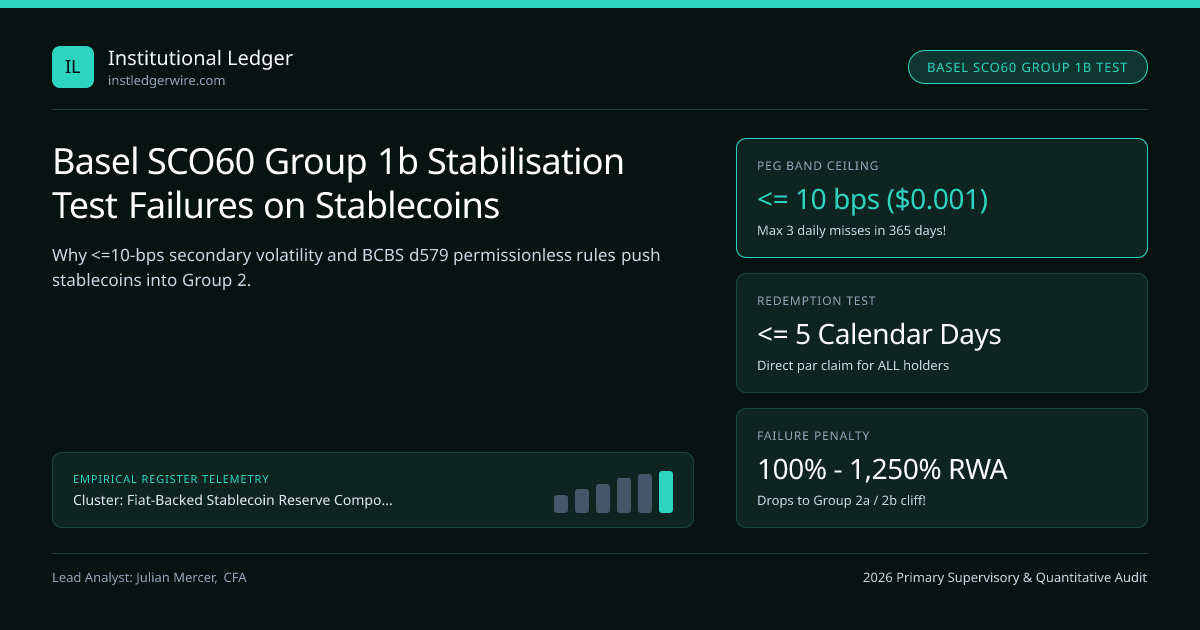
Here is one of the most consequential—and least understood—fault lines in global institutional crypto: even a 100% Treasury-backed, Big-4 attested stablecoin routinely fails the Basel Committee's SCO60 Group 1b bank capital test! Because SCO60.12 tolerates no more than three daily price deviations exceeding 10 basis points ($0.0010) in 365 days—and BCBS d579 penalizes permissionless blockchains—regulated banks structure stablecoin custody and settlement strictly off their own proprietary balance sheets.
Anatomy of the Two-Part Stabilisation Test (SCO60.12 & SCO60.13)#
When we introduced Basel SCO60 Group 1 vs Group 2 bank capital weights in Silo 1 and our fiat-backed stablecoin reserve cornerstone guide, we highlighted the 50x capital cliff separating Group 1 from Group 2b. For tokenized bonds/equities (Group 1a), passing relies on legal parity. For cryptoassets with stabilisation mechanisms (stablecoins, Group 1b), the BCBS SCO60 2026 Benchmark Standard imposes a brutal double gauntlet:
- Test 1 — The 10-bps Peg-Value Test (
SCO60.12): Over a rolling 12-month horizon, the market value of the stablecoin may deviate from the peg value by more than 10 basis points (0.10%) NO MORE THAN 3 TIMES! And if it deviates by more than 20 basis points even once, regulatory scrutiny intensifies immediately. - Test 2 — The 5-Calendar-Day Redemption Risk Test (
SCO60.13&BCBS d579): Reserve assets must >= 100% of peg value (plus an overcollateralization buffer if reserves carry any market volatility), consist solely of minimal-risk short-term assets segregated in bankruptcy-remote custody, AND all holders must possess a direct legal claim to redeem at par within <= 5 calendar days!
Four Concrete Reasons Public-Chain Stablecoins Trip SCO60#
Why do bank regulatory-capital quants find that nearly every public-chain ERC-20 stablecoin fails at least one prong of Group 1b?
- Prong A (10-bps Burn Fees): As proven in Authorized Participant arbitrage spreads, any offshore issuer charging a 10-bps burn fee creates a +/-12-bps deadband—failing
SCO60.12dozens of times per year! - Prong B (Weekend Curve Skew): Even zero-fee regulated USDC trades 24/7 on public AMMs and CLOBs (Bitstamp, Bitfinex) while Fedwire is closed 104 weekend days a year. Four brief Sunday-evening 12-bps Curve pool imbalances in 12 months disqualify Group 1b!
- Prong C ("5 Calendar Days" vs "T+2 Business Days"!): Notice Basel wrote 5 calendar days—not business days! Over a 4-day Good Friday / Easter Monday bank holiday weekend, a redemption submitted Thursday night that wires Tuesday afternoon takes 5+ calendar days unless settled via 24/7 intrabank rails!
- Prong D (
BCBS d579Permissionless Blockchain Amendments): In July 2024 (d579), BCBS reinforced its skepticism that banks can satisfactorily mitigate governance, finality, and validator-sanctions risks on permissionless blockchains under Classification Condition 3!
| Basel SCO60 Criterion | Exact Statutory Threshold | Why Public-Chain Stablecoins Trip | Bank Strategic Response | ||
|---|---|---|---|---|---|
Peg-Value Test (SCO60.12) | ` | Market_Price - $1.00 | <= 10 bps` (max 3 breaches / 365d) | Weekend Fedwire close + Curve skew prints $0.9988 >3x/yr | Do not hold stablecoins overnight on bank's own balance sheet |
Redemption Risk (SCO60.13) | Direct par claim for ALL holders within <= 5 calendar days | Non-MiCA issuers restrict direct burns to whitelisted KYB APs; 4-day Easter weekend + T+2 = 6 calendar days! | Use EU MiCA Art. 49 EMTs where statutory claim is universal | ||
| Regulated Supervision | Supervised prudential capital & liquidity issuer | State MTLs without prudential bank/EMI capital fail test | Require NYDFS Trust / EU EMI / MAS / HKMA Bank charter | ||
Permissionless Chain (BCBS d579) | Must mitigate validator & settlement finality risks | Public Ethereum/Solana validator anonymity scrutinized by BCBS | Settle interbank legs via Project Agora & Canton |
Crucial Carve-Out: Client Custody (SCO60.5) Costs 0% RWA Capital!#
Before concluding that banks cannot touch stablecoins, read SCO60.5 carefully!
- Punitive Group 2 credit/market risk weights apply ONLY when a bank holds stablecoins as principal on its OWN corporate balance sheet!
- When BNY Mellon, State Street, Standard Chartered Zodia, or a BaFin/FINMA bank safekeeps USDC or EURC off-balance-sheet on behalf of institutional custody clients (and is exempt from balance-sheet recognition under SEC SAB 122), the bank incurs 0% Group 2 RWA credit/market risk weight (only standard operational risk on custody fee revenue)!
- Variables & $1,000,000,000 Bank Balance-Sheet Settlement Float Capital Comparison (CET1 Floor = 11.5%, Pre-Tax Bank Hurdle ROE = 14.0%):
- 1. Passes Group 1b (Look-Through: 90% 0%-wt US T-Bills + 10% 20%-wt G-SIB Cash -> Blended RWA Weight = 2.0%):
- Required CET1 Equity = $1,000M * 0.020 * 0.115 = $2,300,000 -> Annual Capital Cost = $322,000/yr (3.2 bps — negligible!).
- 2. Fails SCO60.12 on Day #4 (>10 bps Sunday wick) -> Drops to Group 2a (100% RWA Weight):
- Required CET1 Equity = $1,000M * 1.00 * 0.115 = $115,000,000 -> Annual Capital Cost = $16,100,000/yr (161 bps)!
- 3. Fails Group 2a Hedge/Liquidity -> Drops to Group 2b (1,250% RWA Weight = 100% Deduction!):
- Required CET1 Equity = $1,000,000,000 -> Annual Capital Cost = $140,000,000/yr (1,400 bps — COMPLETELY UNECONOMICAL FOR BANKS!).
How G-SIBs Bridge Client Stablecoins Without Holding Them Overnight#
When a bank's FX or prime desk facilitates a client conversion from USDC into fiat USD, the bank executes instant back-to-back atomic conversion via Circle Mint intrabank rails—holding 0 USDC across its end-of-day balance-sheet reporting cut—while building permissioned tokenized bank deposits for its own interbank books!
Prudential Capital Playbook for Bank Digital-Asset Desks#
Bank capital-management teams active in our Stablecoin Reserve Attestation hub automate intraday zero-inventory sweeps on client stablecoin on/off-ramps so end-of-day principal Group 2 exposure equals $0.00, custody client stablecoins strictly in off-balance-sheet fiduciary vaults, and verify counterparties in our verification portal.
Frequently asked questions
How strict is Basel SCO60.12’s "10 basis points, max 3 times per year" peg-stability test?
Razor-thin! Ten basis points of $1.0000 is literally one-tenth of one cent ($0.9990 to $1.0010)! Even traditional government ETFs and cross-border FX pairs move >10 bps intraday. If a stablecoin closes outside $0.9990–$1.0010 on just four Sunday nights out of 365 days, it automatically fails Group 1b and plunges into punitive Group 2 capital charges for the next year!
Why did the Basel Committee add the "Redemption Risk Test" AFTER seeing the Peg-Value Test could be gamed?
Before TerraUSD (UST) collapsed in May 2022, algorithmic UST actually stayed within 10 bps on 362+ days during bull markets via subsidized Anchor yields! Shocked by Terra’s collapse, BCBS added SCO60.13: the Peg-Value Test ONLY counts if backed by 100%+ audited, segregated, low-volatility reserve assets AND a direct legal par redemption right within 5 calendar days!
Do US non-MiCA stablecoins fail SCO60.13’s "all holders have a direct redemption claim" rule?
Often yes unless structured like EU MiCA! Under SCO60.13 and d579, if ONLY whitelisted primary Authorized Participants have a legal claim on the issuer while secondary bank/corporate holders do not hold a direct statutory claim (unlike EU MiCA Article 49 EMTs where *every* holder has a direct statutory claim!), supervisors can disqualify Group 1b status!
What happens to a G-SIB bank’s capital charge when a stablecoin fails Group 1b and drops into Group 2?
Instead of receiving low Group 1b look-through risk weights (~0%–20% reflecting underlying T-Bills and G-SIB bank cash), the stablecoin drops into Group 2a (100% risk weight if liquid hedged criteria pass) or Group 2b (1,250% risk weight = 100% dollar-for-dollar Tier-1 capital deduction plus the hard 1% Tier-1 Group 2 exposure cap)!
Publication record
- Published
- November 13, 2026
- Updated
- November 15, 2026
- Author
- Julian Mercer, CFA
- Review
- Review not recorded
- Automated fact check
- Passed in the stored pipeline record
- Source URLs
- 3 recorded
AI assistance recorded: anthropic/claude-opus-4.6. This field does not establish human review or source verification.
Academic & Institutional Attribution
Cite This Research & Embed Live Data Card
Standard academic & institutional research paper citation format.
Julian Mercer, CFA. (2026, November 15). Basel SCO60 Group 1b Stabilisation Test Failures on Stablecoins. Institutional Ledger. https://instledgerwire.com/stories/basel-sco60-group-1b-stabilisation-mechanism-test-failuresRegulatory Directory Cross-Reference
Referenced Institutions & Regulatory Registries
Mentioned Regulated Institutions
Referenced Supervisory Authorities
Related Stablecoin Reserve Attestation Audit & Institutional Briefings
Explore Stablecoin Reserve Attestation Audit Hub (20) →Stablecoin Reserve Attestation Audit
Fiat-Backed Stablecoin Reserve Composition, Audits & T-Bill Custody GuideStablecoin Reserve Attestation Audit
Treasury-Bill Yield Compression & Stablecoin Issuer Reserve EconomicsStablecoin Reserve Attestation Audit
AICPA AT-C 205 Monthly Stablecoin Reserve Attestation Criteria DecodedStablecoin Reserve Attestation Audit
Overnight Reverse Repo & 93-Day T-Bill WAM Caps in StablecoinsStablecoin Reserve Attestation Audit
EU MiCA Title III (ART) vs Title IV (EMT) Stablecoin Safeguarding RulesStablecoin Reserve Attestation Audit
MiCA’s 60% EU Bank Deposit Mandate for Significant Stablecoins: Tail RiskStablecoin Reserve Attestation Audit
NYDFS USD Stablecoin Guidance: T+2 Par Redemption & Trust SegregationStablecoin Reserve Attestation Audit
Primary Mint/Burn Fedwire Cutoffs vs Weekend Curve Pool DepegsInstitutional Crypto Prime Margin
Stressed VaR & Concentration Liquidity Add-Ons for Altcoin CollateralMarket Insights
Nomura explores sale of crypto unit Laser Digital: BloombergRegulatory Compliance
Uncalled US House races could send more crypto allies to CongressRegulatory Compliance
South Korea to permit crypto withdrawal freezes during hacking threats
Institutional Ledger Data, Benchmarks & Contributor Records
CC BY 4.0 Open Data
Open Institutional Datasets (CSV / JSON) →
Download desk-compiled quantitative series & schemas.
2026 Reference Matrix
2026 Institutional Benchmarks & Thresholds →
Statutory capital, clearing, margin & rate conventions.
Editorial Records
Authors & Review Records →
View named contributors where those records are available.
Complete Index
Master Research & Dossier Archive →
Browse all published briefings by topic pillar & date.