
Stablecoin Reserve Attestation Audit
Authorized Participant Arbitrage Spreads & Stablecoin Par Peg Mechanics
Just like ETF Authorized Participants keep SPY and IBIT pinned to NAV, whitelisted OTC market makers enforce stablecoin $1.00 pegs via primary mint/burn arbitrage—bounded by burn fees and capital cost.
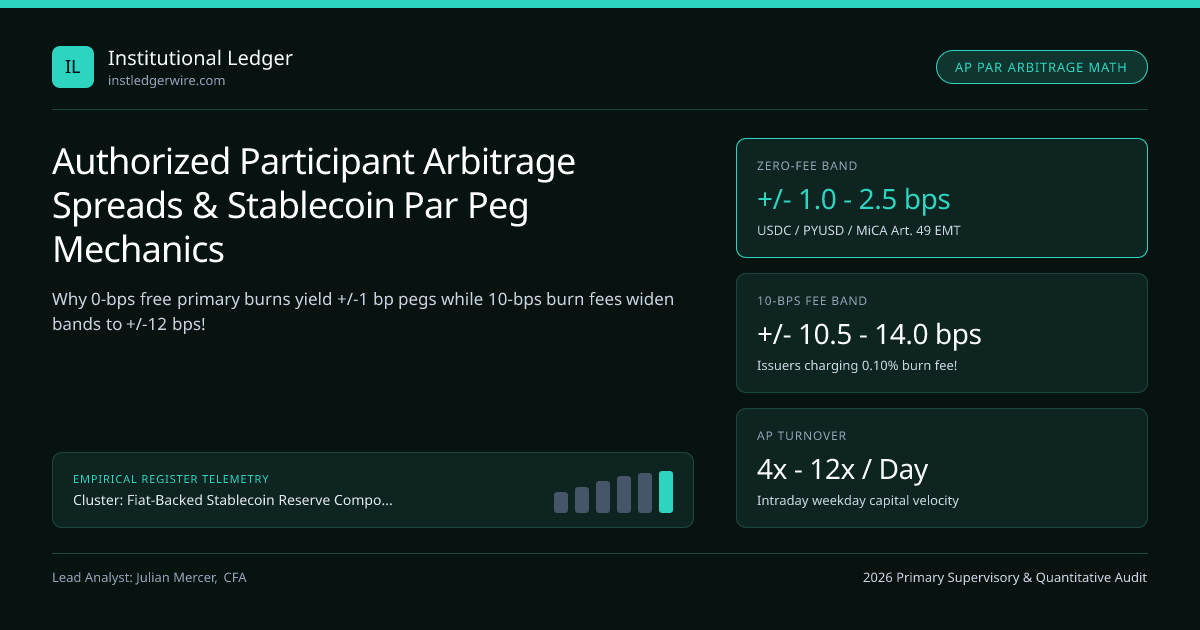
Why does one fiat-backed stablecoin hug $1.0000 within 1.5 basis points all week while a rival 100%-backed stablecoin wanders between $0.9986 and $1.0014? The secret has nothing to do with marketing and everything to do with microstructure friction inside the Authorized Participant (AP) primary mint/burn loop: specifically, primary redemption fees, minimum ticket gates, and intrabank capital-recycling velocity.
How Primary Mint/Burn Fees Mathematically Dictate Secondary Peg Width#
In exchange-traded funds—such as US Spot Bitcoin and Ethereum ETFs—every quant knows the No-Arbitrage Band Law: secondary market prices can deviate freely from underlying Net Asset Value by up to the exact round-trip cost of primary creation/redemption!
Apply that exact equation across our fiat-backed stablecoin reserve cornerstone guide:
- If an offshore stablecoin charges a 0.10% (
10 bps) primary redemption fee (and enforces a $100,000 minimum burn), an institutional market maker on Bitfinex or Bitstamp nets only$0.9990per burned token before exchange fees and SWIFT wire float! Inside the 24-basis-point wide corridor from$0.9988to$1.0012, primary mint/burn arbitrage is mathematically unprofitable—leaving secondary prices to drift purely on orderbook flow! - Conversely, under the USDC MiCA & NYDFS 2026 Benchmark Standard (where Circle Mint charges 0.0 bps and EU MiCA Article 49 legally bans retail/normal redemption fees), total arbitrage friction drops to ~1.2 basis points!
Capital Velocity: Turning $25M Into $300M/Day of Peg Stabilization#
Fee-free burning is half the equation; settlement cycle time ($ au$) is the other half. Suppose a sudden $250M market sell wave hits a stablecoin on Tuesday morning, and a market maker (Aquanow, Wintermute, Flow Traders) holds $25M of dedicated arbitrage balance sheet:
- If the issuer takes 48 hours (
T+2) to wire back USD over international SWIFT, the AP buys $25M once—and then sits sidelined for two full days while the remaining $225M sell wave pushes the peg lower! - When both the AP and the issuer bank at the same global custodian (BNY Mellon intrabank API book transfers or instant European SEPA rails), burning $25M returns spendable USD to the AP's exchange sub-account in 12 to 20 minutes—allowing that single $25M balance sheet to absorb all $250M of selling in 10 rapid cycles before lunch!
| Arbitrage Mechanism | Spot Crypto ETF AP (Spot ETFs) | Zero-Fee Regulated Stablecoin (USDC) | Fee-Gated Offshore Stablecoin |
|---|---|---|---|
| Eligible Arbitrageurs | SEC/FINRA self-clearing Broker-Dealers (4–8 firms) | 500+ KYB institutions, OTC desks (Aquanow, B2BX) & exchanges (Bitstamp) | Restricted high-minimum offshore KYB ($100k+ floor) |
| Primary Fee | Fixed ~$500–$1,500 basket fee + cash execution | 0.0 bps ($0) under Circle Mint & ESMA MiCA Art. 49 | 10.0 bps (capped or tiered at $1,000–0.10%) |
| Settlement Speed | T+1 NSCC equity vs Coinbase/Fidelity custody | 10–30 minutes intrabank T+0 (weekdays) | T+1 to T+3 international SWIFT wire |
| Resulting Peg Tightness | +/- 5 to 18 bps around live BTC NAV | +/- 1.0 to 2.5 bps around $1.0000 | +/- 8.0 to 15.0 bps deadband |
BIS Empirical Finding: Why Open KYB Onboarding Beats Exclusive AP Clubs#
Bank for International Settlements Working Paper No. 1087 (Crypto shocks and retail losses / Stablecoin primary-secondary market segmentation) proved empirically that onboarding breadth acts as a shock absorber during banking stress. When primary mint/burn gates are open to hundreds of verified corporate treasurers, payment processors, CASPs, and hedge funds (rather than gated behind 4 insiders), non-dealer corporations step in directly to redeem their own coins at $1.00 par without paying dealer bid-ask spreads.
- Variables & Equilibrium Secondary Arbitrage Trigger Comparison ($10M Ticket, AP Hurdle Cost of Capital r = 12.0%/yr):
- 1. Zero-Fee Intrabank Issuer (
Burn_Fee = 0 bps, VIP_CEX_Fee = 1.0 bp, Settlement = 0.5 hrs): - Capital Cost = 0.12 * (0.5 / 8,760) = 0.07 bps -> Total Friction = 1.07 bps!
- AP buys aggressively the instant secondary price hits $0.99988!
- 2. 10-bps Fee + 24-Hour SWIFT Wire Issuer (
Burn_Fee = 10.0 bps, CEX_Fee = 1.0 bp, Settlement = 24 hrs): - Capital Cost = 0.12 * (24 / 8,760) = 3.29 bps -> Total Friction = 14.29 bps!
- Price drifts freely down to $0.99857 with ZERO primary burn arbitrage occurring!
The Unexpected Basel III SCO60 Consequence of 10-bps Burn Fees!#
Here is where microstructure meets bank regulation: as we prove in Basel SCO60 Group 1b stabilisation mechanism test failures, Basel requires a stablecoin to stay within 10 basis points ($0.9990–$1.0010) of its peg! Any issuer charging a 10-bps primary redemption fee mathematically guarantees its own failure under Basel SCO60's peg-stability test!
Direct Primary Mint/Burn Onboarding SOP for Treasury Desks#
Institutional treasurers active in our Stablecoin Reserve Attestation hub never pay secondary exchange slippage on $5M+ stablecoin conversions—they open direct zero-fee primary mint/burn accounts ahead of time, pre-link intrabank USD/EUR accounts, and verify issuer charters via our verification portal.
Frequently asked questions
Why does charging a 0.10% (10 bps) primary redemption fee cause a stablecoin to trade between $0.9988 and $1.0012?
Suppose an OTC market maker can burn coins at the issuer for $1.0000 minus a 10-bps ($0.0010) fee = $0.9990 net fiat payout, plus 1.5 bps of exchange execution/gas/funding cost. Buying coins at $0.9993 loses money! Rational APs stand aside until secondary price falls below $0.99885, creating a permanent 23-bps wide trading band!
How do Spot Crypto ETF Authorized Participants (IBIT/FBTC) differ from Stablecoin Mint/Burn arbitrageurs?
Spot Crypto ETF APs must be SEC-registered, FINRA-regulated self-clearing broker-dealers (Jane Street, Virtu, JPMorgan, Macquarie) creating/redeeming 25,000–40,000 share baskets once daily at 4:00 PM ET NAV; stablecoin primary arbitrageurs include global KYB-onboarded crypto market makers (Wintermute, Aquanow, Flow Traders, Cumberland) minting/burning continuously intraday!
How many times per day can a market maker recycle $25M of arbitrage capital on weekday US hours?
When co-banked at the issuer’s settlement bank (e.g., BNY Mellon intrabank API book transfers), an AP’s burn request pays USD in 5 to 20 minutes and ERC-20/Solana deposits clear exchanges in 1 to 12 minutes—allowing a single $25M working-capital line to cycle 8 to 12 times per day ($200M–$300M daily peg stabilization volume)!
What happens if an issuer restricts primary mint/burn onboarding to only 3 trading firms?
Thin AP competition creates oligopolistic arbitrage spreads during stress! As BIS Working Paper No. 1087 documented empirically, stablecoins with broad, open institutional KYB onboarding (hundreds of corporate/OTC primary accounts) recover from intraday shocks 3x–4x faster and with half the basis-point deviation of narrow-gate tokens.
Publication record
- Published
- November 13, 2026
- Updated
- November 15, 2026
- Author
- Julian Mercer, CFA
- Review
- Review not recorded
- Automated fact check
- Passed in the stored pipeline record
- Source URLs
- 3 recorded
AI assistance recorded: anthropic/claude-opus-4.6. This field does not establish human review or source verification.
Academic & Institutional Attribution
Cite This Research & Embed Live Data Card
Standard academic & institutional research paper citation format.
Julian Mercer, CFA. (2026, November 15). Authorized Participant Arbitrage Spreads & Stablecoin Par Peg Mechanics. Institutional Ledger. https://instledgerwire.com/stories/authorized-participant-arbitrage-spreads-stablecoin-par-pegsRegulatory Directory Cross-Reference
Referenced Institutions & Regulatory Registries
Mentioned Regulated Institutions
Referenced Supervisory Authorities
Related Stablecoin Reserve Attestation Audit & Institutional Briefings
Explore Stablecoin Reserve Attestation Audit Hub (20) →Stablecoin Reserve Attestation Audit
Fiat-Backed Stablecoin Reserve Composition, Audits & T-Bill Custody GuideStablecoin Reserve Attestation Audit
Singapore MAS Single-Currency Stablecoin (SCS) Framework & 5-Day SLAStablecoin Reserve Attestation Audit
Hong Kong HKMA Fiat-Referenced Stablecoin (FRS) Ordinance & CustodyStablecoin Reserve Attestation Audit
CPMI-IOSCO PFMI Rules for Systemically Important StablecoinsStablecoin Reserve Attestation Audit
Intraday Snapshot Window Dressing vs Continuous Proof-of-Reserve OraclesStablecoin Reserve Attestation Audit
Custodial T-Bill Safekeeping: BNY Mellon & State Street Reserve ModelsStablecoin Reserve Attestation Audit
Stablecoin Smart-Contract Freeze & Blacklist Governance Under OFAC/FinCENStablecoin Reserve Attestation Audit
FX Basis & Negative-Rate Risks in Non-USD (EUR, JPY, CHF) StablecoinsInstitutional Crypto Prime Margin
Portfolio VaR & SPAN Margin Models for Multi-Leg Digital Asset BooksInstitutional Crypto Prime Margin
Weekend Gap Risk: CME Friday 4:00 PM CT Close vs 24/7 PerpetualsInstitutional Crypto Prime Margin
Restaking & EigenLayer AVS Slashing Contagion: Institutional PolicyInstitutional Crypto Prime Margin
On-Chain Wallet Ownership Proofs: BIP-322, EIP-191 & Micro-Transfers
Institutional Ledger Data, Benchmarks & Contributor Records
CC BY 4.0 Open Data
Open Institutional Datasets (CSV / JSON) →
Download desk-compiled quantitative series & schemas.
2026 Reference Matrix
2026 Institutional Benchmarks & Thresholds →
Statutory capital, clearing, margin & rate conventions.
Editorial Records
Authors & Review Records →
View named contributors where those records are available.
Complete Index
Master Research & Dossier Archive →
Browse all published briefings by topic pillar & date.