
Institutional Crypto Prime Margin
Stressed VaR & Concentration Liquidity Add-Ons for Altcoin Collateral
Accepting $40M of a token that trades only $12M per day at a flat 25% haircut guarantees lender insolvency; institutional prime risk engines enforce square-root ADV liquidity add-ons and hard 2%-depth caps!
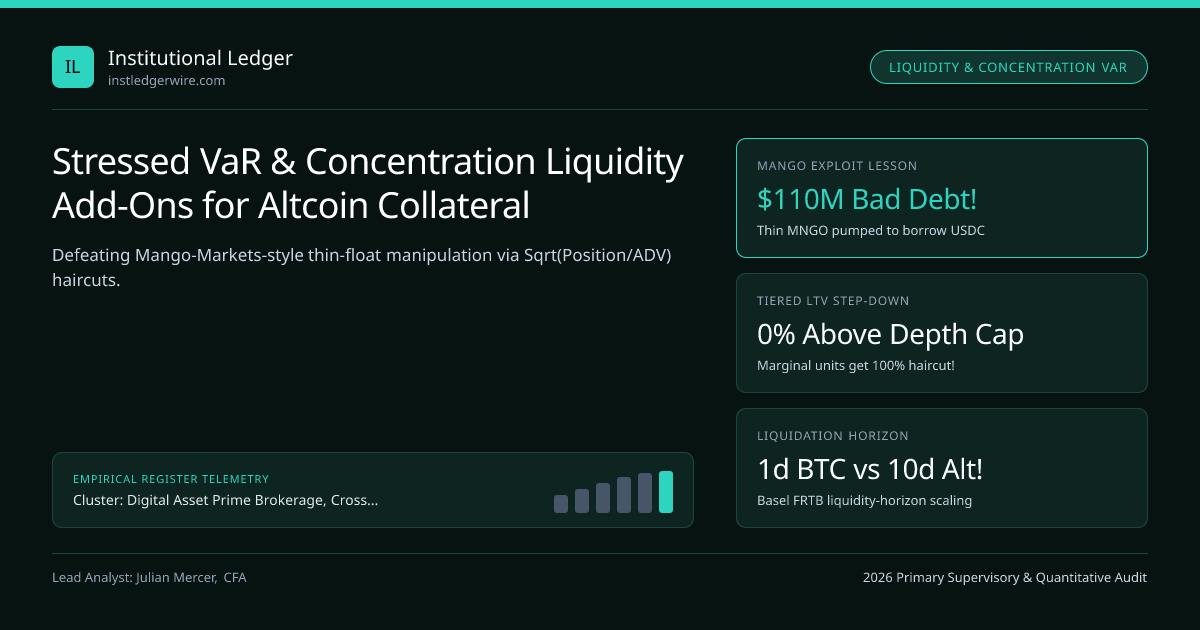
Here is a Subtle GAAP-versus-Risk paradox every institutional CFO and CRO must master: *under FASB ASC 820 and ASC 350-60, if your fund holds 15% of an altcoin's circulating supply trading at $10.00, accounting rules REQUIRE marking that position at `Price Quantity with zero size-blockage discount—yet if a prime broker lends against that same position without a square-root liquidity haircut, the prime broker will go bankrupt!** Modeling **Stressed VaR Liquidity Horizons** and **2%`-Orderbook-Depth Caps** prevents Mango-Markets and Curve-style concentration blowups.
Anatomy of Thin-Float Manipulation: Mango Markets ($110M) & Curve (CRV)#
Two historic incidents permanently rewrote institutional collateral risk manuals across CEXs, DeFi protocols, and prime brokers:
- October 2022 Mango Markets (
$110MDrain): As charged by the CFTC and DOJ, Avi Eisenberg exploited a risk engine that valued massiveMNGOperpetual gains using raw spot prices without checking whether the global market had 1% of the liquidity needed to unwind that size! Pumping thin spot books for a few million dollars let him extract$110Min hard liquid treasuries! - Summer 2023 Curve (
CRV) Concentration Squeeze: Over$100M+of a founder's token supply was pledged across lending markets against$60M+of stablecoin borrows—exceeding total global orderbook bid depth by 10x and forcing emergency OTC bailouts to avert cascading bad debt!
Almgren-Chriss Square-Root Impact & Basel FRTB Liquidity Horizons#
In our institutional crypto prime brokerage cornerstone guide and portfolio VaR and SPAN margin models, tier-1 risk engines replace static LTV tables with a three-factor mathematical formula aligned with Basel BCBS d457 (FRTB) and Basel SCO60:
- Factor 1 — Multi-Day Liquidity Horizon (
Sqrt(LH)): Unwinding$50M BTCacross Bitstamp, Backpack Exchange, Bitfinex, and Aquanow takes hours (LH = 1d); unwinding$15Mof a mid-cap token without crashing the price -40% requires slicing via TWAP over 5 to 10 days (Sqrt(10) = 3.16xvolatility scaling)! - Factor 2 — Genuine Regulated
2%Depth (Anti-Wash-Trade Filter): Scraping time-weighted resting bids within-2.0%of mid exclusively from regulated Tier-1 venues—ignoring fake wash-traded offshore volume completely! - Factor 3 — Tokenomics Unlock Calendar Penalty: Automatically hiking collateral haircuts by
+20%seven days ahead of any scheduled VC / Team token cliff unlock exceeding3%of circulating float!
| Asset Collateral Tier | Minimum Regulated 2% Bid Depth | Liquidation Horizon (LH) | Base Haircut (Tier 1) | Hard Per-Client Credit Cap |
|---|---|---|---|---|
Tier 1: USDC, BUIDL T-Bills | Par primary redemption + deep CLOBs | 0.5 – 1 Day | 2% – 5% | $250M+ |
Tier 2: BTC, ETH (Bitstamp, Backpack, Bitfinex) | >= $50M global regulated 2% depth | 1 – 2 Days | 15% – 20% | $150M+ (step-down > $100M) |
Tier 3: Liquid Major L1s & Vetted LSTs (SOL, wstETH) | >= $10M regulated 2% depth | 3 – 5 Days | 28% – 38% | $25M – $50M |
| Tier 4: Vetted Mid-Cap Altcoins | >= $2.5M across >= 3 Tier-1 CLOBs + OTC (Aquanow, B2BX) | 5 – 10 Days | 50% – 65% | $3M – $10M Hard Ceiling |
Tier 5: Micro-Caps, Low-Float (<15%), House Tokens | Thin / wash-traded | Illiquid | 100% Haircut (0% LTV!) | $0 — Strictly custody-only |
Why GAAP ASC 350-60 Marks P * Q While Risk Engines Haircut 80%+#
Fund investors occasionally ask: "Why does our administrator's FASB ASC 350-60 NAV report value our locked/concentrated altcoin sleeve at $30M, while our prime broker gives us only $5M of Initial Margin credit?"
- Because FASB
ASC 820explicitly prohibits applying size ("blockage") discounts when valuing unrestrictedLevel 1/Level 2assets for financial reporting, whereas a lender's credit engine prices worst-case forced-liquidation recovery during a market crash! - Remember also from negative-balance non-existence proofs: any venue that assigns >0% collateral credit to its own native exchange token (
FTT-style self-collateralization!) fails institutional solvency audits immediately!
- Haircut(Q) = Min( 1.00, Stressed1DayES995 * Sqrt(LiquidityHorizonDays) + ImpactCoeff(0.75) * DailySigma * Sqrt( Q / GenuineRegulatedADV ) )
- CollateralCreditUSD(Q) = Integral{0..Q} [ 1 - MarginalHaircut(q) ] dq (Capped at HardDollarCeiling!)
- Variables & Why GAAP Fair Value != Prime Collateral Value on $30,000,000 Mid-Cap Altcoin Position:
- Token Parameters: DailySigma = 8.5%; Stressed1DayES = 22.0%; LH = 5 Days; GenuineRegulatedADV = $18,000,000; HardCap = $6,000,000
- 1. FASB ASC 350-60 / ASC 820 GAAP Balance Sheet Value: $30,000,000 (ASC 820 forbids size blockage discounts on Level 1/2 marks!).
- 2. Formula Haircut at Q = $30M: Min(1.00, 0.22 * Sqrt(5) + 0.75 * 0.085 * Sqrt(30 / 18)) = Min(1.00, 0.492 + 0.082) = 57.4% + Hard Cap ->
- Prime Collateral Credit = $6,000,000 Maximum (80.0% Effective Haircut — Zero Mango-Style Bad-Debt Risk!)*
OTC Block Liquidation Agreements for Concentrated Venture Positions#
When a venture or liquid-token hedge fund holds a large mid-cap position, rather than pledging it into automated CLOB liquidation engines, institutional prime desks arrange ring-fenced bilateral OTC Collar / Forward facilities with wholesale block desks (B2BX, 8 Blocks Capital)—eliminating public orderbook cascade risk.
Collateral Concentration & Haircut Governance Checklist#
Chief Risk Officers active in our Digital Asset Prime Brokerage & PoR hub audit prime collateral schedules to confirm 0% LTV on exchange house tokens, progressive Sqrt(Q/Depth) marginal brackets under ESMA and BaFin risk controls, and verify counterparties via our verification portal.
Frequently asked questions
How did the October 2022 Mango Markets attacker steal $110M without hacking a single line of smart-contract code?
Pure collateral-concentration math failure! The attacker funded two accounts, bought $400M+ nominal notional of MNGO perpetuals on a razor-thin orderbook, then spent just $4M pumping illiquid spot MNGO +1,000% across thin CEX books! Because Mango’s risk engine applied a flat collateral weight without an orderbook-depth cap, it let the attacker "borrow" $110M of real USDC/BTC/SOL against $450M of phantom paper MNGO equity and walk away!
Why is "2%-Slippage Executable Orderbook Depth" 10x safer than raw 24-hour reported trading volume (ADV)?
High-frequency market makers or wash-trading bots can churn $200M of 24-hour volume back and forth inside a $50,000 top-of-book spread—yet if a prime liquidation engine tries to sell $5M in 10 minutes, the bid side evaporates -45%! Measuring time-averaged resting USD bid depth within -2.0% of mid-price across regulated spot CLOBs captures *true* immediate liquidation capacity!
What is a "Marginal Tiered LTV Step-Down Schedule" in prime collateral management?
Just like progressive income tax brackets! For example, on a mid-cap L1 token: the first $2M posted receives 60% LTV (40% haircut); $2M–$8M receives 40% LTV (60% haircut); $8M–$15M receives 20% LTV (80% haircut); and every dollar above $15M receives 0% LTV (100% haircut)—capping maximum platform exposure deterministically!
Why do prime brokers also cap Aggregate Platform-Wide Concentration (<= 3% of Circulating Free Float) across ALL clients combined?
Even if ten separate hedge funds each post $8M of Token X (passing individual $10M per-client caps), if all ten funds get margin-called during the same -30% altcoin crash, the prime broker has to liquidate $80M simultaneously! Platform-wide caps (<= 2%–3% of true unlocked free float) prevent crowded multi-client liquidation cliffs.
Publication record
- Published
- November 12, 2026
- Updated
- November 14, 2026
- Author
- Julian Mercer, CFA
- Review
- Review not recorded
- Automated fact check
- Passed in the stored pipeline record
- Source URLs
- 3 recorded
AI assistance recorded: anthropic/claude-opus-4.6. This field does not establish human review or source verification.
Academic & Institutional Attribution
Cite This Research & Embed Live Data Card
Standard academic & institutional research paper citation format.
Julian Mercer, CFA. (2026, November 14). Stressed VaR & Concentration Liquidity Add-Ons for Altcoin Collateral. Institutional Ledger. https://instledgerwire.com/stories/stressed-var-liquidity-add-ons-illiquid-altcoin-collateralRegulatory Directory Cross-Reference
Referenced Institutions & Regulatory Registries
Mentioned Regulated Institutions
Related Institutional Crypto Prime Margin & Institutional Briefings
Explore Institutional Crypto Prime Margin Hub (20) →Institutional Crypto Prime Margin
Institutional Crypto Prime Brokerage, Cross-Venue Netting & zk-PoR Guide (2026)Institutional Crypto Prime Margin
zk-SNARK Merkle-Sum Tree Proof-of-Reserves: Auditing Exchange LiabilitiesInstitutional Crypto Prime Margin
Negative-Balance Non-Existence Proofs & Hidden Collateral Encumbrance RiskInstitutional Crypto Prime Margin
Cross-Exchange Delta-Neutral Cash-and-Carry Basis Margining MechanicsInstitutional Crypto Prime Margin
Institutional ETH Staking Slashing Insurance & Correlated Penalty MathInstitutional Crypto Prime Margin
Validator Exit Churn Limits, Unbonding Queues & Liquidity DiscountsInstitutional Crypto Prime Margin
Prime Broker Cross-Margining: Spot ETFs, CME Futures & Perp OffsetsInstitutional Crypto Prime Margin
Liquid Staking Tokens (LST) Collateral Haircuts & Depeg Cascade ModelsRegulatory Compliance
Statement on Proposed Amendments to the Custody RulesRegulatory Compliance
Statement on Proposal to Address the Custody of Crypto Assets Under the Investment Advisers Act and the Investment Company ActRegulatory Benchmarks
Institutional Digital Asset, Tokenized RWA & Custody Venues 2026 Licensing Benchmark: 6D Prudential Scorecard Across 111 Audited EntitiesCompliance Forensics
How to Verify Institutional Digital Asset, Tokenized RWA & Custody Venues Licences & Detect Clone Firms: 2026 Supervisory Lookup Playbook
Institutional Ledger Data, Benchmarks & Contributor Records
CC BY 4.0 Open Data
Open Institutional Datasets (CSV / JSON) →
Download desk-compiled quantitative series & schemas.
2026 Reference Matrix
2026 Institutional Benchmarks & Thresholds →
Statutory capital, clearing, margin & rate conventions.
Editorial Records
Authors & Review Records →
View named contributors where those records are available.
Complete Index
Master Research & Dossier Archive →
Browse all published briefings by topic pillar & date.