
Tokenized Treasuries Rwa Settlement
Chainlink & DTCC Smart NAV Oracle Attestation Latency Controls
DTCC Smart NAV and decentralized oracle networks replace legacy mainframe file transfers with cryptographically signed on-chain Net Asset Value feeds guarded by heartbeat staleness breakers.
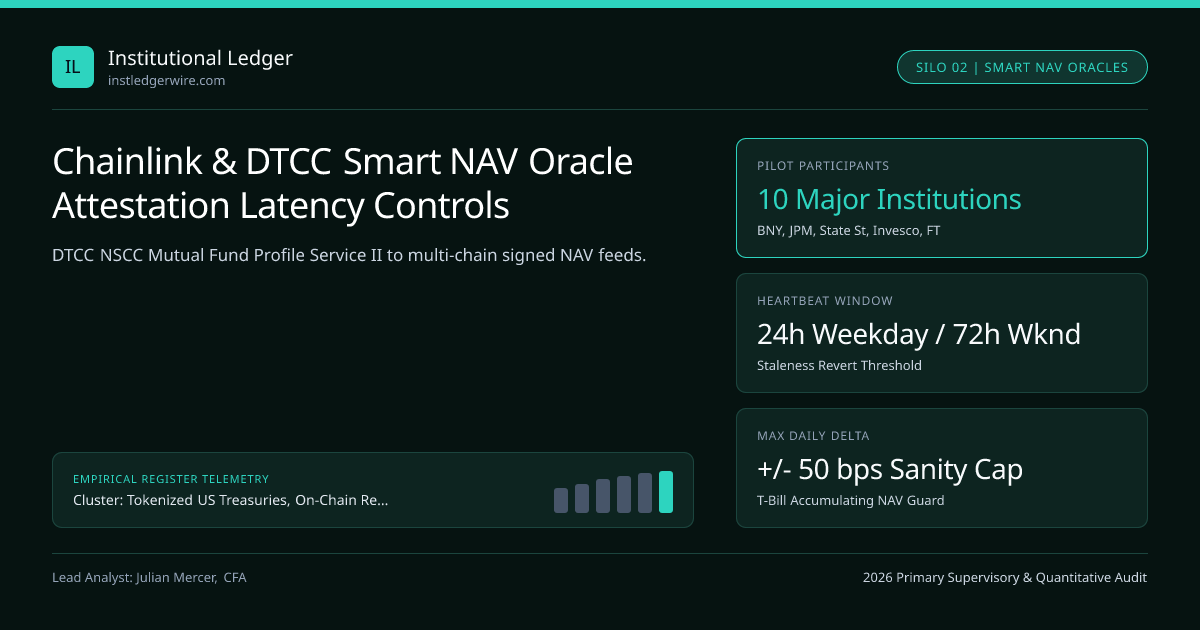
Tokenizing a US Treasury fund solves custody and transfer speed, yet creates an immediate distributed-systems vulnerability: smart contracts on Ethereum, Arbitrum, or Canton cannot natively read BNY Mellon's off-chain accounting mainframes. Validated by DTCC alongside 10 major Wall Street institutions—including BNY Mellon, JPMorgan, State Street, Franklin Templeton, and Invesco—the DTCC Smart NAV Framework paired with Chainlink decentralized oracle networks replaces brittle batch files with cryptographically signed, circuit-breaker-guarded on-chain Net Asset Value feeds.
From DTCC MFPS II Mainframes to Chain-Agnostic Signed Attestations#
In traditional US wealth management, virtually every brokerage and trust bank relies on DTCC's Mutual Fund Profile Service II (MFPS II) to disseminate official end-of-day Net Asset Values and dividend rates across thousands of CUSIPs. However, MFPS II was architected for overnight batch reconciliation—not atomic smart-contract collateral engines executing 24/7.
Under the DTCC Smart NAV 2026 Benchmark Standard examined in our tokenized US Treasuries and RWA settlement cornerstone guide, DTCC acts as the governed data provider while Chainlink's Cross-Chain Interoperability Protocol (CCIP) and Off-Chain Reporting (OCR3) consensus layer abstract away blockchain fragmentation. Fund administrators strike official 4:00 PM ET NAVs, sign structured payloads cryptographically, and route canonical price updates across permissioned bank ledgers and public EVM/non-EVM chains within seconds—without requiring fund administrators to maintain custom RPC nodes on 12 different blockchains.
Defeating Fat-Finger Uploads & Step-Function NAV Arbitrage#
Engineering an institutional RWA oracle for accumulating note structures like Ondo OUSG and USDY requires defending against two subtle failure modes that have drained lesser DeFi protocols:
- Back-Office Decimal & Fat-Finger Guards: Even Tier-1 fund administrators occasionally transmit a misplaced decimal in manual NAV files. Because an underlying portfolio of <=93-day US Treasury bills cannot mathematically gain more than ~15–25 bps in a single session absent extraordinary Fed emergency cuts, hardened on-chain oracle aggregators enforce a hard per-epoch sanity corridor (
-25 bps to +30 bps). Any update breaching that corridor automatically quarantine-pauses new mints and borrows while alerting human risk quorums. - Eliminating Weekend Step-Jump Dilution: If an accumulating RWA token updates its price once on Monday at 16:00 ET to reflect three days of weekend Treasury interest (
~3.75 bps) while allowing instant T+0 par mints at 15:58 ET, predatory bots extract risk-free dilution from long-term holders. Production RWA contracts eliminate this via SEC Rule 22c-1 forward pricing on primary subscriptions or bounded per-second linear interpolation between daily strikes.
| Oracle Control Guard | Solidity / Ledger Enforcement Logic | Targeted Failure Mode | Institutional Calibration |
|---|---|---|---|
| Origin Signature Check | Verify Fund Admin + DTCC Smart NAV ECDSA/EdDSA sig | Compromised oracle relayer node injecting fake price | 2-of-2 Admin + Registry attestation |
| Per-Epoch Delta Cap | require(newNav <= oldNav * 10030 / 10000 && newNav >= oldNav * 9975 / 10000) | Back-office decimal typo (e.g., USD 1084.0 instead of USD 108.40 on OUSG) | -25 bps to +30 bps max daily T-Bill move |
| Calendar-Aware Heartbeat | Dynamic maxStaleness (26h Mon-Fri, 76h Weekend, 100h Holiday) | False-positive weekend collateral freeze on Aquanow / DeFi | Synced to SIFMA US Gov Bond Calendar |
| Continuous Yield Curve | NAV(t) = NAV_strike * (1 + r_approved * (t - t_strike) / 31536000) | 16:00 ET step-function front-running / Friday-Monday 3-day jump | Capped strictly at current 3m T-Bill yield |
SIFMA Holiday-Aware Heartbeats & Dual Proof-of-Reserve Conjunction#
Standard crypto price feeds (such as ETH/USD) tick every few seconds 24/7, allowing lending markets to set tight 1-hour staleness heartbeats. Applying a rigid 24-hour staleness check to a traditional mutual-fund NAV feed causes catastrophic false-positive freezes every Saturday evening and Memorial Day weekend! Institutional margin engines integrating RWA collateral across CFTC GMAC derivatives frameworks and OTC desks (Aquanow, Bitstamp) deploy SIFMA-calendar-aware heartbeat state machines—enforcing 26-hour staleness Tuesday through Friday, 76-hour staleness across standard weekends, and 100-hour windows across US federal bank holidays, paired with cross-chain CCIP interoperability and live Proof-of-Reserve supply checks.
- Variables & Weekend Oracle Step-Jump Arbitrage Prevention ($500M Accumulating Tokenized Treasury Pool):
- rTBillAnnual = 0.0456 (4.56% annualized portfolio yield -> 1.25 bps/day; 3.75 bps across 3-day Friday-to-Monday accrual batch!)
- 1. Unprotected Step-Function Oracle (Publishes +3.75 bps jump all at once Monday 16:00 ET with 0 bps mint/redeem fee):
- Arbitrageur mints $100M at Monday 15:59 ET, captures +3.75 bps ($37,500 risk-free dilution of existing holders) at 16:01 ET, and redeems!
- 2. Protected Continuous Accrual + T+0 Cutoff Architecture (DTCC Smart NAV 2026 Standard):
- Accrues 0.052 bps per hour continuously across all 72 weekend hours (capped by signed Friday yield ceiling
r_approved) OR locks subscription price to forward next-strike NAV (Forward Pricingper SEC Rule 22c-1) -> Arbitrage dilution = $0.00!
Regulatory Oversight of Benchmark & Oracle Providers Under MiCA & IOSCO#
Supervisors including ESMA, MAS, and IOSCO increasingly audit oracle dependencies as critical third-party ICT infrastructure (subject to EU DORA registers). Custodians and issuers therefore prohibit single-EOA price pushers, requiring Byzantine-fault-tolerant multi-node consensus plus direct cryptographic origin signatures from the regulated Fund Administrator.
Oracle Resilience Audit Checklist for Risk Engineers#
Smart-contract auditors and risk officers evaluating RWA integrations inside our Tokenized Treasuries & RWA Settlement hub verify non-zero answeredInRound checks, test 3-day holiday weekend staleness simulations on staging forks, confirm +/-30 bps circuit-breaker caps, and cross-check entity benchmarks on our verification portal.
Frequently asked questions
What legacy financial bottleneck did the DTCC Smart NAV and Chainlink pilot solve?
Today, DTCC Mutual Fund Profile Service II distributes daily mutual fund prices via point-to-point mainframe batch files and fixed-cutoff messages around 18:00-20:00 ET. Smart NAV wraps DTCC-governed price and dividend attestations into chain-agnostic, cryptographically signed messages accessible via APIs and on-chain smart contracts.
Why do accumulating RWA tokens require stricter oracle sanity bounds than stable $1.00 rebasing funds?
In an accumulating share class like OUSG (where token price rises daily from $100.00 to $108.50+ as Treasury interest accrues), lending and redemption contracts multiply tokenAmount * oraclePrice. If a fat-finger administrator upload or oracle exploit pushes oraclePrice up 20%, an attacker could borrow 20% excess USDC instantaneously unless capped by a +/-30 bps daily sanity breaker.
How should smart contracts handle weekend and US bank holiday NAV staleness without false-positive freezes?
If a margin contract enforces a naive require(block.timestamp - updatedAt <= 86400) 24-hour heartbeat, every tokenized fund published only on US business days will freeze automatically at 18:01 ET every Saturday! Institutional oracle wrappers integrate holiday-calendar-aware heartbeats (26h weekday / 76h weekend / 100h 3-day holiday) or continuous deterministic accrual curves.
How do Chainlink Proof of Reserve and NAV feeds interact on tokenized Treasury protocols?
Institutional contracts enforce dual-oracle conjunction: the Redemption/Lending router requires BOTH a fresh NAV price feed AND a Proof-of-Reserve attestation confirming custodialTBillAssets >= tokenTotalSupply * currentNAV, halting mints immediately if off-chain reserves lag on-chain supply.
Publication record
- Published
- November 14, 2026
- Updated
- November 15, 2026
- Author
- Julian Mercer, CFA
- Review
- Review not recorded
- Automated fact check
- Passed in the stored pipeline record
- Source URLs
- 3 recorded
AI assistance recorded: anthropic/claude-opus-4.6. This field does not establish human review or source verification.
Academic & Institutional Attribution
Cite This Research & Embed Live Data Card
Standard academic & institutional research paper citation format.
Julian Mercer, CFA. (2026, November 15). Chainlink & DTCC Smart NAV Oracle Attestation Latency Controls. Institutional Ledger. https://instledgerwire.com/stories/chainlink-dtcc-smart-nav-oracle-attestation-latency-controlsRegulatory Directory Cross-Reference
Referenced Institutions & Regulatory Registries
Mentioned Regulated Institutions
Related Tokenized Treasuries Rwa Settlement & Institutional Briefings
Explore Tokenized Treasuries Rwa Settlement Hub (20) →Tokenized Treasuries Rwa Settlement
Tokenized US Treasuries, On-Chain Repo DvP & RWA Settlement: 2026 GuideTokenized Treasuries Rwa Settlement
Canton Network & Broadridge DLR Intraday Tokenized Repo ClearingTokenized Treasuries Rwa Settlement
Ondo OUSG & USDY Bankruptcy-Remote SPV Note Structuring AuditTokenized Treasuries Rwa Settlement
BIS Project Agora: Tokenized Commercial Bank Deposits & Wholesale CBDCTokenized Treasuries Rwa Settlement
Eurosystem DLT Trials: Bundesbank Trigger, Pontes & Appia Central Bank DvPTokenized Treasuries Rwa Settlement
MAS Project Guardian & Global Layer One (GL1): Cross-Border RWA RepoTokenized Treasuries Rwa Settlement
Project mBridge Multi-CBDC PvP Corridor: Sovereign Settlement & Nostro ReliefTokenized Treasuries Rwa Settlement
24/7 USDC Redemption Liquidity Buffers for Tokenized US Treasury FundsOff Exchange Triparty Collateral
Account Control Agreements (ACA) for Bilateral Crypto DerivativesOff Exchange Triparty Collateral
Pledged Tokenized T-Bills as Off-Exchange Perpetual Futures MarginOff Exchange Triparty Collateral
Automatic Deleveraging (ADL) & Clawback Risks on Mirrored AccountsOff Exchange Triparty Collateral
2-of-3 MPC Co-Signer Dispute Deadlocks & Timelock Escape Hatches
Institutional Ledger Data, Benchmarks & Contributor Records
CC BY 4.0 Open Data
Open Institutional Datasets (CSV / JSON) →
Download desk-compiled quantitative series & schemas.
2026 Reference Matrix
2026 Institutional Benchmarks & Thresholds →
Statutory capital, clearing, margin & rate conventions.
Editorial Records
Authors & Review Records →
View named contributors where those records are available.
Complete Index
Master Research & Dossier Archive →
Browse all published briefings by topic pillar & date.