
Off Exchange Triparty Collateral
Pledged Tokenized T-Bills as Off-Exchange Perpetual Futures Margin
Posting zero-yield stablecoins as perpetual futures initial margin sacrifices 420+ bps of sovereign carry. Off-exchange custodians now pledge tokenized US Treasuries while settling variation margin in USDC.
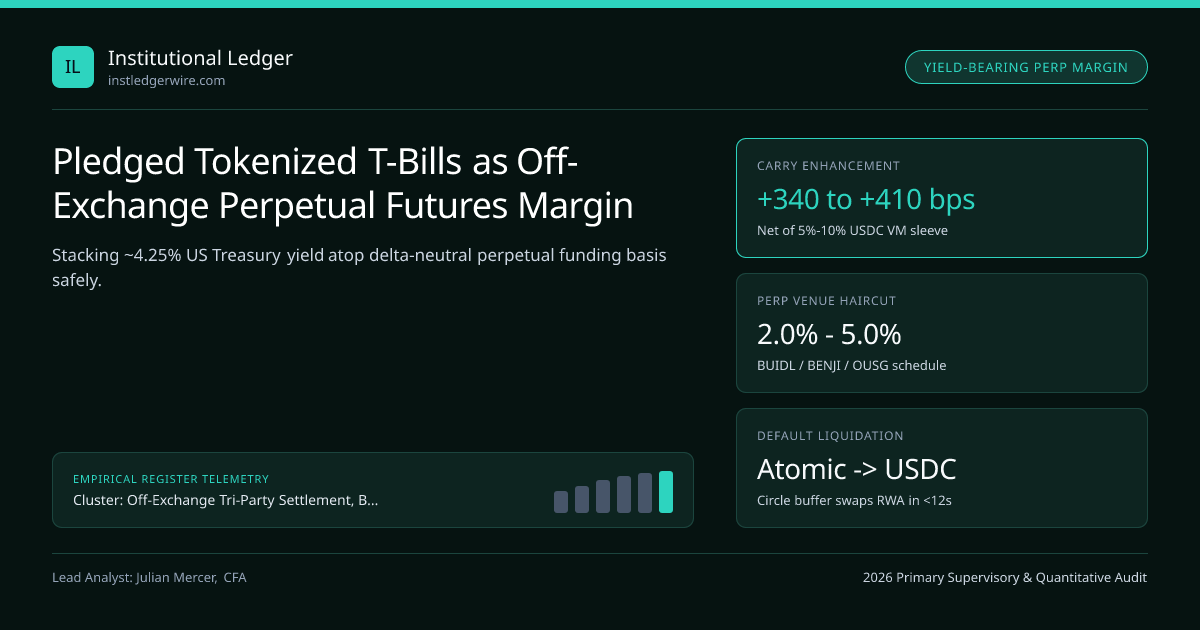
For five years, delta-neutral crypto basis traders endured a maddening structural tax: to short $130 million of linear Bitcoin or Ethereum perpetual futures on BitMEX, Bitfinex, or Backpack Exchange, a conservative desk had to post ~$70 million of zero-yield stablecoins—handing $3 million per year of risk-free US Treasury interest free of charge to stablecoin issuers! By pledging BlackRock BUIDL and Ondo OUSG inside off-exchange tri-party vaults, institutional desks now reclaim that sovereign yield while keeping principal 100% off-exchange.
Why Linear Perpetuals Beat Coin-Margined Inverse Contracts When Paired With RWA#
Historically, basis funds tried to avoid dead stablecoin collateral by trading coin-margined ("inverse") perpetuals—posting physical BTC directly as margin for a short BTCUSDperp contract. However, quantitative traders know inverse contracts carry a toxic mathematical flaw during bull-market rallies: because contract payoff is nonlinear (1 / BTC_Price), a sudden 35% Bitcoin surge rapidly erodes the BTC value of your short margin right as your dollar loss accelerates—forcing emergency top-ups or early liquidations (negative convexity drag).
Linear USD/USDC-margined perpetuals eliminate convexity drag completely, and—as integrated across our off-exchange tri-party collateral cornerstone guide and CFTC GMAC collateral haircut standards—backing linear perps with pledged tokenized US Treasuries eliminates the 0%-yield cash penalty too!
Engineering the 85% RWA Initial Margin / 15% USDC Variation Margin Split#
You cannot post 100.0% of your vault in tokenized Treasury shares if your perpetual venue settles funding every 8 hours and variation margin every 4 hours in cash stablecoins. Institutional prime desks automate a two-bucket vault policy:
- Core Initial Margin Bucket (80%–88% in BUIDL / OUSG): Satisfies the exchange's base initial-margin requirement at a 2% to 5% collateral haircut. Shares sit untouched for months, compounding ~4.25% sovereign T-Bill yield without generating daily taxable disposals.
- Working Variation-Margin Sleeve (12%–20% in USDC): Absorbs 4-hour mark-to-market debits and 8-hour funding flows seamlessly. Automated treasury bots refill USDC from BUIDL (or sweep excess positive USDC funding into BUIDL!) only when the USDC sleeve crosses
< 8%or> 22%bands.
| Margin Collateral Asset | Collateral Haircut | Net Collateral Yield | Crash Correlation to Crypto | Liquidation Rail at 03:00 UTC Sunday |
|---|---|---|---|---|
| Idle USDT / USDC | 0% – 1% | 0.00% (issuer keeps yield) | Low (check bank reserve concentration) | Direct native settlement |
| BlackRock BUIDL | 2.0% – 5.0% | ~4.25% sovereign T-Bill/RRP | Zero / Negative (flight-to-quality asset!) | Atomic Circle smart-contract USDC swap |
| Ondo OUSG | 3.0% – 5.0% | ~4.20% accumulating NAV | Zero / Negative (US Gov T-Bills) | Stacked OUSG + BUIDL instant USDC router |
| Synthetic Basis Dollars | 10.0% – 25.0% | Variable (collapses in bear mkt) | Highly Positive! Depeg risk when funding flips negative | DeFi AMM curve (slippage during crash) |
Why Risk Officers Reject "Synthetic Basis Dollars" as Bear-Market Margin#
Some retail venues accept synthetic delta-neutral tokens as high-yield margin. Institutional risk committees draw a hard line here: synthetic basis tokens generate yield from the exact same crypto perpetual funding market you are trading! During a violent risk-off bear crash when perpetual funding plunges deeply negative (-30% annualized), synthetic tokens suffer simultaneous yield inversion and secondary depeg pressure (wrong-way correlation risk), whereas US Treasury bills enjoy sovereign flight-to-safety bids.
- Variables & $200M Institutional Delta-Neutral Basis Fund ($130M Long Spot BTC + $70M Linear Perp Margin Vault @ ~1.85x Perp Leverage):
- rPerpFunding = 0.1150 (11.50% annualized perpetual funding rate received on $130M short BTC-PERP leg -> $14,950,000/yr)
- MarginVaultTotal = $70,000,000 off-exchange collateral ($59.5M BlackRock BUIDL [85%] + $10.5M USDC VM buffer [15%])
- rNetTBill = 0.0425 (4.25% net BUIDL yield after 20 bps fund fee)
- CustodyMirrorFee = 0.0010 (10 bps across $200M AUM = $200,000/yr)
- 1. Legacy 100% Idle Stablecoin Margin Vault:
- Net Fund Profit = $14,950,000 + $0 - $200,000 = $14,750,000/yr (7.375% Net Fund ROE)
- 2. Pledged Tokenized T-Bill Off-Exchange Vault ($59.5M BUIDL + $10.5M USDC):
- Incremental Sovereign T-Bill Income = $59,500,000 * 0.0425 = +$2,528,750/yr!
- Net Fund Profit = $17,278,750/yr (8.639% Net Fund ROE -> +126.4 bps pure alpha with ZERO extra market risk!).
03:00 UTC Sunday Default Liquidation via Circle’s Atomic Buffer#
Exchanges willingly grant 95%–98% collateral value to pledged BUIDL and OUSG inside off-exchange mirror loops because the custodian's smart-contract liquidation adapter connects directly to 24/7 USDC smart-contract liquidity buffers and whitelisted OTC RFQ desks (Aquanow, Bitstamp)—converting defaulted RWA shares into par USDC in under 12 seconds on a Sunday morning.
Deployment Blueprint for Basis & Arbitrage Portfolio Managers#
Portfolio managers active in our Off-Exchange Tri-Party Collateral hub calibrate 85/15 RWA-to-USDC vault bands against 99% 4-hour price-jump simulations, confirm dividend pass-through rules in accumulating vs rebasing share classes, and verify tri-party custodians via our verification portal.
Frequently asked questions
Why couldn’t perpetual futures exchanges accept traditional CUSIP US Treasury bills directly before tokenization?
If a leveraged perpetual account breaches maintenance margin at 2:00 AM Sunday, traditional CUSIP T-Bills sitting at a prime bank cannot be liquidated or transferred until Fedwire reopens Monday morning—leaving the exchange exposed to 30+ hours of uncompensated gap risk. Tokenized T-Bills with 24/7 USDC redemption buffers liquidate atomically on-chain in seconds.
Why must desks pair pledged BUIDL/OUSG with a 10%–15% liquid USDC variation-margin sleeve?
Perpetual futures settle funding rates every 8 hours and variation margin every 4–8 hours in cash/stablecoins. Paying every -$200k 8-hour funding debit by burning BUIDL shares would create unnecessary redemption churn and tax lots; keeping 85% in BUIDL (Initial Margin) and 15% in USDC (Variation Margin buffer) captures 85% of T-Bill yield cleanly.
How much extra return does a delta-neutral BTC basis fund earn by switching from USDT/USDC margin to pledged tokenized T-Bills?
Suppose spot-vs-perp funding carry yields 10.5% annualized on short notional (requiring 50% margin = $50M collateral per $100M notional, plus $100M spot). Replacing $50M of 0%-yield stablecoin margin with 85% BUIDL (@ 4.25% net) adds +$1.81M/yr (+361 bps on margin equity) of risk-free sovereign yield with zero incremental directional risk!
Do ERC-3643 whitelist restrictions interfere when a custodian forecloses on pledged BUIDL after a trader defaults?
No, because both the tri-party custodian’s liquidation router and the Circle BUIDL-to-USDC instant redemption contract (plus pre-onboarded OTC dealers) are pre-whitelisted inside Securitize’s ERC-3643 Identity Registry. Foreclosure converts RWA shares directly into unrestricted USDC to settle the venue.
Publication record
- Published
- November 13, 2026
- Updated
- November 14, 2026
- Author
- Julian Mercer, CFA
- Review
- Review not recorded
- Automated fact check
- Passed in the stored pipeline record
- Source URLs
- 3 recorded
AI assistance recorded: anthropic/claude-opus-4.6. This field does not establish human review or source verification.
Academic & Institutional Attribution
Cite This Research & Embed Live Data Card
Standard academic & institutional research paper citation format.
Julian Mercer, CFA. (2026, November 14). Pledged Tokenized T-Bills as Off-Exchange Perpetual Futures Margin. Institutional Ledger. https://instledgerwire.com/stories/pledged-tokenized-t-bills-off-exchange-perpetual-marginRegulatory Directory Cross-Reference
Referenced Institutions & Regulatory Registries
Mentioned Regulated Institutions
Primary Tier-1 Supervisory Registries
Related Off Exchange Triparty Collateral & Institutional Briefings
Explore Off Exchange Triparty Collateral Hub (20) →Off Exchange Triparty Collateral
Off-Exchange Tri-Party Settlement & Bankruptcy-Remote Crypto Custody GuideOff Exchange Triparty Collateral
Automatic Deleveraging (ADL) & Clawback Risks on Mirrored AccountsOff Exchange Triparty Collateral
2-of-3 MPC Co-Signer Dispute Deadlocks & Timelock Escape HatchesOff Exchange Triparty Collateral
ISDA Digital Asset Derivatives Definitions & CSA Collateral SchedulesOff Exchange Triparty Collateral
Cross-Venue Collateral Reallocation Latency & Liquidity BuffersOff Exchange Triparty Collateral
Exchange Hot-Wallet Sweep Thresholds & Withdrawal Queue SLAsOff Exchange Triparty Collateral
Rehypothecation Prohibitions & Segregated On-Chain Pledge Vault AuditsOff Exchange Triparty Collateral
CFTC FCM Customer Segregation (4d / LSOC) vs Offshore Perp PledgesStablecoin Reserve Attestation Audit
Authorized Participant Arbitrage Spreads & Stablecoin Par Peg MechanicsStablecoin Reserve Attestation Audit
Singapore MAS Single-Currency Stablecoin (SCS) Framework & 5-Day SLAStablecoin Reserve Attestation Audit
Hong Kong HKMA Fiat-Referenced Stablecoin (FRS) Ordinance & CustodyStablecoin Reserve Attestation Audit
CPMI-IOSCO PFMI Rules for Systemically Important Stablecoins
Institutional Ledger Data, Benchmarks & Contributor Records
CC BY 4.0 Open Data
Open Institutional Datasets (CSV / JSON) →
Download desk-compiled quantitative series & schemas.
2026 Reference Matrix
2026 Institutional Benchmarks & Thresholds →
Statutory capital, clearing, margin & rate conventions.
Editorial Records
Authors & Review Records →
View named contributors where those records are available.
Complete Index
Master Research & Dossier Archive →
Browse all published briefings by topic pillar & date.