
Tokenized Treasuries Rwa Settlement
BIS Project Agora: Tokenized Commercial Bank Deposits & Wholesale CBDC
BIS Project Agora unites seven major central banks and over 40 commercial banking groups on a unified programmable ledger combining wholesale CBDC reserves with tokenized commercial deposits.
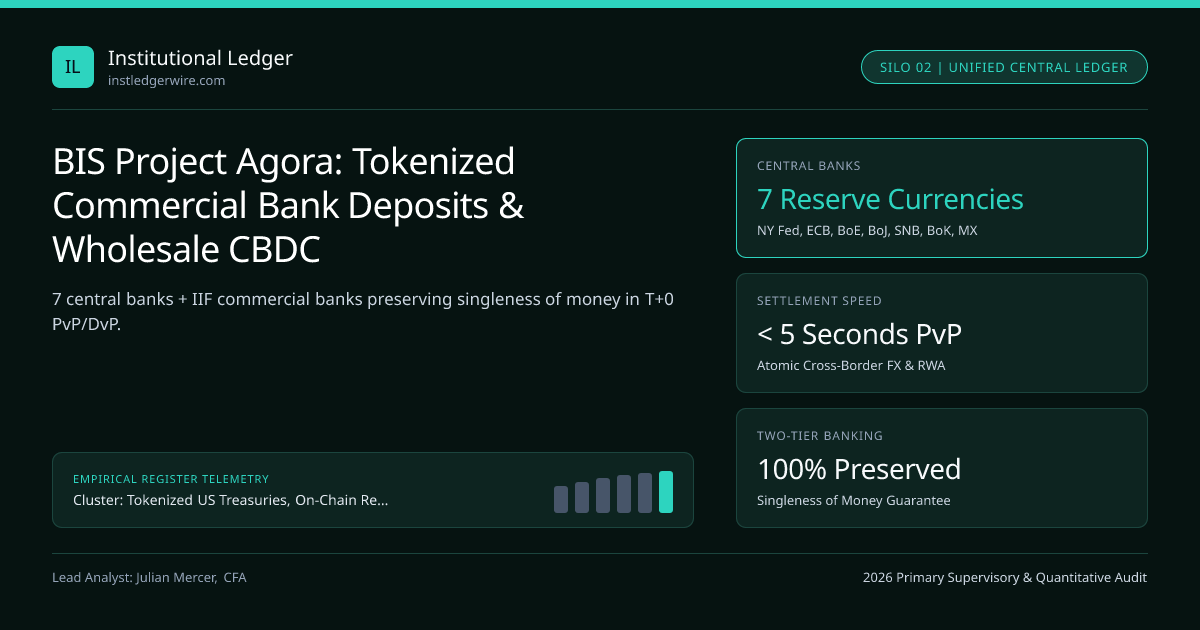
Private stablecoins proved that programmable digital dollars can settle globally in seconds, yet central bankers warn that fragmented stablecoin issuers threaten the singleness of money and drain commercial bank deposit funding. Coordinated by the Bank for International Settlements and the Institute of International Finance across seven reserve-currency central banks and 40+ global commercial banks, the BIS Project Agora Wholesale CBDC & Tokenized Deposit Ledger builds the definitive institutional counter-architecture: a unified programmable ledger fusing risk-free wholesale CBDC reserves with interest-bearing tokenized commercial bank deposits.
Preserving the Two-Tier Monetary System & Singleness of Money#
In his foundational BIS Finternet and Unified Ledger blueprints, Hyun Song Shin highlighted why nineteenth-century free-banking banknotes traded at variable discounts depending on which private bank issued them—and why uncoordinated private stablecoins risk recreating that exact friction during liquidity panics (such as USDC's brief $0.88 secondary dip during March 2023 regional bank runs). Modern economies preserve the singleness of money—the guarantee that $1 at JPMorgan equals $1 at Citigroup or Deutsche Bank—because commercial bank transfers settle interbank at 1:1 par across the central bank's risk-free balance sheet.
As integrated into our tokenized US Treasuries and RWA settlement cornerstone guide, the BIS Project Agora 2026 Benchmark Standard brings this exact two-tier monetary hierarchy onto a programmable multi-partition ledger uniting the Federal Reserve Bank of New York, ECB, Bank of England, Bank of Japan (JFSA jurisdiction), Swiss National Bank (FINMA), Bank of Korea, and Bank of Mexico.
How Interbank Tokenized Deposits Extinguish via Wholesale CBDC#
Today, individual G-SIB deposit tokens—such as JPMorgan Kinexys Digital Payments (JPM Coin) or Citi Token Services—settle instantaneously 24/7 within that single bank's global branch ledger, but hit legacy Fedwire/TARGET2 walls the moment a client of Bank A pays a supplier banking at Bank B.
On Project Agora's unified ledger, each central bank operates a sovereign wholesale CBDC (wCBDC) core partition while commercial banks operate tokenized deposit partitions:
- When Corporate Client X (at US Bank A) purchases tokenized sovereign debt or settles an invoice with Corporate Client Y (at European Bank B), smart contracts verify pre-trade AML/sanctions screening atomically alongside the value transfer—eliminating multi-day SWIFT
MT103 / pacs.008compliance holds. - Within a single sub-5-second atomic commit, Bank A's deposit token is burned, NY Fed USD wCBDC swaps via an automated or RFQ FX liquidity provider against ECB EUR wCBDC, and Bank B mints fresh EUR tokenized deposits for Client Y. Neither Client Y nor Bank B ever holds bilateral credit exposure to Bank A.
| Programmable Money Instrument | Legal Liability Issuer | Interbank Par Settlement Mechanism | Interest / Yield Bearing? | Primary Institutional Scope |
|---|---|---|---|---|
| Wholesale CBDC (Project Agora) | Central Bank (NY Fed, ECB, BoE, BoJ, SNB) | Direct Sovereign Reserve Asset (0% RWA) | Central bank reserve policy rate | Interbank wCBDC settlement & sovereign bond DvP |
| Tokenized Commercial Deposit | G-SIB Commercial Bank (BaFin / OCC / FINMA) | Extinguished & settled 1:1 via wCBDC on Agora | Yes — pays corporate deposit interest | Corporate treasury 24/7 sweeps & Canton repo |
| Regulated Fiat Stablecoin (USDC/EURC) | Non-Bank Trust / EMI (NYSDFS / ESMA) | Secondary AMM/OTC or wire via reserve banks | Prohibited directly under EU MiCA Art. 50 | Public DeFi, non-bank hedge funds & Aquanow OTC |
| Legacy Nostro / Vostro SWIFT | Correspondent Bank Chain | Sequential MT/ISO 20022 messaging + CLS window | Minimal / trapped vostro drag | Legacy cross-border corporate trade |
Closing the $2.2 Trillion Daily Non-CLS FX Herstatt Gap#
BIS Triennial Survey data shows more than $2.2 trillion per day of global foreign-exchange turnover still settles outside CLS Payment-versus-Payment (PvP) protection—particularly across emerging-market corridors (like MXN and KRW) and same-day T+0 FX swaps needed to fund atomic T+0 Treasury repo. By embedding multi-currency wCBDC directly alongside tokenized securities, Agora eliminates cross-currency Herstatt principal risk and frees up to 42% of trapped correspondent nostro/vostro pre-funding.
- Variables & Multi-Currency G-SIB Correspondent Banking Simulation ($18.0B Trapped Global Nostro Pre-Funding Across 7 Agora Currencies):
- TotalTrappedNostro_Balances = $18,000,000,000 idle pre-funded balances across USD, EUR, GBP, JPY, CHF, KRW, MXN accounts
- NostroReductionPct = 0.42 (42% liquidity pooling reduction via atomic unified-ledger PvP + just-in-time repo)
- HurdleROESpread = 0.0165 (165 bps opportunity cost of trapped nostro vs productive loan/HQLA deployment)
- FX Settlement Risk Capital Saved: Eliminating non-CLS corridor Herstatt settlement exposure ($4.5B daily MXN/KRW/crosses) saves $11.2M/yr BCBS supervisory credit charge
- Worked Annual G-SIB Treasury Benefit:
- 1. Freed Nostro Balance Pool = $18,000,000,000 * 0.42 = $7,560,000,000 redeployed into earning HQLA
- 2. Net Annual Liquidity Yield Improvement = $7,560M * 0.0165 = $124,740,000/yr
- 3. Plus FX PvP Capital & Reconciliation Fail Savings ($11.20M + $8.90M) = $144,840,000/yr per G-SIB treasury group!
Coexistence with Regulated Stablecoins & Regional DLT Corridors#
For corporate treasurers, tokenized bank deposits hold two decisive advantages over EU MiCA and NYDFS stablecoins: commercial banks can pay interest directly on tokenized corporate deposits (whereas MiCA Article 50 bans stablecoin issuer interest), and bank deposits carry normal BCBS SCO60 cash risk weights. Meanwhile, non-bank crypto hedge funds and OTC liquidity desks (Aquanow, Bitstamp) continue using regulated USDC/EURC on public chains, bridging into wholesale bank rails via dual-licensed trust banks alongside Eurosystem wholesale DLT trials and Project mBridge.
Treasury Readiness Roadmap for Wholesale Programmable Money#
Multinational corporate treasurers and bank cash-management desks tracking our Tokenized Treasuries & RWA Settlement hub upgrade ERP systems to ISO 20022 API hooks compatible with tokenized bank deposit accounts, benchmark corridor savings across our datasets directory, and verify supervised counterparties via our verification portal.
Frequently asked questions
What is the structural difference between a tokenized commercial bank deposit and a fiat-backed stablecoin?
A fiat-backed stablecoin (like USDC) is a bearer token transferable across open wallets backed 100% by segregated T-Bills/cash, trading on secondary markets where temporary depegs can occur. A tokenized commercial bank deposit is a direct liability of a regulated commercial bank (like JPMorgan or Citi) booked to KYC-verified depositors, settling interbank transfers at guaranteed 1:1 par via central-bank wCBDC.
Which seven central banks participate in the BIS Project Agora unified ledger consortium?
Project Agora spans the world's dominant reserve and trade currencies: the Federal Reserve Bank of New York, European Central Bank (Eurosystem), Bank of England, Bank of Japan, Swiss National Bank, Bank of Korea, and Bank of Mexico, partnered with 40+ global commercial banks convened by the IIF.
How does Project Agora preserve the "singleness of money" across competing commercial banks?
When Bank A transfers $50 million of Bank A Tokenized Deposits to a corporate client at Bank B, Bank B does not hold an unsecured claim on Bank A. Instead, the unified ledger atomically burns $50M of Bank A deposit tokens, transfers $50M of wholesale Federal Reserve / ECB CBDC from Bank A's reserve partition to Bank B's reserve partition, and mints $50M of Bank B deposit tokens—guaranteeing 1:1 par convertibility.
Why do central banks prefer wholesale CBDC on Project Agora over retail CBDCs for institutional RWA?
Wholesale CBDC stays strictly restricted to regulated financial institutions holding central-bank reserve accounts, avoiding retail bank disintermediation and consumer privacy debates while providing risk-free central-bank finality for cross-border FX and tokenized Treasury DvP.
Publication record
- Published
- November 14, 2026
- Updated
- November 15, 2026
- Author
- Julian Mercer, CFA
- Review
- Review not recorded
- Automated fact check
- Passed in the stored pipeline record
- Source URLs
- 3 recorded
AI assistance recorded: anthropic/claude-opus-4.6. This field does not establish human review or source verification.
Academic & Institutional Attribution
Cite This Research & Embed Live Data Card
Standard academic & institutional research paper citation format.
Julian Mercer, CFA. (2026, November 15). BIS Project Agora: Tokenized Commercial Bank Deposits & Wholesale CBDC. Institutional Ledger. https://instledgerwire.com/stories/bis-project-agora-tokenized-commercial-bank-deposits-cbdcRegulatory Directory Cross-Reference
Referenced Institutions & Regulatory Registries
Mentioned Regulated Institutions
Referenced Supervisory Authorities
Related Tokenized Treasuries Rwa Settlement & Institutional Briefings
Explore Tokenized Treasuries Rwa Settlement Hub (20) →Tokenized Treasuries Rwa Settlement
Tokenized US Treasuries, On-Chain Repo DvP & RWA Settlement: 2026 GuideTokenized Treasuries Rwa Settlement
Eurosystem DLT Trials: Bundesbank Trigger, Pontes & Appia Central Bank DvPTokenized Treasuries Rwa Settlement
MAS Project Guardian & Global Layer One (GL1): Cross-Border RWA RepoTokenized Treasuries Rwa Settlement
Project mBridge Multi-CBDC PvP Corridor: Sovereign Settlement & Nostro ReliefTokenized Treasuries Rwa Settlement
24/7 USDC Redemption Liquidity Buffers for Tokenized US Treasury FundsTokenized Treasuries Rwa Settlement
Cross-Chain Burn-and-Mint Interoperability (CCIP) for Tokenized RWATokenized Treasuries Rwa Settlement
G-SIB SLR, LCR & Level 1 HQLA Eligibility of Tokenized Sovereign DebtTokenized Treasuries Rwa Settlement
Rebasing ($1.00 Par) vs Accumulating NAV Tokenized Money-Market FundsOff Exchange Triparty Collateral
2-of-3 MPC Co-Signer Dispute Deadlocks & Timelock Escape HatchesOff Exchange Triparty Collateral
ISDA Digital Asset Derivatives Definitions & CSA Collateral SchedulesOff Exchange Triparty Collateral
Cross-Venue Collateral Reallocation Latency & Liquidity BuffersOff Exchange Triparty Collateral
Exchange Hot-Wallet Sweep Thresholds & Withdrawal Queue SLAs
Institutional Ledger Data, Benchmarks & Contributor Records
CC BY 4.0 Open Data
Open Institutional Datasets (CSV / JSON) →
Download desk-compiled quantitative series & schemas.
2026 Reference Matrix
2026 Institutional Benchmarks & Thresholds →
Statutory capital, clearing, margin & rate conventions.
Editorial Records
Authors & Review Records →
View named contributors where those records are available.
Complete Index
Master Research & Dossier Archive →
Browse all published briefings by topic pillar & date.