
Tokenized Treasuries Rwa Settlement
MAS Project Guardian & Global Layer One (GL1): Cross-Border RWA Repo
Spearheaded by MAS alongside JFSA, FCA, and FINMA, Project Guardian and Global Layer One (GL1) standardize cross-border tokenized sovereign bond repo and FX swaps across 40+ global banks.
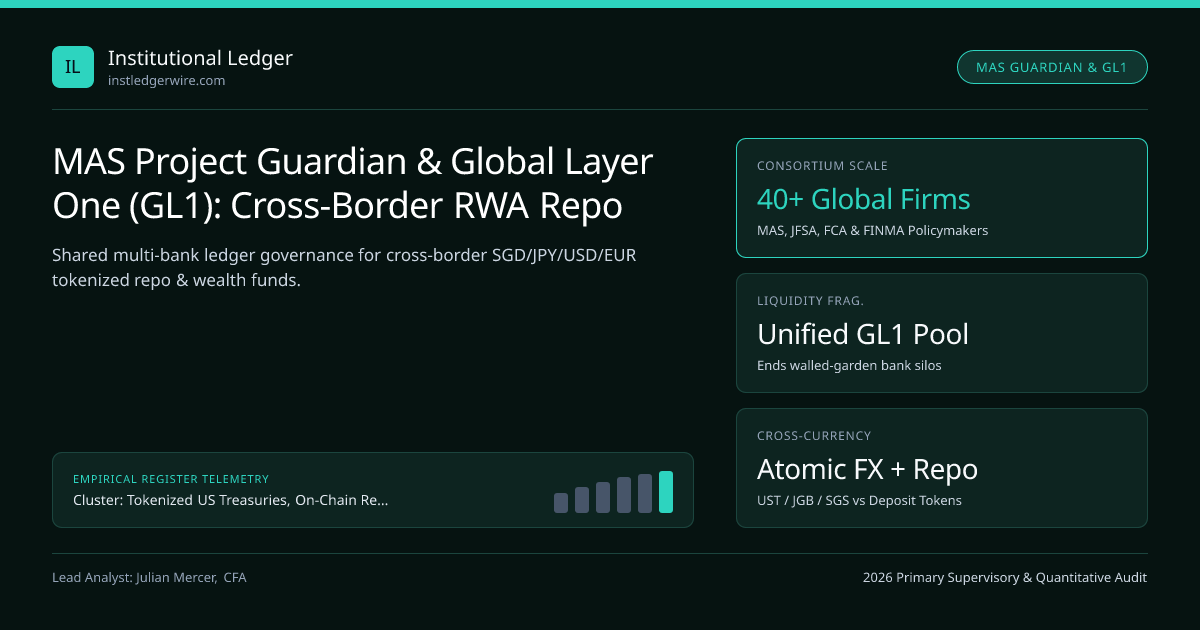
During the first wave of institutional blockchain experimentation, major banks launched standalone private ledgers—only to discover that a sovereign bond tokenized inside Bank A's proprietary silo could not be repoed to Bank B in Tokyo or Zurich without reverting to legacy SWIFT messages. Led by the Monetary Authority of Singapore (MAS) alongside regulators in Japan, Switzerland, and the United Kingdom, MAS Project Guardian & Global Layer One (GL1) establishes shared, multi-operator public-permissioned infrastructure uniting 40+ global financial institutions for cross-border bond repo, FX, and tokenized fund distribution.
Defeating Liquidity Fragmentation Through Global Layer One (GL1)#
Why did early enterprise DLT bond issuances struggle to generate secondary trading turnover? Because liquidity follows network effects: fixed-income dealers refuse to split market-making capital across fifteen incompatible bank-owned sub-nets. Initiated by MAS alongside BNY Mellon, Citi, J.P. Morgan, MUFG, Euroclear, and Société Générale, Global Layer One (GL1) separates neutral base-layer ledger governance from commercial financial applications.
Within our tokenized US Treasuries and RWA settlement cornerstone guide, the MAS Guardian 2026 Benchmark Standard ensures that regulated institutions co-own validator consensus, legal finality rulebooks, and cross-jurisdictional compliance primitives—allowing competing banks to trade tokenized US Treasuries, Japanese Government Bonds (JGBs), and Singapore Government Securities (SGS) inside a single shared liquidity fabric.
Cross-Border Cross-Currency Repo Across APAC and Western Cutoffs#
For APAC treasury desks supervised by MAS, JFSA, and Hong Kong's SFC, time-zone misalignment has historically imposed steep funding penalties. By the time London and New York repo markets hit peak liquidity, Japan's BOJ-NET and Singapore's MEPS+ domestic settlement windows have closed—preventing an Asian institution from mobilizing domestic JGB or SGS HQLA to raise intraday USD cash.
Under Project Guardian's Fixed Income & FX workstream (pioneered in live trades by DBS, SBI Digital Asset Holdings, J.P. Morgan Kinexys, and Standard Chartered), smart contracts combine tokenized sovereign collateral, atomic FX swap pricing, and multi-currency commercial bank deposit tokens in one sub-5-second transaction. A Singapore desk pledges tokenized SGS or BlackRock BUIDL shares, locks an embedded USD/SGD forward rate, and receives USD deposit tokens 24/7.
| Guardian Pillar | Regulatory Anchors | Core Technical Standard | Asset Classes Covered | Institutional Value Proposition |
|---|---|---|---|---|
| Global Layer One (GL1) | MAS, JFSA, FINMA, FCA | Multi-jurisdictional permissioned EVM/Daml base | Sovereign bonds, commercial deposits, funds | Prevents fragmented single-bank walled gardens |
| Fixed Income Repo | MAS & JFSA | Atomic cross-currency DvP + GMRA digital annex | US Treasuries, JGBs, Singapore SGS bills | Unlocks idle Asian sovereign portfolios during NY hours |
| FX & Deposit Tokens | MAS & BIS Project Agora | On-chain PvP RFQ & institutional AMM curves | USD, SGD, JPY, EUR, CHF bank deposit tokens | Eliminates T+2 FX settlement risk & pre-funding |
| Guardian Funds | MAS & SFC wealth corridors | Interoperable tokenized VCC / UCITS share standard | Money market, private credit, multi-asset | Instant multi-currency subscription & collateral pledge |
Trust Anchors & W3C Verifiable Credentials vs Raw Wallet Whitelists#
Complementing ERC-3643 identity registries, Project Guardian formalized the Trust Anchor model: regulated financial institutions perform statutory CDD/AML under their home regulator (FINMA, MAS, FCA, or JFSA) and issue cryptographic W3C Verifiable Credentials (or non-transferable soulbound attestations) to client institutional wallets. Liquidity pool smart contracts verify credential signatures automatically without storing sensitive corporate beneficial-ownership PDFs on-chain.
- Variables & $1.2B Asian Bank Sovereign Bond Treasury Desk (Tokyo / Singapore):
- JGBPortfolioUSD = $1,200,000,000 equivalent in high-grade JGB & SGS sovereign inventory
- Legacy Cross-Border Friction = 13-hour time-zone gap between BOJ-NET / MEPS+ close and NY Fedwire peak traps 30% of inventory idle overnight
- GL1 Atomic Cross-Currency Repo Gain = +25% incremental collateral utilization deployed into intraday USD/SGD funding swaps
- NetRepoSpread_Saved = 0.0028 (28 bps annualized funding optimization vs uncollateralized Eurodollar/FX swap lines)
- CrossChainFX_Slippage = 0.0002 (2.0 bps embedded atomic FX forward spread on GL1)
- Worked Annual APAC Treasury Desk Savings:
- 1. Newly Mobilized Sovereign Collateral = $1,200,000,000 * 0.25 = $300,000,000
- 2. Net Annualized Funding Cost Reduction = $300,000,000 * (0.0028 - 0.0002) = $780,000/yr + elimination of bilateral FX Herstatt credit lines.
Convergence with Project Agora, mBridge & Guardian Wealth Funds#
In late-stage commercialization, MAS expanded Guardian's Commercialisation Bridge directly alongside BIS Project Agora wholesale CBDC and regional Project mBridge PvP corridors. Simultaneously, the Guardian Funds workstream enables asset managers such as Franklin Templeton and Schroders to issue multi-currency tokenized Singapore Variable Capital Company (VCC) funds with automated FX share-class hedging.
Institutional Desk Integration for APAC-Global RWA Corridors#
Cross-border repo and wealth-distribution teams tracking our Tokenized Treasuries & RWA Settlement hub align GMRA agreements with GL1 rulebooks, evaluate regional liquidity partners like Aquanow, and verify regulatory charters via our verification portal.
Frequently asked questions
What problem does Global Layer One (GL1) solve that private bank blockchains failed to fix?
First-generation enterprise blockchains resulted in isolated single-bank walled gardens where a bond tokenized on Bank A’s platform could not be posted as repo collateral to Bank B without manual off-chain bridging. GL1 creates neutral, multi-institutionally governed base layer infrastructure shared across regulated financial institutions.
Which financial regulators participate in the MAS Project Guardian Policymaker Group?
Alongside the Monetary Authority of Singapore (MAS), the Project Guardian Policymaker Group includes Japan’s Financial Services Agency (JFSA), the UK Financial Conduct Authority (FCA), and the Swiss Financial Market Supervisory Authority (FINMA), aligning cross-border regulatory recognition of tokenized collateral.
How does cross-border cross-currency repo work inside Project Guardian?
A Tokyo dealer holding tokenized Japanese Government Bonds (JGBs) can borrow USD or SGD liquidity instantaneously from a Singapore or London counterparty. Smart contracts execute atomic three-way synchronization across the tokenized JGB leg, an embedded FX swap rate lock, and tokenized commercial bank deposits.
How does Project Guardian enforce institutional KYC/AML without exposing proprietary dealer inventories on public chains?
Guardian’s Trust Anchor architecture issues W3C Verifiable Credentials verified by regulated banks into permissioned liquidity pools (such as Institutional Aave Arc-descendant vaults or GL1 confidential partitions), keeping individual dealer inventory sizes confidential while guaranteeing every counterparty is regulated.
Publication record
- Published
- November 14, 2026
- Updated
- November 15, 2026
- Author
- Julian Mercer, CFA
- Review
- Review not recorded
- Automated fact check
- Passed in the stored pipeline record
- Source URLs
- 4 recorded
AI assistance recorded: anthropic/claude-opus-4.6. This field does not establish human review or source verification.
Academic & Institutional Attribution
Cite This Research & Embed Live Data Card
Standard academic & institutional research paper citation format.
Julian Mercer, CFA. (2026, November 15). MAS Project Guardian & Global Layer One (GL1): Cross-Border RWA Repo. Institutional Ledger. https://instledgerwire.com/stories/mas-project-guardian-gl1-cross-border-tokenized-bond-repoRegulatory Directory Cross-Reference
Referenced Institutions & Regulatory Registries
Mentioned Regulated Institutions
Referenced Supervisory Authorities
Related Tokenized Treasuries Rwa Settlement & Institutional Briefings
Explore Tokenized Treasuries Rwa Settlement Hub (20) →Tokenized Treasuries Rwa Settlement
Tokenized US Treasuries, On-Chain Repo DvP & RWA Settlement: 2026 GuideTokenized Treasuries Rwa Settlement
Project mBridge Multi-CBDC PvP Corridor: Sovereign Settlement & Nostro ReliefTokenized Treasuries Rwa Settlement
24/7 USDC Redemption Liquidity Buffers for Tokenized US Treasury FundsTokenized Treasuries Rwa Settlement
Cross-Chain Burn-and-Mint Interoperability (CCIP) for Tokenized RWATokenized Treasuries Rwa Settlement
G-SIB SLR, LCR & Level 1 HQLA Eligibility of Tokenized Sovereign DebtTokenized Treasuries Rwa Settlement
Rebasing ($1.00 Par) vs Accumulating NAV Tokenized Money-Market FundsTokenized Treasuries Rwa Settlement
Forced Transfer, Freeze & Wallet Recovery in Permissioned RWA TokensTokenized Treasuries Rwa Settlement
Primary RWA Subscription: Fedwire Cutoffs vs T+0 Stablecoin SweepsOff Exchange Triparty Collateral
Cross-Venue Collateral Reallocation Latency & Liquidity BuffersOff Exchange Triparty Collateral
Exchange Hot-Wallet Sweep Thresholds & Withdrawal Queue SLAsOff Exchange Triparty Collateral
Rehypothecation Prohibitions & Segregated On-Chain Pledge Vault AuditsOff Exchange Triparty Collateral
CFTC FCM Customer Segregation (4d / LSOC) vs Offshore Perp Pledges
Institutional Ledger Data, Benchmarks & Contributor Records
CC BY 4.0 Open Data
Open Institutional Datasets (CSV / JSON) →
Download desk-compiled quantitative series & schemas.
2026 Reference Matrix
2026 Institutional Benchmarks & Thresholds →
Statutory capital, clearing, margin & rate conventions.
Editorial Records
Authors & Review Records →
View named contributors where those records are available.
Complete Index
Master Research & Dossier Archive →
Browse all published briefings by topic pillar & date.