
Tokenized Treasuries Rwa Settlement
24/7 USDC Redemption Liquidity Buffers for Tokenized US Treasury Funds
Underlying US Treasury bills cannot settle over Fedwire on Sundays, yet BlackRock BUIDL and Ondo OUSG offer instant 24/7 par redemptions via dedicated on-chain USDC smart-contract liquidity buffers.
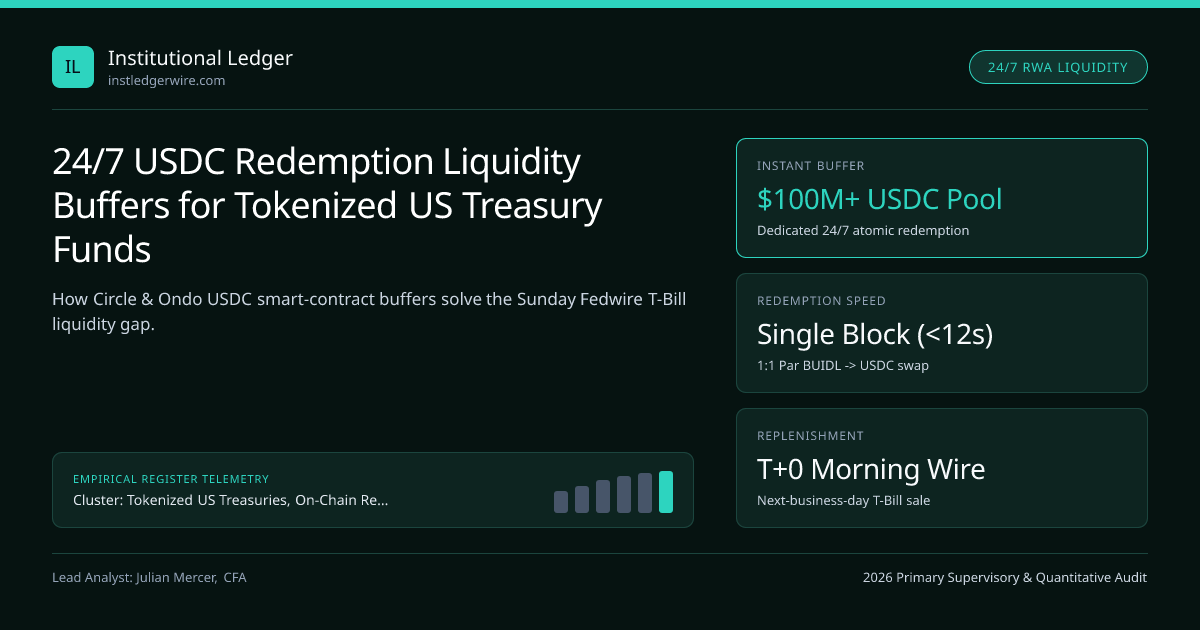
Here lies the central temporal paradox of public-blockchain Real-World Assets: Ethereum and Solana trade 24 hours a day, 365 days a year, whereas the underlying US Treasury bills backing tokenized funds only settle for cash when Fedwire opens Monday through Friday. As examined across our tokenized US Treasuries and RWA settlement cornerstone guide, institutional flagships such as BlackRock BUIDL and Ondo OUSG bridged this 65-hour weekend abyss through pre-funded, oracle-guarded 24/7 USDC smart-contract liquidity buffers.
Why External Stablecoin Facilities Beat Internal Cash Sleeves#
If a tokenized money-market fund simply kept 15% of shareholder subscriptions sitting idle as uninvested stablecoins inside its own treasury wallet to meet Sunday redemptions, when 3-month Treasury bills pay 4.50%, that 15% zero-yield sleeve would inflict 67.5 basis points of annual cash drag—rendering the fund uncompetitive against traditional Wall Street government money funds.
Circle and BlackRock/Securitize solved this incentive problem elegantly via an external smart-contract liquidity facility. Because Circle earns reserve interest on the Treasury bills backing regulated USDC under NYDFS supervision, Circle can economically post $100M+ of USDC inside an on-chain BUIDL liquidity contract at zero fee and zero portfolio cash drag to BUIDL shareholders. When a hedge fund swaps $25M of BUIDL for $25M of USDC at 3:00 AM Sunday to meet variation margin on Bitstamp or Bitfinex, BUIDL's internal portfolio remains 100% invested in earning T-Bills and Fed Overnight Reverse Repo.
Stacked Liquidity Routing: How Ondo OUSG Chains Into BUIDL & USDC#
Composability allows downstream RWA protocols to stack liquidity facilities without duplicating idle capital. As detailed in our structural audit of Ondo OUSG and USDY bankruptcy-remote SPVs, Ondo's OUSG smart contract maintains a primary USDC buffer and holds BlackRock BUIDL as its core reserve asset.
When an institutional holder calls redeemInstant on OUSG during a weekend volatility spike:
- If OUSG's local USDC vault covers the redemption, USDC transfers immediately at the latest Chainlink / DTCC Smart NAV oracle price.
- If local USDC runs low, OUSG's smart contract atomically redeems a matching slice of its BUIDL shares through Circle's BUIDL-to-USDC smart contract and forwards the resulting USDC to the investor inside a single composable transaction.
| Liquidity Buffer Parameter | External Sponsor Vault (BUIDL + Circle) | Stacked SPV Router (Ondo OUSG) | Internal On-Chain Sleeve | Pure T+1 Wire Fund (BENJI Base) |
|---|---|---|---|---|
| Weekend Instant Liquidity | Yes — up to vault USDC balance ($100M+) | Yes — OUSG buffer + Circle BUIDL pass-through | Yes — capped at internal % sleeve | Via secondary OTC (Aquanow) or P2P only |
| Portfolio Cash Yield Drag | 0 bps (external sponsor balance sheet) | ~5–12 bps (blended operating buffer) | 45–90 bps (10%–20% zero-yield USDC) | 0 bps (100% T-Bills / Fed RRP) |
| Per-Investor Daily Cap | Smart-contract rolling 24h quota | Rolling 24h global + per-investor cap | Pro-rata pool availability | Unlimited at T+1 Fedwire open |
| Depeg Circuit Breaker | Halts if USDC deviates from NYDFS $1 par | Oracle guard checks NAV + USDC peg | Governance pause guardian | Settled in USD bank wires |
Anti-Whale Quotas, Depeg Guards & Monday Replenishment Cycles#
Risk committees auditing 24/7 redemption contracts verify three defensive smart-contract parameters:
- Rolling 24-Hour Per-Entity & Global Caps: Prevents a single opportunistic arbitrageur from draining the entire $100M weekend buffer in one block, preserving fair liquidity access across onboarded trading desks.
- Bidirectional Stablecoin Peg Breakers: If USDC itself ever trades below
$0.995during a banking stress event, an automated Chainlink price guard halts instant swaps so arbitrageurs cannot dump impaired stablecoins into the vault or drain par assets unfairly. - Monday 08:30 ET Fedwire Replenishment: When Fedwire Securities and primary dealer repo desks reopen Monday morning, the liquidity operator redeems excess accumulated RWA shares via primary wire settlement sweeps and refills the on-chain USDC buffer.
- Variables & $1.5B Tokenized Treasury Fund Liquidity Engineering Comparison:
- Fund_AUM = $1,500,000,000 institutional AUM held by crypto prime & hedge fund desks
- Weekend99VaRRedemption = 0.080 (8.0% peak 72-hour holiday-weekend margin-call redemption surge = $120,000,000 needed)
- r_TBill = 0.0450 (4.50% underlying US Treasury Bill & Overnight RRP portfolio yield)
- Case A (Naive Internal 8.0% Uninvested USDC Portfolio Sleeve):
- InternalYieldDrag = 0.080 * 450 bps = 36.0 bps/yr drag ($5,400,000/yr lost investor yield!)
- Case B (External Issuer-Sponsored USDC Smart-Contract Facility — Circle/BUIDL Architecture):
- Circle backs the $120M USDC vault with its own interest-earning NYDFS reserve T-Bills while earning USDC ecosystem circulation!
- Portfolio Yield Drag to RWA Holders = 0.0 bps ($5,400,000/yr yield preserved + 100% Sunday instant liquidity).
Stress Behavior vs Secondary OTC Liquidity Discounts#
Crucially, exhausting an instant USDC buffer never forces a fire-sale of underlying Treasury bills. Once the smart-contract buffer hits zero, redemptions queue cleanly for standard next-business-day par wire settlement—or urgent desks can seek bilateral Sunday quotes via secondary OTC RFQ liquidity providers such as Aquanow.
Due-Diligence Checklist for Treasury Liquidity Managers#
Allocators operating across our Tokenized Treasuries & RWA Settlement hub monitor live on-chain vault USDC balances via block-explorer dashboards, model 99% weekend margin VaR against daily per-wallet redemption quotas, and verify fund custodians through our verification portal.
Frequently asked questions
How can BlackRock BUIDL redeem instantly into USDC at 3:00 AM on Sunday when US bond markets are closed?
BUIDL does not sell underlying Treasury bills on Sunday morning. Instead, whitelisted holders transfer BUIDL shares into a dedicated Circle smart-contract liquidity facility pre-funded with $100M+ of USDC. The smart contract sends USDC atomically in the same block while Circle holds the acquired BUIDL shares or redeems them when Fedwire reopens Monday.
Does holding a USDC liquidity buffer inside a tokenized Treasury fund dilute investor yield?
If held directly inside the fund’s portfolio, 0%-yielding stablecoins create cash drag (e.g., a 10% idle USDC sleeve reduces a 4.50% T-Bill yield by 45 bps). Separating the USDC facility onto an external liquidity provider’s balance sheet (like Circle’s external BUIDL facility) preserves ~100% T-Bill/RRP portfolio yield inside BUIDL itself.
How does Ondo OUSG achieve multi-layer instant USDC liquidity?
Ondo OUSG maintains its own direct USDC instant-redemption buffer plus programmatic access to redeem its underlying BlackRock BUIDL holdings through the Circle BUIDL-to-USDC smart contract, creating stacked 24/7 instant liquidity capacity for institutional derivative margin desks.
What happens if a market panic drains 100% of the on-chain USDC liquidity buffer over a holiday weekend?
The on-chain USDC smart contract simply reverts further instant-swap transactions once its balanceOf(USDC) hits zero; no principal loss or discounted forced sale occurs. Investors submit standard primary redemption requests settled at par $1.00 via Fedwire/USDC when US Treasury repo and bill markets open on the next business day.
Publication record
- Published
- November 13, 2026
- Updated
- November 14, 2026
- Author
- Julian Mercer, CFA
- Review
- Review not recorded
- Automated fact check
- Passed in the stored pipeline record
- Source URLs
- 3 recorded
AI assistance recorded: anthropic/claude-opus-4.6. This field does not establish human review or source verification.
Academic & Institutional Attribution
Cite This Research & Embed Live Data Card
Standard academic & institutional research paper citation format.
Julian Mercer, CFA. (2026, November 14). 24/7 USDC Redemption Liquidity Buffers for Tokenized US Treasury Funds. Institutional Ledger. https://instledgerwire.com/stories/usdc-redemption-liquidity-buffers-for-tokenized-treasury-fundsRegulatory Directory Cross-Reference
Referenced Institutions & Regulatory Registries
Mentioned Regulated Institutions
Referenced Supervisory Authorities
Related Tokenized Treasuries Rwa Settlement & Institutional Briefings
Explore Tokenized Treasuries Rwa Settlement Hub (20) →Tokenized Treasuries Rwa Settlement
Tokenized US Treasuries, On-Chain Repo DvP & RWA Settlement: 2026 GuideTokenized Treasuries Rwa Settlement
Cross-Chain Burn-and-Mint Interoperability (CCIP) for Tokenized RWATokenized Treasuries Rwa Settlement
G-SIB SLR, LCR & Level 1 HQLA Eligibility of Tokenized Sovereign DebtTokenized Treasuries Rwa Settlement
Rebasing ($1.00 Par) vs Accumulating NAV Tokenized Money-Market FundsTokenized Treasuries Rwa Settlement
Forced Transfer, Freeze & Wallet Recovery in Permissioned RWA TokensTokenized Treasuries Rwa Settlement
Primary RWA Subscription: Fedwire Cutoffs vs T+0 Stablecoin SweepsTokenized Treasuries Rwa Settlement
Secondary OTC RFQ Liquidity & Weekend Discounts in Tokenized TreasuriesTokenized Treasuries Rwa Settlement
ERC-3643 (T-REX) Identity Registries & On-Chain RWA WhitelistingOff Exchange Triparty Collateral
Rehypothecation Prohibitions & Segregated On-Chain Pledge Vault AuditsOff Exchange Triparty Collateral
CFTC FCM Customer Segregation (4d / LSOC) vs Offshore Perp PledgesOff Exchange Triparty Collateral
EU MiCA Article 70 & 75 CASP Safeguarding in Off-Exchange SettlementOff Exchange Triparty Collateral
English-Law Fixed vs Floating Charges & Trusts on Digital Collateral
Institutional Ledger Data, Benchmarks & Contributor Records
CC BY 4.0 Open Data
Open Institutional Datasets (CSV / JSON) →
Download desk-compiled quantitative series & schemas.
2026 Reference Matrix
2026 Institutional Benchmarks & Thresholds →
Statutory capital, clearing, margin & rate conventions.
Editorial Records
Authors & Review Records →
View named contributors where those records are available.
Complete Index
Master Research & Dossier Archive →
Browse all published briefings by topic pillar & date.