
Off Exchange Triparty Collateral
2-of-3 MPC Co-Signer Dispute Deadlocks & Timelock Escape Hatches
In 2-of-3 MPC off-exchange vaults, what happens if both the exchange and custodian co-signer go offline or dispute a margin call? Pre-signed timelock escape hatches guarantee deterministic exit.
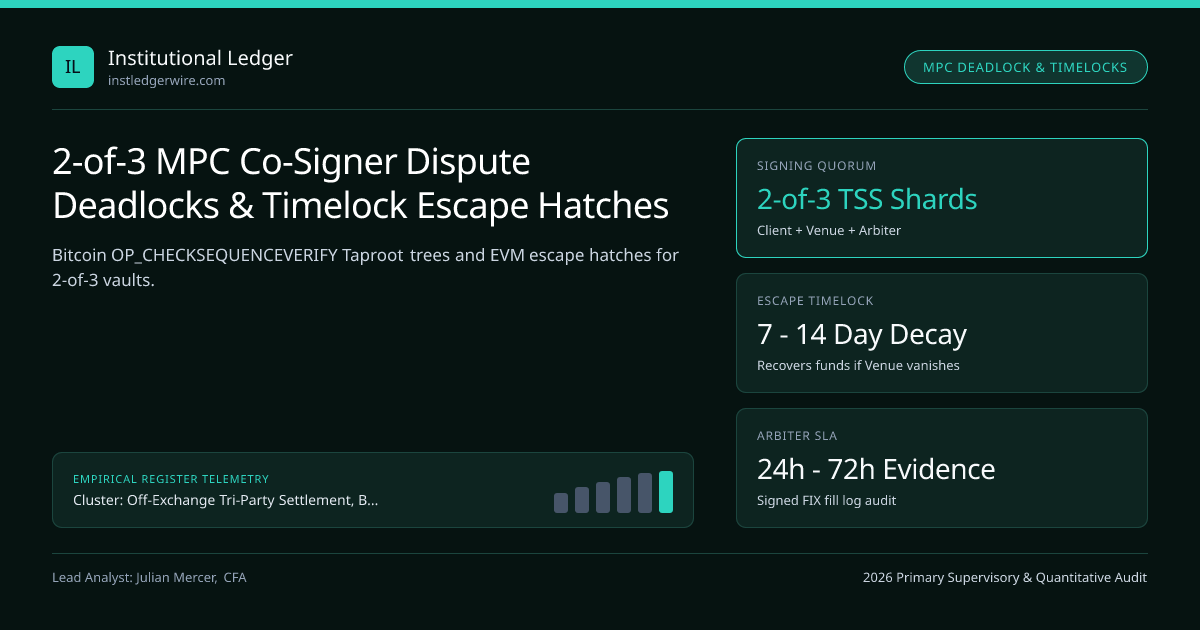
Every institutional CISO evaluating a 2-of-3 Multi-Party Computation (MPC) off-exchange vault asks two adversarial questions: "First, what if a rogue exchange colludes or lies about a margin call to trigger the third co-signer? Second, what if both the exchange and the custody vendor get hit with simultaneous bankruptcy injunctions—are our coins trapped on-chain forever?" Solving both requires cryptographically non-repudiable order logs paired with Layer-1 timelock escape hatches.
Why 2-of-2 Multisig Is a Trap — and How 2-of-3 MPC Assigns Key Shards#
In early institutional custody experiments, engineers proposed simple 2-of-2 multisig between the Hedge Fund and the Exchange: neither side could steal from the other! That design collapsed the first time an exchange entered liquidation—because a court-appointed liquidator immediately froze the exchange's signing server, locking the solvent Hedge Fund's $50M inside a permanent 2-of-2 stalemate!
As outlined across our off-exchange tri-party collateral cornerstone guide and custodial mirror loops vs bank tri-party control, modern off-exchange vaults distribute three independent key shards:
- Shard A (Trader): Held inside the fund's own internal HSM or policy-guarded enclave.
- Shard B (Exchange): Held by the partner trading venue (Bitstamp, Bitfinex, BitMEX, Backpack Exchange).
- Shard C (Neutral Co-Signer / Arbiter): Held by a chartered custodian or automated hardware-attested AWS Nitro / SGX dispute-resolution engine.
Deterministic Dispute Resolution via ECDSA-Signed FIX Order Chains#
How do you prevent human bias or social engineering at Shard C during a $20M flash-crash dispute? By removing subjective human guesswork! In institutional off-exchange APIs, the Trader's execution engine cryptographically signs every order payload (clOrdID, symbol, side, qty, price, timestamp) using a registered session key before transmitting it to the matching engine, and the Exchange returns a counter-signed fill receipt.
If either party refuses to sign the scheduled 4-hour variation-margin sweep:
- Either side opens a formal On-Chain / API Dispute Ticket with Shard C.
- Within a strict 24-to-48-hour evidence window, the Exchange must upload the Merkle-chained log of Trader-signed orders since the prior settled checkpoint, evaluated against an independent composite spot index (e.g., CME CF Bitcoin Real-Time Index).
- If the Exchange proves the Trader owes -$4.2M, Shard C + Shard B co-sign exact -$4.2M to the Exchange and Shard C + Shard A co-sign the remaining $45.8M principal straight back to the Trader! If the Exchange went bust and uploads nothing within 48 hours, Shard C + Shard A release 100.0% to the Trader.
| Failure / Dispute Scenario | Naive 2-of-2 Vault Outcome | 2-of-3 MPC + L1 Timelock Outcome | Cryptographic Resolution Path |
|---|---|---|---|
| Normal 4h Settlement | Client + Venue sign | Client + Venue sign (2-of-3) | Sub-second TSS round; Arbiter idle |
| Exchange Collapses (FTX-style) | PERMANENT DEADLOCK (Venue key frozen) | Client + Arbiter co-sign release in 48h | Arbiter verifies zero owed debt & signs |
| Trader Refuses Losing Sweep | Venue stranded with unpaid loss | Venue + Arbiter co-sign owed PnL | Venue submits Trader's ECDSA-signed orders |
| Custodian Vendor Offline | Normal ops continue | Client + Venue co-sign direct unwind | Zero dependency on vendor cloud uptime |
| BOTH Venue + Vendor Vanish! | 100% Permanent Coin Loss | 100% Client Recovery after 14 days | Bitcoin OP_CSV / EVM initiateExit matures |
Layer-1 Sovereign Exit: Bitcoin Taproot OP_CSV & EVM Challenge Queues#
What if Shard C's technology company also goes dark? Sovereign escape hatches guarantee L1 exit without Shard B or Shard C:
- On Ethereum / EVM Chains (USDC, RWA tokens): The vault smart contract implements
requestUnilateralExit. Calling it starts an immutable 7-to-14-day block timestamp countdown. If neither Venue+Arbiter submits a valid signed debt proof during those 14 days,finalizeExitreleases 100% of tokens to the Trader's cold address. - On Native Bitcoin: Using Taproot (
BIP-341), normal 2-of-3 MPC spends use the compact Schnorr key-path (indistinguishable on-chain and low fee), while a committed Tapscript leaf encodes<2016 blocks> OP_CHECKSEQUENCEVERIFY OP_DROP <Client_Cold_Pubkey> OP_CHECKSIGtriggered from an exit-initiation anchor transaction.
- Variables & $150M Institutional Off-Exchange Vault Catastrophic Deadlock Model (5-Year Horizon):
- PVenueInsolvency_Freeze = 0.04 (4.0% cumulative 5-year exchange insolvency / litigation key freeze risk)
- PArbiterSimultaneous_Halt = 0.01 (1.0% probability custodian co-signer faces simultaneous regulatory stay or outage)
- 1. 2-of-2 Vault Without Arbiter (
P_Freeze = 4.0%-> $6,000,000 expected frozen capital!) - 2. 2-of-3 MPC Without L1 Timelock (
P_Freeze = 0.04 * 0.01 = 0.04%-> $60,000 residual tail risk) - 3. 2-of-3 MPC + Audited 14-Day Taproot / EVM Timelock Escape (
Has_OnChain_Timelock_Escape = 1): - Permanent Deadlock Probability = 0.0000% (Client's own air-gapped FIPS HSM recovers 100% of $150M sovereignly on L1!).
Preserving UCC § 12-105 Control Priority Alongside Escape Timelocks#
Legal counsel confirms that a conditional 14-day fallback exit does not impair UCC Article 12 § 12-105(e) shared-control lien perfection, because the Exchange retains full 14-day window power with Shard C to sweep any legitimate owed obligation before the timelock matures.
Cryptographic Fire-Drill Protocol for Custody Engineering Teams#
Security architects active in our Off-Exchange Tri-Party Collateral hub execute annual testnet black-swan recovery drills—simulating dead Exchange and dead Vendor nodes to verify internal HSM scripts broadcast and sweep Taproot/EVM timelocks cleanly, while verifying providers in our verification portal.
Frequently asked questions
Who holds the three key shares in a 2-of-3 MPC off-exchange collateral vault?
Shard 1 sits inside the institutional fund’s own HSM/MPC enclave; Shard 2 belongs to the partner trading venue; Shard 3 is held by an independent regulated custodian, law-firm escrow, or automated cryptographic policy co-signer that signs only upon verified dispute evidence.
How does the third Arbiter shard know whether the Trader or the Exchange is telling the truth in a PnL dispute?
Institutional mirror protocols require every order submitted by the Trader to carry an Ed25519/ECDSA API signature over (symbol, side, qty, limit_price, nonce, timestamp). In a dispute, the Exchange submits the chain of client-signed orders plus public mark-price index proofs, allowing deterministic mathematical recomputation of owed PnL.
How does a Bitcoin Taproot timelock escape hatch work without smart contracts?
Using Taproot (BIP-341) script-path spending and relative timelocks (BIP-112 OP_CHECKSEQUENCEVERIFY), the vault address commits to a normal 2-of-3 MuSig2/FROST key-path spend PLUS a hidden script leaf allowing 1-of-1 Client recovery after N = 2,016 Bitcoin blocks (~14 days) if no cooperative refresh occurs.
Why must a Bitcoin relative timelock vault "heartbeat refresh" periodically while positions remain open?
If an absolute OP_CHECKLOCKTIMEVERIFY timestamp expired while the Trader still held a losing -$20M short position, the Trader could unilaterally rug-pull the collateral from the Exchange! Using relative OP_CSV UTXO refreshes (or EVM challenge-period contracts) ensures the countdown clock starts ONLY after the Trader initiates an on-chain exit request.
Publication record
- Published
- November 13, 2026
- Updated
- November 15, 2026
- Author
- Julian Mercer, CFA
- Review
- Review not recorded
- Automated fact check
- Passed in the stored pipeline record
- Source URLs
- 3 recorded
AI assistance recorded: anthropic/claude-opus-4.6. This field does not establish human review or source verification.
Academic & Institutional Attribution
Cite This Research & Embed Live Data Card
Standard academic & institutional research paper citation format.
Julian Mercer, CFA. (2026, November 15). 2-of-3 MPC Co-Signer Dispute Deadlocks & Timelock Escape Hatches. Institutional Ledger. https://instledgerwire.com/stories/custodian-cosigner-dispute-deadlocks-timelock-escape-hatchesRegulatory Directory Cross-Reference
Referenced Institutions & Regulatory Registries
Mentioned Regulated Institutions
Primary Tier-1 Supervisory Registries
Related Off Exchange Triparty Collateral & Institutional Briefings
Explore Off Exchange Triparty Collateral Hub (20) →Off Exchange Triparty Collateral
Off-Exchange Tri-Party Settlement & Bankruptcy-Remote Crypto Custody GuideOff Exchange Triparty Collateral
ISDA Digital Asset Derivatives Definitions & CSA Collateral SchedulesOff Exchange Triparty Collateral
Cross-Venue Collateral Reallocation Latency & Liquidity BuffersOff Exchange Triparty Collateral
Exchange Hot-Wallet Sweep Thresholds & Withdrawal Queue SLAsOff Exchange Triparty Collateral
Rehypothecation Prohibitions & Segregated On-Chain Pledge Vault AuditsOff Exchange Triparty Collateral
CFTC FCM Customer Segregation (4d / LSOC) vs Offshore Perp PledgesOff Exchange Triparty Collateral
EU MiCA Article 70 & 75 CASP Safeguarding in Off-Exchange SettlementOff Exchange Triparty Collateral
English-Law Fixed vs Floating Charges & Trusts on Digital CollateralStablecoin Reserve Attestation Audit
Hong Kong HKMA Fiat-Referenced Stablecoin (FRS) Ordinance & CustodyStablecoin Reserve Attestation Audit
CPMI-IOSCO PFMI Rules for Systemically Important StablecoinsStablecoin Reserve Attestation Audit
Intraday Snapshot Window Dressing vs Continuous Proof-of-Reserve OraclesStablecoin Reserve Attestation Audit
Custodial T-Bill Safekeeping: BNY Mellon & State Street Reserve Models
Institutional Ledger Data, Benchmarks & Contributor Records
CC BY 4.0 Open Data
Open Institutional Datasets (CSV / JSON) →
Download desk-compiled quantitative series & schemas.
2026 Reference Matrix
2026 Institutional Benchmarks & Thresholds →
Statutory capital, clearing, margin & rate conventions.
Editorial Records
Authors & Review Records →
View named contributors where those records are available.
Complete Index
Master Research & Dossier Archive →
Browse all published briefings by topic pillar & date.