
Tokenized Treasuries Rwa Settlement
Ondo OUSG & USDY Bankruptcy-Remote SPV Note Structuring Audit
Ondo Finance structures over $2.65B across OUSG and USDY using bankruptcy-remote Delaware SPVs, independent collateral agent first-priority UCC liens, and 3% first-loss equity cushions.
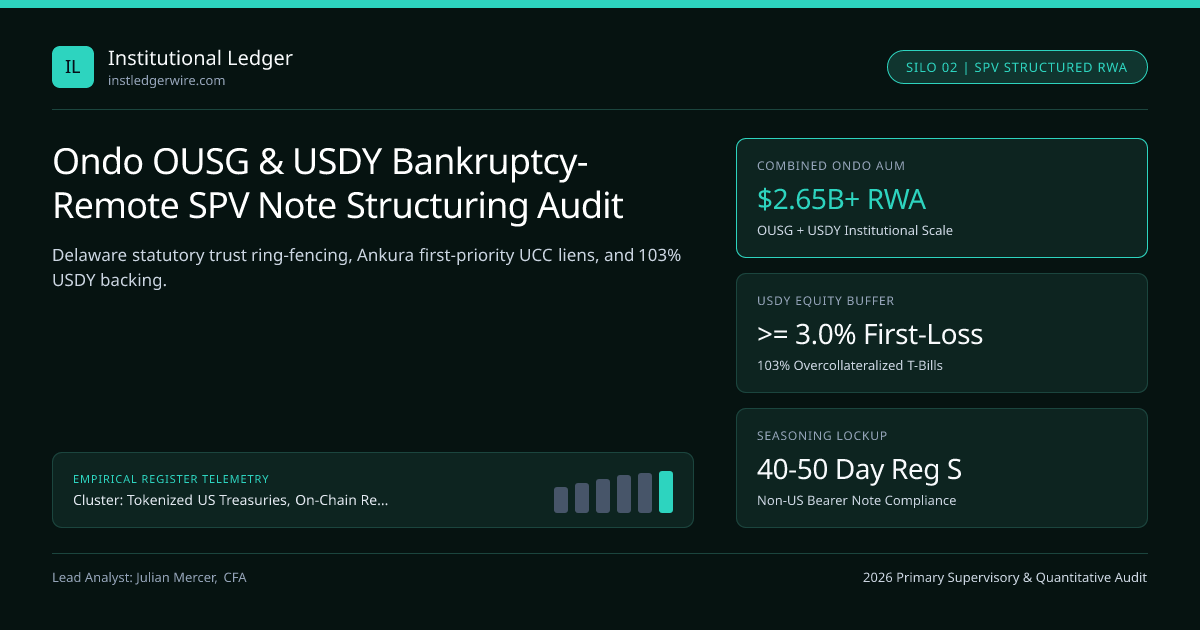
When an allocator buys a tokenized Treasury note issued by a venture-backed fintech company rather than a century-old mutual fund complex, issuer bankruptcy isolation determines whether underlying Treasury bills belong to tokenholders or vanish into corporate Chapter 11 litigation. Across more than $2.65 billion in combined RWA AUM under the Ondo OUSG & USDY Benchmark, institutional securitization techniques—substantive non-consolidation opinions, independent Collateral Agent UCC control agreements, and 3% first-loss equity cushions—transform fintech SPV notes into senior secured sovereign claims.
Substantive Non-Consolidation & Independent Director Veto Mechanics#
Why did legacy crypto yield lenders implode in 2022? Because customer deposits were swept into operating companies carrying Venture Debt, intercompany loans, and proprietary trading liabilities. Institutional structured finance prevents parent-company contagion through a Bankruptcy-Remote Special Purpose Vehicle (SPV).
In the architecture of Ondo USDY LLC (a Delaware limited liability company analyzed within our tokenized US Treasuries and RWA settlement cornerstone guide), corporate separateness is enforced by four hard legal covenants backed by formal substantive non-consolidation legal opinions:
- Strict Single-Purpose Charter: The SPV's operating agreement prohibits incurring external corporate debt, hiring operating staff, or conducting any business other than holding US bank demand deposits and short-term US Treasuries against issued notes.
- Independent Director Veto: The SPV board includes an independent professional director (appointed via corporate-services fiduciaries like CSC or Wilmington Trust) whose affirmative vote is mandatory before the SPV can file voluntary Chapter 11—preventing a distressed parent tech company from dragging the reserve vehicle into bankruptcy to access cash.
Perfected First-Priority UCC Liens via Ankura Trust Control Agreements#
Bankruptcy remoteness alone is incomplete without perfected collateral control under Articles 8 and 9 of the Uniform Commercial Code (UCC). Ondo USDY LLC pledges 100% of its cash and Treasury accounts to Ankura Trust Company acting as independent Collateral Agent and Security Trustee for the benefit of all USDY tokenholders.
crucially, Ankura executes tri-party Deposit Account Control Agreements (DACAs) with partner US banks and Securities Account Control Agreements (SACAs) with T-Bill custodians. Under UCC Sections 9-104 and 8-106, control perfects a first-priority senior security interest superior to any subsequent judgment creditor. Every business day, Ankura independently verifies bank/custodian statements confirming at least 103% asset backing (a 300-bps first-loss equity cushion funded by the sponsor). If the issuer ever misses a redemption SLA or breaches covenants, noteholder governance or the Collateral Agent triggers a Notice of Exclusive Control, freezing issuer access and liquidating T-Bills directly to pay tokenholders.
| Structural Feature | Ondo OUSG | Ondo USDY / rUSDY | BlackRock BUIDL | Unsecured Offshore Yield Token |
|---|---|---|---|---|
| Legal Instrument | Limited Partnership / Trust Share | Senior Secured Debt Note (Delaware LLC) | BVI / Delaware 3(c)(7) Fund Share | Unregulated Terms-of-Service IOU |
| Target Investor Geography | US & Global Qualified Purchasers (Reg D) | Non-US Investors Only (SEC Regulation S) | US & Global Qualified Purchasers | Offshore retail / unverified |
| Transferability Model | Permissioned Whitelist Only | Freely transferable post 40-50d Reg S lock | Permissioned Whitelist Only | Unrestricted (high regulatory freeze risk) |
| Bankruptcy Protection | Segregated Fund LP Assets | Substantive Non-Consolidation + Ankura UCC Lien | Segregated Fund Assets at BNY Mellon | None (Chapter 11 / CIMA / BMA creditor) |
| Overcollateralization | 100% NAV Equity Share | >= 103.0% (3.0% First-Loss Equity Cushion) | 100% NAV Equity Share | Often opaque or rehypothecated |
Regulation S Offshore Bearer Mobility (USDY) vs Reg D 3c7 Liquidity (OUSG)#
Under the Ondo OUSG & USDY 2026 Benchmark Standard, Ondo bifurcates its product shelf across US and offshore securities rules:
- USDY (Regulation S): Issued exclusively to non-US investors outside the United States. After completing KYC/AML minting and waiting out a 40-to-50-day Regulation S distribution seasoning lockup, USDY becomes transferable across non-US wallets on Ethereum, Solana, Mantle, and Sui—serving offshore hedge funds and venues supervised by BMA, CIMA, or VARA (while remaining strictly blocked to US Persons and subject to EU MiCA public-offer rules).
- OUSG (Regulation D 506c / Section 3c7): Serves US and global Qualified Purchasers at a $100,000 minimum ticket (50x more accessible than the $5 million floor on BlackRock BUIDL), holding BUIDL and short-term T-Bills inside a whitelisted wrapper with instant 24/7 USDC liquidity.
- Variables & Interest-Rate Stress Test on USDY 103% Overcollateralized Reserve Pool ($900M Liability, $927M Reserve):
- Overcollateralization_Ratio = 1.0300 (3.00% first-loss equity subordinated behind senior secured USDY noteholders)
- Portfolio Composition = 15% Overnight Bank Demand Deposits (Duration = 0.00 yrs) + 85% Short-Dated US T-Bills (Avg Maturity 65 days = 0.178 yrs)
- Effective Portfolio Modified Duration = 0.85 * (0.178 / (1 + 0.0445)) = 0.1448 years
- Worked Instantaneous Parallel Yield-Curve Shock Capacity:
- MaxInstantaneousRate_Spike = (1.0300 - 1.0000) / 0.1448 * 10,000 = 0.0300 / 0.1448 * 10,000 = +2,071.8 bps (+20.72% single-day Fed rate hike!)
- Even under an extreme +400 bps single-day Treasury market dislocation:
- Portfolio Mark-to-Market Drawdown = 0.1448 * 0.0400 = -0.579% ($5.37M absorbed entirely by $27.0M equity cushion -> Noteholder coverage stays at 102.40%!)
Oracle Pricing & Custody Integration for Accumulating SPV Notes#
Because both OUSG and USDY offer accumulating token variants alongside $1.00 rebasing variants (rOUSG / rUSDY), institutional prime desks at Aquanow and Bitfinex rely on sanity-bounded NAV oracles and rebasing versus accumulating accounting rules inside NYDFS qualified custody.
SPV Credit Due Diligence Checklist for Institutional Allocators#
Credit committees reviewing SPV-issued RWA notes inside our Tokenized Treasuries & RWA Settlement hub demand executed DACA/SACA summaries, read the law firm substantive non-consolidation opinion, verify daily Collateral Agent reserve attestations, and check entity profiles via our verification portal.
Frequently asked questions
What happens to USDY noteholders if Ondo Finance Inc. (the parent software company) goes bankrupt?
USDY is issued by Ondo USDY LLC, a legally separate, bankruptcy-remote Delaware SPV with an independent director whose unanimous consent is required for voluntary bankruptcy, backed by legal non-consolidation opinions. Furthermore, Ankura Trust Company holds a perfected first-priority security interest for noteholders and accelerates/liquidates T-Bills directly if the issuer defaults.
Why does USDY enforce a 40-to-50-day minting lockup before tokens become freely transferable on-chain?
To issue unregistered debt notes outside the United States without violating the US Securities Act of 1933, USDY complies with Regulation S Category 2/3 safe harbors, which mandate a 40-day "distribution compliance period" ensuring notes do not flow back into the hands of US Persons during primary issuance.
Why would a US Qualified Purchaser buy Ondo OUSG when OUSG holds BlackRock BUIDL inside its portfolio?
BlackRock BUIDL requires a $5,000,000 minimum initial subscription and pays yield via monthly token airdrops at a $1.00 par price. OUSG lowers the minimum subscription to $100,000, offers both an accumulating share class (OUSG, preferred for DeFi collateral) and a $1.00 rebasing class (rOUSG), and provides deep 24/7 atomic USDC mint-and-burn smart contracts.
What protects USDY holders against short-term US Treasury interest-rate mark-to-market dips?
Ondo maintains a minimum 3.0% first-loss equity overcollateralization buffer inside Ondo USDY LLC (at least $103 of short-dated T-Bills and demand bank deposits for every $100 of USDY liability), corroborated by daily Ankura Trust verification reports.
Publication record
- Published
- November 14, 2026
- Updated
- November 15, 2026
- Author
- Julian Mercer, CFA
- Review
- Review not recorded
- Automated fact check
- Passed in the stored pipeline record
- Source URLs
- 3 recorded
AI assistance recorded: anthropic/claude-opus-4.6. This field does not establish human review or source verification.
Academic & Institutional Attribution
Cite This Research & Embed Live Data Card
Standard academic & institutional research paper citation format.
Julian Mercer, CFA. (2026, November 15). Ondo OUSG & USDY Bankruptcy-Remote SPV Note Structuring Audit. Institutional Ledger. https://instledgerwire.com/stories/ondo-ousg-usdy-bankruptcy-remote-spv-note-structuringRegulatory Directory Cross-Reference
Referenced Institutions & Regulatory Registries
Mentioned Regulated Institutions
Related Tokenized Treasuries Rwa Settlement & Institutional Briefings
Explore Tokenized Treasuries Rwa Settlement Hub (20) →Tokenized Treasuries Rwa Settlement
Tokenized US Treasuries, On-Chain Repo DvP & RWA Settlement: 2026 GuideTokenized Treasuries Rwa Settlement
BIS Project Agora: Tokenized Commercial Bank Deposits & Wholesale CBDCTokenized Treasuries Rwa Settlement
Eurosystem DLT Trials: Bundesbank Trigger, Pontes & Appia Central Bank DvPTokenized Treasuries Rwa Settlement
MAS Project Guardian & Global Layer One (GL1): Cross-Border RWA RepoTokenized Treasuries Rwa Settlement
Project mBridge Multi-CBDC PvP Corridor: Sovereign Settlement & Nostro ReliefTokenized Treasuries Rwa Settlement
24/7 USDC Redemption Liquidity Buffers for Tokenized US Treasury FundsTokenized Treasuries Rwa Settlement
Cross-Chain Burn-and-Mint Interoperability (CCIP) for Tokenized RWATokenized Treasuries Rwa Settlement
G-SIB SLR, LCR & Level 1 HQLA Eligibility of Tokenized Sovereign DebtOff Exchange Triparty Collateral
Automatic Deleveraging (ADL) & Clawback Risks on Mirrored AccountsOff Exchange Triparty Collateral
2-of-3 MPC Co-Signer Dispute Deadlocks & Timelock Escape HatchesOff Exchange Triparty Collateral
ISDA Digital Asset Derivatives Definitions & CSA Collateral SchedulesOff Exchange Triparty Collateral
Cross-Venue Collateral Reallocation Latency & Liquidity Buffers
Institutional Ledger Data, Benchmarks & Contributor Records
CC BY 4.0 Open Data
Open Institutional Datasets (CSV / JSON) →
Download desk-compiled quantitative series & schemas.
2026 Reference Matrix
2026 Institutional Benchmarks & Thresholds →
Statutory capital, clearing, margin & rate conventions.
Editorial Records
Authors & Review Records →
View named contributors where those records are available.
Complete Index
Master Research & Dossier Archive →
Browse all published briefings by topic pillar & date.