
Tokenized Treasuries Rwa Settlement
Tokenized MMF Collateral Haircuts & CFTC GMAC Derivatives Margin Rules
CFTC Global Markets Advisory Committee (GMAC) standards allow Futures Commission Merchants and clearinghouses to accept tokenized government MMFs at 2% sovereign haircuts under CFTC Rule 1.25.
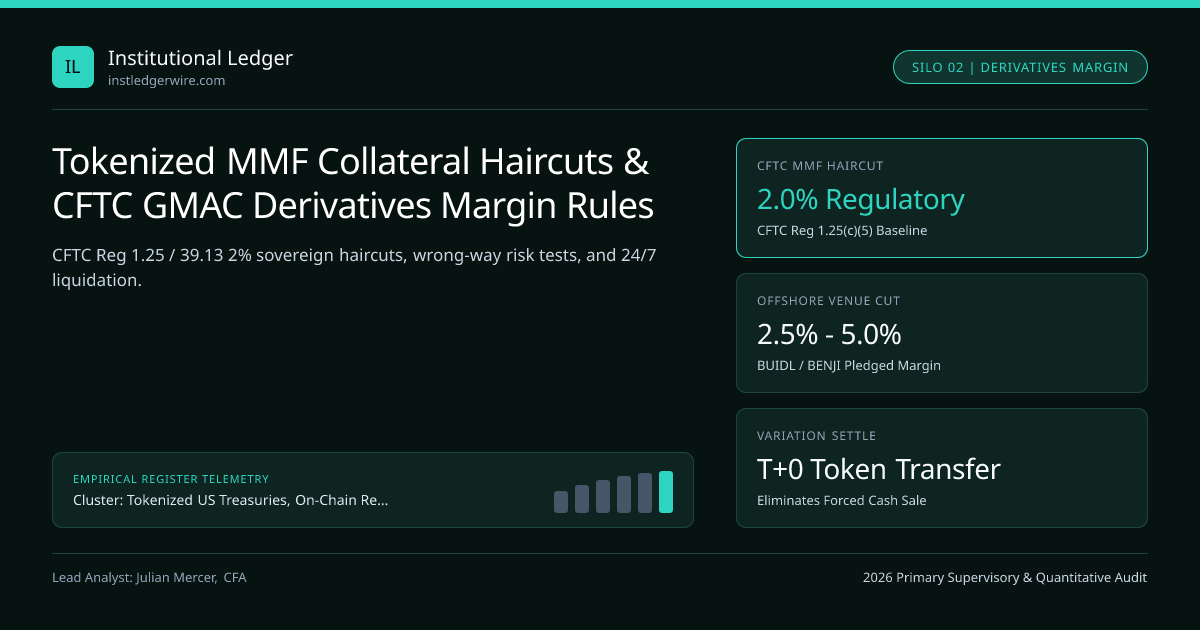
On November 21, 2024, the Commodity Futures Trading Commission's Global Markets Advisory Committee (GMAC) approved landmark recommendations clearing the operational path for registered Futures Commission Merchants (FCMs), Swap Dealers, and Derivatives Clearing Organizations (DCOs) to accept tokenized US Treasury funds and sovereign debt as non-cash margin. Anchored at a 2.0% baseline regulatory haircut under CFTC Regulation 1.25 and benchmarked via the DTCC Smart NAV Tokenized Collateral Framework, yield-bearing RWA tokens now compete head-to-head with idle cash across institutional derivatives books.
CFTC Regulations 1.25, 23.156 & 39.13: Look-Through Parity Explained#
Prior to the GMAC Digital Asset Markets Subcommittee blueprint, compliance teams at CME clearing members hesitated to accept on-chain shares of BlackRock BUIDL or Franklin BENJI due to uncertainty over whether blockchain recordkeeping altered CFTC collateral classifications. GMAC resolved that ambiguity by affirming technology-neutral look-through: distributed ledger technology is strictly an operational book-entry and transfer mechanism, not a new asset class.
Provided a tokenized money-market fund invests solely in assets permitted under CFTC Regulation 1.25 (US government securities and reverse repos), meets Rule 1.25(b)(1) next-day marketability and liquidation standards, resides in a legally perfected segregated custody account under UCC Articles 8 and 12, and enforces ERC-3643-grade transfer controls, FCMs apply the exact 2.0% SEC Rule 15c3-1 / CFTC Reg 1.25(c)(5) money-market haircut used for traditional off-chain MMFs.
Eliminating March 2020 "Dash-for-Cash" Liquidation Spirals#
Beyond the 400+ bps carry boost modeled in our tokenized US Treasuries and RWA settlement cornerstone guide, systemic regulators at the Federal Reserve, BIS, and ESMA support tokenized collateral mobility because it cures procyclical fire-sales. During the March 2020 COVID shock and September 2022 UK gilt LDI crisis, pension funds and hedge funds facing sudden intraday Variation Margin calls had to sell Treasury bonds and MMF shares into illiquid dealer books just to wire fiat cash before clearinghouse cutoffs—amplifying sovereign yield spikes.
When both counterparties accept tokenized Treasury MMF shares directly over T+0 DLT rails, an institutional fund satisfies a $50 million Sunday or intraday margin call without selling a single underlying Treasury bill—transferring ownership of the $1.00 fund share in seconds while the underlying T-Bills remain undisturbed at BNY Mellon or State Street.
| Derivatives Margin Regime | Governing Statutory Rule | Base Haircut | DLT Operational Add-On | Total Effective Haircut |
|---|---|---|---|---|
| US Regulated FCM / DCO | CFTC Reg 1.25(c)(5) & Reg 39.13(g)(10) | 2.0% | 0.0% - 0.5% (if DTCC Smart NAV integrated) | 2.0% - 2.5% |
| Uncleared OTC Swaps (UMR) | CFTC Reg 23.156 / BCBS-IOSCO UMR | 0.5% - 2.0% (tenor based) | 0.0% (held at OCC/NYDFS tri-party custodian) | 0.5% - 2.0% |
| Tier-1 Crypto Prime / OTC | Bilateral CSA (Aquanow, 8 Blocks Capital) | 2.0% | +0.5% to +1.5% (USDC buffer sizing check) | 2.5% - 3.5% |
| Offshore Perpetual Venues | Exchange Risk Engine (Bitfinex, Bitmex) | 2.0% | +2.0% to +3.0% (weekend stress depeg guard) | 4.0% - 5.0% |
| European EMIR Clearing | ESMA EMIR RTS Art. 46 (Gov MMF / Bond) | 1.5% - 2.5% | Subject to DLT Pilot / CRD custodian look-through | 2.0% - 3.0% |
How Crypto Prime & Perpetual Venues Calibrate 2.5%–5.0% RWA Haircuts#
In institutional digital asset derivatives—spanning OTC swap dealers like Aquanow and perpetual futures venues such as Bitfinex and Bitmex integrated via bankruptcy-remote pledges—risk engines layer pragmatic DLT liquidity add-ons onto the 2.0% statutory base:
- Zero Wrong-Way Correlation: Posting native ETH or SOL to margin a long crypto perpetual creates severe wrong-way risk (collateral plunges at the exact instant the trade loses money, requiring 15% to 30% haircuts). US Treasury bills exhibit neutral or flight-to-safety correlation during crypto crashes, justifying tight 2.5% to 5.0% haircuts.
- Instant USDC Pool Sizing: Risk engines compare the client's pledged RWA size against live 24/7 USDC redemption pool balances and Chainlink / DTCC Smart NAV oracle freshness, stepping haircuts from 2.5% on <$50M pledges to 4.0%–5.0% on >$150M blocks that exceed instant weekend pool depth.
- Variables & Risk-Engine Calibration for $80M BlackRock BUIDL Margin Pledge:
- Hstatutory2a7 = 0.0200 (2.00% CFTC Reg 1.25(c)(5) money market baseline)
- sigma1dNAV = 0.0004 (4 bps daily WAM<=45d T-Bill mark-to-market volatility); z999 = 3.09; MPOR_days = 1.0 -> +0.12%
- InstantUSDCPool = $100,000,000 live smart-contract USDC liquidity buffer (> $80M position -> excess ratio = 0!)
- Case A ($80M Pledge <= $100M Instant Pool):
- Total Haircut = 2.00% + 0.12% + 0.00% = 2.12% (rounded to 2.50% prime margin schedule -> $78.0M buying power!)
- Case B ($250M Mega-Pledge > $100M Instant Pool; $150M waits for Monday morning Fedwire at 45 bps weekend gap stress):
- Liquidity Overflow Add-On = ($150M / $250M) * 0.0045 = +0.27% -> Total Haircut = 2.39% (tiered 3.50% large-block schedule)
Tri-Party Pledge Perfection Without Exchange Balance-Sheet Exposure#
Crucially, institutional funds never deposit tokenized Treasury shares directly into an offshore exchange's hot wallet—doing so would breach ERC-3643 transfer-agent whitelists anyway. Instead, tokens stay inside a qualified NYDFS or OCC custody vault under a tri-party Account Control Agreement (ACA), mirroring margin buying power onto the trading venue while preserving 100% sovereign bankruptcy remoteness under the DTCC Smart NAV 2026 Standard.
FCM & Prime Margin Onboarding Checklist for RWA Collateral#
Derivatives treasurers onboarding RWA collateral inside our Tokenized Treasuries & RWA Settlement hub verify CFTC Reg 1.25 acknowledgment letters with their FCM, negotiate tiered haircut schedules tied to instant USDC pool telemetry, and audit counterparty registrations on our verification portal.
Frequently asked questions
Did CFTC GMAC create a brand-new asset class for tokenized Treasury margin or apply look-through parity?
CFTC GMAC applied strict "same asset, same risk, same rules" look-through parity: if the underlying instrument already qualifies as eligible customer margin under CFTC Regulation 1.25 (for FCMs), Regulation 39.13 (for DCOs), or Regulation 23.156 (for uncleared swaps), recording and transferring it on a compliant distributed ledger preserves its eligibility.
Why is the regulatory haircut on tokenized government MMFs 2.0% instead of 0.5% for <1Y direct T-Bills?
Under SEC Rule 15c3-1(c)(2)(vi)(D)(1) cross-referenced by CFTC Regulation 1.25(c)(5), money market mutual fund shares receive a standardized 2.0% haircut, whereas direct US Treasury bills maturing in under 3 months receive 0% to 0.5%. The extra 150 bps reflects fund wrapper operational administration while eliminating CUSIP roll management.
What additional risk add-ons do crypto prime desks add on top of the 2.0% statutory CFTC haircut?
Institutional crypto venues (and tri-party clearing networks) evaluate three DLT-specific add-ons: (1) instant on-chain USDC pool depth relative to position size (+50 to +150 bps if position exceeds instant pool), (2) NAV oracle staleness (+50 bps), and (3) chain finality/bridge risk (+100 bps if bridged rather than native).
Can tokenized MMFs satisfy both Initial Margin (IM) and Variation Margin (VM)?
Historically, Initial Margin accepted non-cash securities (T-Bills/MMFs) while Variation Margin required cash wires because securities took T+1 to transfer. Because tokenized MMFs transfer atomically in seconds with stable $1.00 par value, bilateral ISDA/CSA annexes increasingly accept direct tokenized MMF transfers for intraday VM.
Publication record
- Published
- November 14, 2026
- Updated
- November 14, 2026
- Author
- Julian Mercer, CFA
- Review
- Review not recorded
- Automated fact check
- Passed in the stored pipeline record
- Source URLs
- 3 recorded
AI assistance recorded: anthropic/claude-opus-4.6. This field does not establish human review or source verification.
Academic & Institutional Attribution
Cite This Research & Embed Live Data Card
Standard academic & institutional research paper citation format.
Julian Mercer, CFA. (2026, November 14). Tokenized MMF Collateral Haircuts & CFTC GMAC Derivatives Margin Rules. Institutional Ledger. https://instledgerwire.com/stories/tokenized-mmf-collateral-haircuts-cftc-gmac-derivatives-marginRegulatory Directory Cross-Reference
Referenced Institutions & Regulatory Registries
Mentioned Regulated Institutions
Referenced Supervisory Authorities
Related Tokenized Treasuries Rwa Settlement & Institutional Briefings
Explore Tokenized Treasuries Rwa Settlement Hub (20) →Tokenized Treasuries Rwa Settlement
Tokenized US Treasuries, On-Chain Repo DvP & RWA Settlement: 2026 GuideTokenized Treasuries Rwa Settlement
Chainlink & DTCC Smart NAV Oracle Attestation Latency ControlsTokenized Treasuries Rwa Settlement
Canton Network & Broadridge DLR Intraday Tokenized Repo ClearingTokenized Treasuries Rwa Settlement
Ondo OUSG & USDY Bankruptcy-Remote SPV Note Structuring AuditTokenized Treasuries Rwa Settlement
BIS Project Agora: Tokenized Commercial Bank Deposits & Wholesale CBDCTokenized Treasuries Rwa Settlement
Eurosystem DLT Trials: Bundesbank Trigger, Pontes & Appia Central Bank DvPTokenized Treasuries Rwa Settlement
MAS Project Guardian & Global Layer One (GL1): Cross-Border RWA RepoTokenized Treasuries Rwa Settlement
Project mBridge Multi-CBDC PvP Corridor: Sovereign Settlement & Nostro ReliefOff Exchange Triparty Collateral
Bankruptcy-Remote SPVs & Statutory Trusts in Exchange InsolvencyOff Exchange Triparty Collateral
Account Control Agreements (ACA) for Bilateral Crypto DerivativesOff Exchange Triparty Collateral
Pledged Tokenized T-Bills as Off-Exchange Perpetual Futures MarginOff Exchange Triparty Collateral
Automatic Deleveraging (ADL) & Clawback Risks on Mirrored Accounts
Institutional Ledger Data, Benchmarks & Contributor Records
CC BY 4.0 Open Data
Open Institutional Datasets (CSV / JSON) →
Download desk-compiled quantitative series & schemas.
2026 Reference Matrix
2026 Institutional Benchmarks & Thresholds →
Statutory capital, clearing, margin & rate conventions.
Editorial Records
Authors & Review Records →
View named contributors where those records are available.
Complete Index
Master Research & Dossier Archive →
Browse all published briefings by topic pillar & date.