
Institutional Crypto Prime Margin
Cross-Exchange Delta-Neutral Cash-and-Carry Basis Margining Mechanics
A delta-neutral long-spot / short-futures crypto basis trade has zero terminal price exposure—yet asymmetric intraday variation-margin drains during parabolic rallies can liquidate under-buffered short legs!
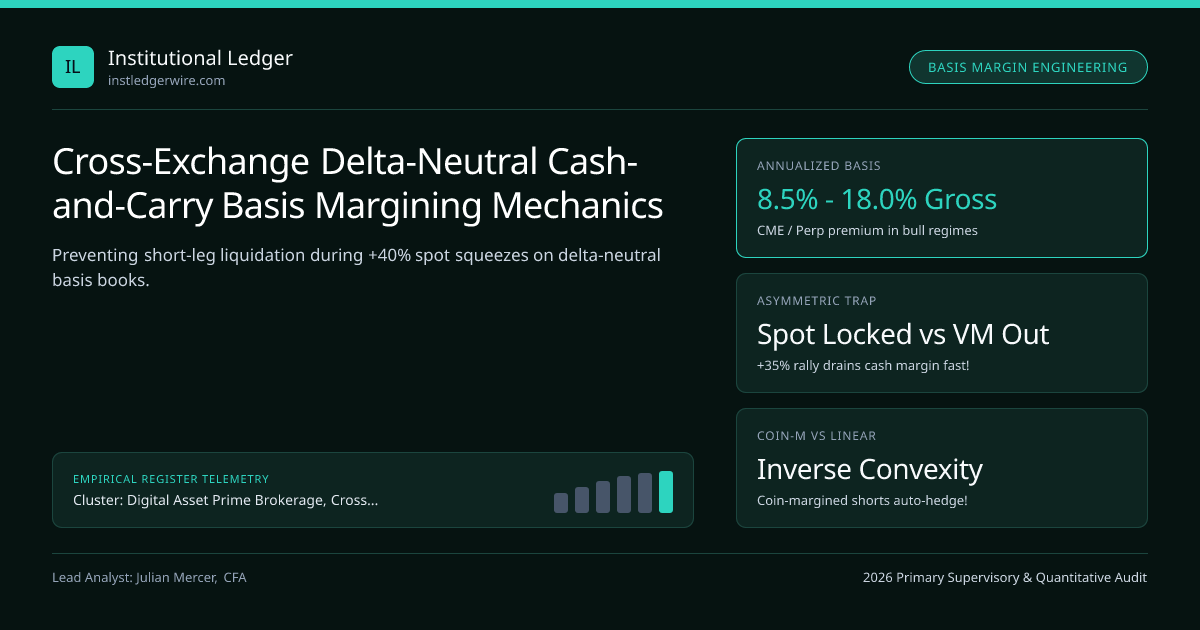
On paper, the Bitcoin and Ethereum cash-and-carry basis trade—buying spot while selling an equal dollar amount of quarterly futures or perpetual swaps—is the cleanest delta-neutral yield engine in global finance. Yet during every parabolic crypto bull run, under-engineered "market-neutral" desks blow up when Bitcoin surges +30% in a weekend! Their error is never directional math; it is siloed variation-margin plumbing—leaving gains trapped on the long leg while cash drains out of the short leg.
Why Siloed USD-Linear Shorts Blow Up During Spot Squeezes#
In our institutional crypto prime brokerage cornerstone guide, we model the exact cash-flow asymmetry of a split-venue basis trade:
- Suppose you buy
1,000 BTCat$100,000($100M) on Bitstamp, lock those coins inside cold custody, and short$100Mof USD-margined linear contracts backed by$20MUSDC. - Over a holiday weekend, an ETF inflow shock sends Bitcoin +25% higher to
$125,000, while retail leverage pushes the 90-day futures basis from+2.5%out to+6.5%($133,125futures price!). - Your cold-custody BTC gained
+$25.0M, but your USD-linear short just suffered a-$30.6Mmark-to-market drawdown! Unless an automated prime collateral router sweeps fresh margin within minutes, the derivatives engine liquidates your short at$133,125—leaving you naked long right before a -15% mean-reversion flush!
Three Institutional Architectures That Eliminate Asymmetric Liquidation#
Veteran quantitative desks structure cash-and-carry books using one of three battle-tested margin topologies:
- 1x Coin-Margined (
Inverse) Shorts via Off-Exchange Pledges: Pioneered on BitMEX and supported across institutional derivatives venues (Bitfinex), inverse contracts quote in USD (1 contract = $100) while settling margin in native BTC or ETH! BecausePnL_in_BTC = Notional_USD * (1/Entry_Price - 1/Exit_Price), a1xshort BTC inverse position literally cannot be liquidated on an upward price move (save only for temporary basis widening, easily covered by a 10%–15% extra BTC cushion)! - BD/FCM Spot ETF vs CME Portfolio Margin: As examined in prime broker cross-margining across spot ETFs, CME futures, and perps, holding US Spot Bitcoin/Ether ETF shares inside the same regulated prime clearing entity as short CME futures lets spot equity appreciation offset futures variation margin automatically!
- Intraday Synchronized Collateral Mobility: Using prime auto-sweep rails and networks like Canton Network to rebalance pledged T-Bills and stablecoins 24/7 whenever short-leg margin utilization crosses
65%.
| Basis Trade Architecture | Collateral Posted on Short Leg | Upward Rally Liquidation Risk | Net Capital Efficiency | Best Institutional Fit |
|---|---|---|---|---|
| Siloed Spot + Isolated USD-Linear Perp | Idle USDC / USDT on CEX | SEVERE — +25% rally drains cash VM | Low (0.70x) | Avoid without automated 24/7 sweep bots |
1x Inverse (Coin-M) Off-Exchange Short | Pledged BTC / ETH via tri-party vault (BitMEX, Bitfinex) | Near-Zero (only basis-widening tail) | 1.00x Unlevered | Sovereign / endowment market-neutral cash funds |
Spot + Pledged BUIDL + Prime Sweep | Yield-bearing T-Bills + Spot in custody | Low — automated 5-min rebalance SLA | 1.15x Yield-Stacked | Crypto-native delta-neutral hedge funds |
| BD/FCM Spot ETF vs CME Futures | Portfolio-margined IBIT/ETHA + T-Bills | Minimal — unified clearing equity | 3.0x – 4.2x Levered | Multi-strategy Wall Street pods |
Dated Quarterly Futures (CME BTIC) vs Perpetual Funding Carry#
Should an institutional carry book short CME dated quarterly futures or offshore 8-hour perpetual swaps?
- Dated Quarterly Futures: Locks in a known, fixed convergence yield between trade entry and final settlement (executed cleanly via CME Basis Trade at Index Close (
BTIC) blocks with OTC liquidity desks like Aquanow and 8 Blocks Capital)—zero risk of negative funding bleed! - Perpetual Swaps: Frequently pay 15%–35% annualized during euphoric retail bull waves, but can flip deeply negative (-10% to -40% annualized!) within hours during deleveraging crashes—requiring active execution alpha to unwind without crossing wide spreads (perpetual funding-rate volatility & auto-liquidation engines).
- MaxRallyPct = ( PostedCashMarginRatio - MaintenanceMarginRatio - BasisWideningShock ) / ( 1 + MaintenanceMargin_Ratio )
- Variables & $100,000,000 Siloed Linear Perp Short Stress Test vs Unified Prime Cross-Margin:
- MaintenanceMarginRatio (MMR) = 2.50%; BasisWideningShock (FOMO spike from +2.5% to +7.5% raw spread) = 5.00%
- 1. Naively Funded Isolated Short ($18M USDC posted = 18.0% Cash Margin):
- MaxRallyPct = (0.180 - 0.025 - 0.050) / 1.025 = +10.24% BTC Move Triggers Liquidation! (Routine single-day crypto candle!)
- 2. Unified Prime Cross-Margin (Long $100M Spot BTC pledged alongside $18M T-Bills; 90% LTV credit on Spot BTC gain):
- Every +10% BTC rally adds +$9.0M of offsetting borrowing power -> Survives >+250% parabolic BTC rally with zero forced close!
Stress-Testing Basis Blowout (+600 bps Raw Spread Shock)#
Even inside a unified cross-margin or 1x Coin-M account, risk managers enforce a mandatory +600 bps raw basis-widening stress reserve: ensuring that if quarterly futures temporarily jump to an 8% premium over spot during a squeeze, portfolio equity remains comfortably above maintenance margin until convergence restores full carry profit.
Basis Desk Risk Governance Checklist#
Quantitative portfolio managers active in our Digital Asset Prime Brokerage & PoR hub prohibit unbuffered isolated USD-linear shorts against locked cold spot, automate 65%-utilization margin sweeps under CFTC and ESMA best-practice controls, and verify execution counterparties via our verification portal.
Frequently asked questions
How can a 100% delta-hedged cash-and-carry basis trade get liquidated when Bitcoin goes UP?
Suppose you hold $100M Spot BTC in cold custody and short $100M USD-linear perpetuals on an exchange backed by $20M USDC margin. If BTC surges +22% over a Sunday night, your cold-wallet BTC is now worth $122M (+$22M gain), BUT the exchange matching engine cannot see your cold wallet—it sees -$22M unrealized loss on $20M USDC margin and auto-liquidates your short leg at the exact top!
Why do institutional basis desks love Coin-Margined (Inverse) contracts for pure crypto-collateralized carry?
On an inverse (Coin-M) perpetual or quarterly contract (pioneered by BitMEX), you post 1,000 BTC as collateral and short $100M notional (1x short = synthetic USD!). If BTC doubles from $100k to $200k, you owe 500 BTC in loss on the short—leaving you with 500 BTC * $200k = $100M exact value, with zero USD cash margin call ever triggered!
Why did CFTC Commitments of Traders (COT) reports show Hedge Funds short $10B+ of CME Bitcoin futures against Spot ETFs?
That is the textbook onshore institutional ETF-vs-CME Cash-and-Carry Basis Trade! Hedge funds buy shares of liquid US Spot Bitcoin ETFs (IBIT, FBTC) and simultaneously sell CME Bitcoin futures (BTC) trading at an 8%–16% annualized premium—capturing risk-minimal Treasury-plus spread inside regulated prime accounts.
What is "basis widening mark-to-market risk" prior to quarterly futures expiration?
At maturity T, futures must converge to spot (Basis -> 0). Before T, however, retail FOMO can push a 90-day futures contract from a +2.5% raw premium (+10% ann.) out to an +8.0% raw premium (+32% ann.)! Even with spot and futures cross-margined, that temporary +5.5% basis widening consumes $5.5M of equity per $100M book until expiry.
Publication record
- Published
- November 13, 2026
- Updated
- November 15, 2026
- Author
- Julian Mercer, CFA
- Review
- Review not recorded
- Automated fact check
- Passed in the stored pipeline record
- Source URLs
- 3 recorded
AI assistance recorded: anthropic/claude-opus-4.6. This field does not establish human review or source verification.
Academic & Institutional Attribution
Cite This Research & Embed Live Data Card
Standard academic & institutional research paper citation format.
Julian Mercer, CFA. (2026, November 15). Cross-Exchange Delta-Neutral Cash-and-Carry Basis Margining Mechanics. Institutional Ledger. https://instledgerwire.com/stories/cross-exchange-delta-neutral-cash-and-carry-basis-marginingRegulatory Directory Cross-Reference
Referenced Institutions & Regulatory Registries
Mentioned Regulated Institutions
Referenced Supervisory Authorities
Related Institutional Crypto Prime Margin & Institutional Briefings
Explore Institutional Crypto Prime Margin Hub (20) →Institutional Crypto Prime Margin
Institutional Crypto Prime Brokerage, Cross-Venue Netting & zk-PoR Guide (2026)Institutional Crypto Prime Margin
Institutional ETH Staking Slashing Insurance & Correlated Penalty MathInstitutional Crypto Prime Margin
Validator Exit Churn Limits, Unbonding Queues & Liquidity DiscountsInstitutional Crypto Prime Margin
Prime Broker Cross-Margining: Spot ETFs, CME Futures & Perp OffsetsInstitutional Crypto Prime Margin
Liquid Staking Tokens (LST) Collateral Haircuts & Depeg Cascade ModelsInstitutional Crypto Prime Margin
Principal vs Agency Prime Execution & Institutional Smart Order RoutingInstitutional Crypto Prime Margin
Crypto Securities Lending: Open-Term Recall SLAs, GMSLA & Borrow RatesInstitutional Crypto Prime Margin
Portfolio VaR & SPAN Margin Models for Multi-Leg Digital Asset BooksMarket Insights
Stablecoin supply falls $14.2B in biggest 30-day drop since June 2022Cryptocurrency Markets
Crypto hack losses equal 57 cents per $1 earned onchain: Ark’s ValenteRegulatory Compliance
European Union Presses the Button for Tokenized Assets: Common Standards Are Coming - Cryptonews.netMonetary Policy
Hot US inflation raises odds of half-point Fed hike in December
Institutional Ledger Data, Benchmarks & Contributor Records
CC BY 4.0 Open Data
Open Institutional Datasets (CSV / JSON) →
Download desk-compiled quantitative series & schemas.
2026 Reference Matrix
2026 Institutional Benchmarks & Thresholds →
Statutory capital, clearing, margin & rate conventions.
Editorial Records
Authors & Review Records →
View named contributors where those records are available.
Complete Index
Master Research & Dossier Archive →
Browse all published briefings by topic pillar & date.