
Institutional Crypto Prime Margin
Perpetual Funding-Rate Volatility, Impact Notional & Auto-Liquidation Engines
Perpetual futures tether to spot without an expiry date via 1-to-8-hour funding transfers and Mark-Price auto-liquidation engines—mechanics every institutional quant must model down to the basis point!
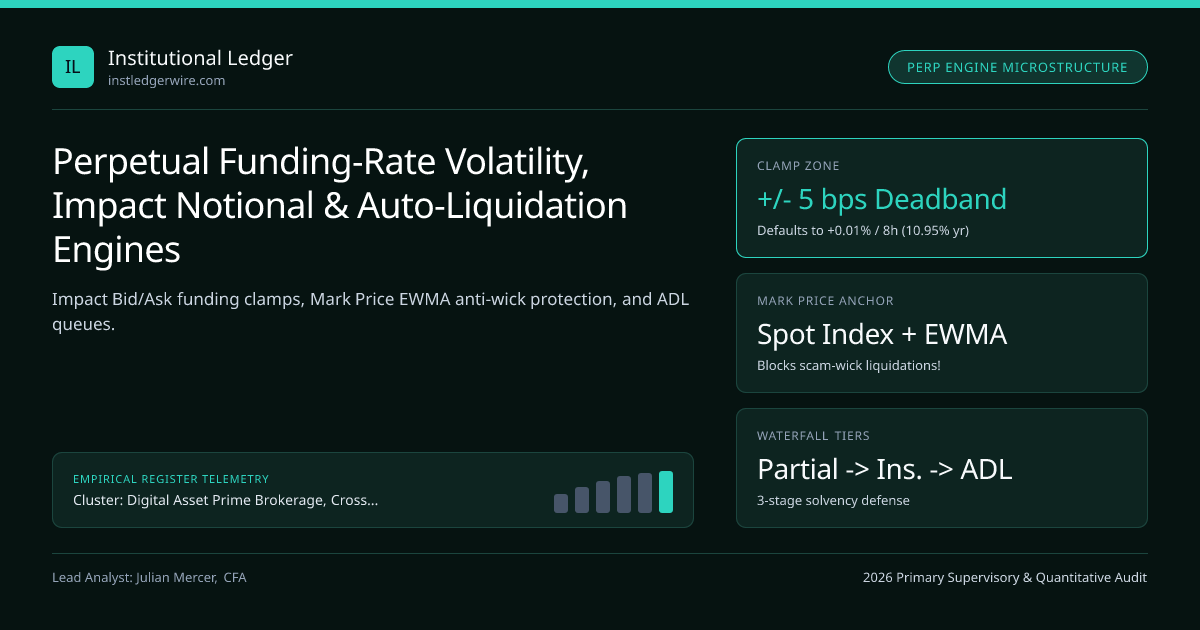
More daily notional volume trades in crypto perpetual swaps—first invented on BitMEX in May 2016—than in all spot orderbooks and dated futures combined! Yet beneath a deceptively simple interface sits a sophisticated piece of financial engineering: Impact Margin Notional funding clamps, trimmed multi-venue EWMA Mark Prices, incremental bracket liquidations, and ADL insurance waterfalls. Modeling those four equations separates durable institutional carry desks from funds blindsided by -140% APR negative-funding squeezes.
Inside the Impact Bid/Ask & +/- 5 bps Clamp Formula#
Why doesn't a perpetual swap just compare its mid-price to spot? Because a manipulator could place a $1,000 bid 1% above spot for five minutes to trick millions of dollars of open interest into paying inflated funding!
Instead, as formalized in our institutional crypto prime brokerage cornerstone guide, institutional matching engines walk down the actual resting limit orderbook by a fixed Impact Margin Notional (IMN) (for example, $500,000 on BTC-PERP):
- On deep
BTCandETHbooks,$500ksits tightly within2–4 bpsof spot—falling inside the[-0.04%, +0.06%]clamp deadband so funding holds rock-steady at+0.01% / 8h(10.95% APR)! - On a low-float altcoin where orderbook depth thins out during a short squeeze, walking
$200kdown the bid side drops1.20%below spot—drivingPremium Index (P)deeply negative and forcing short sellers to pay-0.50%to-0.75%every 4–8 hours! (That is why institutional fundamental shorts use fixed-term GMSLA spot borrows rather than altcoin perps!)
How Composite Mark Price Defeats Single-Exchange "Scam Wicks"#
In early unregulated markets, if a whale fat-fingered a market sell on Exchange X that briefly wicked last-traded price down -25% for 200 milliseconds while global spot barely moved -1%, thousands of leveraged longs got unfairly liquidated!
Institutional perpetual engines (BitMEX, Backpack Exchange, Bitfinex) trigger margin calls exclusively off Fair Mark Price:
- Trimmed Median Constituent Spot Index: Aggregates real-time spot ticks across 5–8 independent liquid spot venues (Bitstamp, etc.), automatically discarding outliers or stale feeds (
> 3%deviation or> 15sheartbeat timeout)! - Exponentially Weighted Moving Average (
EWMA) Basis: Smooths the perp-to-spot basis over a 1-to-5-minute window so instantaneous taker sweeps on the perp book cannot moveMark Priceand hunt stops!
| Perpetual Engine Component | Retail / Fragile Venue Design | Institutional-Grade Venue Standard (BitMEX, Backpack, Bitfinex) |
|---|---|---|
| Liquidation Trigger Price | Last traded perpetual print (scam-wick prone!) | Trimmed Multi-Exchange Spot Index + EWMA Basis (Bitstamp, etc.) |
| Position Unwind Mode | 100% full-account market dump at MMR breach | Incremental Tiered Partial Liquidation (trims down one leverage bracket!) |
| Insurance Fund Transparency | Unaudited internal database counter | Publicly verifiable on-chain / real-time wallet balance |
Impact Margin Notional (IMN) | Tiny $10k top-of-book (easily spoofed!) | Deep $250k–$1M orderbook sweep preventing funding manipulation |
| ADL Counterparty Risk | Frequent opaque clawbacks (ADL risks) | Multi-hundred-million-dollar Insurance Fund + public adlQuantile API |
Incremental Bracket Unwinds, Insurance Funds & Keeping ADL Score Low#
What happens when a genuine macro move pushes an over-leveraged trader past Maintenance Margin (MMR)?
- Incremental Partial Liquidation: Rather than dumping a
$40Mposition in one catastrophic market order, tiered bracket engines first cancel resting open orders to free margin, then liquidate only the 10%–20% slice needed to step down one leverage tier! - Insurance Fund &
ADLDefense: Only if a 30% flash crash blows clean through0%Bankruptcy Price and exhausts the venue's Insurance Fund does Automatic Deleveraging (ADL) close opposing profitable positions! Institutional basis desks trading US Spot ETFs vs Perps monitor real-time Insurance Fund ratios and keep subaccount effective leverage<= 2.5xso theiradlQuantilestays pinned at1/5!
- 1. ImpactBid = AverageFillPriceToSell( ImpactMarginNotionalUSD )
- ImpactAsk = AverageFillPriceToBuy ( ImpactMarginNotionalUSD )
- 2. PremiumIndex (P) = ( Max(0, ImpactBid - SpotIndex) - Max(0, SpotIndex - ImpactAsk) ) / SpotIndex
- 3. FundingRate (F) = TWAP(P) + Clamp( InterestBase(0.01%) - TWAP(P), -0.05%, +0.05% )
- Worked Regime Examples ($50,000,000 Short BTC-PERP Basis Hedge):
- Regime 1 — Calm Mild Contango (TWAP(P) = +0.03%): F = +0.03% + Clamp(-0.02%, -0.05%, +0.05%) = +0.010% / 8h (+$15,000/day = +10.95% APR earned!)
- Regime 2 — Bull Mania (TWAP(P) = +0.14%): F = +0.14% - 0.05% = +0.090% / 8h (+$135,000/day = +98.55% APR earned!)
- Regime 3 — Panic Backwardation (TWAP(P) = -0.18%): F = -0.18% + 0.05% = -0.130% / 8h (-$195,000/day BLEED paid by short hedger!)
Accounting for 1,095 Annual Funding Transfers Under FASB ASC 350-60#
An 8-hour perpetual position generates 1,095 realized funding cash flows per year (or 8,760 per year on 1-hour contracts!). Institutional prime sub-ledgers aggregate hourly/8-hour funding credits separately from FASB ASC 350-60 principal mark-to-market for clean tax and performance attribution (tax-lot & prime sub-ledger sync).
Perpetual Venue Microstructure Audit Checklist#
Quant risk leads active in our Digital Asset Prime Brokerage & PoR hub verify constituent Spot Index methodology under ESMA and VARA market-integrity rules, audit Insurance Fund-to-Open-Interest ratios (>= 1.5%), and validate venues via our verification portal.
Frequently asked questions
Why does the standard perpetual funding rate stay stuck at exactly +0.0100% per 8 hours (10.95% APR) so much of the time?
Look at the +/- 0.05% (5 bps) clamp formula: F = P + clamp(0.01% - P, -0.05%, +0.05%)! Whenever the perpetual’s premium P over spot sits anywhere inside -0.04% to +0.06%, P cancels out inside the clamp and F evaluates to exact flat +0.0100% (10.95% annualized)—reflecting the historical USD vs BTC base-interest differential!
Why did many exchanges switch stressed altcoin perpetuals from 8-hour discrete funding to 1-hour or continuous streaming funding?
On discrete 8-hour clocks (00:00, 08:00, 16:00 UTC), predatory HFT bots practiced "funding sniping": opening short positions at 07:59:55 UTC to collect a +0.30% payout at 08:00:00 UTC and dumping at 08:00:01 UTC, creating violent artificial price whipsaws every 8 hours! Streaming or 1-hour funding eliminates discrete sniping cliffs.
What is the difference between Maintenance Margin Price (Liquidation Price) and Bankruptcy Price?
Suppose you buy $10M BTC-PERP at $100,000 with 5.0% initial margin ($500k) and 1.5% Maintenance Margin ($150k). Your Liquidation Price is ~$96,446 (1.5% equity remaining); your Bankruptcy Price is $95,000 (0.0% equity remaining). That ~$1,446 cushion gives the liquidation engine room to unwind on the CLOB and transfer any leftover surplus into the Insurance Fund!
How can an institutional hedger monitor their ADL (Automatic Deleveraging) queue percentile in real time?
Exchanges rank profitable accounts for ADL by **PnL_Percentage * Effective_Leverage (visualized as 1 to 5 lit indicator bars via API adlQuantile). Keeping moderate account leverage (<=2x–3x)** inside your perp subaccount drops your ADL priority score into the bottom quintile—protecting your short basis hedge while high-leverage retail traders get deleveraged first!
Publication record
- Published
- November 12, 2026
- Updated
- November 15, 2026
- Author
- Julian Mercer, CFA
- Review
- Review not recorded
- Automated fact check
- Passed in the stored pipeline record
- Source URLs
- 3 recorded
AI assistance recorded: anthropic/claude-opus-4.6. This field does not establish human review or source verification.
Academic & Institutional Attribution
Cite This Research & Embed Live Data Card
Standard academic & institutional research paper citation format.
Julian Mercer, CFA. (2026, November 15). Perpetual Funding-Rate Volatility, Impact Notional & Auto-Liquidation Engines. Institutional Ledger. https://instledgerwire.com/stories/perpetual-funding-rate-volatility-auto-liquidation-enginesRegulatory Directory Cross-Reference
Referenced Institutions & Regulatory Registries
Mentioned Regulated Institutions
Related Institutional Crypto Prime Margin & Institutional Briefings
Explore Institutional Crypto Prime Margin Hub (20) →Institutional Crypto Prime Margin
Institutional Crypto Prime Brokerage, Cross-Venue Netting & zk-PoR Guide (2026)Institutional Crypto Prime Margin
Institutional MEV Protection: Private RPCs, Block Relays & Sandwich DefenseInstitutional Crypto Prime Margin
Tax-Lot Relief (HIFO, Specific ID) & FASB ASC 350-60 Prime Sub-Ledger SyncInstitutional Crypto Prime Margin
Multi-Custodian Prime Routing & Single-Point-of-Failure MitigationInstitutional Crypto Prime Margin
Stressed VaR & Concentration Liquidity Add-Ons for Altcoin CollateralInstitutional Crypto Prime Margin
zk-SNARK Merkle-Sum Tree Proof-of-Reserves: Auditing Exchange LiabilitiesInstitutional Crypto Prime Margin
Negative-Balance Non-Existence Proofs & Hidden Collateral Encumbrance RiskInstitutional Crypto Prime Margin
Cross-Exchange Delta-Neutral Cash-and-Carry Basis Margining MechanicsRegulatory Compliance
The $2.85B Binance hackers lost shows why the UK needs stablecoin freeze rulesCryptocurrency Markets
GOPAX halts crypto trading, withdrawals to move all assets to cold storageMarket Insights
Russia finalizes crypto trading rules ahead of Nov. 17 rolloutCryptocurrency Crime
Ex-FBI counterintelligence agent stole almost $2.5M in crypto
Institutional Ledger Data, Benchmarks & Contributor Records
CC BY 4.0 Open Data
Open Institutional Datasets (CSV / JSON) →
Download desk-compiled quantitative series & schemas.
2026 Reference Matrix
2026 Institutional Benchmarks & Thresholds →
Statutory capital, clearing, margin & rate conventions.
Editorial Records
Authors & Review Records →
View named contributors where those records are available.
Complete Index
Master Research & Dossier Archive →
Browse all published briefings by topic pillar & date.