
Institutional Crypto Prime Margin
On-Chain Wallet Ownership Proofs: BIP-322, EIP-191 & Micro-Transfers
Anyone can paste a rich-list Bitcoin address into a spreadsheet; proving live uncompromised private-key control without waking air-gapped HSMs unnecessarily requires BIP-322, EIP-191, and EIP-1271 challenge protocols.
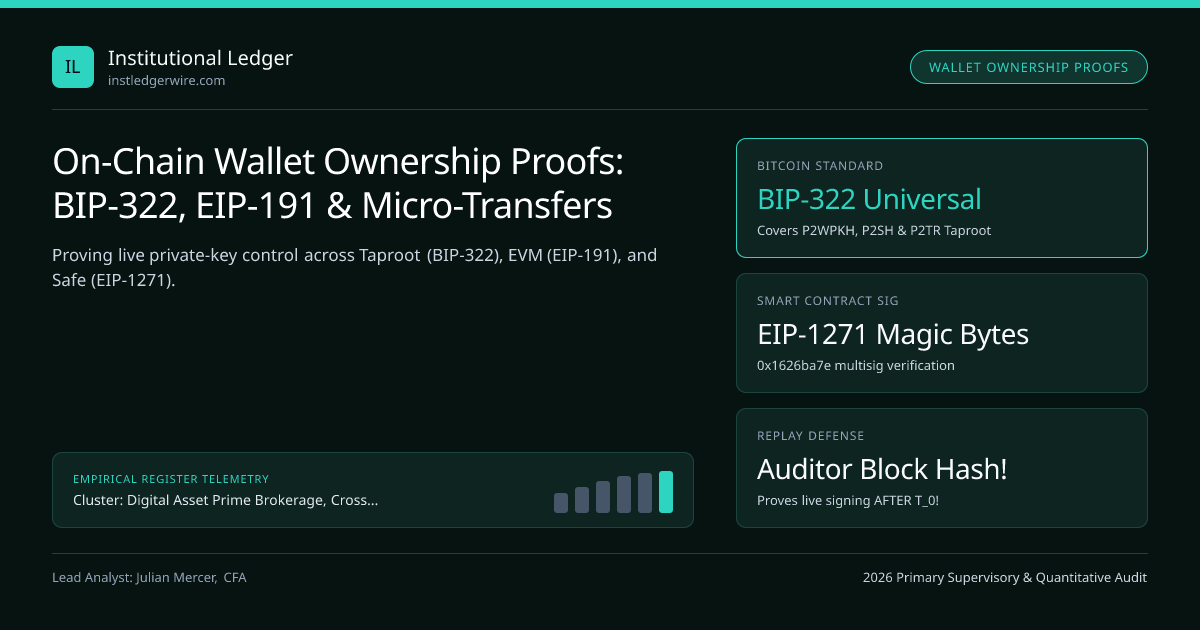
During a notorious 2014 exchange audit, a bankrupt founder briefly convinced an observer he controlled 250,000 BTC simply by importing a public whale address into his wallet UI in "watch-only" mode! Even a decade later, poorly designed Proof-of-Reserves scripts still accept static signatures lacking recent block-hash entropy or break down on Taproot (bc1p) and Safe (EIP-1271) multisig vaults. Institutional auditors and fund ODD engineers verify live private-key custody using anti-replay BIP-322, EIP-191, and EIP-1271 cryptographic challenges.
Three Rules of Ironclad Challenge Strings: Causality, Binding & Safety#
When pairing on-chain asset verification with zk-SNARK Merkle-Sum Tree liabilities inside our institutional crypto prime brokerage cornerstone guide, every cryptographic challenge message must enforce three mathematical properties:
- Temporal Causality (Anti-Replay): Embedding the
64-hex-char Block_Hashof a Bitcoin or Ethereum block mined at the start of the audit ceremony guarantees the signature could NOT have been pre-computed weeks earlier! - Entity Binding (Anti-Double-Count): Embedding the exact legal entity name /
LEIprevents a corporate parent from using one shared cold wallet to pass solvency audits for both its European ESMA CASP subsidiary and its offshore entity on the same afternoon! - Strict Domain Separation (Anti-Blind-Signing): Prefixing
\x19Ethereum Signed Message:\n(EIP-191),BIP0322-signed-message(BIP-322), or\xffsolana offchainguarantees mathematically that a malicious auditor can never trick cold-vault signers into signing a disguised valid mainnet withdrawal transaction!
Modernizing Bitcoin & Smart-Wallet Proofs: BIP-322 & EIP-1271#
Institutional custody rarely sits in single-key legacy addresses anymore:
- Bitcoin Taproot & Native SegWit (
BIP-322): Whether an institution uses2-of-3P2WSHmultisig orMuSig2Schnorr Taproot (bc1p...) on Bitstamp, Bitfinex, or BitMEX,BIP-322constructs a standardized virtual transaction spending a zero-value virtual output—allowing any open-source verifier to validate full Bitcoin Script / Taproot witness satisfaction completely off-chain with zero miner fees! - Smart-Contract Vaults (
EIP-1271): Multi-billion-dollar ERC-20 treasuries held inside Safe (formerly Gnosis Safe) smart contracts have no ECDSA private key for the contract address itself! Instead, auditors querySafeContract.isValidSignature(challengeHash, concatenatedOwnerSigs)via an archive RPC node pinned to exact snapshot blockT_0—confirming it returns the magic selector0x1626ba7e!
| Blockchain / Wallet Architecture | Cryptographic Ownership Standard | Why Domain Separation Is Critical | Fallback Method for Air-Gapped HSMs |
|---|---|---|---|
Bitcoin SegWit & Taproot (bc1q / bc1p) | BIP-322 Virtual Witness Proof | Tag BIP0322-signed-message cannot spend real UTXOs! | Exact-satoshi self-transfer (Vault -> Vault) |
EVM EOA & Threshold MPC (ETH, USDC, ARB) | EIP-191 (0x19 personal_sign) | Leading 0x19 byte makes RLP transaction collision impossible (EIP-155 safe) | 0 ETH self-tx with Auditor_Nonce in calldata |
EVM Smart-Contract Multisig (Safe) | EIP-1271 isValidSignature(hash, sig) | Verifies M-of-N owner signatures against live contract storage at block T_0 | On-chain SignMessageLib event emission |
Solana / EdDSA Chains (SOL, SUI, APT) | Ed25519 Off-Chain Message Prefix | \xffsolana offchain header prevents signing sneaky SPL token drains! | 0.00001 SOL + SPL Memo program instruction |
Handling Strict Air-Gapped FIPS 140-3 HSMs: The Deterministic Self-Send#
What if a conservative NYDFS Trust or FINMA bank running air-gapped FIPS 140-3 Level 3 HSMs prohibits off-chain message signing altogether under its SOC 1 Type II security policy?
Big-4 audit teams under SEC SAB 122 and FASB ASC 350-60 run a Live-Observed Deterministic Self-Transfer ("Satoshi / Calldata Test"):
- On EVM chains, sending
0 ETHfromVault_A -> Vault_Awithdata = sha256(Auditor_Challenge)costs< $0.50and never moves a penny of client assets! - On Bitcoin, spending a small designated control UTXO back to the vault's own script within a tight 30-minute observed window proves operational key health without exposing customer principal.
- Msg = "POROWNERSHIPV2" || "|" || VenueLEI || "|" || TargetChainID || "|" || WalletAddress || "|" || FinalizedBlockNumber || "|" || FinalizedBlockHash || "|" || Auditor256BitSalt
- Verification Invariants Required Before Counting Wallet_Balance Toward Solvency:
- 1. Causality Proof: BlockTimestamp(FinalizedBlockHash) >= SnapshotCutTime - 600Seconds [Proves key wasn't lost months ago!]
- 2. Signature Proof: VerifyBIP322OrEIP191OrEIP1271( WalletAddress, Msg, Signature ) === TRUE
- 3. Uniqueness Proof: CountAcrossAllAuditedEntities( ChainID, WalletAddress ) === 1 [Prevents two sister entities double-counting 1 vault!]
Automating Public Verification Scripts for Continuous Solvency#
Leading transparent exchanges (Backpack Exchange, BitMEX) publish downloadable JSON bundles containing every cold/hot wallet address, snapshot block height, challenge string, and BIP-322/EIP-191 signature—letting any institutional prime client verify 100% of asset control independently in 3 seconds.
Wallet Ownership Audit Checklist for Fund Administrators#
Fund administrators and ODD teams active in our Digital Asset Prime Brokerage & PoR hub reject screenshots or undated signatures, enforce fresh block-hash challenges + entity-bound LEI strings, and cross-check qualified custodians via our verification portal.
Frequently asked questions
Why must an auditor’s signature challenge include a brand-new Bitcoin or Ethereum block hash?
Suppose an exchange lost its cold-wallet seed phrase in July, or secretly borrowed a whale’s signature last year. If the auditor only asks for "Exchange X owns this wallet," the exchange can hand over an old cached signature! Requiring "Audit_ID_9482 || Venue_Slug || BTC_Block_885000_Hash_00000000000000000002a7..." mathematically proves the HSM held live signing power after Block 885,000 was mined!
Why couldn’t Bitcoin SegWit (bc1q) and Taproot (bc1p) cold vaults use the original 2011 Bitcoin signmessage RPC?
Satoshi’s original signmessage only defined secp256k1 public-key recovery for uncompressed/compressed P2PKH (1...) scripts—it had zero awareness of P2WSH multisig scripts or BIP-340 Schnorr Taproot script trees! BIP-322 solves this cleanly by constructing a non-spendable virtual transaction (to_sign spending to_spend at nSequence = 0) that validates any standard Bitcoin script without broadcasting on-chain!
Why do some bank-grade cold HSM custodians prefer an on-chain "Move-to-Self Micro-Transaction" over off-chain message signing?
Hardened air-gapped HSM policies often disable arbitrary off-chain message signing so a compromised coordinator can never trick cold signers into signing a disguised transaction hash! Instead, the auditor instructs the custodian: *"Between 14:00 and 14:30 UTC on Tuesday, send exactly 0.00148293 BTC from Vault A back to Vault A’s own change address"*—proving live quorum execution right on the public ledger!
How do you prove ownership of staked Ethereum validators whose funds sit inside the Beacon Chain Deposit Contract rather than an EOA?
Staked ETH doesn’t sit in an EOA balanceOf—it sits on the Beacon Chain indexed by Validator Public Key! Auditors verify two things: (1) the validator’s immutable 0x01 / 0x02 withdrawal credential equals the custodian’s verified cold vault address, AND (2) the custodian proves live control of that exact cold withdrawal vault via EIP-191 / EIP-1271!
Publication record
- Published
- November 12, 2026
- Updated
- November 15, 2026
- Author
- Julian Mercer, CFA
- Review
- Review not recorded
- Automated fact check
- Passed in the stored pipeline record
- Source URLs
- 3 recorded
AI assistance recorded: anthropic/claude-opus-4.6. This field does not establish human review or source verification.
Academic & Institutional Attribution
Cite This Research & Embed Live Data Card
Standard academic & institutional research paper citation format.
Julian Mercer, CFA. (2026, November 15). On-Chain Wallet Ownership Proofs: BIP-322, EIP-191 & Micro-Transfers. Institutional Ledger. https://instledgerwire.com/stories/on-chain-wallet-ownership-cryptographic-signature-challengesRegulatory Directory Cross-Reference
Referenced Institutions & Regulatory Registries
Mentioned Regulated Institutions
Referenced Supervisory Authorities
Related Institutional Crypto Prime Margin & Institutional Briefings
Explore Institutional Crypto Prime Margin Hub (20) →Institutional Crypto Prime Margin
Institutional Crypto Prime Brokerage, Cross-Venue Netting & zk-PoR Guide (2026)Institutional Crypto Prime Margin
Prime Credit Intermediation & Post-2022 Undercollateralized Lending BansInstitutional Crypto Prime Margin
Perpetual Funding-Rate Volatility, Impact Notional & Auto-Liquidation EnginesInstitutional Crypto Prime Margin
Institutional MEV Protection: Private RPCs, Block Relays & Sandwich DefenseInstitutional Crypto Prime Margin
Tax-Lot Relief (HIFO, Specific ID) & FASB ASC 350-60 Prime Sub-Ledger SyncInstitutional Crypto Prime Margin
Multi-Custodian Prime Routing & Single-Point-of-Failure MitigationInstitutional Crypto Prime Margin
Stressed VaR & Concentration Liquidity Add-Ons for Altcoin CollateralInstitutional Crypto Prime Margin
zk-SNARK Merkle-Sum Tree Proof-of-Reserves: Auditing Exchange LiabilitiesCryptocurrency Crime
The Shadowy Crypto Services Helping the Binance Hackers Launder Stolen BillionsRegulatory Compliance
EU taps industry to set standards for tokenized securitiesRegulatory Compliance
The $2.85B Binance hackers lost shows why the UK needs stablecoin freeze rulesCryptocurrency Markets
GOPAX halts crypto trading, withdrawals to move all assets to cold storage
Institutional Ledger Data, Benchmarks & Contributor Records
CC BY 4.0 Open Data
Open Institutional Datasets (CSV / JSON) →
Download desk-compiled quantitative series & schemas.
2026 Reference Matrix
2026 Institutional Benchmarks & Thresholds →
Statutory capital, clearing, margin & rate conventions.
Editorial Records
Authors & Review Records →
View named contributors where those records are available.
Complete Index
Master Research & Dossier Archive →
Browse all published briefings by topic pillar & date.