
Institutional Crypto Prime Margin
Institutional MEV Protection: Private RPCs, Block Relays & Sandwich Defense
Broadcasting a $10M on-chain swap with a naive 1.0% slippage tolerance to Ethereum’s public mempool guarantees an instant -$98,000 MEV sandwich extraction; private order-flow relays and solver auctions eliminate mempool leakage!
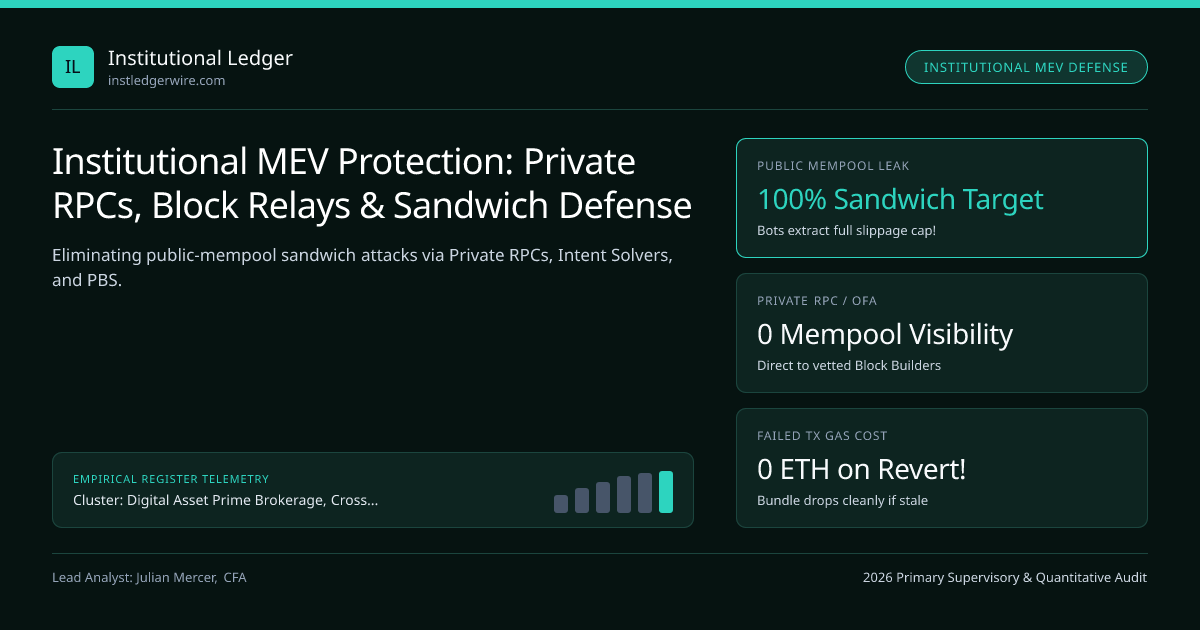
In March 2024, an institutional treasury wallet swapped $2.2 million of stablecoins on an on-chain pool with a careless slippage setting over a default public RPC endpoint—and lost more than $200,000 inside twelve seconds to an automated MEV sandwich bot! Whenever an institution interacts directly with public EVM or Solana liquidity pools, broadcasting unshielded swap calldata to the public mempool violates basic fiduciary execution hygiene (flagged explicitly by ESMA under MiCA Best Execution rules).
Why Public Mempools Act as Adversarial Predatory Dark Pools in Reverse#
In traditional equity markets, broadcasting your exact limit price (minAmountOut) to high-frequency front-runners 6 seconds before your order reaches the matching engine would send the exchange operator to prison! On public permissionless blockchains (studied extensively by BIS Working Paper No. 1116 and ESMA), the public devp2p mempool does exactly that by default:
- Every pending transaction sits visible globally for
2 to 12 secondsbefore a validator seals the block. - Generalized MEV searcher bots simulate your pending calldata against current pool reserves in
< 3 ms. WheneverConfigured_Slippage > True_Pool_Impact + 2 * Gas_Cost, you do NOT get "up to 1% slippage"—you are mathematically guaranteed to get 0.999% slippage!
Architecture of Institutional MEV Defense: Private RPCs & Order-Flow Auctions#
Integrating seamlessly with principal vs agency prime execution and smart order routing and our institutional crypto prime brokerage cornerstone guide, enterprise custody platforms (Fireblocks, Copper, Anchorage, Safe institutional modules) enforce a three-tier on-chain execution firewall:
- Default Private RPC Endpoint Override: Hardcoding custody signing daemons to broadcast
eth_sendRawTransactionexclusively to multi-builder encrypted relays (Flashbots Protect,MEV Blocker,Titan/Beaverdirect TLS)—fanning out privately to>90%of Ethereum block builders with contractual no-frontrunning SLAs! - Order-Flow Auction (
OFA) Rebates: When your legitimate$10Mswap moves a Curve regulated USDC orwstETHpool by+5 bpsrelative to Bitstamp or Backpack Exchange, someone will arbitrage the pool back to parity right after your trade. AnOFAauctions off that harmless back-run slot and wires 90% of the arbitrage profit directly back to your custody vault! - Intent-Based
EIP-1271Batch Auctions: For largeSafemultisig treasuries, signing off-chainCoW ProtocolProgrammable/TWAP Intents pits bonded solvers (routing across CEXs, Aquanow, and DEXs) against each other to deliver optimal uniform clearing prices!
| On-Chain Execution Rail | Public Mempool Exposure | Sandwich Vulnerability | Revert Gas Cost | Best Institutional Fit |
|---|---|---|---|---|
Default Public Node RPC (eth_sendRawTransaction) | 100% Public inside 50ms | EXTREME — guaranteed bot target | Paid in full | Simple point-to-point ETH/USDC transfers ONLY (0% DEX price risk) |
Multi-Builder Private RPC (Flashbots Protect / Custody Relay) | 0% Public (TLS to Builders) | Eliminated (contractual no-frontrun) | $0.00 | Urgent single-block DeFi Vault, lending & USDC ops |
Batch Intent Solvers (CoW Protocol EIP-1271 TWAP) | 0% Public (off-chain signed order) | Eliminated (uniform batch clearing) | $0.00 | $5M–$100M DAO / fund treasury wstETH & stablecoin rebalances |
| Wholesale Off-Chain RFQ (Aquanow, B2BX, 8 Blocks) | 0% Public (atomic DvP settle) | Zero — firm principal price | $0.00 | Cross-chain & ERC-3643 RWA institutional blocks |
MPC Policy-Engine Guardrails: Hardcoding minAmountOut Bounds#
Why do catastrophic 50%-loss sandwich attacks still hit careless DeFi users? Because someone clicked through a broken frontend quote where minAmountOut = 0 or 1! Connecting to smart-contract allowlisting and EIP-712 typed signing guards, institutional MPC policy engines decode DEX router calldata pre-signature and cryptographically reject any swap whose minAmountOut deviates by > 25 bps from live Chainlink / Pyth oracle value!
- ExpectedVictimLossUSD = SwapNotionalUSD * Max( 0, ConfiguredSlippageTolerancePct - NativePoolPriceImpactPct - SearcherPriorityBribe_Pct )
- Variables & Why Setting "1.0% Slippage Just So My $10M Treasury Tx Doesn't Fail" Costs $92,000 Instantly:
- Swap_Notional = $10,000,000 USDC -> wstETH on deep $250M liquidity pool (True Native Pool Impact = 0.04% = $4,000)
- 1. Sent to Public RPC w/ 1.00% Slippage Tolerance:
- Searcher front-runs right up to your 1.00% wall! Victim loses 0.96% = -$96,000 (-$92,000 pure MEV theft above $4k true impact!).
- 2. Sent via Private Order-Flow Auction RPC w/ 0.12% Slippage + 90% Backrun Rebate:
- Victim pays $4,000 true AMM impact, receives +$1,800 CEX-DEX backrun rebate -> Net Cost = -$2,200 (Saves $93,800 on a single click!)
Why Permissioned ERC-3643 RWA Pools Are Natively Immune to Bot Sandwiching#
Notice an underrated institutional advantage of ERC-3643 permissioned RWA tokens: because transfer reverts unless both sender and receiver hold verified KYB ONCHAINID claims, anonymous MEV searcher bots cannot even hold the RWA token for 1 millisecond to sandwich you!
On-Chain Execution & MEV Governance Checklist#
DeFi and treasury execution leads active in our Digital Asset Prime Brokerage & PoR hub ban public-mempool DEX broadcasts across all MPC workspaces, enforce <= 20 bps oracle-checked minAmountOut guards under ESMA and FCA / BaFin Best Execution rules, and verify execution partners via our verification portal.
Frequently asked questions
How does an atomic 3-transaction MEV "sandwich attack" extract $95,000 from a $10M institutional swap in a single 12-second block?
Suppose your script submits a swap of 10,000,000 USDC -> wstETH on Curve/Uniswap with maxSlippage = 1.00% (minOut = $9,900,000) to a default public Alchemy/Infura RPC. An MEV searcher sees your pending tx in the mempool, constructs an atomic bundle: [Tx1: Bot Buys wstETH pushing price up +0.96%] -> [Tx2: Your Victim Swap fills at -$96k worst limit!] -> [Tx3: Bot Sells wstETH pocketing ~$95k risk-free!]!
Why do reverted transactions cost $0 gas when routed through Flashbots Protect or CoW Protocol?
On the public mempool, if price moves beyond your slippage tolerance before block inclusion, miners/validators still include your failed transaction and charge $50–$500 of reverted gas! Private builder endpoints simulate bundles pre-inclusion—if a transaction would revert, the block builder simply omits it from the block at $0.00 gas cost!
What is the OFAC compliance trade-off across Ethereum Proposer-Builder Separation (PBS / mev-boost) relays?
Some mev-boost relays filter transactions touching OFAC SDN-sanctioned contracts (regulated/filtering relays), while "neutral / non-filtering" relays include all protocol-valid transactions (yielding slightly faster average block inclusion during peak congestion). Institutional custodians select vetted private builder endpoints that satisfy both zero mempool leakage and strict sanctions compliance!
Does Solana have a public mempool, and how does MEV protection work on Solana institutional swaps?
Solana removed its public gossip mempool, yet validators and Jito block-engine searchers can still reorder transactions routed to public leaders! Institutional Solana trading desks route via SWQoS (Stake-Weighted Quality of Service) private RPCs, tight dynamic slippage (<= 10–15 bps), dontFront Jito bundle account markers, or off-chain RFQ solvers (Jupiter RFQ)!
Publication record
- Published
- November 12, 2026
- Updated
- November 15, 2026
- Author
- Julian Mercer, CFA
- Review
- Review not recorded
- Automated fact check
- Passed in the stored pipeline record
- Source URLs
- 3 recorded
AI assistance recorded: anthropic/claude-opus-4.6. This field does not establish human review or source verification.
Academic & Institutional Attribution
Cite This Research & Embed Live Data Card
Standard academic & institutional research paper citation format.
Julian Mercer, CFA. (2026, November 15). Institutional MEV Protection: Private RPCs, Block Relays & Sandwich Defense. Institutional Ledger. https://instledgerwire.com/stories/institutional-mev-protection-private-rpc-validator-block-relaysRegulatory Directory Cross-Reference
Referenced Institutions & Regulatory Registries
Mentioned Regulated Institutions
Related Institutional Crypto Prime Margin & Institutional Briefings
Explore Institutional Crypto Prime Margin Hub (20) →Institutional Crypto Prime Margin
Institutional Crypto Prime Brokerage, Cross-Venue Netting & zk-PoR Guide (2026)Institutional Crypto Prime Margin
Tax-Lot Relief (HIFO, Specific ID) & FASB ASC 350-60 Prime Sub-Ledger SyncInstitutional Crypto Prime Margin
Multi-Custodian Prime Routing & Single-Point-of-Failure MitigationInstitutional Crypto Prime Margin
Stressed VaR & Concentration Liquidity Add-Ons for Altcoin CollateralInstitutional Crypto Prime Margin
zk-SNARK Merkle-Sum Tree Proof-of-Reserves: Auditing Exchange LiabilitiesInstitutional Crypto Prime Margin
Negative-Balance Non-Existence Proofs & Hidden Collateral Encumbrance RiskInstitutional Crypto Prime Margin
Cross-Exchange Delta-Neutral Cash-and-Carry Basis Margining MechanicsInstitutional Crypto Prime Margin
Institutional ETH Staking Slashing Insurance & Correlated Penalty MathCryptocurrency Markets
GOPAX halts crypto trading, withdrawals to move all assets to cold storageMarket Insights
Russia finalizes crypto trading rules ahead of Nov. 17 rolloutCryptocurrency Crime
Ex-FBI counterintelligence agent stole almost $2.5M in cryptoRegulatory Compliance
Statement on Proposed Amendments to the Custody Rules
Institutional Ledger Data, Benchmarks & Contributor Records
CC BY 4.0 Open Data
Open Institutional Datasets (CSV / JSON) →
Download desk-compiled quantitative series & schemas.
2026 Reference Matrix
2026 Institutional Benchmarks & Thresholds →
Statutory capital, clearing, margin & rate conventions.
Editorial Records
Authors & Review Records →
View named contributors where those records are available.
Complete Index
Master Research & Dossier Archive →
Browse all published briefings by topic pillar & date.