
Institutional Crypto Prime Margin
Prime Credit Intermediation & Post-2022 Undercollateralized Lending Bans
Three Arrows Capital borrowed billions from ten crypto lenders simultaneously using the same unverified NAV PDF; 2026 prime credit intermediation replaces blind balance-sheet loans with real-time Net Open Position caps!
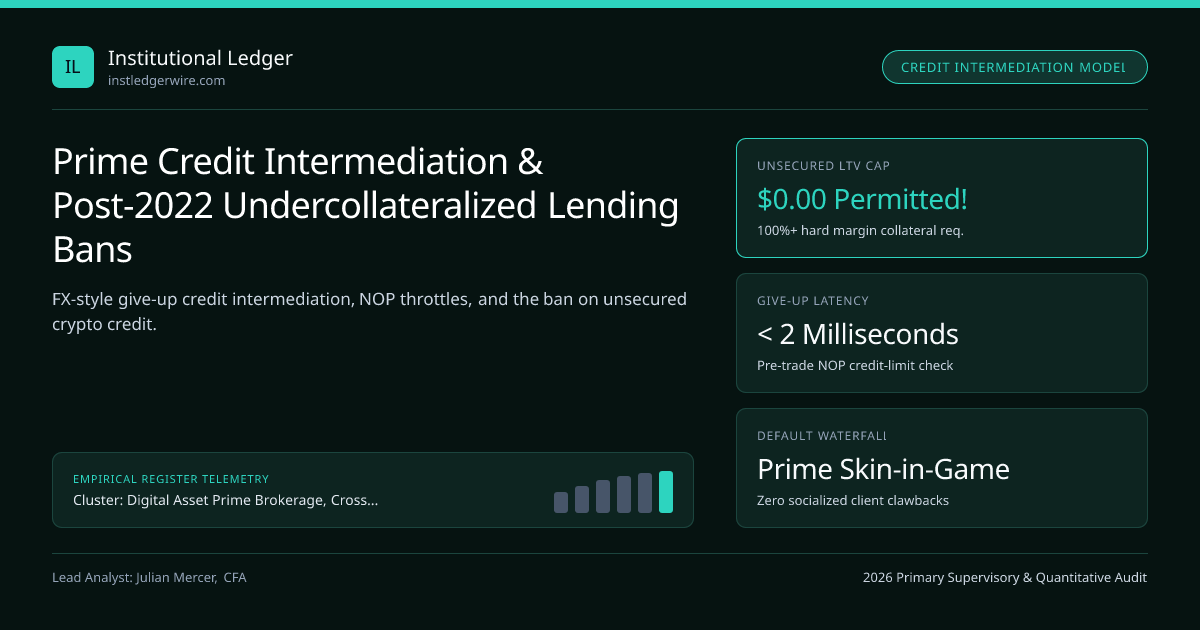
Every post-mortem of the 2022 crypto credit contagion—Genesis, BlockFi, Voyager, Celsius, Three Arrows Capital—arrives at the exact same root sin: wiring hundreds of millions of dollars of uncollateralized Bitcoin and stablecoins out to external hedge-fund wallets based on unaudited PDF balance sheets. Institutional prime brokerage in 2026 solved fragmented market access without ever resurrecting unsecured lending by adapting Wall Street's battle-tested FX Prime Brokerage (FXPB) Give-Up Credit Intermediation architecture.
How FX-Style "Give-Up" Credit Intermediation Unifies Fragmented Liquidity#
In global foreign exchange—a $7.5 trillion-per-day market with no single central stock exchange—how does a macro hedge fund trade seamlessly across twenty bank and non-bank liquidity providers without posting $10M of margin at each of the twenty desks?
Through Prime Brokerage Give-Up Agreements, now standardized for digital assets as detailed in our institutional crypto prime brokerage cornerstone guide:
- Single Legal & Collateral Hub: The hedge fund signs one Master Prime Agreement and posts
$25Mof collateral inside a bankruptcy-remote vault. - Tri-Party Designation Notices: The Prime Broker (
PB) issues electronic Designation / Credit-Limit Schedules to approved Executing Dealers (EDs) (Aquanow, B2BX, 8 Blocks Capital) and connected exchanges (Bitstamp, Backpack Exchange, BitMEX, Bitfinex, CME). - Instant Novation: When the hedge fund hits an
Aquanowquote for$15M BTCand sells$15M CME BTC, both trades instantaneously give up (novate) to the Prime Broker—leavingAquanowwith zero hedge-fund credit risk and giving the hedge fund one netted position!
The Walled-Garden Invariant: Why Collateral Never Leaves the Ring Unhedged#
Why can a prime broker safely grant 4x–5x hedged trading notional inside a give-up ring while strictly banning $1 of undercollateralized external loans?
- Closed Control Loop: Every spot coin bought, every future shorted, and every option held sits inside custodial accounts where only the Prime Broker's risk engine authorizes external blockchain withdrawals!
- If the client clicks "Withdraw 200 BTC to external wallet," the SPAN 2 risk engine recomputes post-withdrawal Initial Margin in
12 ms—blocking the withdrawal unless remaining equity covers 100%+ of required Initial Margin! - By contrast, under the Basel SCO60 2026 Benchmark Standard and FSB Global Crypto Recommendations, handing uncollateralized assets to a counterparty who can walk off-platform violates every rule of prudential finance!
| Credit Dimension | Discredited 2021 Shadow-Bank Model | 2026 Institutional Prime Give-Up Standard |
|---|---|---|
| Collateral Requirement | 0% – 50% ("reputation / AUM" loans) | 100%+ SPAN / Stressed VaR locked prior to order entry |
| Can Borrower Withdraw Principal? | Yes — sent freely to external wallets/DeFi! | NO — collateral stays inside ring-fenced custody / trading loop! |
| Aggregate Leverage Visibility | Zero (monthly self-reported email PDFs) | Real-time sub-second visibility across every venue & OTC dealer |
| Executing Counterparties | Siloed bilateral credit risk | Instant Give-Up Novation across Aquanow, B2BX, 8 Blocks, Bitstamp, Backpack |
| Margin Breach Action | Slow 3-to-5-business-day email cure notice | Automated <5ms NOP revocation + staged algorithmic unwind |
Sub-2ms Pre-Trade NOP Kill-Switches vs Legacy "3-Day Cure Notices"#
In 2022, bilateral lending contracts gave defaulting hedge funds "3 to 5 business days to cure a margin call"—an eternity in a 24/7 market that drops 35% on a Saturday! Modern prime credit engines enforce two automated electronic gates:
- Pre-Trade
NOPThrottling (< 2 ms): Executing dealers query a low-latency credit-hub API (Traiana-style crypto credit switch) before accepting orders; if margin utilization hits85%, only risk-reducing (reduce-only) orders pass! - Staged Algorithmic Liquidation (
95%->100%MMR): Instead of dumping a $100M book in one market order, the prime's Agency SOR trims 10% slices smoothly to restore margin health.
- ApproveOrderk <==> ( PostedHaircuttedCollateralUSD + UnrealizedNetPnLUSD ) >= SPANIM( CurrentBook + IncomingOrderk ) / MaxUtilizationCap(0.90)
- Variables & Why "Ring-Fenced Give-Up Leverage" != "Undercollateralized Lending" ($20,000,000 Equity Pod):
- 1. Banned Undercollateralized Loan: Lender wires $80M BTC to Pod's external wallet against $20M USDC -> If BTC rises +35% ($108M) and Pod loses it in DeFi, Lender suffers -$88,000,000 unsecured wipeout!
- 2. Ring-Fenced Prime Give-Up: Pod posts $20M BUIDL; buys $80M BTC on Bitstamp + sells $80M CME/Perp via Give-Up (both legs stay inside Prime clearing ring!):
- Net Portfolio SPAN IM = $14.2M <= $20.0M Equity (141% overcollateralized vs net risk; 0 BTC can EVER leave the ring unhedged!).
Evaluating Your Prime Broker’s Own Balance Sheet & Default Waterfall#
Because all give-up trades novate through the prime broker, allocators audit the prime's own audited equity capital, confirm complete legal segregation between Client A and Client B (zero cross-client margin mutualization!), and maintain multi-custodian prime failover.
Prime Credit Intermediation Due Diligence Checklist#
Operational due diligence teams active in our Digital Asset Prime Brokerage & PoR hub require written confirmation of zero unsecured/undercollateralized loan origination anywhere on the prime broker's corporate balance sheet under ESMA, MAS, and NYDFS standards, verifying entities via our verification portal.
Frequently asked questions
How could Three Arrows Capital (3AC) borrow $3.5B+ unsecured in 2021–2022 without any prime broker noticing?
Because there was no central prime clearing visibility! 3AC showed Lender A a self-reported $3B NAV summary to borrow $400M unsecured, then walked next door to Lenders B, C, D, and E with the exact same NAV sheet! None of the lenders controlled 3AC’s trading accounts or saw its aggregate leverage until BTC/LUNA/stETH crashed and wiped out every lender simultaneously!
How does the traditional Tier-1 FX Prime Brokerage (FXPB) "Give-Up" model translate to institutional crypto?
Borrowed directly from Citibank/JPMorgan FX Prime Brokerage (and pioneered in digital assets by firms like Hidden Road / Ripple Prime, Marex, and FalconX): the Hedge Fund posts collateral once to the Prime Broker (PB) and receives Designation Letters (NOP limits) to trade directly with 15 Executing Dealers / Exchanges. Every fill instantly gives up to the PB—so the PB sees 100% of the fund’s live positions in real time!
What is the difference between banned "Undercollateralized Lending" and permitted "Post-Trade Settlement Credit"?
Banned Undercollateralized Lending hands a borrower $50M BTC to withdraw to external wallets against $10M collateral (20% coverage = $40M unsecured hole!). Permitted Settlement Credit lets an ETF AP or sovereign fund with $100M inside its NYDFS custody vault execute a $25M spot trade on Bitstamp today and settle the T+0 net wire 4 hours later while the custody vault remains contractually locked!
How does Basel III SCO60 reinforce the ban on uncollateralized bank crypto lending?
Under Basel SCO60, any unhedged or unsecured Group 2b cryptoasset claim attracts a punitive 1,250% risk weight (dollar-for-dollar CET1 equity deduction!), whereas fully collateralized securities-financing / margin loans backed by eligible financial collateral with daily remargining qualify for standard haircut-adjusted exposure calculations!
Publication record
- Published
- November 12, 2026
- Updated
- November 14, 2026
- Author
- Julian Mercer, CFA
- Review
- Review not recorded
- Automated fact check
- Passed in the stored pipeline record
- Source URLs
- 3 recorded
AI assistance recorded: anthropic/claude-opus-4.6. This field does not establish human review or source verification.
Academic & Institutional Attribution
Cite This Research & Embed Live Data Card
Standard academic & institutional research paper citation format.
Julian Mercer, CFA. (2026, November 14). Prime Credit Intermediation & Post-2022 Undercollateralized Lending Bans. Institutional Ledger. https://instledgerwire.com/stories/prime-credit-intermediation-undercollateralized-lending-bansRegulatory Directory Cross-Reference
Referenced Institutions & Regulatory Registries
Mentioned Regulated Institutions
Related Institutional Crypto Prime Margin & Institutional Briefings
Explore Institutional Crypto Prime Margin Hub (20) →Institutional Crypto Prime Margin
Institutional Crypto Prime Brokerage, Cross-Venue Netting & zk-PoR Guide (2026)Institutional Crypto Prime Margin
Perpetual Funding-Rate Volatility, Impact Notional & Auto-Liquidation EnginesInstitutional Crypto Prime Margin
Institutional MEV Protection: Private RPCs, Block Relays & Sandwich DefenseInstitutional Crypto Prime Margin
Tax-Lot Relief (HIFO, Specific ID) & FASB ASC 350-60 Prime Sub-Ledger SyncInstitutional Crypto Prime Margin
Multi-Custodian Prime Routing & Single-Point-of-Failure MitigationInstitutional Crypto Prime Margin
Stressed VaR & Concentration Liquidity Add-Ons for Altcoin CollateralInstitutional Crypto Prime Margin
zk-SNARK Merkle-Sum Tree Proof-of-Reserves: Auditing Exchange LiabilitiesInstitutional Crypto Prime Margin
Negative-Balance Non-Existence Proofs & Hidden Collateral Encumbrance RiskRegulatory Compliance
EU taps industry to set standards for tokenized securitiesRegulatory Compliance
The $2.85B Binance hackers lost shows why the UK needs stablecoin freeze rulesCryptocurrency Markets
GOPAX halts crypto trading, withdrawals to move all assets to cold storageMarket Insights
Russia finalizes crypto trading rules ahead of Nov. 17 rollout
Institutional Ledger Data, Benchmarks & Contributor Records
CC BY 4.0 Open Data
Open Institutional Datasets (CSV / JSON) →
Download desk-compiled quantitative series & schemas.
2026 Reference Matrix
2026 Institutional Benchmarks & Thresholds →
Statutory capital, clearing, margin & rate conventions.
Editorial Records
Authors & Review Records →
View named contributors where those records are available.
Complete Index
Master Research & Dossier Archive →
Browse all published briefings by topic pillar & date.