
Qualified Custody Mpc Hsm Controls
FINMA DLT Custody Segregation & Swiss Art. 242a Bankruptcy Privilege
Switzerland's DLT Act codified explicit statutory bankruptcy segregation under DEBA Article 242a and Banking Act Article 16(1bis), anchoring FINMA institutional crypto custody.
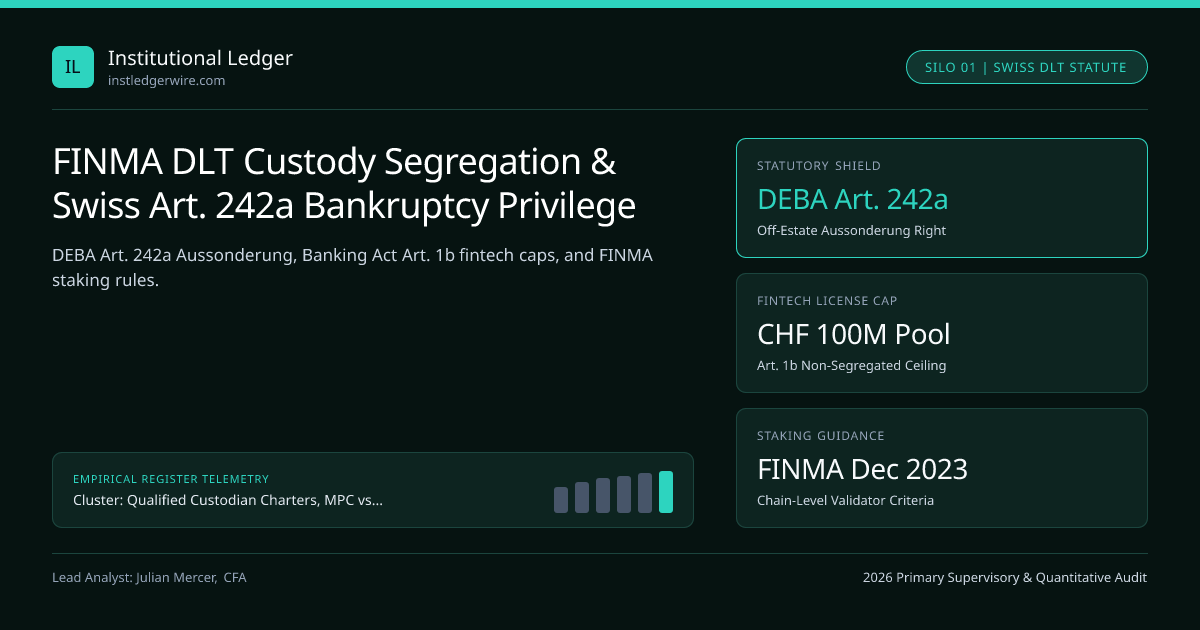
Long before major jurisdictions drafted crypto-specific insolvency rules, Switzerland enacted its Federal Act on the Adaptation of Federal Law to Developments in Distributed Ledger Technology (the Swiss DLT Act), inserting Article 242a directly into the Swiss Debt Enforcement and Bankruptcy Act (SchKG / DEBA) and Article 16(1bis) into the Swiss Banking Act. Supervised by FINMA, this statutory architecture eliminates common-law guesswork over whether cryptographic tokens constitute segregable property during bank liquidation.
DEBA Article 242a & Banking Act Article 16(1bis): Statutory Aussonderung#
In civil-law jurisdictions, traditional bankruptcy separation (Aussonderung) historically applied only to corporeal chattels (Sachen), leaving intangible cryptographic keys vulnerable to general estate claims unless rescued by special legislation. Switzerland closed that gap decisively in August 2021. Under DEBA Article 242a, if a custodian goes bankrupt, the bankruptcy administration must surrender (Herausgabe) crypto-based assets controlled by the debtor back to the beneficial owner—provided the custodian bound itself to hold the assets in constant readiness for the client and either:
- Allocated the assets individually to the client on the distributed ledger, or
- Allocated the assets to a collective pool (
Sammelverwahrung) where it is determinable at every point in time which proportion of the collective pool belongs to each individual client.
For licensed Swiss crypto banks and private banks, Banking Act Article 16(1bis) mirrors this rule, elevating segregated DLT tokens to the same off-balance-sheet insolvency status as traditional custodied securities (Depotwerte) under Article 37d. As highlighted in our qualified digital asset custody cornerstone guide, failing either readiness or share-determinability converts omnibus tokens into general bank deposits—triggering catastrophic Basel SCO60 1,250% Group 2 capital charges.
Ledger-Based Securities (Registerwertrechte) & SNB Wholesale CBDC#
Beyond native Bitcoin and Ether, Switzerland's Code of Obligations Article 973d created Ledger-Based Securities (Registerwertrechte)—allowing equities, structured notes, and corporate bonds to be issued natively on a blockchain without a central paper global certificate. On SIX Digital Exchange (SDX) and institutional DLT rails benchmarked alongside the Eurosystem DLT 2026 Standard, Swiss banks settle tokenized bonds atomically against real Swiss Franc wholesale Central Bank Digital Currency (SNB Project Helvetia Phase III).
Hardware key security in Zurich and Zug typically relies on domestically manufactured Swiss HSM appliances (such as Securosys Primus clusters housed inside deep alpine military-grade bunkers), pairing air-gapped FIPS 140-3 Level 3 HSM controls with strict Swiss data-sovereignty statutes.
| Alpine Custody Regime | Supervisor | Statutory Segregation Clause | Tokenized Securities (Registerwertrechte) | EEA Single-Market Passport |
|---|---|---|---|---|
| Swiss Full Bank License | FINMA | BankG Art. 16(1bis) & Art. 37d | Native Swiss Code of Obligations Art. 973d | No (Third-country under ESMA MiCA) |
| Swiss FinTech License (Art. 1b) | FINMA | DEBA Art. 242a (if segregated) | Restricted; cannot act as central securities depository | No |
| Liechtenstein TVTG / MiCA CASP | FMA Liechtenstein | TVTG Art. 25 insolvency separation + MiCA Art. 70 | TVTG Trustworthy Technology Token Container | Yes — full 30-state EEA Passport |
| German Dual KWG / MiCA | BaFin | KWG / MiCA Art. 70 & 75 | German eWpG crypto-securities register | Yes — full 30-state EEA Passport |
FINMA Guidance 08/2023 on Institutional Custodial Staking#
In December 2023, FINMA published Guidance 08/2023 (Staking) addressing whether validator lockups and slashing risks invalidate "constant readiness" under Article 16(1bis). FINMA established a pragmatic institutional safe harbor: direct chain-level staking by a FINMA-supervised institution (or delegated to a prudentially vetted sub-custodian) preserves off-balance-sheet fiduciary treatment if there is no counterparty credit link, deterministic withdrawal credentials pointing back to the segregated custody vault, a comprehensive Digital Asset Resolution Package (DARP) documenting emergency exit procedures, and transparent client risk sign-off on unbonding delays and slashing.
- Variables & Swiss Private Bank Custody Mandate (CHF 8.0B Client Segregated BTC/ETH + CHF 150M House Market-Making):
- 1. Segregated Client Custody (CHF 8,000,000,000 under BankG Art. 16(1bis) & DEBA Art. 242a):
- Credit & Leverage Exposure Inclusion = CHF 0 (100% off-balance-sheet fiduciary Depotwerte parity)
- Annual Custody & Staking Fee @ 22 bps = CHF 17,600,000 -> FINMA OpRisk Capital Charge (~15% BIC) = CHF 2,640,000
- 2. Unsegregated / Omnibus Without Determinable Share Record (Hypothetical Failure Case):
- Reclassified as On-Balance-Sheet Public Deposit -> Triggers 1,250% Group 2b RWA under FINMA/BCBS SCO60!
- Hypothetical Capital Penalty on CHF 8.0B = CHF 8,000,000,000 CET1 (instant regulatory insolvency)
- 3. House Principal Book (CHF 40M Group 2a Hedged @ 250% eff. RWA = CHF 100M RWA -> CHF 10.5M CET1 at 10.5% Swiss buffer)
Cross-Border EEA Strategy: Pairing Swiss FINMA with Liechtenstein or BaFin#
Because Switzerland sits outside the European Economic Area, a standalone FINMA bank license does not grant an automatic EU MiCA passport under ESMA rules. Consequently, alpine wealth managers and prime liquidity venues (connecting into European order books like Bitstamp) frequently pair a Zurich FINMA custody hub for global sovereign/private-wealth clients with an EEA-passported affiliate licensed by FMA Liechtenstein under the TVTG/MiCA regime or BaFin in Frankfurt—a dual-hub strategy detailed in our BaFin vs MiCA CASP comparison.
Alpine Custody Verification Steps for Global Allocators#
Institutional treasuries allocating capital inside our Qualified Custody & HSM Controls hub verify that Swiss custody agreements explicitly invoke Banking Act Art. 16(1bis) and DEBA Art. 242a, inspect the custodian's FINMA-mandated DARP documentation, and confirm active supervisory status via our regulators directory and verification portal.
Frequently asked questions
What exact conditions must a Swiss custodian satisfy for clients to claim DEBA Article 242a bankruptcy separation?
Under DEBA Art. 242a(2), the custodian must commit contractually to hold the crypto-based assets in constant readiness for the client, and the assets must either be allocated individually to the client on the blockchain or allocated to a collective pool where each client exact share is unambiguously determinable at all times.
When does omnibus crypto pooling in Switzerland cross the line into requiring a full Banking License?
If a Swiss custodian pools client tokens on-chain without maintaining real-time determinable individual share records—or reserves any right to lend, rehypothecate, or trade client tokens for its own account—the holdings become "public deposits" requiring a full Swiss Banking Act license (or capped at CHF 100M under an Art. 1b FinTech license).
How did FINMA Guidance 08/2023 regulate custodial Ethereum staking for Swiss private banks?
FINMA permitted Swiss banks and securities firms to offer custodial staking off-balance-sheet under Art. 16(1bis) provided staking occurs on protocols with unambiguous withdrawal mechanics, zero rehypothecation, vetted validator operators, and explicit client risk acknowledgment covering slashing and unbonding queues.
How does Liechtenstein TVTG custody compare with Swiss FINMA DLT custody for family offices?
Liechtenstein's Token and TT Service Provider Act (TVTG), supervised by FMA Liechtenstein, introduced the civil-law "value right" container and TT Key Depositary role with EEA MiCA alignment, while Switzerland offers deeper G-SIB/private-bank balance sheets and SIX Digital Exchange (SDX) wholesale CHF CBDC integration.
Publication record
- Published
- November 14, 2026
- Updated
- November 15, 2026
- Author
- Julian Mercer, CFA
- Review
- Review not recorded
- Automated fact check
- Passed in the stored pipeline record
- Source URLs
- 3 recorded
AI assistance recorded: anthropic/claude-opus-4.6. This field does not establish human review or source verification.
Academic & Institutional Attribution
Cite This Research & Embed Live Data Card
Standard academic & institutional research paper citation format.
Julian Mercer, CFA. (2026, November 15). FINMA DLT Custody Segregation & Swiss Art. 242a Bankruptcy Privilege. Institutional Ledger. https://instledgerwire.com/stories/finma-dlt-custody-segregation-swiss-bankruptcy-privilegeRegulatory Directory Cross-Reference
Referenced Institutions & Regulatory Registries
Mentioned Regulated Institutions
Referenced Supervisory Authorities
Related Qualified Custody Mpc Hsm Controls & Institutional Briefings
Explore Qualified Custody Mpc Hsm Controls Hub (20) →Qualified Custody Mpc Hsm Controls
Qualified Digital Asset Custody, MPC Signing & FIPS 140-3 HSM Controls: 2026 GuideQualified Custody Mpc Hsm Controls
MAS Payment Services Act 90% Cold Wallet Mandate & Statutory TrustQualified Custody Mpc Hsm Controls
Hong Kong SFC Virtual Asset Custody: 98% Cold Seed Storage & InsuranceQualified Custody Mpc Hsm Controls
ADGM FSRA, Dubai VARA & DIFC DFSA Qualified Crypto Custody RulebooksQualified Custody Mpc Hsm Controls
FASB ASU 2023-08 (ASC 350-60) Fair-Value Crypto Custody ReportingQualified Custody Mpc Hsm Controls
Smart-Contract Allowlisting & EIP-712 Typed-Data Signing GuardsQualified Custody Mpc Hsm Controls
Custodian Sub-Custody Delegation & Ancillary Staking Liability LawQualified Custody Mpc Hsm Controls
NYDFS Limited Purpose Trust vs OCC National Trust Charters in Crypto CustodyTokenized Treasuries Rwa Settlement
Cross-Chain Burn-and-Mint Interoperability (CCIP) for Tokenized RWATokenized Treasuries Rwa Settlement
G-SIB SLR, LCR & Level 1 HQLA Eligibility of Tokenized Sovereign DebtTokenized Treasuries Rwa Settlement
Rebasing ($1.00 Par) vs Accumulating NAV Tokenized Money-Market FundsTokenized Treasuries Rwa Settlement
Forced Transfer, Freeze & Wallet Recovery in Permissioned RWA Tokens
Institutional Ledger Data, Benchmarks & Contributor Records
CC BY 4.0 Open Data
Open Institutional Datasets (CSV / JSON) →
Download desk-compiled quantitative series & schemas.
2026 Reference Matrix
2026 Institutional Benchmarks & Thresholds →
Statutory capital, clearing, margin & rate conventions.
Editorial Records
Authors & Review Records →
View named contributors where those records are available.
Complete Index
Master Research & Dossier Archive →
Browse all published briefings by topic pillar & date.