
Qualified Custody Mpc Hsm Controls
BaFin Krypto-Verwahrgeschaeft vs EU MiCA Article 70 CASP Custody Rules
Germany's pioneering KWG Krypto-Verwahrgeschaeft regime transitions into EU MiCA Article 70 CASP custody, introducing 27-state passporting, strict restitution liability, and DORA resilience.
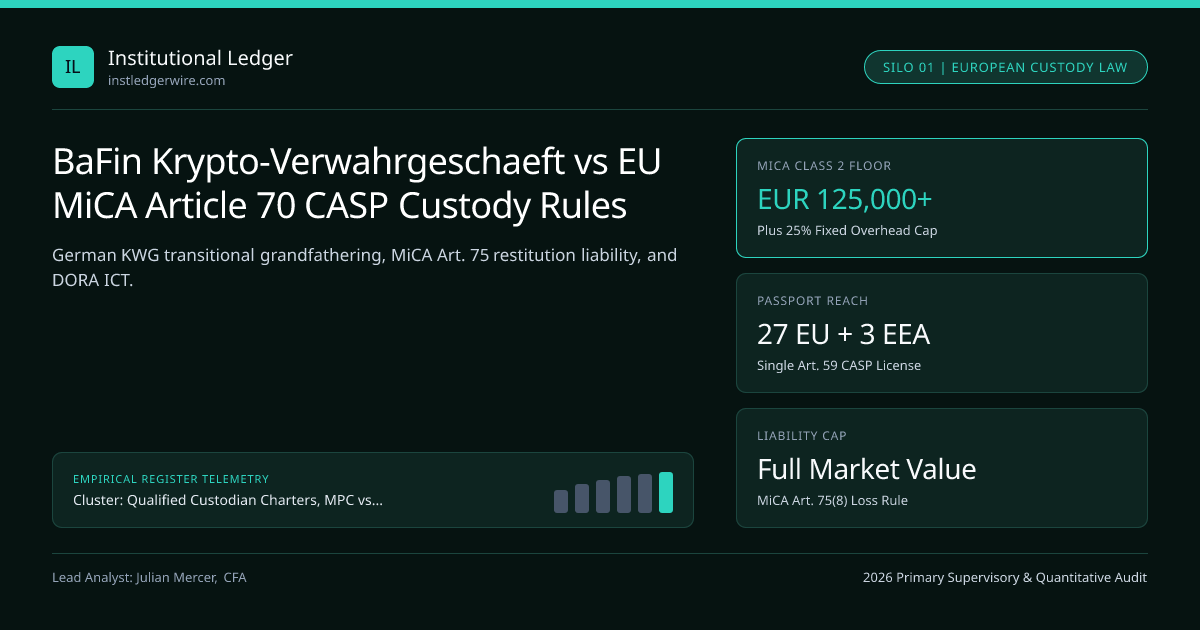
Germany pioneered bank-grade European crypto regulation in January 2020 by codifying Krypto-Verwahrgeschaeft under Section 1(1a) Sentence 2 No. 6 of the German Banking Act (KWG), supervised jointly by BaFin and the Deutsche Bundesbank. With the full implementation of the European Union's Markets in Crypto-Assets Regulation (MiCA) supervised across national authorities and ESMA, European institutional safekeeping now operates on a harmonized dual track: MiCA Articles 70 and 75 govern crypto-assets and regulated fiat stablecoins, while KWG and eWpG rules continue to govern tokenized securities.
From National KWG Silos to EU-Wide MiCA Article 59/60 Passporting#
Under the pre-MiCA landscape, a custodian holding a German KWG crypto-custody license still faced fragmented Virtual Asset Service Provider (VASP) registrations in France (AMF PSAN), Italy (OAM), Spain, and the Netherlands (DFSA Denmark and peers) to market cross-border institutional safekeeping. MiCA swept away those national barriers: an entity obtaining a Class 2 CASP custody authorization under Article 59—or an EU credit institution filing a streamlined 40-working-day notification under Article 60—gains an automatic single-market passport under Article 65 across all 27 EU and 3 EEA states.
Conversely, non-EU custodians face ESMA's uncompromising Article 61 reverse-solicitation guidelines, which prohibit third-country firms (including US or offshore venues) from soliciting European pension funds, insurers, or UCITS/AIF managers without establishing an EU-authorized MiCA subsidiary. Global exchanges operating European arms such as Bitstamp and Bitonic structured dedicated EU entities precisely to preserve institutional orderflow.
MiCA Article 70 Segregation & Article 75(8) Strict Restitution Liability#
Within our qualified digital asset custody cornerstone architecture, MiCA introduces arguably the toughest statutory investor-protection clause globally. Under Article 70, CASPs must safeguard client rights of ownership, maintain legally and operationally segregated distributed-ledger addresses from house estates, and protect client assets against claims of CASP creditors in insolvency—paralleling our analysis of omnibus versus segregated on-chain wallets.
Article 75(8) escalates accountability further: a CASP custodian is statutorily liable to its institutional or retail clients for the loss of any crypto-assets or means of access resulting from an incident attributable to the CASP, capped at the full market value of the lost crypto-asset at the moment the loss occurred. Boilerplate terms-of-service liability waivers capping damages at 12 months of custody fees are unenforceable under MiCA. Furthermore, Article 75(9) restricts sub-custody delegation strictly to other CASPs authorized under MiCA (or equivalent supervised third-country frameworks with explicit client disclosure).
| Regulatory Parameter | Legacy German KWG Sec. 1(1a) | EU MiCA CASP Custody (Art. 70 & 75) | CRD IV Credit Institution (Art. 60) | French PSAN -> MiCA (AMF / ACPR) |
|---|---|---|---|---|
| Primary Supervisor | BaFin + Deutsche Bundesbank | Home NCA (BaFin / AMF) + ESMA | ECB SSM + National Competent Authority | AMF & ACPR |
| Geographic Reach | Germany only (required host VASP regs) | Full 27 EU + 3 EEA Single Passport | Full EU/EEA Banking + MiCA Passport | Full EU/EEA Passport post-transition |
| Minimum Prudential Capital | EUR 150,000 initial capital + MaRisk | Higher of EUR 125,000 or 25% prior-year fixed overheads | Full CRR III bank capital + SCO60 alignment | Higher of EUR 125,000 or 25% fixed overheads |
| Sub-Custody Delegation | Permitted under MaRisk outsourcing | Restricted to authorized MiCA/equivalent custodians (Art. 75(9)) | CRD/DORA critical ICT & sub-custody rules | MiCA Art. 75(9) + DORA ICT register |
| Tokenized Securities Scope | Covered via eWpG / WpIG license | Excluded from MiCA (requires MiFID II / DLT Pilot) | Covered natively (Depotgeschaeft + Eurosystem DLT) | Covered under French DEEP Blockchain Decree |
Why German Spezialfonds Still Require KWG & eWpG Dual Permissions#
Institutional allocators structuring mandates in Frankfurt or Luxembourg must remember MiCA's Article 2(4) boundary: MiCA explicitly excludes crypto-assets that qualify as financial instruments under MiFID II. When a German bank issues a digital bearer bond on a blockchain under the Electronic Securities Act (eWpG) or participates in the Eurosystem Exploratory Wholesale DLT Settlement Trials (Trigger, Pontes & Appia), those instruments require a KWG Kryptowertpapierregisterfuehrung (crypto-securities registrar) or traditional Depotgeschaeft custody license rather than a standalone MiCA CASP license. German institutional Spezial-AIF funds (permitted to allocate up to 20% to crypto-assets) therefore favor CRD banks or dual-licensed BaFin custodians capable of holding both native BTC/ETH and eWpG tokenized bonds under one depositary (Verwahrstelle) oversight roof.
- Variables & European Custodian Capital Calibration (Frankfurt Institutional Custody Entity, EUR 12B AUM):
- PriorYearFixedOverheads = EUR 18,400,000 (staffing, BaFin/audit fees, colocation HSM cages, non-discretionary IT)
- Fixed Overhead Requirement (FOR, MiCA Art. 67) = 0.25 * EUR 18,400,000 = EUR 4,600,000 CET1-equivalent own funds
- DORATLPTReserve = EUR 650,000 annualized Threat-Led Penetration Testing & ICT third-party concentration buffer
- Art75LiabilityBuffer = Uninsured warm-tier exposure (EUR 35M velocity cap - EUR 25M crime insurance = EUR 10.0M) * 15% Pillar-2 stress weight = EUR 1,500,000
- Worked European Prudential Adequacy Check:
- 1. Statutory MiCA Art. 67 Floor = max(EUR 125,000, EUR 4,600,000) = EUR 4,600,000 own funds (or insurance policy per Art. 67(3))
- 2. Internal Economic Capital Target (including Art. 75(8) strict restitution buffer + DORA) = EUR 4.60M + EUR 0.65M + EUR 1.50M = EUR 6.75M
- 3. Passport Savings vs Legacy 11-Country National VASP Registrations = ~EUR 2.10M/yr legal & local entity overhead eliminated
DORA ICT Resilience & Threat-Led Penetration Testing (TLPT)#
Simultaneously with MiCA, the EU Digital Operational Resilience Act (DORA) binds every regulated crypto custodian to bank-grade ICT governance. Custodians must maintain live registers of critical third-party ICT providers—including cloud enclave vendors and threshold MPC software suppliers—report severe cyber incidents within strict four-hour regulatory windows, and undergo TIBER-EU Threat-Led Penetration Testing alongside air-gapped FIPS 140-3 HSM controls.
European Custodian Selection Checklist for Institutional Funds#
European AIFMs and corporate treasurers vetting custodians inside our Qualified Custody & HSM Controls hub verify ESMA's central MiCA CASP register, confirm Article 67 Fixed Overhead Requirement capital buffers, check eWpG/MiFID permissions for tokenized fixed income, and cross-reference active supervisory records on our verification portal.
Frequently asked questions
Why do German institutional custodians still hold KWG permissions after MiCA took effect?
MiCA governs crypto-assets that are NOT MiFID II financial instruments (such as BTC, ETH, and EMTs/ARTs). Tokenized bonds and fund shares issued under Germany Electronic Securities Act (eWpG) qualify as MiFID financial instruments, requiring KWG/WpIG custody and crypto-securities registrar licenses supervised by BaFin.
How strict is custodian loss liability under EU MiCA Article 75(8)?
MiCA Article 75(8) makes CASP custodians statutorily liable to clients for the loss of crypto-assets or means of access resulting from any incident attributable to the CASP, capped at the market value at the time the loss occurred. Only external events beyond reasonable control escape liability.
How does EU DORA (Regulation 2022/2554) affect MiCA-authorized digital asset custodians?
Every MiCA CASP falls directly within the Digital Operational Resilience Act (DORA), mandating ICT risk management frameworks, major cyber-incident reporting within strict hourly windows, Threat-Led Penetration Testing (TLPT), and formal register oversight of third-party MPC/cloud ICT providers.
Can a French AMF or German BaFin MiCA custodian serve institutional clients across all EU states?
Yes. Once authorized under MiCA Article 59 (or notified under Article 60 for CRD credit institutions), a custodian notifies its home NCA under Article 65 and passports safekeeping and administration services across all 27 EU and 3 EEA jurisdictions without host-state re-licensing.
Publication record
- Published
- November 14, 2026
- Updated
- November 14, 2026
- Author
- Julian Mercer, CFA
- Review
- Review not recorded
- Automated fact check
- Passed in the stored pipeline record
- Source URLs
- 3 recorded
AI assistance recorded: anthropic/claude-opus-4.6. This field does not establish human review or source verification.
Academic & Institutional Attribution
Cite This Research & Embed Live Data Card
Standard academic & institutional research paper citation format.
Julian Mercer, CFA. (2026, November 14). BaFin Krypto-Verwahrgeschaeft vs EU MiCA Article 70 CASP Custody Rules. Institutional Ledger. https://instledgerwire.com/stories/bafin-krypto-verwahrgeschaeft-vs-mica-casp-custody-rulesRegulatory Directory Cross-Reference
Referenced Institutions & Regulatory Registries
Mentioned Regulated Institutions
Related Qualified Custody Mpc Hsm Controls & Institutional Briefings
Explore Qualified Custody Mpc Hsm Controls Hub (20) →Qualified Custody Mpc Hsm Controls
Qualified Digital Asset Custody, MPC Signing & FIPS 140-3 HSM Controls: 2026 GuideQualified Custody Mpc Hsm Controls
Spot Bitcoin & Ether ETF In-Kind Creation Custody SLA WorkflowsQualified Custody Mpc Hsm Controls
Quorum Policy Engines & Biometric Hardware Co-Signing ControlsQualified Custody Mpc Hsm Controls
Disaster Recovery, Shamir Key Sharding & Geographic Custody QuorumsQualified Custody Mpc Hsm Controls
FINMA DLT Custody Segregation & Swiss Art. 242a Bankruptcy PrivilegeQualified Custody Mpc Hsm Controls
MAS Payment Services Act 90% Cold Wallet Mandate & Statutory TrustQualified Custody Mpc Hsm Controls
Hong Kong SFC Virtual Asset Custody: 98% Cold Seed Storage & InsuranceQualified Custody Mpc Hsm Controls
ADGM FSRA, Dubai VARA & DIFC DFSA Qualified Crypto Custody RulebooksTokenized Treasuries Rwa Settlement
Eurosystem DLT Trials: Bundesbank Trigger, Pontes & Appia Central Bank DvPTokenized Treasuries Rwa Settlement
MAS Project Guardian & Global Layer One (GL1): Cross-Border RWA RepoTokenized Treasuries Rwa Settlement
Project mBridge Multi-CBDC PvP Corridor: Sovereign Settlement & Nostro ReliefTokenized Treasuries Rwa Settlement
24/7 USDC Redemption Liquidity Buffers for Tokenized US Treasury Funds
Institutional Ledger Data, Benchmarks & Contributor Records
CC BY 4.0 Open Data
Open Institutional Datasets (CSV / JSON) →
Download desk-compiled quantitative series & schemas.
2026 Reference Matrix
2026 Institutional Benchmarks & Thresholds →
Statutory capital, clearing, margin & rate conventions.
Editorial Records
Authors & Review Records →
View named contributors where those records are available.
Complete Index
Master Research & Dossier Archive →
Browse all published briefings by topic pillar & date.