
Qualified Custody Mpc Hsm Controls
Air-Gapped FIPS 140-3 Level 3 & Level 4 HSM Cold Signing Vaults Explained
NIST FIPS 140-3 Level 3 and Level 4 Hardware Security Modules anchor deep cold digital asset custody through active tamper zeroization, Faraday cages, and optical air-gap ceremonies.
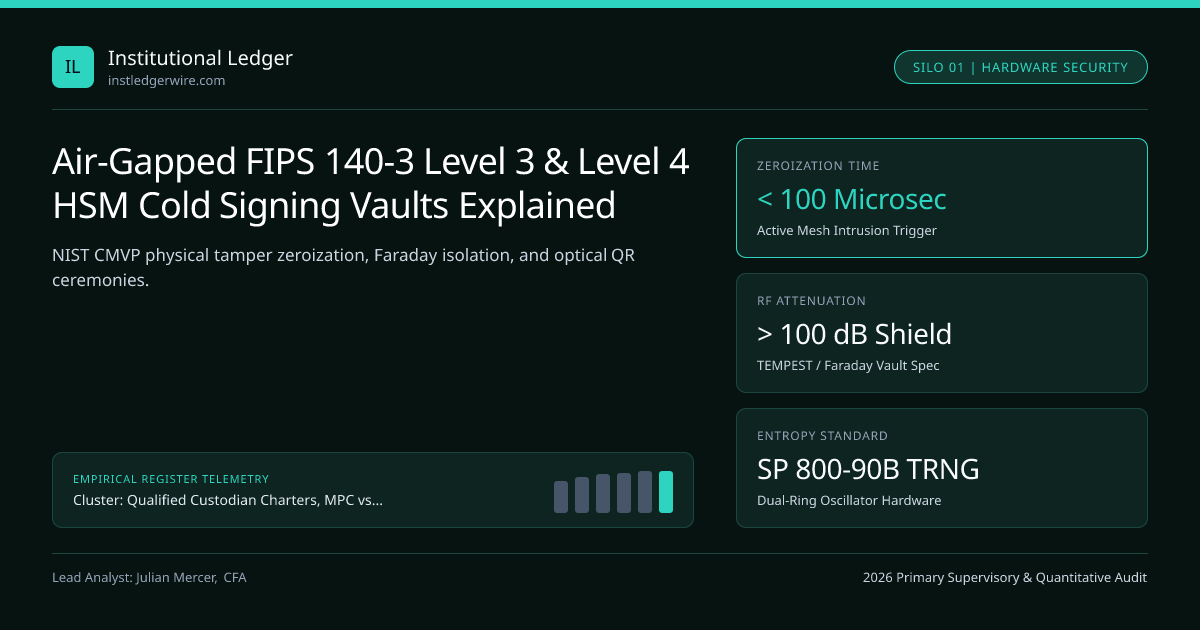
More than $140 billion in institutional Bitcoin, Ether, and sovereign reserve tokens sits inside offline Hardware Security Modules validated under NIST Federal Information Processing Standard (FIPS) 140-3 Security Levels 3 and 4. By isolating secp256k1 and Ed25519 private scalars behind active tamper-zeroization meshes, TEMPEST-grade Faraday enclosures, and unidirectional optical QR air-gaps, cold HSM vaults eliminate remote cyber-exploitation surfaces and unlock 55%-to-75% lower Lloyd's specie insurance pricing.
From FIPS 140-2 to FIPS 140-3: CMVP Validation & Native Curve Boundaries#
Under NIST's Cryptographic Module Validation Program (CMVP), legacy FIPS 140-2 certificates transitioned to sunset status in favor of FIPS 140-3, which harmonizes US federal standards with international ISO/IEC 19790:2012 and ISO/IEC 24759 testing protocols. For digital asset custodians detailed in our qualified digital asset custody cornerstone guide, FIPS 140-3 introduces three critical upgrades: mandatory NIST SP 800-90B raw entropy source health testing on boot and before every signature, cryptographic vendor-signed firmware loading, and formal non-invasive side-channel mitigation against Electromagnetic Analysis (EMA) and Differential Power Analysis (DPA).
Crucially, institutional auditors verify whether secp256k1, Ed25519, and BIP-32 hierarchical deterministic key derivation execute inside the validated FIPS boundary rather than inside an unvalidated user-space host library. Regulators including the Hong Kong SFC and MAS explicitly inspect CMVP certificate numbers during licensing reviews to confirm that plaintext private keys can never be exported outside hardware potting.
Level 3 vs Level 4 Physical Tamper Envelopes & BBRAM Zeroization#
Selecting between Security Level 3 and Security Level 4 involves balancing physical fault resistance against environmental maintenance complexity. A FIPS 140-3 Level 3 HSM encapsulates its cryptographic processor in hard, high-density epoxy resin and enforces identity-based authentication via smartcard PIN Entry Devices (PEDs) so quorum officers never type passphrases into general-purpose keyboards. Opening the chassis trips micro-switches that discharge battery-backed static RAM (BBRAM), zeroizing every critical security parameter in less than 100 microseconds.
Security Level 4 goes further by wrapping the entire multi-chip module in an active fine-pitch conductive security mesh paired with Environmental Failure Protection (EFP). If a nation-state lab attempts liquid-nitrogen cooling below -40 degrees Celsius to induce SRAM data remanence, micro-drilling with focused ion beams, or over-voltage clock glitching, the Level 4 boundary triggers instantaneous hardware key erasure. Because battery-backed tamper meshes permanently brick an HSM if internal cells deplete after 7 to 10 years, custodial ops teams schedule rolling disaster-recovery Shamir and HSM key-cloning rotations across tri-continental vaults.
| Cryptographic Module Class | NIST / ISO Standard | Physical Tamper Response | Typical Signing Latency | Specie Underwriting Tier | Primary Custody Mandate |
|---|---|---|---|---|---|
| Air-Gapped HSM (Level 4) | FIPS 140-3 L4 / PCI PTS HSM | Active multi-axis drill, laser & voltage zeroize | 4h - 24h physical vault | Tier-1 Primary Specie (lowest rate) | Sovereign reserves & Spot ETF cold vaults |
| Air-Gapped HSM (Level 3) | FIPS 140-3 L3 (ISO 19790) | Cover-switch zeroize + epoxy potting + PED cards | 2h - 12h Faraday ceremony | Tier-1 Specie (NYSDFS / SFC) | Pension & corporate treasury cold tier |
| Networked HSM + MPC Hybrid | FIPS 140-3 L3 backing MPC | Tamper-responsive shard storage; online TLS bus | 200ms - 2s automated | Crime / Cyber composite policy | Prime clearing & Bitstamp sweep buffer |
| Cloud HSM (Level 2/3) | AWS CloudHSM / Azure Dedicated | Datacenter cage + Level 3 appliance; shared cloud | 15ms - 90ms API | Commercial crime sub-limit | Hot withdrawal wallets (bitFlyer) |
Optical Air-Gap Ceremonies & Unidirectional Payload Verification#
Even a Level 4 HSM can sign a malicious sweep transaction if connected over TCP/IP to a compromised orchestration server—the exact failure mode behind several exchange warm-wallet thefts. Deep cold vaults enforced for spot Bitcoin and Ether ETF in-kind creation custody therefore physically remove Ethernet, Wi-Fi, and Bluetooth transceivers from vault terminals and house signing consoles inside >100 dB RF-attenuated Faraday rooms.
When an authorized redemption passes policy checks, two or more background-screened vault officers pass dual-biometric man-traps carrying personal PED smartcards. An external display renders the unsigned transaction as an animated UR/Fountain-coded QR stream through optical glass. Inside the vault, an offline verifier decodes the destination address against pre-ceremony paper and cryptographic whitelists, signs inside the HSM, and emits only the 64- or 65-byte signature back across the optical camera diode.
- Variables & Institutional Calibration ($6.0B Cold Reserve Program):
- N_sites = 3 geographically separated Class-3 UL vault facilities (New York, Zurich, Singapore)
- Cvaultops = $1,150,000/yr per site (armed access, Faraday certification, 24/7 dual-custody staffing)
- N_hsm = 12 FIPS 140-3 Level 3/4 HSM appliances (4 per site: active + hot-spare + DR clone)
- Chsmamort = $48,000/yr per appliance (5-year hardware depreciation + CMVP firmware maintenance + BBRAM rotation)
- Limit_specie = $600,000,000 dedicated Lloyd's cold-vault specie policy (12 segregated $500M vault partitions)
- r_specie = 0.0042 (42 bps annualized specie premium rate on insured limit; vs 135 bps for online crime cover)
- Worked Cost & Risk Efficiency Calculation:
- 1. Infrastructure & Staffing = (3 * $1.15M) + (12 * $0.048M) = $3,450,000 + $576,000 = $4,026,000/yr
- 2. Specie Insurance Premium = $600,000,000 * 0.0042 = $2,520,000/yr (saves $5.58M/yr vs 135 bps online crime rate!)
- 3. Total Annual Cold Vault Cost = $6,546,000 / $6,000,000,000 = 10.91 bps of AUM (supporting 15-25 bps custody fee schedules)
Hybrid HSM-Backed MPC, Specie Insurance & Prudential Risk Reduction#
Rather than treating hardware modules and MPC as mutually exclusive, leading trust banks combine both: threshold ECDSA and EdDSA MPC key shares are themselves stored inside networked FIPS 140-3 Level 3 HSMs for sub-second warm liquidity, while 92%+ of reserves stay air-gapped. Under Basel III BCBS SCO60 operational risk reviews and specie crime insurance underwriting, physical air-gap segregation unlocks standalone vault policies up to $1 billion per syndicate tower.
Cold Vault Inspection Protocol for Fiduciary Committees#
Institutional due diligence teams reviewing custodians in our Qualified Custody & HSM Controls hub verify NIST CMVP certificate statuses directly, audit annual Faraday RF-attenuation test logs inside SOC 1 and SOC 2 Type II reports, and confirm supervised entity standing via our compliance verification directory and benchmark datasets.
Frequently asked questions
What is the operational difference between FIPS 140-3 Security Level 3 and Security Level 4?
FIPS 140-3 Level 3 requires hard opaque potting, intrusion switches that erase plaintext critical security parameters upon chassis opening, and multi-factor role authentication. Level 4 wraps the cryptographic boundary in an active piezo/conductive mesh that triggers instant zeroization upon micro-drilling, thermal freeze below -40C, or voltage glitching.
How do air-gapped HSM cold vaults transmit transactions without connecting to a network?
An online coordinator builds an unsigned Bitcoin PSBT (BIP-174) or Ethereum EIP-712 payload, displays it as an animated Fountain-coded QR sequence through a viewing pane, and vault officers scan it into an offline HSM terminal inside the Faraday room, returning only the 65-byte ECDSA signature via QR.
Why did legacy FIPS 140-2 HSMs require custom firmware modules to support Bitcoin and Ethereum?
Standard banking HSMs originally shipped only NIST P-256/P-384 curves rather than secp256k1 or BIP-32 hierarchical deterministic key derivation. Modern institutional HSMs (such as Thales Luna, Securosys Primus, and IBM Crypto Express) execute native secp256k1 and Ed25519 inside the FIPS boundary.
How are HSM master seed backups protected against single-site fire or seismic catastrophe?
During the witnessed genesis ceremony, the HSM exports encrypted key-cloning shares onto M-of-N FIPS-validated smartcards or hardware backup tokens protected by PIN pads, which armed couriers transport to three or more tectonically independent bank vaults.
Publication record
- Published
- November 14, 2026
- Updated
- November 15, 2026
- Author
- Julian Mercer, CFA
- Review
- Review not recorded
- Automated fact check
- Passed in the stored pipeline record
- Source URLs
- 3 recorded
AI assistance recorded: anthropic/claude-opus-4.6. This field does not establish human review or source verification.
Academic & Institutional Attribution
Cite This Research & Embed Live Data Card
Standard academic & institutional research paper citation format.
Julian Mercer, CFA. (2026, November 15). Air-Gapped FIPS 140-3 Level 3 & Level 4 HSM Cold Signing Vaults Explained. Institutional Ledger. https://instledgerwire.com/stories/air-gapped-fips-140-3-level-3-hsm-cold-signing-vaultsRegulatory Directory Cross-Reference
Referenced Institutions & Regulatory Registries
Mentioned Regulated Institutions
Related Qualified Custody Mpc Hsm Controls & Institutional Briefings
Explore Qualified Custody Mpc Hsm Controls Hub (20) →Qualified Custody Mpc Hsm Controls
Qualified Digital Asset Custody, MPC Signing & FIPS 140-3 HSM Controls: 2026 GuideQualified Custody Mpc Hsm Controls
SOC 1 Type II vs SOC 2 Type II Audits in Institutional Crypto CustodyQualified Custody Mpc Hsm Controls
Basel III SCO60 Group 1 vs Group 2 Crypto Bank Capital Weights ExplainedQualified Custody Mpc Hsm Controls
SEC SAB 122 & FASB ASC 450-20 Custody Liability Accounting for BanksQualified Custody Mpc Hsm Controls
Specie & Crime Insurance Exclusions in Digital Asset Cold VaultsQualified Custody Mpc Hsm Controls
Omnibus vs Segregated On-Chain Wallets: Insolvency & Bailment LawQualified Custody Mpc Hsm Controls
BaFin Krypto-Verwahrgeschaeft vs EU MiCA Article 70 CASP Custody RulesQualified Custody Mpc Hsm Controls
Spot Bitcoin & Ether ETF In-Kind Creation Custody SLA WorkflowsTokenized Treasuries Rwa Settlement
BlackRock BUIDL (Reg D 3c7) vs Franklin BENJI (1940 Act MMF) ComparedTokenized Treasuries Rwa Settlement
Tokenized MMF Collateral Haircuts & CFTC GMAC Derivatives Margin RulesTokenized Treasuries Rwa Settlement
Chainlink & DTCC Smart NAV Oracle Attestation Latency ControlsTokenized Treasuries Rwa Settlement
Canton Network & Broadridge DLR Intraday Tokenized Repo Clearing
Institutional Ledger Data, Benchmarks & Contributor Records
CC BY 4.0 Open Data
Open Institutional Datasets (CSV / JSON) →
Download desk-compiled quantitative series & schemas.
2026 Reference Matrix
2026 Institutional Benchmarks & Thresholds →
Statutory capital, clearing, margin & rate conventions.
Editorial Records
Authors & Review Records →
View named contributors where those records are available.
Complete Index
Master Research & Dossier Archive →
Browse all published briefings by topic pillar & date.