
Qualified Custody Mpc Hsm Controls
Smart-Contract Allowlisting & EIP-712 Typed-Data Signing Guards
Institutional digital asset custodians eliminate blind-signing exploits by enforcing enclave-level EIP-712 structured-data decoding, ABI function-selector allowlists, and pre-sign EVM state simulation.
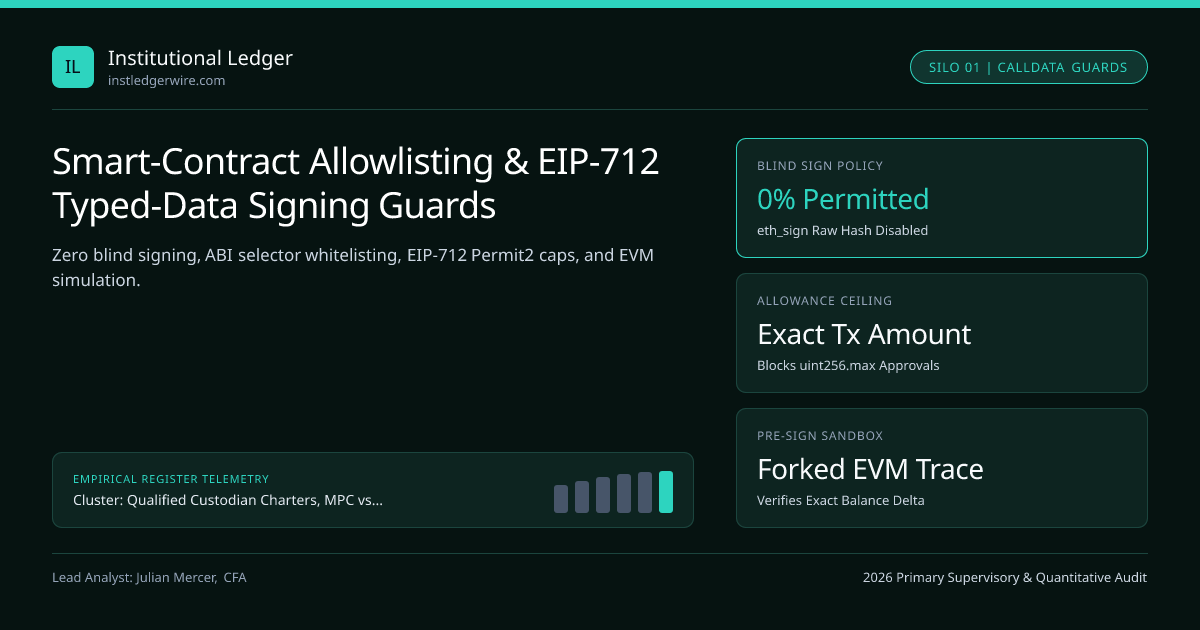
As institutional capital moves beyond passive Bitcoin cold storage into on-chain subscriptions for BlackRock BUIDL, ERC-3643 permissioned securities, and RFQ OTC settlement, blind signing has become the number-one operational threat vector in digital asset custody. Defeating frontend supply-chain hijacks requires banning raw eth_sign digests and enforcing three concentric enclave defenses: EIP-712 typed-data parsing, ABI parameter-level allowlisting, and forked-EVM pre-execution trace simulation.
Anatomy of Frontend Poisoning & DelegateCall Blind-Signing Drains#
In early 2025, one of the largest exchange warm-wallet breaches in history occurred without a single cryptographic key leak: attackers compromised a third-party multisig web interface so that human signers saw a routine cold-to-warm transfer on their browser screens, while their hardware tokens blind-signed a 32-byte hash executing a delegatecall that overwrote contract storage Slot 0 (the implementation pointer) to an attacker backdoor.
Within our qualified digital asset custody cornerstone architecture, institutional custodians treat every web browser, dApp frontend, and WalletConnect relay as 100% untrusted. Raw digest endpoints (eth_sign and unparsed personal_sign) are disabled at the firmware and enclave policy-engine level.
ABI Function-Selector & Calldata Byte-Offset Allowlisting#
Coarse contract-level whitelisting fails completely in EVM finance. If a treasury desk whitelists the official USDC token contract (0xA0b86991...) so traders can redeem tokenized Treasury shares, a compromised workstation can craft valid calldata against that exact whitelisted contract calling transfer(0xAttacker, 100_000_000e6) or approve(0xAttacker, type(uint256).max).
Institutional ABI guards inside threshold MPC enclaves parse the raw RLP data field byte-by-byte against a signed ABI specification:
- Bytes
0..4(Function Selector): Permit0xa9059cbb(transfer) or0xdb006a75(redeem); hard-rejectsetApprovalForAll,upgradeTo, and anydelegatecallwrapper. - Bytes
4..36(Recipient / Spender Address): Assert the 20-byte recipient matches the client's own whitelisted custody vault or KYC-bound sub-account at Bitstamp or Aquanow. - Bytes
36..68(Uint256 Notional): Enforce exact per-trade allowance caps—banning infinite2^256 - 1token approvals permanently.
| Signing Payload Type | Exploit Vector if Unguarded | Enclave Policy Guard Rule | Institutional Use Case |
|---|---|---|---|
ERC-20 transfer / approve | Whitelisted USDC contract called with attacker recipient or uint256.max | Decode bytes[4:68]; assert to in Vault Whitelist & amount <= TradeSize | Stablecoin sweeps & Bitstamp / Aquanow funding |
EIP-712 Permit / Permit2 | Gasless off-chain phishing signature drains wallet later | Verify domain.verifyingContract, spender whitelist, and deadline <= now + 900s | Institutional RFQ OTC settlement (Bancor / DEX RFQ) |
Tokenized RWA subscribe / redeem | Compromised UI redirects redemption proceeds to external receiver | Assert receiver arg == Custody Vault & check ERC-3643 registry hash | BlackRock BUIDL T+0 redemptions |
| Multisig / Proxy Admin Call | Poisoned UI injects Operation.DelegateCall to overwrite owner slot | Hard-ban delegatecall (op == 1) & verify zero EIP-1967 slot delta in trace | Cold/warm treasury governance (MAS & NYSDFS norms) |
EIP-712 Structured Intents & Permit2 Deadline Containment#
Modern institutional OTC settlement and gasless RWA transfers rely heavily on EIP-712 (eth_signTypedData_v4) structured messages. Because an EIP-712 signature never touches the blockchain until a counterparty submits it, careless signing of EIP-2612 Permit or Permit2 structs grants invisible blank checks. Hardened custody enclaves reconstruct the EIP712Domain separator (name, version, chainId, verifyingContract) independently, reject any Permit whose deadline exceeds 15 minutes from current block time, and display the decoded struct fields directly on officer Secure Element screens.
- Variables & Institutional DeFi / RWA Treasury Stress Model ($300M Tokenized RWA & Stablecoin Desk):
- P(UI_Compromise) = 0.025 annualized risk of third-party web dApp / CDN / DNS frontend injection
- 1. Legacy Blind-Signing Hardware Setup (PassABI = 1.0, PassSim = 1.0):
- Expected Annual Loss = 0.025 * 1.0 * 1.0 * $300,000,000 = $7,500,000/yr catastrophic expected loss!
- 2. Contract-Address-Only Whitelist (Fails on shared USDC/BUIDL contracts -> Pass_ABI = 0.85):
- Expected Annual Loss = 0.025 * 0.85 * $300,000,000 = $6,375,000/yr
- 3. Enclave ABI Argument Guard + EIP-1967 Implementation Hash Pinning + Forked EVM Balance-Delta Cap ($5M/tx):
- P(PassABIArg_Guard to non-whitelisted recipient) = 0.0000 (deterministic byte check inside enclave)
- P(Unpinned Proxy Upgrade Bypass) = 0.0001 (requires simultaneous archival RPC quorum corruption)
- Residual Expected Loss = 0.025 * 0.0001 * $5,000,000 = $12.50/yr (>99.9998% risk elimination)
Forked-EVM Pre-Execution Simulation & Proxy Implementation Pinning#
Even strict ABI decoding can be tricked if an external protocol's EIP-1967 proxy contract was maliciously upgraded moments earlier. Before releasing signature shares, institutional custodians run a local archival EVM fork (debug_traceCall across dual independent Reth/Geth nodes enforced under MAS and NYSDFS node-integrity standards). The enclave verifies that the target proxy's 0x360894... implementation slot hash matches an auditor-pinned commit, and confirms that simulated post-transaction ERC-20 Transfer balance deltas match policy thresholds within zero wei of unexpected outflow.
DeFi & Tokenized RWA Signing Policy Checklist#
Risk engineers configuring smart-contract workspaces inside our Qualified Custody & HSM Controls hub revoke all legacy non-zero ERC-20 allowances, pin proxy implementation hashes for every RWA fund contract, require trusted-display balance-delta confirmation, and audit venue permissions through our verification portal.
Frequently asked questions
Why do institutional custodians permanently disable legacy eth_sign in MPC and HSM enclaves?
Raw eth_sign signs an arbitrary 32-byte hash without an EIP-191 prefix or structural schema. An attacker can craft a hash that actually represents a valid mainnet RLP transaction or Safe multisig ownership transfer (swapOwner). Disabling raw digest signing forces every signature through typed RLP or EIP-712 parsers.
How can an EIP-712 off-chain signature drain an institutional wallet without paying gas?
Standards like EIP-2612 permit and Uniswap Permit2 allow gasless ERC-20 spending approvals via off-chain EIP-712 signatures. If a trader unknowingly signs a malicious PermitSingle message with amount = uint160.max and a distant expiration, the attacker broadcasts that signature on-chain and sweeps tokens immediately.
How does ABI argument-level allowlisting protect tokenized RWA and DeFi interactions?
Simply whitelisting the USDC contract address (0xA0b8...) is dangerous because calling USDC.transfer(attacker, 50M) hits that exact whitelisted contract! Institutional ABI guards inspect both the 4-byte selector (0xa9059cbb) AND decode ABI calldata bytes 4..36 to verify the recipient parameter is itself a whitelisted custody vault.
What attack vector does pre-signing forked-EVM state simulation catch that static ABI decoding misses?
Upgradeable proxy contracts (EIP-1967) can change implementation logic behind an unchanged proxy address. Forked-EVM simulation runs debug_traceCall against current block storage, checking actual Transfer event logs and storage slot mutations (such as proxy implementation slot 0x3608...) to catch compromised upgrades before signing.
Publication record
- Published
- November 14, 2026
- Updated
- November 14, 2026
- Author
- Julian Mercer, CFA
- Review
- Review not recorded
- Automated fact check
- Passed in the stored pipeline record
- Source URLs
- 3 recorded
AI assistance recorded: anthropic/claude-opus-4.6. This field does not establish human review or source verification.
Academic & Institutional Attribution
Cite This Research & Embed Live Data Card
Standard academic & institutional research paper citation format.
Julian Mercer, CFA. (2026, November 14). Smart-Contract Allowlisting & EIP-712 Typed-Data Signing Guards. Institutional Ledger. https://instledgerwire.com/stories/smart-contract-allowlisting-eip-712-typed-signing-guardsRegulatory Directory Cross-Reference
Referenced Institutions & Regulatory Registries
Mentioned Regulated Institutions
Related Qualified Custody Mpc Hsm Controls & Institutional Briefings
Explore Qualified Custody Mpc Hsm Controls Hub (20) →Qualified Custody Mpc Hsm Controls
Qualified Digital Asset Custody, MPC Signing & FIPS 140-3 HSM Controls: 2026 GuideQualified Custody Mpc Hsm Controls
Custodian Sub-Custody Delegation & Ancillary Staking Liability LawQualified Custody Mpc Hsm Controls
NYDFS Limited Purpose Trust vs OCC National Trust Charters in Crypto CustodyQualified Custody Mpc Hsm Controls
Threshold ECDSA & EdDSA MPC Key-Share Refresh Ceremonies in CustodyQualified Custody Mpc Hsm Controls
Air-Gapped FIPS 140-3 Level 3 & Level 4 HSM Cold Signing Vaults ExplainedQualified Custody Mpc Hsm Controls
SOC 1 Type II vs SOC 2 Type II Audits in Institutional Crypto CustodyQualified Custody Mpc Hsm Controls
Basel III SCO60 Group 1 vs Group 2 Crypto Bank Capital Weights ExplainedQualified Custody Mpc Hsm Controls
SEC SAB 122 & FASB ASC 450-20 Custody Liability Accounting for BanksTokenized Treasuries Rwa Settlement
Secondary OTC RFQ Liquidity & Weekend Discounts in Tokenized TreasuriesOff Exchange Triparty Collateral
Custodial Mirror-Settlement Loops vs Bank Tri-Party Control AgreementsOff Exchange Triparty Collateral
UCC Article 12 Controllable Electronic Records (CER): Crypto Lien PerfectionOff Exchange Triparty Collateral
UCC Article 8 Financial-Asset Election & Securities Intermediary Custody
Institutional Ledger Data, Benchmarks & Contributor Records
CC BY 4.0 Open Data
Open Institutional Datasets (CSV / JSON) →
Download desk-compiled quantitative series & schemas.
2026 Reference Matrix
2026 Institutional Benchmarks & Thresholds →
Statutory capital, clearing, margin & rate conventions.
Editorial Records
Authors & Review Records →
View named contributors where those records are available.
Complete Index
Master Research & Dossier Archive →
Browse all published briefings by topic pillar & date.