
Qualified Custody Mpc Hsm Controls
FASB ASU 2023-08 (ASC 350-60) Fair-Value Crypto Custody Reporting
FASB ASU 2023-08 (ASC 350-60) mandates quarterly fair-value measurement of corporate crypto holdings through net income, requiring principal-market custodial price feeds and lot-level rollforwards.
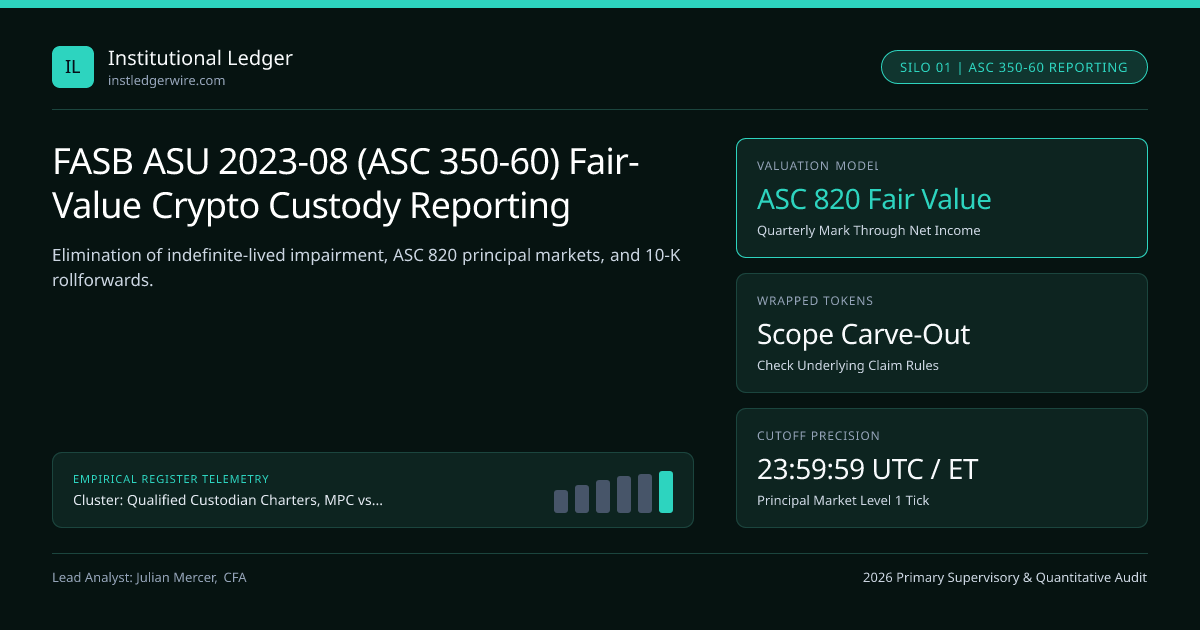
For corporate CFOs, public endowments, and private funds preparing US GAAP financial statements under the FASB ASU 2023-08 (ASC 350-60) 2026 Benchmark Standard, qualified digital asset custodians are no longer passive key vaults—they are primary financial-reporting data engines. By mandating quarterly fair-value measurement through net income on a dedicated balance-sheet line item, ASC 350-60 requires custodial sub-ledgers to deliver lot-level cost-basis relief on every Layer-1 gas fee and auditable Principal Market price ticks under ASC 820.
The Six Scope Gates of ASC 350-60-15-1: Why USDC & RWA Sit Outside#
Before applying fair-value crypto accounting, controllers must pass every token in their custodial workspace through the six cumulative scope gates of ASC 350-60-15-1: the asset must (a) meet the US GAAP definition of an intangible asset, (b) not provide the asset holder with enforceable rights to or claims on underlying goods, services, or other assets, (c) be created or reside on a distributed ledger based on blockchain or similar technology, (d) be secured through cryptography, (e) be fungible, and (f) not be created or issued by the reporting entity or its related parties.
Gate (b) creates an essential operational split inside modern multi-asset custody portals reviewed in our qualified digital asset custody cornerstone guide. Native Bitcoin, Ether, and Solana pass all six gates and report on the separate ASC 350-60 balance-sheet line. Conversely, fiat-backed USDC/EURC and tokenized US Treasury funds confer contractual claims on underlying dollars or securities—routing them to financial-instrument standards rather than ASC 350-60. Non-fungible tokens fail Gate (e), and self-issued protocol treasury tokens fail Gate (f).
ASC 820 Principal Market Selection & Accessible Regulated Venues#
Measuring fair value at 23:59:59 UTC on quarter-end requires strict adherence to ASC Topic 820 (Fair Value Measurement). Auditors reject generic coin-aggregator averages (which blend offshore unregulated perpetual ticks and tether pairs). Under ASC 820-10-35-5A, the reporting corporation must designate a specific Principal Market—defined as the market with the greatest volume and level of activity for the crypto asset that the reporting entity can legally access.
For a US public company supervised alongside NYSDFS compliance norms, an offshore un-KYC'd exchange is legally inaccessible and therefore disqualified even if its headline volume is larger. Instead, treasurers formally document an onboarded, regulated USD spot venue—such as Bitstamp or institutional prime liquidity desks like Aquanow—as their Level 1 Principal Market, pulling unadjusted closing trade ticks without deducting hypothetical brokerage commissions.
| Digital Asset Holding Type | Enforceable Underlying Claim? | Governing US GAAP Standard | Quarterly Measurement Rule | Custodial Sub-Ledger Requirement |
|---|---|---|---|---|
| Native Bitcoin (BTC) & Ether (ETH) | No | FASB ASC 350-60 | ASC 820 Fair Value through Net Income | Lot-level additions, gas dispositions & Principal Market tick |
| Regulated Fiat Stablecoins (USDC) | Yes — 1:1 USD par claim | ASC 305 / Financial Asset | Amortized cost / par (test credit/depeg) | Daily par reconciliation & issuer reserve check |
| Tokenized US Treasury MMFs | Yes — 1940 Act / 3(c)(7) fund share | ASC 321 / ASC 946 Investment | Daily NAV / Fair Value | Transfer-agent share balance + dividend sweep |
| Creator-Issued / Self-Created Tokens | N/A (Excluded per 350-60-15-1(f)) | Legacy ASC 350 / Treasury rules | Excluded from ASC 350-60 fair-value markup | Strict treasury lockup segregation |
| Custodian's Own Balance Sheet | Client holds title (Bailment) | SEC SAB 122 / ASC 450-20 | Off-balance-sheet unless loss probable | SOC 1 Type II client parity proof |
Custodial Sub-Ledger Rollforwards & Layer-1 Gas Disposition Math#
The heaviest engineering lift under ASC 350-60-50 lies in the mandatory annual footnote rollforward. Entities must reconcile opening balances, additions, dispositions, and cumulative realized gains and losses unit-by-unit, disclosing whether cost basis is relieved via Specific Identification or FIFO. Every time a custodial warm wallet spends 0.0042 ETH to pay Layer-1 Ethereum gas during a treasury rebalance, US GAAP treats that gas expenditure as a taxable and accounting disposition of an intangible asset—requiring the custodial sub-ledger to relieve a specific historical ETH lot, book a realized gain or loss for the spread between lot cost and spot ETH at block timestamp, and expense the fair value of gas consumed.
Consequently, external auditors rely heavily on the custodian's SOC 1 Type II ICFR examination to validate automated block-timestamp pricing and lot-relief completeness, complementing the custodian's own off-balance-sheet posture under SEC SAB 122.
- Variables & Corporate Treasury Q4 GAAP Close (10,000 BTC + 25,000 ETH Held in NYDFS Segregated Custody):
- Opening Q4 Carrying Value (Q3 ASC 820 Close):
- 10,000 BTC @ $72,000 = $720,000,000; 25,000 ETH @ $2,600 = $65,000,000 -> Total Opening = $785,000,000
- Intraday Q4 Dip to $64,000 BTC (Under Legacy ASC 350-30, would trigger -$80M permanent impairment even if BTC rebounds!)
- Q4 Principal Market Cutoff (Dec 31 23:59:59 UTC on onboarded Bitstamp USD book):
- BTC = $84,500; ETH = $3,100; Q4 L1 Gas Spent = 4.0 ETH (Specific ID lot basis $1,900/ETH, spent at avg $2,950/ETH)
- Worked Q4 ASC 350-60 Journal Calculation:
- 1. Ending Fair Value = (10,000 * $84,500) + (24,996 * $3,100) = $845,000,000 + $77,487,600 = $922,487,600
- 2. Gas Fee Realized Gain on Disposition = 4.0 * ($2,950 - $1,900) = +$4,200 (plus -$11,800 G&A custody gas expense)
- 3. Unrealized Fair-Value Remeasurement Gain in Q4 Net Income = +$137,499,400 (vs -$80,000,000 permanent distortion under legacy GAAP!)
Locked Staking Positions & ASC 820 Fair-Value Restrictions#
When corporate treasuries stake Ether or hold lockup-restricted tokens via custodial sub-custody or validator delegation, controllers apply ASC 820 restriction rules: contractual lockups specific to the holder do not reduce Level 1 fair value, whereas protocol-level transfer restrictions embedded in the token contract itself require an observable Level 2/3 market-participant liquidity discount.
Audit Readiness Checklist for Corporate Crypto Treasuries#
Controllers closing quarterly books inside our Qualified Custody & HSM Controls hub adopt a formal Principal Market Accounting Policy Memo prior to Q1 close, configure API feeds from SOC 1 Type II certified custodians, segregate native crypto from RWA/stablecoin wallets, and confirm venue regulatory status on our verification portal.
Frequently asked questions
Why are USDC stablecoins and tokenized US Treasuries excluded from FASB ASC 350-60 scope?
Criterion 2 of ASC 350-60-15-1 excludes any token that provides the asset holder with enforceable rights to or claims on underlying goods, services, or other financial assets. Because regulated USDC and tokenized T-Bills (like BUIDL or BENJI) confer legal redemption claims on cash or securities, they are accounted for as financial assets or cash equivalents rather than ASC 350-60 crypto intangibles.
How do wrapped tokens like WBTC or liquid staking tokens test ASC 350-60 eligibility?
Corporate controllers must inspect the exact legal terms of a wrapped or liquid-staking token: if the wrapper grants a contractually enforceable redemption claim against a central custodian for underlying BTC/ETH, it may fall outside ASC 350-60 into receivable/hybrid financial-instrument rules, whereas native BTC and ETH sit squarely inside ASC 350-60.
How is the ASC 820 "principal market" chosen when a company custodies crypto in cold storage?
Under ASC 820-10-35-5A, even if tokens sit untouched inside an NYDFS cold vault, the principal market is the regulated exchange or OTC liquidity venue with the greatest volume and level of activity for that token that the reporting entity can legally access (such as Coinbase Institutional, Bitstamp, or Kraken—never an inaccessible offshore exchange).
What custodial sub-ledger exports are mandatory for ASC 350-60-50 annual rollforward footnotes?
ASC 350-60-50-3 requires an annual reconciliation of opening balance, additions (purchases, staking/mining receipts), dispositions (sales, gas fees spent), and realized/unrealized gains and losses, alongside explicit disclosure of the cost-basis relief method (FIFO or specific identification) per wallet.
Publication record
- Published
- November 14, 2026
- Updated
- November 15, 2026
- Author
- Julian Mercer, CFA
- Review
- Review not recorded
- Automated fact check
- Passed in the stored pipeline record
- Source URLs
- 3 recorded
AI assistance recorded: anthropic/claude-opus-4.6. This field does not establish human review or source verification.
Academic & Institutional Attribution
Cite This Research & Embed Live Data Card
Standard academic & institutional research paper citation format.
Julian Mercer, CFA. (2026, November 15). FASB ASU 2023-08 (ASC 350-60) Fair-Value Crypto Custody Reporting. Institutional Ledger. https://instledgerwire.com/stories/fasb-asu-2023-08-asc-350-60-fair-value-custody-reportingRegulatory Directory Cross-Reference
Referenced Institutions & Regulatory Registries
Mentioned Regulated Institutions
Referenced Supervisory Authorities
Related Qualified Custody Mpc Hsm Controls & Institutional Briefings
Explore Qualified Custody Mpc Hsm Controls Hub (20) →Qualified Custody Mpc Hsm Controls
Qualified Digital Asset Custody, MPC Signing & FIPS 140-3 HSM Controls: 2026 GuideQualified Custody Mpc Hsm Controls
Smart-Contract Allowlisting & EIP-712 Typed-Data Signing GuardsQualified Custody Mpc Hsm Controls
Custodian Sub-Custody Delegation & Ancillary Staking Liability LawQualified Custody Mpc Hsm Controls
NYDFS Limited Purpose Trust vs OCC National Trust Charters in Crypto CustodyQualified Custody Mpc Hsm Controls
Threshold ECDSA & EdDSA MPC Key-Share Refresh Ceremonies in CustodyQualified Custody Mpc Hsm Controls
Air-Gapped FIPS 140-3 Level 3 & Level 4 HSM Cold Signing Vaults ExplainedQualified Custody Mpc Hsm Controls
SOC 1 Type II vs SOC 2 Type II Audits in Institutional Crypto CustodyQualified Custody Mpc Hsm Controls
Basel III SCO60 Group 1 vs Group 2 Crypto Bank Capital Weights ExplainedTokenized Treasuries Rwa Settlement
Primary RWA Subscription: Fedwire Cutoffs vs T+0 Stablecoin SweepsTokenized Treasuries Rwa Settlement
Secondary OTC RFQ Liquidity & Weekend Discounts in Tokenized TreasuriesOff Exchange Triparty Collateral
Custodial Mirror-Settlement Loops vs Bank Tri-Party Control AgreementsOff Exchange Triparty Collateral
UCC Article 12 Controllable Electronic Records (CER): Crypto Lien Perfection
Institutional Ledger Data, Benchmarks & Contributor Records
CC BY 4.0 Open Data
Open Institutional Datasets (CSV / JSON) →
Download desk-compiled quantitative series & schemas.
2026 Reference Matrix
2026 Institutional Benchmarks & Thresholds →
Statutory capital, clearing, margin & rate conventions.
Editorial Records
Authors & Review Records →
View named contributors where those records are available.
Complete Index
Master Research & Dossier Archive →
Browse all published briefings by topic pillar & date.