
Qualified Custody Mpc Hsm Controls
Custodian Sub-Custody Delegation & Ancillary Staking Liability Law
Delegating long-tail Layer-1 safekeeping or validator operations to sub-custodians introduces fourth-party insolvency and slashing gaps governed strictly under MiCA Article 75(9) and NYDFS rules.
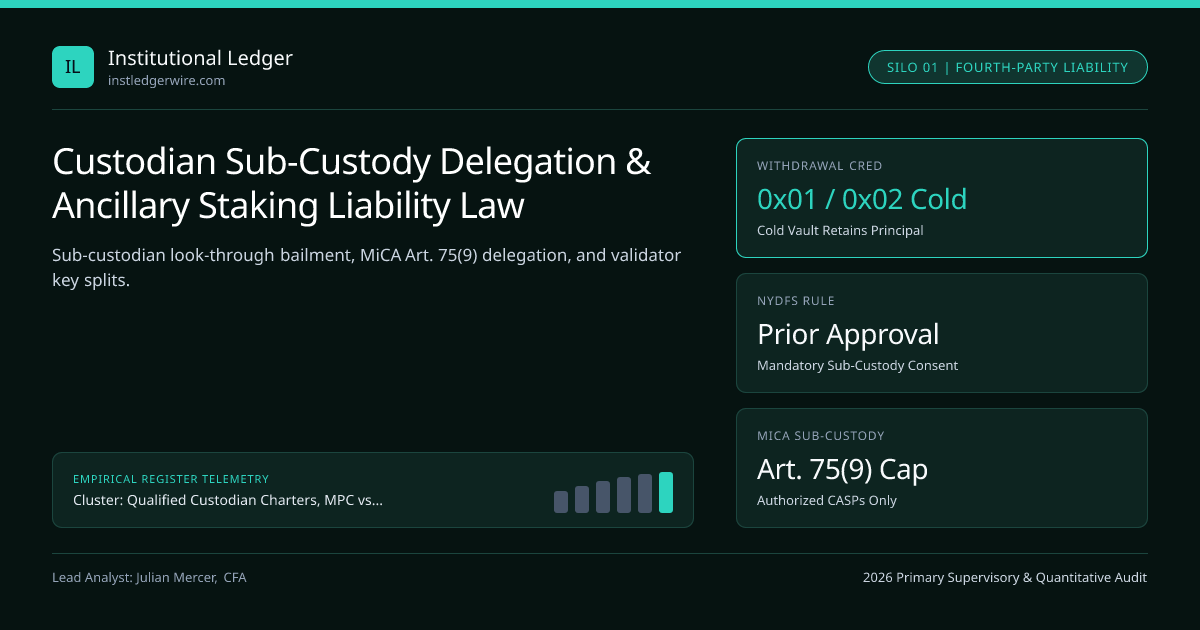
Global asset managers rarely realize that a Tier-1 global custodian bank marketing "support for 45+ Layer-1 blockchains and institutional staking" frequently delegates non-EVM chains and validator operations to fourth-party sub-custodians. Under NYSDFS custodial insolvency guidance, EU MiCA Article 75(9), and SEC SAB 122, auditing sub-custody legal chains and enforcing cryptographic withdrawal-key separation determines whether your fund retains fiduciary bailment or inherits unsecured fourth-party risk.
Sub-Custody Legal Chains Under NYDFS Guidance & EU MiCA Article 75(9)#
In traditional global custody, BNY Mellon or State Street appoints local sub-custodian banks in 90+ equity markets under standardized network management agreements. In digital assets, however, delegating cryptographic keys to an under-capitalized tech vendor can silently strip statutory trust protections. Recognizing this danger, NYSDFS January 2023 Guidance stipulates that engaging a sub-custodian constitutes a material change to business requiring prior NYDFS supervisory approval, submission of the executed sub-custody agreement, verification that client assets remain segregated from the sub-custodian's corporate estate, and transparent client opt-in disclosure.
Europe's rulebook goes even further. Under MiCA Article 75(9) (enforced across ESMA and BaFin), a CASP custodian may only delegate crypto-asset safekeeping to another authorized CASP—blocking EU custodians from offloading long-tail Layer-1 keys onto unlicensed offshore vaults. Moreover, delegation under MiCA does not extinguish the primary custodian's strict restitution liability under Article 75(8), as reviewed in our BaFin vs MiCA CASP legal audit.
Cryptographic Key Splitting in Staking: EIP-7002 & EIP-7251 Controls#
Ancillary staking inside our qualified digital asset custody cornerstone framework avoids true sub-custody transfer altogether on modern Proof-of-Stake architectures. On Ethereum following the Shapella and Pectra (EIP-7002 and EIP-7251) upgrades, cryptographic authority splits cleanly into two non-overlapping keys:
- Cold Withdrawal & Execution-Layer Exit Credentials (
0x01 / 0x02): Generated and held exclusively inside the primary qualified custodian's air-gapped FIPS 140-3 Level 3 HSM vault. Thanks to EIP-7002, the cold vault can unilaterally trigger a validator exit on the execution layer without needing cooperation from the third-party validator operator—eliminating validator hostage attacks!Meanwhile, EIP-7251 (MaxEB) consolidates validator balances from 32 ETH up to 2,048 ETH, slashing key-management sprawl by 64x and auto-compounding consensus rewards. - Hot BLS12-381 Signing Key: Operated by a bare-metal validator specialist behind an EIP-3076 slashing-protection database, capable only of attesting blocks—never moving principal.
| Delegation Structure | Who Controls Principal Keys? | Statutory Regime Constraint | Primary Failure Mode | Required Contractual Safeguard |
|---|---|---|---|---|
| Native White-Label Staking (ETH Pectra) | Primary Custodian Cold HSM (0x02 + EIP-7002) | NYSDFS / FINMA Guidance 08/2023 | Double-signing or minority-client bug slashing | EIP-3076 remote signer + minority client SLA + slashing insurance |
| Licensed Sub-Custody for Long-Tail L1s | Sub-Custodian Trust / CASP | ESMA MiCA Art. 75(9) & NYDFS prior consent | Sub-custodian insolvency or local court freeze | Express third-party beneficiary trust + primary custodian indemnity |
| Exchange Settlement Sub-Account | Integrated Venue (Bitstamp, Bitfinex) | Excluded from cold vault % under MAS / SFC | Exchange matching halt or omnibus shortfall | Tri-party mirror pledge (see Silo 3 off-exchange models) |
| Liquid Staking Token (LST) Swap | Smart Contract / DAO Multisig | Reclassified on balance sheet; tax disposition risk | Smart-contract exploit or secondary depeg | Segregated outside core Spot ETFs custody |
Correlated Slashing Mechanics, Client Diversity & Liability Caps#
While an isolated validator double-sign incurs a modest ~1 ETH penalty plus 36-day inactivity leak, Ethereum's correlation penalty scales proportionally to the total stake slashed within an 18-day window—reaching 100% principal forfeiture if >33% of network validators fail simultaneously due to a consensus-client software bug. Institutional staking SLAs drafted for spot ETF sleeves and pension accounts therefore legally prohibit validator sub-contractors from running any execution or consensus client holding >33% network share, and pair operator indemnities with dedicated parametric specie and slashing insurance.
- Variables & Institutional 100,000 ETH ($310M) Staking Mandate Under Pectra EIP-7251 / EIP-7002:
- GrossProtocolAPR = 0.0325 (3.25% consensus + execution priority fee yield; zero toxic MEV relays)
- Validator_Commission = 0.060 (6.0% institutional bare-metal validator fee = 19.5 bps)
- Custody_Fee = 0.0015 (15.0 bps qualified NYDFS cold withdrawal-key safekeeping)
- pisolatedslash * LGD = 0.0005 * 0.012 = 0.60 bps (mitigated via EIP-3076 remote HSM anti-slashing DB)
- pcorrelatedslash = 0.0002 * 0.180 = 3.60 bps if running >66% supermajority client; drops to 0.15 bps on minority client (<33% share)
- Slashing Insurance Fee = 8.50 bps covering up to 10% principal penalty
- Worked Net Institutional Yield:
- 1. Net Pre-Risk Yield = 325.0 * (1 - 0.06) - 15.0 = 305.5 - 15.0 = 290.5 bps
- 2. Net Insured Yield (Minority Client + Slashing Cover) = 290.5 - 8.5 - 0.15 = 281.85 bps ($8,737,350/yr net institutional income with 0% principal theft exposure via EIP-7002 cold-vault control)
Auditing Carve-Out SOC Reports Across Sub-Custodians & Venues#
Whenever a primary custodian carves out a sub-custodian or liquidity venue (Aquanow, Bitstamp) in Section III of its SOC 1 and SOC 2 Type II audit, operational due diligence teams demand the fourth party's independent Type II reports, verify OFAC-compliant non-toxic MEV relay configurations, and test unilateral EIP-7002 exit execution in staging.
Fourth-Party Governance Checklist for Fiduciary Boards#
Investment committees allocating to staked or multi-chain mandates inside our Qualified Custody & HSM Controls hub prohibit undisclosed sub-delegation in custody agreements, enforce primary-custodian make-whole warranties for fourth-party operational negligence, and verify every entity in the custody chain on our verification portal.
Frequently asked questions
Does a primary bank custodian remain financially liable if its third-party crypto sub-custodian fails?
Under EU MiCA Article 75(8)-(9), statutory liability remains with the primary CASP unless an external event is proved beyond reasonable control. In US common-law and NYDFS trust agreements, however, custodians often negotiate "reasonable care in selection and monitoring" clauses that shift sub-custodian insolvency risk onto the client unless overridden by contract.
How does Ethereum's cryptographic key split protect staked principal from validator operator compromise?
Ethereum Proof-of-Stake separates the BLS12-381 validator signing key (which attests blocks online) from the 0x01 or EIP-7251 0x02 execution-layer withdrawal address. Even if a third-party validator server is hacked, the attacker cannot redirect unstaked ETH principal—their worst-case damage is triggering a double-sign slashing penalty.
Why do SOC 1 Type II carve-out reports hide sub-custodian control failures from superficial readers?
Under the AICPA carve-out method, the primary custodian's SOC 1 auditor stops at the API boundary where instructions leave for the sub-custodian. Allocators must independently demand and review the sub-custodian's own SOC 1 and SOC 2 Type II reports plus legal bailment opinions in the sub-custodian's local domicile.
Does delegating validator operations trigger SEC SAB 122 / ASC 450-20 balance-sheet liability accruals?
Pure non-custodial BLS signing delegation preserves off-balance-sheet treatment under SAB 122 so long as client withdrawal keys remain segregated, zero rehypothecation occurs, and slashing indemnification caps are clearly bounded or insured against probable loss.
Publication record
- Published
- November 14, 2026
- Updated
- November 14, 2026
- Author
- Julian Mercer, CFA
- Review
- Review not recorded
- Automated fact check
- Passed in the stored pipeline record
- Source URLs
- 3 recorded
AI assistance recorded: anthropic/claude-opus-4.6. This field does not establish human review or source verification.
Academic & Institutional Attribution
Cite This Research & Embed Live Data Card
Standard academic & institutional research paper citation format.
Julian Mercer, CFA. (2026, November 14). Custodian Sub-Custody Delegation & Ancillary Staking Liability Law. Institutional Ledger. https://instledgerwire.com/stories/custodian-sub-custody-delegation-ancillary-staking-liabilityRegulatory Directory Cross-Reference
Referenced Institutions & Regulatory Registries
Mentioned Regulated Institutions
Referenced Supervisory Authorities
Related Qualified Custody Mpc Hsm Controls & Institutional Briefings
Explore Qualified Custody Mpc Hsm Controls Hub (20) →Qualified Custody Mpc Hsm Controls
Qualified Digital Asset Custody, MPC Signing & FIPS 140-3 HSM Controls: 2026 GuideQualified Custody Mpc Hsm Controls
NYDFS Limited Purpose Trust vs OCC National Trust Charters in Crypto CustodyQualified Custody Mpc Hsm Controls
Threshold ECDSA & EdDSA MPC Key-Share Refresh Ceremonies in CustodyQualified Custody Mpc Hsm Controls
Air-Gapped FIPS 140-3 Level 3 & Level 4 HSM Cold Signing Vaults ExplainedQualified Custody Mpc Hsm Controls
SOC 1 Type II vs SOC 2 Type II Audits in Institutional Crypto CustodyQualified Custody Mpc Hsm Controls
Basel III SCO60 Group 1 vs Group 2 Crypto Bank Capital Weights ExplainedQualified Custody Mpc Hsm Controls
SEC SAB 122 & FASB ASC 450-20 Custody Liability Accounting for BanksQualified Custody Mpc Hsm Controls
Specie & Crime Insurance Exclusions in Digital Asset Cold VaultsOff Exchange Triparty Collateral
Custodial Mirror-Settlement Loops vs Bank Tri-Party Control AgreementsOff Exchange Triparty Collateral
UCC Article 12 Controllable Electronic Records (CER): Crypto Lien PerfectionOff Exchange Triparty Collateral
UCC Article 8 Financial-Asset Election & Securities Intermediary CustodyOff Exchange Triparty Collateral
Post-Trade Net Settlement Windows & Intraday Venue Credit Exposure
Institutional Ledger Data, Benchmarks & Contributor Records
CC BY 4.0 Open Data
Open Institutional Datasets (CSV / JSON) →
Download desk-compiled quantitative series & schemas.
2026 Reference Matrix
2026 Institutional Benchmarks & Thresholds →
Statutory capital, clearing, margin & rate conventions.
Editorial Records
Authors & Review Records →
View named contributors where those records are available.
Complete Index
Master Research & Dossier Archive →
Browse all published briefings by topic pillar & date.