
Qualified Custody Mpc Hsm Controls
NYDFS Limited Purpose Trust vs OCC National Trust Charters in Crypto Custody
NYDFS Limited Purpose Trust companies and OCC national trust banks dominate US qualified digital asset custody, differing across 50-state preemption, capital floors, and insolvency receivership.
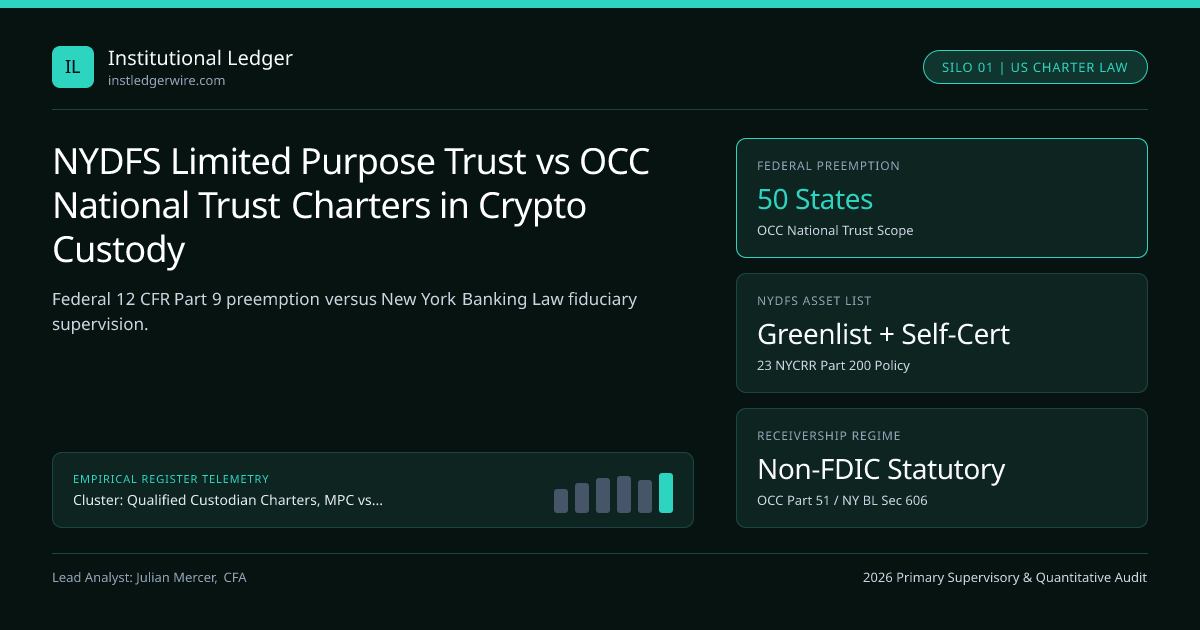
More than 95% of custodied US institutional digital asset AUM—including the $118 billion US spot Bitcoin and Ethereum ETF complex—sits inside entities holding either a New York State Department of Financial Services Limited Purpose Trust Company charter or an Office of the Comptroller of the Currency national trust bank charter. Choosing between these two statutory regimes shapes 50-state federal preemption, token-listing agility, regulatory capital lockups, and statutory receivership priority if a custodian fails.
Advisers Act Section 202(a)(2) and Fiduciary Qualification Mechanics#
Registered Investment Advisers managing private fund or SMA capital must maintain client assets with a "qualified custodian" under SEC Rule 206(4)-2. Because non-security crypto assets cannot clear through a standard SIPC broker-dealer's Rule 15c3-3 reserve formula, allocators rely on the "bank" prong of Advisers Act Section 202(a)(2). As outlined in our qualified digital asset custody cornerstone guide, both an OCC national trust bank under 12 CFR Part 9 and a state trust company supervised by NYSDFS satisfy this requirement when exercising genuine fiduciary powers.
By contrast, commercial money-services businesses registered solely with FinCEN under state MTLs—including spot exchanges like Bitstamp or bitFlyer outside dedicated trust subsidiaries—do not confer statutory bank fiduciary status for US RIA compliance.
OCC National Trust Preemption vs NYDFS Granular Supervisory Controls#
Under 12 U.S.C. 92a and OCC Interpretive Letters 1170 and 1179, a national trust bank enjoys sweeping federal preemption across all 50 states for fiduciary safekeeping, cryptographic key custody, and collateral administration. An institutional prime desk onboarding pension accounts in California, Texas, Illinois, and Florida executes a single 12 CFR Part 9 fiduciary custody agreement without navigating divergent state trust-reciprocity statutes or posting dozens of separate surety bonds. However, Interpretive Letter 1179 requires written supervisory non-objection from the bank's OCC examining office before launching novel distributed-ledger safekeeping, staking, or stablecoin reserve activities.
Conversely, NYSDFS built the earliest crypto-specific rulebook in North America. Under New York Banking Law Article III combined with NYDFS January 2023 Custodial Structures Guidance, Limited Purpose Trusts adhere to prescriptive asset-segregation rules, mandatory disclosure of any sub-custodial arrangements, and coin-listing governance tied to NYDFS-approved self-certification policies. While an NYDFS trust serving out-of-state fiduciary accounts must verify host-state trust reciprocity, Wall Street ETF sponsors favor NYDFS trusts for their decade-long examination track record in spot Bitcoin and Ether ETF in-kind creation custody.
| Charter Dimension | NYDFS Limited Purpose Trust (NYSDFS) | OCC National Uninsured Trust Bank | State-Chartered Non-Depository Trust | Multi-State VASP (FinCEN MSB) |
|---|---|---|---|---|
| Primary Statute | NY Banking Law Art. III & 23 NYCRR 200 | 12 U.S.C. 27(a), 92a & 12 CFR Part 9 | SD / WY / TX Trust Statutes | 31 CFR 1022 + 48 State MTL Acts |
| Advisers Act Sec. 202(a)(2) | Recognized fiduciary trust company | Recognized national bank with trust powers | Case-by-case examination scrutiny | Ineligible as RIA qualified custodian |
| Multi-State Preemption | Requires state-by-state trust reciprocity | Full 50-state NBA fiduciary preemption | Limited interstate reciprocity | Zero preemption; 48+ separate exams |
| Insolvency Resolution | Superintendent possession (NY BL Sec. 606) | OCC Receivership (12 CFR Part 51) | State banking commissioner | Federal Chapter 11 corporate estate |
| Representative Market Usage | Spot Crypto ETFs, stablecoin reserves | Institutional prime custody, pension mandates | Mid-market RIA sub-custody | Retail spot venues (Bitstamp, Bitso) |
Insolvency Receivership: NY Banking Law Section 606 vs 12 CFR Part 51#
The decisive advantage of both charters over unregulated corporate custodians emerges during financial distress. Unchartered crypto lenders and exchanges that collapsed in 2022 entered federal Chapter 11 bankruptcy, trapping omnibus customer balances in multi-year unsecured creditor litigation. Neither an NYDFS Limited Purpose Trust nor an uninsured OCC national trust bank is eligible to be a debtor under 11 U.S.C. Section 109(b)(2).
If an NYDFS trust becomes capital-impaired, the Superintendent takes possession under New York Banking Law Section 606; under Section 617, property held as bailee or fiduciary is segregated and returned directly to beneficial owners outside general creditor distributions. Similarly, the Comptroller resolves an uninsured national trust bank under 12 CFR Part 51 (promulgated in 2016 specifically for uninsured national banks), directing the receiver to transfer or return 12 CFR 9.13 segregated fiduciary accounts intact. Operationalizing this legal shield still demands strict on-chain address hygiene, which we detail in omnibus versus segregated on-chain wallet insolvency treatment.
- Where:
- C_initial = Charter legal & buildout cost (OCC: $6.5M; NYDFS + Interstate: $5.2M)
- Ccapitaldrag = Restricted liquid Tier-1 capital * (HurdleRate 8.5% - TBillYield 4.2% = 4.3%)
- OCC Capital Floor = $25.0M -> $1.075M/yr opportunity cost
- NYDFS Capital Floor = $20.0M + $8.0M interstate surety collateral -> $1.204M/yr
- Cexamaudit = Annual supervisory assessment + SOC 1/2 + BSA/AML testing ($2.40M OCC vs $2.15M NYDFS)
- Nstates * Cstate_maint = State reciprocity filings & legal opinions (OCC: 0 * $0 = $0; NYDFS: 28 states * $32,000 = $896,000/yr)
- Worked 5-Year Institutional Cost Comparison:
- OCC National Trust 5-Yr TCO = $6.50M + 5 * ($1.075M + $2.400M + $0) = $23.875M
- NYDFS Trust + 28 States TCO = $5.20M + 5 * ($1.204M + $2.150M + $0.896M) = $26.450M
- Net 5-Year Preemption Savings = $2.575M (plus 100% elimination of multi-state exam scheduling drift)
Capital Adequacy, SAB 122 Accounting & Sub-Custody Boundaries#
Neither charter carries FDIC deposit insurance, so supervisors impose bespoke liquid-asset and operational-capital floors calibrated to custodied AUM, key-ceremony complexity, and wind-down expenses—typically $10 million to $50 million in unencumbered US Treasury bills and cash. Following SEC SAB 122 and FASB ASC 450-20 custody accounting, public bank holding companies owning OCC or NYDFS trust subsidiaries no longer gross up client digital assets onto consolidated balance sheets, preventing artificial leverage-ratio breaches.
Risk committees inside our Qualified Custody & HSM Controls topic hub still inspect charter call reports and SOC 1 Type II versus SOC 2 Type II audit opinions to confirm that foreign sub-custodians or validator operators never dilute domestic statutory bailment protections.
Institutional Charter Selection Matrix for Multi-Asset Mandates#
Allocators custodying pure BTC, ETH, and tokenized US Treasuries for nationwide ERISA-adjacent or RIA accounts achieve the cleanest statutory footprint under an OCC national trust bank or dual-chartered NYDFS trust. Funds trading broader Layer-1 ecosystems often pair a US trust charter for core reserves with a European BaFin or Swiss FINMA custodian for non-Greenlist assets, cross-referencing active entity registrations on our license verification hub.
Frequently asked questions
Does an NYDFS BitLicense alone qualify an entity as a qualified custodian for RIAs?
No. A standard 23 NYCRR Part 200 BitLicense is a commercial virtual currency license, not a bank or trust charter. Registered Investment Advisers require an NYDFS Limited Purpose Trust Company charter under New York Banking Law or an OCC national bank charter to satisfy Rule 206(4)-2.
How does OCC federal preemption reduce multi-state operational friction for institutional custodians?
Under the National Bank Act, an OCC national trust bank exercises fiduciary safekeeping powers nationwide without obtaining 48+ separate state money transmitter licenses or adhering to divergent state net-worth bonding formulas.
What happens to custodied digital assets if an NYDFS Limited Purpose Trust enters liquidation?
Under NY Banking Law Section 606 and NYDFS January 2023 insolvency guidance, properly segregated custodial assets held as bailment do not form part of the trust company general estate and are returned directly to beneficial owners.
Can either charter access a Federal Reserve Master Account automatically?
Neither an NYDFS uninsured trust nor an OCC uninsured national trust bank receives automatic Federal Reserve master account access; applications undergo Tier 3 scrutiny under Federal Reserve Account Access Guidelines, so cash legs typically settle via partner insured banks.
Publication record
- Published
- November 14, 2026
- Updated
- November 14, 2026
- Author
- Julian Mercer, CFA
- Review
- Review not recorded
- Automated fact check
- Passed in the stored pipeline record
- Source URLs
- 4 recorded
AI assistance recorded: anthropic/claude-opus-4.6. This field does not establish human review or source verification.
Academic & Institutional Attribution
Cite This Research & Embed Live Data Card
Standard academic & institutional research paper citation format.
Julian Mercer, CFA. (2026, November 14). NYDFS Limited Purpose Trust vs OCC National Trust Charters in Crypto Custody. Institutional Ledger. https://instledgerwire.com/stories/nydfs-limited-purpose-trust-vs-occ-national-crypto-custodyRegulatory Directory Cross-Reference
Referenced Institutions & Regulatory Registries
Mentioned Regulated Institutions
Referenced Supervisory Authorities
Related Qualified Custody Mpc Hsm Controls & Institutional Briefings
Explore Qualified Custody Mpc Hsm Controls Hub (20) →Qualified Custody Mpc Hsm Controls
Qualified Digital Asset Custody, MPC Signing & FIPS 140-3 HSM Controls: 2026 GuideQualified Custody Mpc Hsm Controls
Threshold ECDSA & EdDSA MPC Key-Share Refresh Ceremonies in CustodyQualified Custody Mpc Hsm Controls
Air-Gapped FIPS 140-3 Level 3 & Level 4 HSM Cold Signing Vaults ExplainedQualified Custody Mpc Hsm Controls
SOC 1 Type II vs SOC 2 Type II Audits in Institutional Crypto CustodyQualified Custody Mpc Hsm Controls
Basel III SCO60 Group 1 vs Group 2 Crypto Bank Capital Weights ExplainedQualified Custody Mpc Hsm Controls
SEC SAB 122 & FASB ASC 450-20 Custody Liability Accounting for BanksQualified Custody Mpc Hsm Controls
Specie & Crime Insurance Exclusions in Digital Asset Cold VaultsQualified Custody Mpc Hsm Controls
Omnibus vs Segregated On-Chain Wallets: Insolvency & Bailment LawTokenized Treasuries Rwa Settlement
SEC Rule 17Ad Transfer-Agent Recordkeeping for Tokenized FundsTokenized Treasuries Rwa Settlement
Atomic T+0 DvP Intraday Repo vs DTCC & Fedwire Cutoff WindowsTokenized Treasuries Rwa Settlement
BlackRock BUIDL (Reg D 3c7) vs Franklin BENJI (1940 Act MMF) ComparedTokenized Treasuries Rwa Settlement
Tokenized MMF Collateral Haircuts & CFTC GMAC Derivatives Margin Rules
Institutional Ledger Data, Benchmarks & Contributor Records
CC BY 4.0 Open Data
Open Institutional Datasets (CSV / JSON) →
Download desk-compiled quantitative series & schemas.
2026 Reference Matrix
2026 Institutional Benchmarks & Thresholds →
Statutory capital, clearing, margin & rate conventions.
Editorial Records
Authors & Review Records →
View named contributors where those records are available.
Complete Index
Master Research & Dossier Archive →
Browse all published briefings by topic pillar & date.