
Qualified Custody Mpc Hsm Controls
Qualified Digital Asset Custody, MPC Signing & FIPS 140-3 HSM Controls: 2026 Guide
Institutional digital asset custody requires bankruptcy-remote NYDFS or OCC trust charters, FIPS 140-3 Level 3 HSM or threshold MPC quorums, and clean SOC 1 Type II controls under BCBS SCO60.
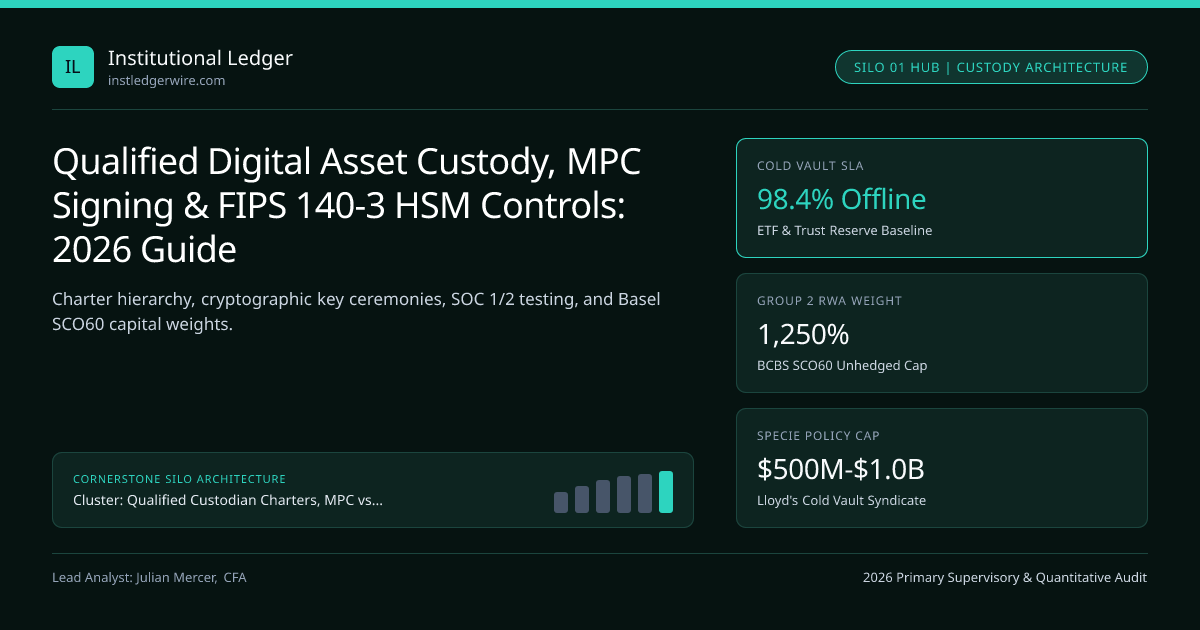
Regulated US pension plans, 1940 Act funds, and spot Bitcoin and Ethereum ETF issuers allocate over $165 billion across chartered digital asset custodians operating under 90%-to-98.4% offline storage floors and dual SOC 1 / SOC 2 Type II scopes. Selecting a counterparty inside our Qualified Custody & Cryptographic Controls hub requires evaluating statutory insolvency remoteness, Multi-Party Computation (MPC) versus NIST FIPS 140-3 HSM key ceremonies, and capital treatment under SEC Staff Accounting Bulletin No. 122 and Basel III BCBS SCO60 (d545).
Statutory Charter Hierarchy: Fiduciary Bailment vs VASP User Terms#
Institutional fiduciaries governed by SEC Advisers Act Rule 206(4)-2 cannot treat unlicensed wallet software or offshore trading accounts as qualified custodians. True bankruptcy remoteness rests on express statutory trust or bailment—meaning title never passes into the custodian's corporate estate under US Bankruptcy Code Section 541. Within the US, allocators compare NYDFS Limited Purpose Trust charters against OCC national trust bank charters, supervised by NYSDFS under 23 NYCRR Part 200 and NY Banking Law Section 100.
Outside North America, European allocators evaluate BaFin KWG crypto-custody licenses alongside MiCA Article 70 CASP rules enforced by BaFin and ESMA, while Swiss banks rely on FINMA DLT segregation privileges under Article 242a DEBA. Across Asia-Pacific, desks audit MAS 90% offline storage mandates and Hong Kong SFC seed-storage and compensation tiers, alongside omnibus versus segregated on-chain wallet insolvency treatment.
Cryptographic Signing Trade-Offs: Threshold MPC vs Air-Gapped FIPS 140-3 HSMs#
Once legal title protection is established, CISOs benchmark key generation and signing primitives. Bank-grade safekeeping historically relied on air-gapped FIPS 140-3 Level 3 and Level 4 HSM cold vaults, where tamper-response meshes zeroize private keys within microseconds of physical intrusion, trading 4-to-24-hour ceremony latency for maximum isolation.
To support programmatic prime settlement without reconstructing a full private key in memory, tier-one custodians deploy threshold ECDSA and EdDSA MPC key-share refresh ceremonies. Under CGGMP21 or FROST Schnorr protocols, distributed key shares rotate every 15 to 60 minutes across isolated hardware enclaves. Production architectures enforce hardware biometric quorum policy engines paired with EIP-712 typed-data smart contract allowlisting and geographically distributed Shamir disaster-recovery quorums.
| Custodial Regime / Architecture | Primary Supervisor | Legal Insolvency Treatment | Cryptographic Key Anchor | Capital & Accounting Standard |
|---|---|---|---|---|
| NYDFS Limited Purpose Trust | NYSDFS | NY Banking Law bailment; off-estate client property | Air-gapped FIPS 140-3 L3 HSM + MPC warm tier | SEC SAB 122 / ASC 450-20 |
| OCC National Trust Bank | US OCC / Federal | 12 CFR Part 9 fiduciary segregation | Hardware HSM quorum with geographic split | Fiduciary off-balance-sheet; BCBS SCO60 |
| German KWG Crypto Custody | BaFin / ESMA | KWG Sec. 1(1a) & MiCA Art. 70 statutory separation | BSI/FIPS certified HSM clusters | CRR III / MiCA Art. 67 prudential own funds |
| Singapore Major Payment Inst. | MAS | PSA statutory trust; 90% cold storage floor | Offline hardware modules; multi-sig policy | MAS Notice PSN02 & PSN08 independent audit |
| Exchange-Integrated VASP | FinCEN / Multi-State | Varies by user agreement; commingling risk if omnibus | Hot/warm MPC sweep (Bitstamp, bitFlyer) | Full reserve Liability + PoR reconciliation |
Prudential Capital & Balance-Sheet Accounting: SAB 122, ASC 350-60 & BCBS SCO60#
Between 2022 and early 2025, G-SIB custody expansion stalled because SEC Staff Accounting Bulletin No. 121 forced public banking groups to recognize safeguarded client tokens on their own balance sheets—immediately consuming Supplementary Leverage Ratio (SLR) headroom. That bottleneck cleared with SEC SAB 122 and FASB ASC 450-20 custody liability accounting, aligning US GAAP treatment with economic reality: unless a legal or operational failure creates a probable and reasonably estimable loss contingency, safeguarded client assets remain off the custodian's balance sheet. Concurrently, corporate treasury clients holding Bitcoin or Ether directly report quarterly mark-to-market fair value under FASB ASU 2023-08 (ASC 350-60) custody reporting.
For internationally active banks, prudential capital calibration follows Basel SCO60 Group 1 versus Group 2 bank capital weights. While Group 2a/2b principal exposures carry a punitive 1,250% risk weight and a strict 1% to 2% Tier 1 exposure cap, SCO60 explicitly carves out pure fiduciary digital asset custody from credit and market risk RWA—leaving only operational risk capital under the Basel III Standardized Measurement Approach (SMA).
- Where:
- AUM_Cold = $8,500,000,000 (94.44% in air-gapped FIPS 140-3 Level 3 HSM vaults)
- AUM_Warm = $410,000,000 (4.56% in 3-of-5 threshold ECDSA MPC enclaves)
- AUM_Hot = $90,000,000 (1.00% in automated settlement sweep wallets)
- p_breach = {Cold: 0.0002, Warm: 0.0015, Hot: 0.0080} annual compromise probability
- LGD_k = {Cold: 1.00, Warm: 0.35 (capped by hourly velocity limit), Hot: 1.00}
- PolicyLimit = {Cold: $650,000,000 specie, Warm: $100,000,000 crime, Hot: $0 excluded}
- Deductible = {Cold: $5,000,000, Warm: $2,500,000, Hot: $0}
- Worked Institutional Stress Scenario ($9.0B ETF + Pension Custody Mandate):
- 1. Cold Single-Vault Cap Check: Split $8.5B across 17 segregated $500M vault shards so each vault stays <= $650M specie limit; uninsured per-event exposure = $5.0M deductible * 0.0002 = $1,000/yr expected loss.
- 2. Warm Tier Exposure: Max hourly velocity cap = $143.5M ($410M * 0.35); uninsured gap above $100M crime bond = $43.5M + $2.5M deductible = $46.0M; expected loss = $46.0M * 0.0015 = $69,000/yr.
- 3. Hot Buffer Exposure: $90.0M * 0.0080 = $720,000/yr (funded via 8.0 bps custodian operational risk reserve = $7.20M/yr fee buffer, yielding 10.0x coverage).
Assurance Verification, ETF Creation SLAs & Specie Insurance Underwriting#
Institutional operational due diligence teams never accept marketing claims regarding "military-grade encryption" or headline policy limits at face value. Instead, risk committees inspect SOC 1 Type II versus SOC 2 Type II custody examination reports across full 12-month observation windows, verifying zero unmitigated exceptions across key-ceremony witness logs, firmware build reproducibility, and automated block-explorer balance proofs. You can cross-check supervised venue licensing records directly via our regulatory verification directory and institutional compliance benchmarks.
Insurance underwriting requires equal scrutiny. As detailed in our audit of specie and crime insurance exclusions for cold vaults, a $500 million Lloyd's specie binder covers physical vault burglary or insider collusion inside designated Faraday facilities, yet frequently excludes hot-wallet API exploits, nation-state cyber attribution clauses, or governance bugs during custodian sub-custody delegation and ancillary staking. Finally, authorized participants executing spot Bitcoin and Ether ETF in-kind creation and redemption SLAs across regulated venues such as Bitstamp and Aquanow enforce strict per-vault concentration caps so no single signing cluster ever exceeds insured loss attachment limits.
Institutional Mandate Sizing & Due Diligence Execution Checklist#
When onboarding a qualified digital asset custodian for an endowment, corporate treasury, or multi-strategy hedge fund, investment committees partition assets across at least two non-correlated charter and cryptographic stacks—pairing, for instance, an NYDFS trust operating offline FIPS 140-3 Level 3 HSMs with an OCC-chartered or FINMA-supervised custodian running enclave-isolated threshold MPC. Every service-level agreement must codify maximum T+0 warm-tier withdrawal velocity caps, deterministic per-client on-chain address segregation, right-to-audit clauses over sub-custodians, and pre-signed offline recovery kits tested semi-annually under external auditor observation alongside our institutional scoring methodology.
Frequently asked questions
What distinguishes a qualified digital asset custodian from a standard VASP wallet provider?
A qualified custodian holds a statutory banking or fiduciary trust charter—such as an NYDFS Limited Purpose Trust or OCC national trust bank—requiring strict legal bailment, segregated client property off the custodian balance sheet, independent capital buffers, and annual SOC 1 Type II examinations.
When do institutional treasuries combine threshold MPC with FIPS 140-3 Level 3 HSMs?
Allocators deploy hybrid stacks: air-gapped FIPS 140-3 Level 3 HSMs secure 85% to 98% of long-term cold reserves behind physical Faraday cages, while 3-of-5 threshold MPC shards hosted inside tamper-evident enclaves process sub-minute intraday ETF and prime settlement flows.
How did SEC SAB 122 change public bank participation in institutional crypto custody?
Issued to rescind SAB 121, SEC SAB 122 removed the requirement for custodians to record safeguarded client tokens as symmetric on-balance-sheet assets and liabilities, instead applying FASB ASC 450-20 or IAS 37 loss-contingency thresholds that preserve Tier 1 leverage capacity.
Why are SOC 2 Type II reports insufficient without a companion SOC 1 Type II examination?
SOC 2 Type II evaluates IT security, availability, and change-management controls, whereas external fund auditors rely on SOC 1 Type II (AT-C 320) to test sub-ledger-to-blockchain reconciliation, fee accrual accuracy, and cutoff completeness for financial statement sign-off.
Publication record
- Published
- November 14, 2026
- Updated
- November 14, 2026
- Author
- Julian Mercer, CFA
- Review
- Review not recorded
- Automated fact check
- Passed in the stored pipeline record
- Source URLs
- 4 recorded
AI assistance recorded: anthropic/claude-opus-4.6. This field does not establish human review or source verification.
Academic & Institutional Attribution
Cite This Research & Embed Live Data Card
Standard academic & institutional research paper citation format.
Julian Mercer, CFA. (2026, November 14). Qualified Digital Asset Custody, MPC Signing & FIPS 140-3 HSM Controls: 2026 Guide. Institutional Ledger. https://instledgerwire.com/stories/qualified-digital-asset-custody-mpc-fips-hsm-soc-guide-2026Regulatory Directory Cross-Reference
Referenced Institutions & Regulatory Registries
Mentioned Regulated Institutions
Referenced Supervisory Authorities
Related Qualified Custody Mpc Hsm Controls & Institutional Briefings
Explore Qualified Custody Mpc Hsm Controls Hub (20) →Qualified Custody Mpc Hsm Controls
NYDFS Limited Purpose Trust vs OCC National Trust Charters in Crypto CustodyQualified Custody Mpc Hsm Controls
Threshold ECDSA & EdDSA MPC Key-Share Refresh Ceremonies in CustodyQualified Custody Mpc Hsm Controls
Air-Gapped FIPS 140-3 Level 3 & Level 4 HSM Cold Signing Vaults ExplainedQualified Custody Mpc Hsm Controls
SOC 1 Type II vs SOC 2 Type II Audits in Institutional Crypto CustodyQualified Custody Mpc Hsm Controls
Basel III SCO60 Group 1 vs Group 2 Crypto Bank Capital Weights ExplainedQualified Custody Mpc Hsm Controls
SEC SAB 122 & FASB ASC 450-20 Custody Liability Accounting for BanksQualified Custody Mpc Hsm Controls
Specie & Crime Insurance Exclusions in Digital Asset Cold VaultsQualified Custody Mpc Hsm Controls
Omnibus vs Segregated On-Chain Wallets: Insolvency & Bailment LawTokenized Treasuries Rwa Settlement
Tokenized US Treasuries, On-Chain Repo DvP & RWA Settlement: 2026 GuideOff Exchange Triparty Collateral
Off-Exchange Tri-Party Settlement & Bankruptcy-Remote Crypto Custody GuideStablecoin Reserve Attestation Audit
Fiat-Backed Stablecoin Reserve Composition, Audits & T-Bill Custody GuideInstitutional Crypto Prime Margin
Institutional Crypto Prime Brokerage, Cross-Venue Netting & zk-PoR Guide (2026)
Institutional Ledger Data, Benchmarks & Contributor Records
CC BY 4.0 Open Data
Open Institutional Datasets (CSV / JSON) →
Download desk-compiled quantitative series & schemas.
2026 Reference Matrix
2026 Institutional Benchmarks & Thresholds →
Statutory capital, clearing, margin & rate conventions.
Editorial Records
Authors & Review Records →
View named contributors where those records are available.
Complete Index
Master Research & Dossier Archive →
Browse all published briefings by topic pillar & date.