
Off Exchange Triparty Collateral
Rehypothecation Prohibitions & Segregated On-Chain Pledge Vault Audits
Hidden collateral rehypothecation destroyed Three Arrows, Celsius, and Genesis counterparties. Institutional off-exchange pledges pair strict legal rehypothecation bans with 24/7 on-chain UTXO/addresswatchers.
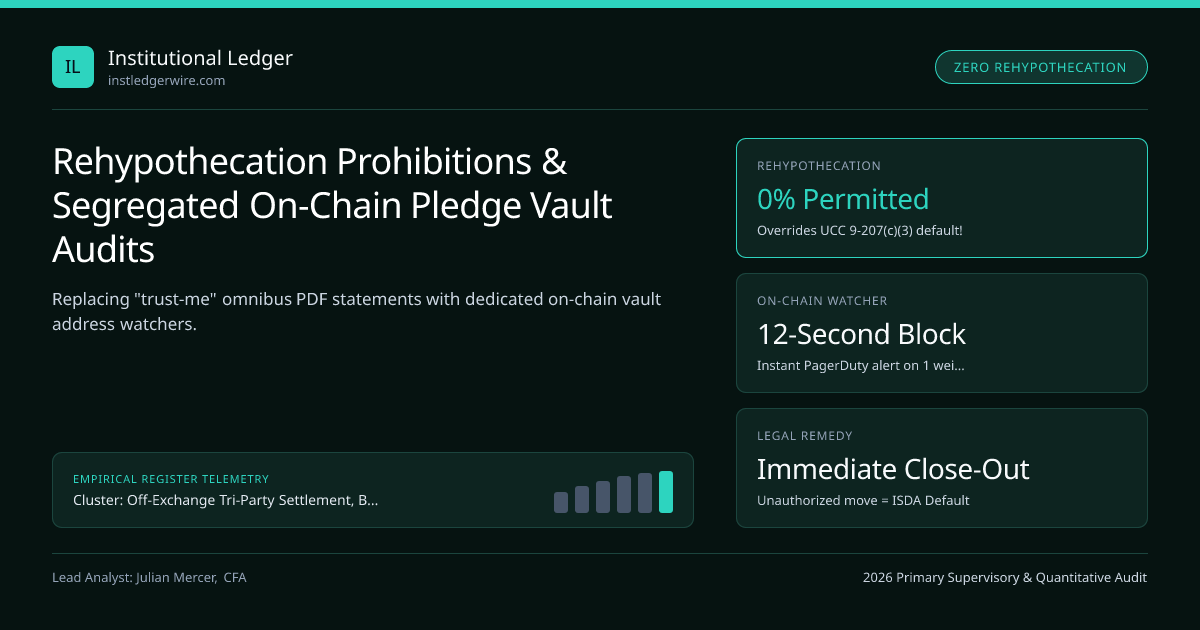
Here is a statutory landmine that shocks even seasoned portfolio managers: under New York Uniform Commercial Code § 9-207(c)(3), if you pledge digital assets to a counterparty who takes statutory possession or control—and your contract stays silent on rehypothecation—state law automatically authorizes your counterparty to re-pledge and rehypothecate your collateral! Pairing ironclad contractual overrides with dedicated, block-by-block audited on-chain pledge vaults makes public blockchains the most transparent collateral audit rail in financial history.
Closing the Lethal NY UCC § 9-207(c)(3) Default Rehypothecation Loophole#
In traditional prime brokerage (such as SEC Rule 15c3-3 margin accounts allowing rehypothecation up to 140% of a client's debit balance), dealers subsidize cheap financing by lending out client securities behind the scenes. In crypto's 2022 credit crisis, opaque prime desks copied that playbook without capital buffers—accepting BTC collateral from Fund A and lending it unsecured to Fund B!
When drafting any off-exchange pledge, tri-party Account Control Agreement, or ISDA Credit Support Annex covered in our off-exchange tri-party collateral cornerstone guide, legal counsel enforces three non-negotiable clauses:
- Explicit
UCC § 9-207(c)(3)Negation: Expressly contract out of § 9-207(c)(3), forbidding any sale, loan, repo, staking, restaking, or secondary lien creation prior to an uncured Event of Default and valid Notice of Exclusive Control. - Bailment / Security-Interest Retention (Never Title Transfer on IM): Reject English-law Title Transfer CSAs for Initial Margin; use Security Interest CSAs (like the ISDA 2016/2018 Phase 1 IM CSA) where beneficial ownership never leaves the Pledgor.
- Cross-Default Hair-Trigger: Any breach of the non-rehypothecation covenant constitutes an immediate Event of Default with zero grace period, entitling the Pledgor to terminate all trades and sweep all margin home.
Why Dedicated On-Chain Addresses Beat Omnibus Proof-of-Reserves#
Pay the extra 2 to 4 basis points for a individually segregated on-chain vault address (just as US Spot Bitcoin and Ethereum ETFs require) rather than sitting inside a commingled omnibus custody address! Why?
- In an omnibus wallet holding 80,000 BTC for 200 clients, if 5,000 BTC moves out at 04:00 UTC, you have no way of knowing from the blockchain whether Client #42 legitimately withdrew 5,000 BTC or whether the custodian illegally lent out your 5,000 BTC until the next monthly audit snapshot!
- In a dedicated segregated vault address (
1 vault = 1 client-venue pledge relationship), your expected transaction count between scheduled 4-hour variation-margin sweeps is literally zero! Your firm's internal compliance server runs a lightweight Bitcoin Core and Geth/Erigon full node watching your exact vault addresses in the mempool and every block. As long as your UTXO sits unspent on Layer-1, zero on-chain rehypothecation is a mathematical fact, not an accounting promise.
| Audit Layer | Vulnerability Targeted | Institutional Verification Control | Governing Standard |
|---|---|---|---|
| Statutory Default Law | Silent right to re-pledge under UCC § 9-207(c)(3) | Express clause: "Secured Party shall have NO right to sell, pledge, rehypothecate, assign, invest, use, commingle, or otherwise dispose of Collateral" | NY UCC Art. 9 & CFTC Reg 23.157 |
| On-Chain Movement | Unauthorized external loan / hack | Internal full-node WebSocket watcher on dedicated bc1q / 0x vault address | Continuous 24/7 internal DevSecOps |
| Off-Chain Double-Lien | Custodian secretly issuing two mirror liens on one vault | SOC 1 Type II control objective + Client cryptographic counter-signature on every delegation ID | AICPA AT-C 320 & NYDFS Exam |
| Accounting Balance Sheet | Counterparty booking your margin as its own asset | Confirm counterparty excludes segregated vault under SEC SAB 122 & GAAP | Big-4 financial statement footnote |
Defeating the "Internal Double-Pledge" Vector via SOC 1 & Signed Lien IDs#
A sharp auditor asks the next logical question: "Okay, the coins never moved on-chain—what stops a dishonest custodian from telling both Bitstamp and Bitfinex off-chain that each has a 100% first-priority lien on that same $50M vault?"
Institutional mirror networks block double-pledging through two controls:
- Cryptographic Client Delegation Signatures: Each delegation message transmitted to an exchange embeds your Trader key's ECDSA signature over
(vault_address, venue_id, delegated_amount, total_vault_cap, sequence_nonce), and SOC 1 Type II auditors test the custodian's database invariantSUM(active_venue_delegations) <= on_chain_vault_balancecontinuously. - Per-Venue Sub-Vaults in 2-of-3 MPC: In 2-of-3 MPC off-exchange setups, Venue A holds Shard B1 on Sub-Vault 1 while Venue B holds Shard B2 on Sub-Vault 2—making cross-venue double-pledging cryptographically impossible!
- Variables & Expected Unauthorized Encumbrance Loss Prevention ($100M Pledged BTC Vault):
- Suppose a distressed prime counterparty attempts to pledge or borrow $40M from client vaults 14 days before filing Chapter 11.
- 1. Unmonitored Omnibus Pool (Monthly Statement Cycle):
- Detection Lag = up to 30 days -> Counterparty transfers $40M out on Day 16, files Ch. 11 on Day 30 -> $40,000,000 lost in unsecured estate!
- 2. Segregated 2-of-3 MPC / Dedicated On-Chain Vault + Full-Node Mempool Watcher:
- Cryptographically blocked from signing without Client/Arbiter shard; even in custodial SACA, any unauthorized mempool broadcast triggers <12-second alert, instant trading flatten on Bitstamp/CME, and emergency TRO -> $0.00 principal loss!
Regulatory Teeth: NYDFS, MiCA Article 70 & CFTC Reg 23.157#
Across NYDFS Custodial Guidance, EU MiCA Article 70 supervised by ESMA and BaFin, and Hong Kong SFC rules, unauthorized client-asset rehypothecation carries criminal fraud and immediate charter-revocation penalties.
Continuous Vault-Audit Playbook for Institutional Allocators#
Operational due-diligence teams active in our Off-Exchange Tri-Party Collateral hub deploy automated full-node balance monitors on every segregated pledge address, verify explicit UCC § 9-207(c)(3) waivers in legal review, and audit custodian charters via our verification portal.
Frequently asked questions
Does UCC Article 9 forbid a lender or exchange from rehypothecating pledged crypto by default?
NO — the exact opposite! Under Uniform Commercial Code § 9-207(c)(3), a secured party having possession or control of collateral under § 9-104, 9-105, 9-106, or 9-107A "may create a security interest in the collateral" (rehypothecate it!) UNLESS the debtor and secured party explicitly contract otherwise! Never sign a pledge lacking an express § 9-207(c)(3) opt-out!
How does on-chain vault segregation prove zero rehypothecation in real time without trusting an auditor?
When your $50M of BTC or BlackRock BUIDL sits inside a dedicated client-specific on-chain vault address (bc1q... or 0x...) rather than an omnibus pool, your internal risk daemon queries a full Bitcoin/Ethereum node every block. So long as the UTXO set or balanceOf(vault) equals $50M, it is mathematically impossible for anyone to have lent those coins out on-chain!
Can a custodian still create synthetic off-chain "double pledges" against an immobile on-chain vault?
That is why on-chain monitoring MUST pair with SOC 1 Type II encumbrance controls and NYDFS/OCC charter supervision! On-chain immobility proves coins were not lent out externally, while SOC 1 controls over the custodian’s lien-registry database (plus 2-of-3 MPC where your own Shard A signs every lien grant) prevent double-pledging internally.
When do institutional funds ever intentionally permit collateral rehypothecation, and at what price?
Never on Initial Margin! Only if a fund explicitly enters a separate, compensated institutional Securities/Crypto Lending Master Agreement (MSLA/GMSLA) where it receives transparent borrow fees (e.g., 50–200 bps) and holds 102%–105% liquid T-Bill/USDC collateral in return—never bundled silently into trading terms of service.
Publication record
- Published
- November 13, 2026
- Updated
- November 15, 2026
- Author
- Julian Mercer, CFA
- Review
- Review not recorded
- Automated fact check
- Passed in the stored pipeline record
- Source URLs
- 3 recorded
AI assistance recorded: anthropic/claude-opus-4.6. This field does not establish human review or source verification.
Academic & Institutional Attribution
Cite This Research & Embed Live Data Card
Standard academic & institutional research paper citation format.
Julian Mercer, CFA. (2026, November 15). Rehypothecation Prohibitions & Segregated On-Chain Pledge Vault Audits. Institutional Ledger. https://instledgerwire.com/stories/rehypothecation-prohibitions-segregated-pledge-vault-auditsRegulatory Directory Cross-Reference
Referenced Institutions & Regulatory Registries
Mentioned Regulated Institutions
Related Off Exchange Triparty Collateral & Institutional Briefings
Explore Off Exchange Triparty Collateral Hub (20) →Off Exchange Triparty Collateral
Off-Exchange Tri-Party Settlement & Bankruptcy-Remote Crypto Custody GuideOff Exchange Triparty Collateral
CFTC FCM Customer Segregation (4d / LSOC) vs Offshore Perp PledgesOff Exchange Triparty Collateral
EU MiCA Article 70 & 75 CASP Safeguarding in Off-Exchange SettlementOff Exchange Triparty Collateral
English-Law Fixed vs Floating Charges & Trusts on Digital CollateralOff Exchange Triparty Collateral
Intraday Variation Margin Sweeps Over 24/7 Regulated Stablecoin RailsOff Exchange Triparty Collateral
Venue API Outages, Halted Matching & Collateral Release TriggersOff Exchange Triparty Collateral
Custodial Mirror-Settlement Loops vs Bank Tri-Party Control AgreementsOff Exchange Triparty Collateral
UCC Article 12 Controllable Electronic Records (CER): Crypto Lien PerfectionStablecoin Reserve Attestation Audit
Stablecoin Smart-Contract Freeze & Blacklist Governance Under OFAC/FinCENStablecoin Reserve Attestation Audit
FX Basis & Negative-Rate Risks in Non-USD (EUR, JPY, CHF) StablecoinsStablecoin Reserve Attestation Audit
Stablecoin Redemption Gate Fees, Minimum Burn Thresholds & Run DynamicsStablecoin Reserve Attestation Audit
Basel SCO60 Group 1b Stabilisation Test Failures on Stablecoins
Institutional Ledger Data, Benchmarks & Contributor Records
CC BY 4.0 Open Data
Open Institutional Datasets (CSV / JSON) →
Download desk-compiled quantitative series & schemas.
2026 Reference Matrix
2026 Institutional Benchmarks & Thresholds →
Statutory capital, clearing, margin & rate conventions.
Editorial Records
Authors & Review Records →
View named contributors where those records are available.
Complete Index
Master Research & Dossier Archive →
Browse all published briefings by topic pillar & date.