
Off Exchange Triparty Collateral
CFTC FCM Customer Segregation (4d / LSOC) vs Offshore Perp Pledges
Institutional allocators trade regulated CME Bitcoin/Ether futures through CFTC-registered FCMs under CEA Section 4d statutory segregation alongside offshore perpetuals guarded by tri-party vaults.
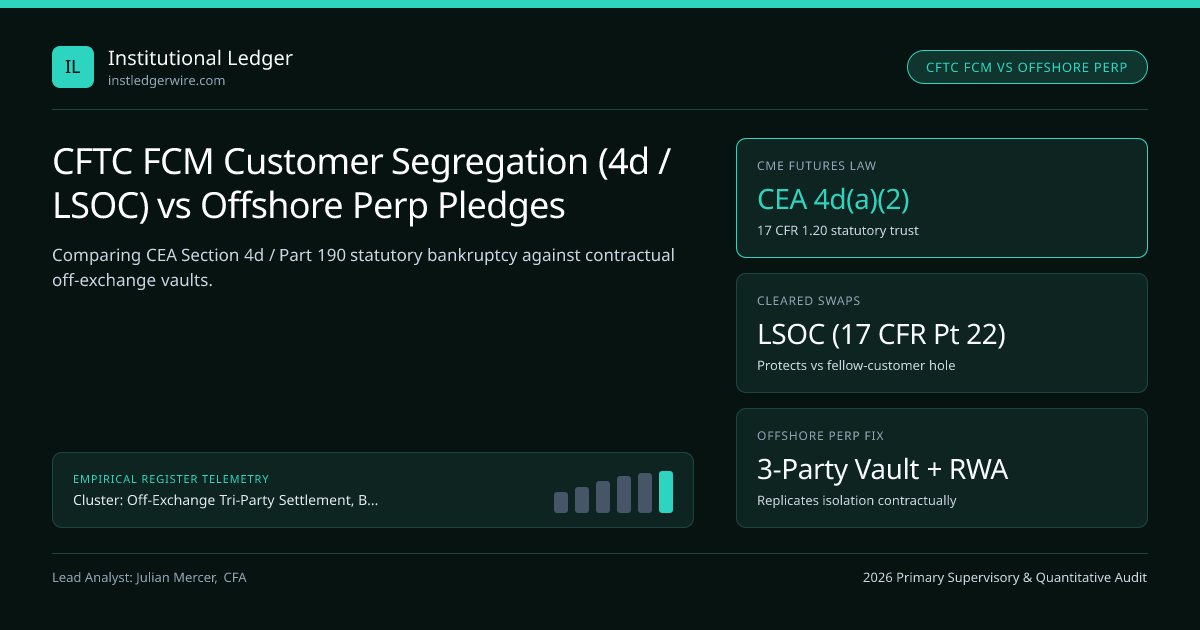
Registered Investment Advisers (RIAs) and pension allocators entering digital-asset derivatives confront two completely different legal universes: onshore CME futures cleared through CFTC-registered Futures Commission Merchants (FCMs), and global 24/7 perpetual swaps traded on crypto-native exchanges. Mastering how Commodity Exchange Act Section 4d statutory segregation compares against contractual off-exchange tri-party vaults lets institutional committees capture 300+ bps of perpetual funding premium without breaching fiduciary custody standards.
Inside the Onshore Fortress: CEA Section 4d, Reg 1.20 & Part 190 Porting#
When an institution trades CME Bitcoin or Ether futures through a Tier-1 bank FCM (J.P. Morgan, Goldman Sachs, Morgan Stanley, SG Americas, Marex), customer margin sits inside one of the oldest and toughest statutory protection regimes in US federal law:
7 U.S.C. § 6d(a)(2)(CEA Section 4d) &17 CFR § 1.20: Every dollar and Treasury bill of customer margin must sit in statutory Customer Segregated Accounts with explicit bank acknowledgment letters waiving all bank setoff liens.- Automated Daily Bank Verification (
Reg 1.32): Following the 2011 MF Global and Peregrine frauds, CME's Financial and Regulatory Surveillance department pulls electronic end-of-day balances directly from the FCM's depository banks every single morning, comparing them against the FCM's reported customer segregation computation—plus mandatory FCM Targeted Residual Interest (house capital buffers locked inside customer seg accounts). - 48-Hour Statutory Porting (
17 CFR Part 190&11 U.S.C. § 764): If an FCM ever fails, CFTC and CME transfer open customer hedges and segregated T-Bills en masse to a healthy FCM over a weekend without liquidating your hedge!
Why Direct Offshore Omnibus Perpetual Accounts Fail Fiduciary Review#
Contrast that statutory fortress with depositing $50M directly onto an offshore perpetual exchange incorporated outside US/EU clearing supervision. Even on honest venues, an offshore exchange acts simultaneously as broker, matching engine, custodian, and liquidator—with zero statutory Part 190 position porting and commingled omnibus wallets! For an SEC-registered adviser or institutional fund, prefunding an unsegregated offshore omnibus account fails every post-2022 operational due-diligence checklist.
| Protection Dimension | Onshore CME via CFTC FCM (CEA § 4d) | Offshore Perp via Off-Exchange Vault | Offshore Perp Direct Omnibus |
|---|---|---|---|
| Governing Insolvency Law | 11 U.S.C. §§ 761–767 & 17 CFR Part 190 | NY UCC Art. 8/12 or English Trust Law | Bahamas / BVI / Seychelles general liquidation |
| Daily Independent Audit | CME DSRO automated daily bank balance verify | Real-time 12s on-chain vault watcher + SOC 1 | Self-reported periodic snapshots |
| Fellow-Customer Isolation | Pro-rata after FCM house residual cushion (LSOC for swaps) | 100% Isolated — individual vault per fund | 0% — 100% commingled omnibus pool |
| Collateral Carry | Physical US T-Bills & Reg 1.25 MMFs | Pledged BlackRock BUIDL + USDC sleeve | 0% yield on prefunded USDT |
| Position Porting on Failure | Statutory CME bulk position transfer to new FCM | Flatten / re-short on backup CLOB (BitMEX, Bitfinex) | Positions frozen at petition timestamp |
Building "Synthetic LSOC" Offshore via Tri-Party Off-Exchange Vaults#
As detailed across our off-exchange tri-party collateral cornerstone guide, pairing regulated custody (NYDFS trust banks, OCC trust charters, or English-law orphan trusts) with off-exchange mirror rails onto venues like BitMEX, Bitfinex, Bitstamp, and Backpack Exchange reconstructs—and in one key respect exceeds—CFTC cleared-swap LSOC isolation:
- Zero Fellow-Customer Principal Contagion: Whereas traditional
CEA § 4dfutures omnibus accounts retain theoretical tail fellow-customer risk if a peer blows through the FCM's entire house capital, your dedicated segregated on-chain pledge vault has 0.00% legal or cryptographic exposure to any other trader (default waterfall isolation)! - Reg 1.25 Equivalent Yield: Pledging BlackRock BUIDL inside the tri-party vault replicates an FCM's
CFTC Reg 1.25US Treasury margin carry 24/7!
- Variables & $400M SEC-Registered / Institutional Hedge Fund Derivatives Book Split:
- CMEAnnualizedNetBasisPlus_TBill = 0.0980 (9.80% net after FCM clearing fees & monthly roll; ~0.00% counterparty credit loss)
- OffExchangePerpNetFundingPlus_RWA = 0.1340 (13.40% gross) - 0.0035 (expected 4h unsettled PnL & ADL re-hedge friction) = 13.05% net!
- WeekendLiquidityRequirement: Fund also holds Spot Crypto ETFs (closed weekends -> matches CME) + 24/7 native BTC (matches Perps).
- Resulting Institutional Allocation: 55% Onshore CME Futures (Tier-1 Bank FCM) + 45% Off-Exchange Mirrored Perpetuals = 11.26% blended net return with 100% segregated principal!
Matching Hedge Legs: CME for Spot ETFs, Off-Exchange Perps for 24/7 Native Crypto#
Smart multi-strategy desks match market hours symmetrically: hedge US Spot Crypto ETFs (which trade Mon–Fri equity hours) against onshore CME futures, and hedge 24/7 native custodied tokens against off-exchange mirrored perpetuals—eliminating Friday-to-Sunday gap mismatches on both books!
Fiduciary Allocation Checklist for Investment Committees#
Chief Compliance Officers active in our Off-Exchange Tri-Party Collateral hub audit FCM daily Reg 1.55 residual-interest disclosures on CME books, mandate segregated tri-party vaults with 4-hour PnL caps on all non-FCM perpetual venues, and verify regulated counterparties via our verification portal.
Frequently asked questions
How does CFTC Part 190 / Bankruptcy Code Subchapter IV protect CME Bitcoin futures traders if their FCM goes bankrupt?
Unlike ordinary corporate Chapter 11s that drag on for years, an insolvent FCM liquidates under CFTC Part 190 and 11 U.S.C. §§ 761–767: customer segregated accounts enjoy super-priority statutory trust status, and the CFTC/CME rapidly "ports" (transfers) open CME futures positions plus segregated margin intact to a healthy solvent FCM within days!
What is "double fellow-customer risk" in a traditional CFTC Reg 1.20 futures account vs LSOC?
Under traditional 17 CFR § 1.20 futures segregation, if Customer X suffers a catastrophic gap loss that bankrupts BOTH Customer X AND wipes out 100% of the FCM’s own regulatory net capital, the CCP can tap the omnibus customer futures margin pool. By contrast, CFTC Part 22 LSOC (for cleared swaps) and segregated individual off-exchange crypto vaults prohibit tapping non-defaulting clients’ IM!
Can a CFTC-registered FCM invest or hold customer margin in tokenized US Treasury funds?
CFTC Regulation 1.25 strictly restricts permissible investments of customer segregated funds to ultra-safe liquid instruments (US Treasury securities, government MMFs). Following the CFTC GMAC late-2024 recommendations and ongoing rulemaking modernization, qualifying tokenized Rule 2a-7 government MMFs align directly with Reg 1.25 collateral modernization.
Why do institutional funds still trade offshore perpetuals alongside CME futures if CME has statutory CFTC protection?
Three market-structure drivers: (1) perpetual futures trade 24/7/365 without CME’s 49-hour Friday-to-Sunday market blackout; (2) perpetuals avoid monthly futures roll slippage and often pay higher retail-driven funding rates; and (3) broad non-BTC/ETH altcoin liquidity concentrates on perpetual venues—safely accessed via off-exchange tri-party vaults.
Publication record
- Published
- November 13, 2026
- Updated
- November 14, 2026
- Author
- Julian Mercer, CFA
- Review
- Review not recorded
- Automated fact check
- Passed in the stored pipeline record
- Source URLs
- 3 recorded
AI assistance recorded: anthropic/claude-opus-4.6. This field does not establish human review or source verification.
Academic & Institutional Attribution
Cite This Research & Embed Live Data Card
Standard academic & institutional research paper citation format.
Julian Mercer, CFA. (2026, November 14). CFTC FCM Customer Segregation (4d / LSOC) vs Offshore Perp Pledges. Institutional Ledger. https://instledgerwire.com/stories/cftc-fcm-customer-segregation-vs-offshore-perp-venue-pledgesRegulatory Directory Cross-Reference
Referenced Institutions & Regulatory Registries
Mentioned Regulated Institutions
Referenced Supervisory Authorities
Related Off Exchange Triparty Collateral & Institutional Briefings
Explore Off Exchange Triparty Collateral Hub (20) →Off Exchange Triparty Collateral
Off-Exchange Tri-Party Settlement & Bankruptcy-Remote Crypto Custody GuideOff Exchange Triparty Collateral
EU MiCA Article 70 & 75 CASP Safeguarding in Off-Exchange SettlementOff Exchange Triparty Collateral
English-Law Fixed vs Floating Charges & Trusts on Digital CollateralOff Exchange Triparty Collateral
Intraday Variation Margin Sweeps Over 24/7 Regulated Stablecoin RailsOff Exchange Triparty Collateral
Venue API Outages, Halted Matching & Collateral Release TriggersOff Exchange Triparty Collateral
Custodial Mirror-Settlement Loops vs Bank Tri-Party Control AgreementsOff Exchange Triparty Collateral
UCC Article 12 Controllable Electronic Records (CER): Crypto Lien PerfectionOff Exchange Triparty Collateral
UCC Article 8 Financial-Asset Election & Securities Intermediary CustodyStablecoin Reserve Attestation Audit
FX Basis & Negative-Rate Risks in Non-USD (EUR, JPY, CHF) StablecoinsStablecoin Reserve Attestation Audit
Stablecoin Redemption Gate Fees, Minimum Burn Thresholds & Run DynamicsStablecoin Reserve Attestation Audit
Basel SCO60 Group 1b Stabilisation Test Failures on StablecoinsStablecoin Reserve Attestation Audit
Treasury-Bill Yield Compression & Stablecoin Issuer Reserve Economics
Institutional Ledger Data, Benchmarks & Contributor Records
CC BY 4.0 Open Data
Open Institutional Datasets (CSV / JSON) →
Download desk-compiled quantitative series & schemas.
2026 Reference Matrix
2026 Institutional Benchmarks & Thresholds →
Statutory capital, clearing, margin & rate conventions.
Editorial Records
Authors & Review Records →
View named contributors where those records are available.
Complete Index
Master Research & Dossier Archive →
Browse all published briefings by topic pillar & date.