
Off Exchange Triparty Collateral
Exchange Hot-Wallet Sweep Thresholds & Withdrawal Queue SLAs
Regulated crypto exchanges cap hot wallets at 1% to 5% of customer assets for cyber insurance compliance—creating 30-to-180-minute withdrawal queue bottlenecks during market crashes unless settled off-exchange.
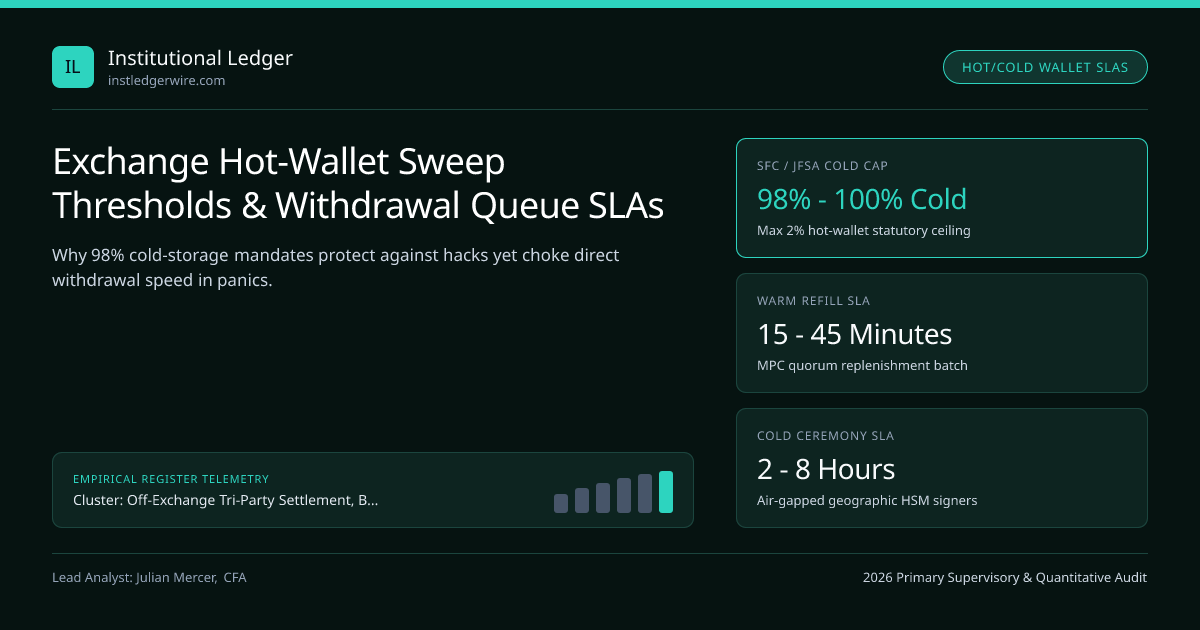
Cybersecurity and liquidity speed sit at opposite ends of a physical seesaw on every centralized crypto exchange: the safer an exchange makes its custody by locking 98% of customer coins inside offline air-gapped cold vaults, the faster its remaining 2% hot wallet runs dry during a volatility spike! Understanding exchange hot-warm-cold sweep thresholds and withdrawal queue SLAs explains both why regulated venues pause instant large withdrawals during panics and why high-velocity arbitrage desks mandate off-exchange rails.
Why Statutory Cold-Storage Rules Cap Hot Wallets at 1% to 2%#
Following North Korean Lazarus Group heists against hot wallets on Bybit, WazirX, and DMM Bitcoin, global regulators codified hard ceilings on internet-connected exchange balances:
- Hong Kong's SFC Virtual Asset Trading Platform (
VATP) rules mandate at least 98% of client virtual assets sit inside air-gapped cold storage, permitting at most 2% in hot/other wallets. - Japan's JFSA requires virtually 100% cold offline storage unless the exchange holds dollar-for-dollar unencumbered proprietary liquid net equity matching every single yen held in a hot wallet (shaping batch withdrawal schedules at venues like bitFlyer).
- Western crime-insurance syndicates (audited in our crime and specie insurance exclusions guide) cap hot-wallet coverage sub-limits sharply above 2%–3% of AUM.
Consequently, as highlighted in our off-exchange tri-party collateral cornerstone guide, a $4 billion exchange holds only $40M to $80M of instant automated withdrawal float across all tokens combined!
Anatomy of a Sunday-Night Withdrawal Bottleneck (Without Insolvency)#
When Bitcoin drops 15% at 02:30 UTC Sunday, market makers across Bitstamp, Bitfinex, and Backpack Exchange simultaneously request $10M–$30M USDC or BTC withdrawals to top up short-squeeze or margin legs elsewhere. Three technical governors fire in sequence:
- Velocity Anomaly Breakers: Exchange SOC 2 security daemons automatically pause automated hot signing whenever rolling 15-minute outflows exceed
3x–5x30-day norms—preventing an active API exploit from draining the hot wallet before security engineers wake up! - Bitcoin UTXO Consolidation Contention: On Bitcoin, if a hot wallet holds ten large UTXOs and broadcasts five unconfirmed withdrawals during a 150 sat/vB mempool spike, unconfirmed change outputs hit ancestor-chain limits until blocks mine or
RBF / CPFPfee bumps clear. - Geographic Cold-Ceremony Lead Time: Refilling $200M from deep air-gapped FIPS 140-3 HSM cold vaults intentionally requires 3-of-5 or 4-of-7 human key custodians across separate time zones to verify out-of-band hashes and sign offline—taking 2 to 6 hours by design!
| Regulatory Jurisdiction | Mandatory Cold Storage Floor | Hot-Wallet Insurance / Cap Rule | Direct Withdrawal Impact During Crash |
|---|---|---|---|
| Hong Kong SFC (VATP Guidelines) | >= 98% in Cold Storage | 100% insurance/compensation on 2% hot + 50% on cold | Strict 2% hot ceiling forces frequent cold refills on surges |
| Japan JFSA (Payment Services Act) | 95% – 100% Cold HSM | Any hot balance must be backed 100% by own liquid net assets! | Japanese venues (bitFlyer) batch large withdrawals on strict schedules |
| New York NYDFS & US Venues | Risk-based (~90%–95% cold norm) | SEC SAB 122 & SOC 2 Type II velocity controls | Automated anti-drain circuit breakers pause anomalous Sunday spikes |
| UAE VARA & EU ESMA MiCA | Segregated cold majority | Mandatory incident-response & hot-loss capital reserve | Favors off-exchange mirrors (Bitstamp, Bitfinex) for instant institutional mobility |
Negotiating Institutional Settlement SLAs & Dedicated Liquidity Lanes#
When trading spot pairs that require actual physical coin delivery (such as Spot Crypto ETF Authorized Participant creation/redemption baskets), institutional desks never use retail web withdrawal queues. Instead, they execute Institutional Settlement Addendums specifying:
- Pre-notified intraday cold-sweep windows (e.g., 12:00 UTC and 20:00 UTC guaranteed settlement cuts);
- Pre-whitelisted custody vault destination addresses exempt from 24-hour address-cooldown locks; and
- Dedicated OTC settlement APIs (Aquanow, B2BX).
- Variables & $4.0B TVL Regulated Exchange Flash-Crash Withdrawal Bottleneck Simulation:
- TotalVenueTVL = $4,000,000,000 client assets
- HotWalletPct = 0.020 (2.0% statutory / insurance hot-wallet ceiling = $80,000,000 automated float)
- NormalHourlyOutflow = $18,000,000/hr ($300,000/min normal baseline)
- StressSurgeMultiplier = 18.0x ($5,400,000/min institutional + retail withdrawal burst during 15% market crash!)
- 1. Hot Wallet Exhaustion Clock = $80,000,000 / $5,400,000 per min = 14.8 minutes!
- 2. Every withdrawal submitted at Minute 15+ waits for Tier-2 Warm (35 min) or Tier-3 Air-Gapped Cold Ceremony (180 min) — proving why arbitrage desks MUST keep rebalancable margin in Off-Exchange Hubs!
Why Off-Exchange Mirrors Permanently Cure the Hot-Wallet Paradox#
For derivatives and margin trading, hub-and-spoke off-exchange reallocation eliminates the hot/cold trade-off completely: your coins stay 100% safe inside your own custodian's vault while API margin undelegation completes in 2 seconds—unaffected by whether 50,000 retail users are clogging the exchange's 2% hot wallet!
Operational Due-Diligence Checklist Before Onboarding Any Venue#
Operations risk officers active in our Off-Exchange Tri-Party Collateral hub request written disclosure of a venue's Hot/Warm/Cold % targets, test a live $5M unannounced Sunday withdrawal before scaling limits, monitor real-time cold-wallet Proof-of-Reserves, and verify licenses in our verification portal.
Frequently asked questions
Why do regulated exchanges refuse to keep 20% of customer assets in hot wallets for instant crash withdrawals?
Two ironclad constraints: first, regulators such as Hong Kong’s SFC (98% cold storage rule) and Japan’s JFSA (following Coincheck/DMM lessons) prohibit large internet-connected hot balances; second, Lloyd’s of London specie/crime underwriters charge 4x–6x higher premiums (or refuse coverage entirely) on hot wallets exceeding 2%–5% of AUM.
What is the difference between a Hot Wallet refill, a Warm Wallet sweep, and a Cold Storage ceremony?
Hot wallets sign programmatically in seconds up to strict per-tx/hourly dollar caps; Warm wallets hold ~3%–8% of assets behind policy-enforced MPC quorums requiring 2-of-3 operations officer approvals (15–45 min SLA); Cold vaults hold 90%–98% in air-gapped FIPS HSMs requiring multi-location physical officer travel/quorum (2–8 hour SLA).
How can a risk officer distinguish a routine Cold-to-Hot refill delay from an FTX-style insolvency freeze?
Transparent venues publish their Cold and Hot wallet addresses via real-time Proof-of-Reserves dashboards! During a legitimate cold refill bottleneck, you can see billions of unencumbered BTC/USDC sitting untouched in the verified Cold address while an on-chain replenishment transaction broadcasts; in an insolvency, cold wallets themselves drain toward zero.
Do institutional VIP whitelisted accounts jump ahead of retail withdrawal queues on centralized exchanges?
Only if dedicated VIP institutional settlement pools or off-exchange custodial rails are contracted! Standard VIP API tiers still pull from the same shared hot-wallet UTXO/ERC-20 float unless isolated via dedicated institutional liquidity lines or off-exchange mirror settlement.
Publication record
- Published
- November 13, 2026
- Updated
- November 15, 2026
- Author
- Julian Mercer, CFA
- Review
- Review not recorded
- Automated fact check
- Passed in the stored pipeline record
- Source URLs
- 3 recorded
AI assistance recorded: anthropic/claude-opus-4.6. This field does not establish human review or source verification.
Academic & Institutional Attribution
Cite This Research & Embed Live Data Card
Standard academic & institutional research paper citation format.
Julian Mercer, CFA. (2026, November 15). Exchange Hot-Wallet Sweep Thresholds & Withdrawal Queue SLAs. Institutional Ledger. https://instledgerwire.com/stories/exchange-hot-wallet-sweep-thresholds-withdrawal-queue-slasRegulatory Directory Cross-Reference
Referenced Institutions & Regulatory Registries
Mentioned Regulated Institutions
Related Off Exchange Triparty Collateral & Institutional Briefings
Explore Off Exchange Triparty Collateral Hub (20) →Off Exchange Triparty Collateral
Off-Exchange Tri-Party Settlement & Bankruptcy-Remote Crypto Custody GuideOff Exchange Triparty Collateral
Rehypothecation Prohibitions & Segregated On-Chain Pledge Vault AuditsOff Exchange Triparty Collateral
CFTC FCM Customer Segregation (4d / LSOC) vs Offshore Perp PledgesOff Exchange Triparty Collateral
EU MiCA Article 70 & 75 CASP Safeguarding in Off-Exchange SettlementOff Exchange Triparty Collateral
English-Law Fixed vs Floating Charges & Trusts on Digital CollateralOff Exchange Triparty Collateral
Intraday Variation Margin Sweeps Over 24/7 Regulated Stablecoin RailsOff Exchange Triparty Collateral
Venue API Outages, Halted Matching & Collateral Release TriggersOff Exchange Triparty Collateral
Custodial Mirror-Settlement Loops vs Bank Tri-Party Control AgreementsStablecoin Reserve Attestation Audit
Custodial T-Bill Safekeeping: BNY Mellon & State Street Reserve ModelsStablecoin Reserve Attestation Audit
Stablecoin Smart-Contract Freeze & Blacklist Governance Under OFAC/FinCENStablecoin Reserve Attestation Audit
FX Basis & Negative-Rate Risks in Non-USD (EUR, JPY, CHF) StablecoinsStablecoin Reserve Attestation Audit
Stablecoin Redemption Gate Fees, Minimum Burn Thresholds & Run Dynamics
Institutional Ledger Data, Benchmarks & Contributor Records
CC BY 4.0 Open Data
Open Institutional Datasets (CSV / JSON) →
Download desk-compiled quantitative series & schemas.
2026 Reference Matrix
2026 Institutional Benchmarks & Thresholds →
Statutory capital, clearing, margin & rate conventions.
Editorial Records
Authors & Review Records →
View named contributors where those records are available.
Complete Index
Master Research & Dossier Archive →
Browse all published briefings by topic pillar & date.