
Institutional Crypto Prime Margin
Tax-Lot Relief (HIFO, Specific ID) & FASB ASC 350-60 Prime Sub-Ledger Sync
Starting in 2025–2026, IRS broker rules mandate strict wallet-by-wallet pre-trade tax-lot identification—forbidding retroactive universal HIFO cherry-picking while GAAP books mark to fair value under FASB ASC 350-60!
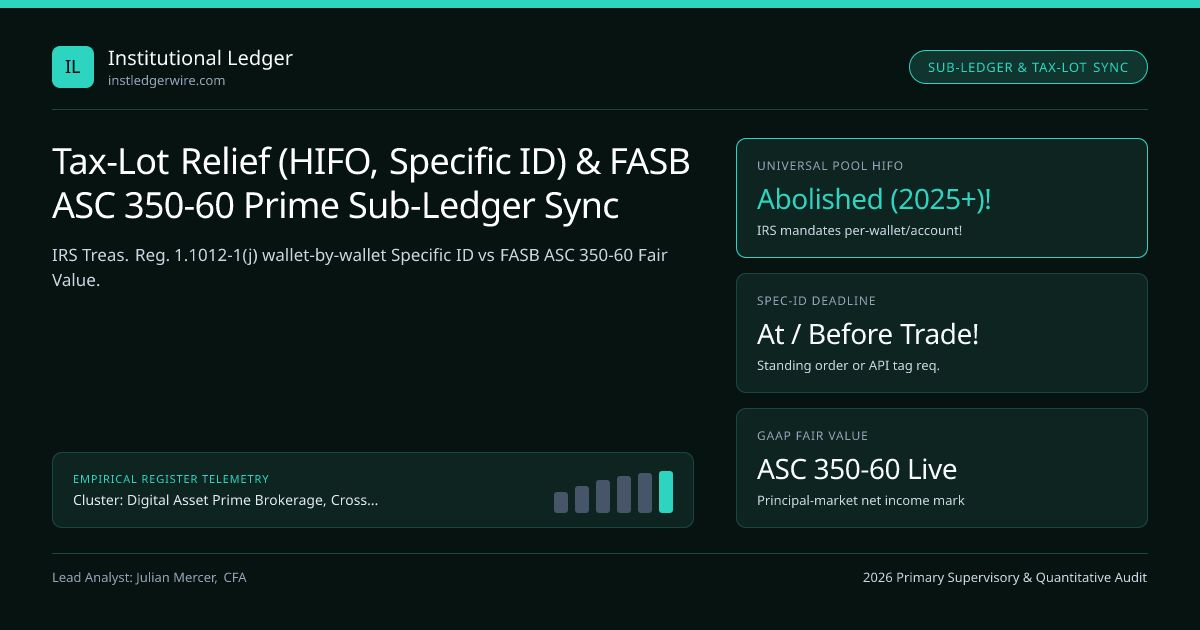
Nothing ruins a quantitative crypto fund's fourth quarter faster than discovering in February that 1.2 million high-frequency Prime SOR child fills, 40,000 Ethereum gas fees, and 1,095 perpetual funding timestamps failed to carry per-wallet tax-lot IDs—forcing the fund auditor to recast the entire year onto punitive mandatory FIFO! In 2026, operating seamlessly under FASB ASC 350-60 Fair Value GAAP alongside IRS Treas. Reg. § 1.1012-1(j) wallet-by-wallet Form 1099-DA rules requires automated sub-ledger synchronization built directly into your prime broker's API.
End of the "Universal Wallet Pool": Mastering IRS Per-Wallet Specific ID#
For a decade, crypto CPAs relied on informal "universal wallet" spreadsheets—treating BTC across five cold vaults and four exchanges as one fungible bucket. Treasury Decision 10000 (Treas. Reg. § 1.1012-1(j)) and Rev. Proc. 2024-28 ended universal pooling permanently:
- Every digital asset custody address, exchange subaccount (Bitstamp, Backpack Exchange, Bitfinex), and prime brokerage sleeve now maintains its own isolated cost-basis lot queue!
- When you transfer
100 BTCfrom your NYDFS cold vault into your prime settlement account, your sub-ledger must identify which specific tax lots moved in that exact blockchain transaction—carrying their original cost basis and holding-period start date into the receiving prime account! - Crucially, to apply
HIFO(Highest-In, First-Out) orMinTaxinside an algorithmic trading account without manually clicking lot IDs on every order, general counsels lodge a timestamped Written Standing Lot-Selection Instruction with the prime broker and fund administrator prior to the start of the tax year!
Navigating FASB ASC 350-60 Fair Value & IRC § 1092 Tax Straddles#
As covered in FASB ASU 2023-08 (`ASC 350-60`) fair-value custody reporting and our institutional crypto prime brokerage cornerstone guide, institutional CFOs run two parallel accounting books off one unified prime event stream:
- GAAP Book (FASB ASC 350-60): Marks spot BTC, ETH, SOL, and USDC to Principal Market Fair Value (
Level 1), presenting crypto assets on a dedicated balance-sheet line separate from goodwill/intangibles, and disclosing roll-forwards of additions, dispositions, and realized gains under the FASB ASC 350-60 2026 Benchmark Standard. - Tax Straddle Trap (
IRC § 1092&§ 1256): Watch out when running cash-and-carry basis books! Holding long spot BTC/ETF against short CME futures creates an Offsetting Position Tax Straddle under IRC § 1092—which can suspend holding-period aging on the spot leg and defer realized losses on one leg until the offsetting gain leg is closed unless a valid IRC § 475(f) Trader Mark-to-Market or Mixed-Straddle Election is filed on time!
| Accounting / Tax Event | US GAAP Book (FASB ASC 350-60) | US Federal Tax Book (IRC § 1001 / § 1012(j)) | Sub-Ledger Automation Control |
|---|---|---|---|
| Quarter-End Unrealized Gain | Recognized in Net Income at Principal Market Fair Value! | Not taxable until realization (except § 475 / § 1256 elections) | Tracks deferred-tax / book-tax basis wedge |
| Sale of 50 BTC via Prime SOR | Relieves historical cost (FIFO/Avg/Spec-ID disclosure) | Per-Account Specific ID / Standing HIFO (else forced FIFO) | Pre-trade standing HIFO memo archived w/ Prime |
| Vault A -> Exchange B Transfer | Non-event internal custody movement | Non-taxable transfer; exact lot basis + holding date carries over; L1 gas tracked | Matches on-chain txHash within 5-min window |
| CME BTC Futures vs Spot ETF | Both marked to Fair Value | CME = IRC § 1256 (60/40 MTM); Spot ETF = IRC § 1091 Wash Sale | Straddle rules (IRC § 1092) flagged on hedged basis! |
Engineering Zero-Break Daily Shadow NAV Reconciliation#
Why do manual CSV downloads fail institutional fund audits? Because on-chain EVM transactions split gas across baseFee + priorityFee in native ETH even when transferring USDC! Institutional prime APIs stream unified FIX Drop-Copy + Blockchain Ledger Webhooks directly into Bitwave, TaxBit, Lukka, or Cryptio—matching internal transfers across Aquanow, B2BX, and custody vaults automatically so T+0 cash and token breaks stay < $1.00.
- VaultAccountInventory: Lot1 = 200 BTC bought in 2023 @ $29,000; Lot2 = 200 BTC bought last month @ $93,500
- 1. Failure to File Pre-Trade Standing Election (IRS Defaults Account to Mandatory FIFO -> Relieves Lot_1!):
- Taxable_Gain = 200 * ($95,000 - $29,000) = $13,200,000 (@ 23.8% LTCG) -> $3,141,600 Immediate Cash Tax Drain!
- 2. Compliant Pre-Trade Standing HIFO Election on Account (Relieves Lot_2 @ $93,500):
- Taxable_Gain = 200 * ($95,000 - $93,500) = $300,000 (@ 40.8% STCG) -> $122,400 Tax ($3,019,200 Working Capital Preserved in Fund!)
Handling Wrapped Tokens (ETH <-> WETH & stETH <-> wstETH) Conservatively#
Tax counsel also document consistent accounting policies for mechanical protocol wrappers (ETH <-> WETH) vs yield-bearing liquid-staking swaps (ETH -> wstETH), flagging every smart-contract interaction instantaneously inside the sub-ledger.
CFO & Tax Counsel Prime Sub-Ledger Checklist#
Chief Financial Officers active in our Digital Asset Prime Brokerage & PoR hub execute annual pre-trade Standing HIFO Elections with every prime/broker, evaluate IRC § 475 / Mixed-Straddle Elections before launching basis pods, and verify institutional infrastructure via our verification portal.
Frequently asked questions
Why did IRS Final Broker Regulations (TD 10000 / Rev. Proc. 2024-28) outlaw "Universal Wallet HIFO"?
Prior to January 1, 2025, aggressive funds sold 100 BTC held on an exchange (bought at $25k) and claimed for tax purposes they actually sold 100 BTC sitting untouched inside cold storage (bought at $68k)! Just as you cannot sell Fidelity shares and claim Schwab tax lots in equities, Treas. Reg. § 1.1012-1(j) requires account-by-account / wallet-by-wallet basis tracking (matching Form 1099-DA broker basis reporting in 2026)!
Can an institutional fund still use HIFO (Highest-In, First-Out) in 2026 without manually tagging every millisecond algo slice?
YES—via a Contemporaneous Written Standing Instruction! Under IRS rules, if your fund executes and timestamps a formal Standing Accounting Policy / Broker Election BEFORE the trade (e.g., *"Within Account #4402, relieve digital asset units in Highest-Cost-Basis-First (HIFO) order"*), automated algorithmic fills within that specific account validly receive HIFO treatment!
How does FASB ASC 350-60 determine "Principal Market" fair value at 4:00 PM ET vs 23:59:59 UTC?
Under ASC 820 & ASC 350-60, a fund cannot pick whichever exchange happened to print the highest closing tick! You must identify your Principal Market—the regulated, accessible venue with the greatest volume and level of activity for that asset (e.g., Bitstamp, Coinbase, or institutional composite)—and apply a consistent daily valuation cut timestamp without deducting hypothetical transaction costs!
Does the US "Wash Sale Rule" (IRC Section 1091) currently apply to spot Bitcoin and Ether, or only crypto securities/ETFs?
Critical distinction! Spot IBIT / ETHA ETF shares ARE securities strictly subject to the 30-day IRC § 1091 Wash Sale Rule! Direct spot BTC and ETH remain classified as property rather than corporate stock/securities under current IRC § 1091 text (unless Congress amends § 1091), though IRS Economic Substance Doctrine (§ 7701(o)) still bars sham zero-risk round-trips!
Publication record
- Published
- November 12, 2026
- Updated
- November 15, 2026
- Author
- Julian Mercer, CFA
- Review
- Review not recorded
- Automated fact check
- Passed in the stored pipeline record
- Source URLs
- 3 recorded
AI assistance recorded: anthropic/claude-opus-4.6. This field does not establish human review or source verification.
Academic & Institutional Attribution
Cite This Research & Embed Live Data Card
Standard academic & institutional research paper citation format.
Julian Mercer, CFA. (2026, November 15). Tax-Lot Relief (HIFO, Specific ID) & FASB ASC 350-60 Prime Sub-Ledger Sync. Institutional Ledger. https://instledgerwire.com/stories/tax-lot-relief-hifo-fifo-asc-350-60-prime-sub-ledger-syncRegulatory Directory Cross-Reference
Referenced Institutions & Regulatory Registries
Mentioned Regulated Institutions
Referenced Supervisory Authorities
Related Institutional Crypto Prime Margin & Institutional Briefings
Explore Institutional Crypto Prime Margin Hub (20) →Institutional Crypto Prime Margin
Institutional Crypto Prime Brokerage, Cross-Venue Netting & zk-PoR Guide (2026)Institutional Crypto Prime Margin
Multi-Custodian Prime Routing & Single-Point-of-Failure MitigationInstitutional Crypto Prime Margin
Stressed VaR & Concentration Liquidity Add-Ons for Altcoin CollateralInstitutional Crypto Prime Margin
zk-SNARK Merkle-Sum Tree Proof-of-Reserves: Auditing Exchange LiabilitiesInstitutional Crypto Prime Margin
Negative-Balance Non-Existence Proofs & Hidden Collateral Encumbrance RiskInstitutional Crypto Prime Margin
Cross-Exchange Delta-Neutral Cash-and-Carry Basis Margining MechanicsInstitutional Crypto Prime Margin
Institutional ETH Staking Slashing Insurance & Correlated Penalty MathInstitutional Crypto Prime Margin
Validator Exit Churn Limits, Unbonding Queues & Liquidity DiscountsMarket Insights
Russia finalizes crypto trading rules ahead of Nov. 17 rolloutCryptocurrency Crime
Ex-FBI counterintelligence agent stole almost $2.5M in cryptoRegulatory Compliance
Statement on Proposed Amendments to the Custody RulesRegulatory Compliance
Statement on Proposal to Address the Custody of Crypto Assets Under the Investment Advisers Act and the Investment Company Act
Institutional Ledger Data, Benchmarks & Contributor Records
CC BY 4.0 Open Data
Open Institutional Datasets (CSV / JSON) →
Download desk-compiled quantitative series & schemas.
2026 Reference Matrix
2026 Institutional Benchmarks & Thresholds →
Statutory capital, clearing, margin & rate conventions.
Editorial Records
Authors & Review Records →
View named contributors where those records are available.
Complete Index
Master Research & Dossier Archive →
Browse all published briefings by topic pillar & date.